Tradeswell’s 10-slide Series A deck is a study in narrative-driven fundraising. Rather than overwhelming investors with granular spreadsheets, the company focused on the 'macro' problem: a fragmented e-commerce value chain where marketing, operations, and logistics are siloed. By positioning themselves as the 'OS for real-time commerce,' they promised to unify these 'vertical vacuums' using machine learning. The deck leans heavily on the experience of its eight-person management team, featuring alumni from AOL, Verizon, and PepsiCo. While the deck lacks traditional Series A components like a…
Key takeaways
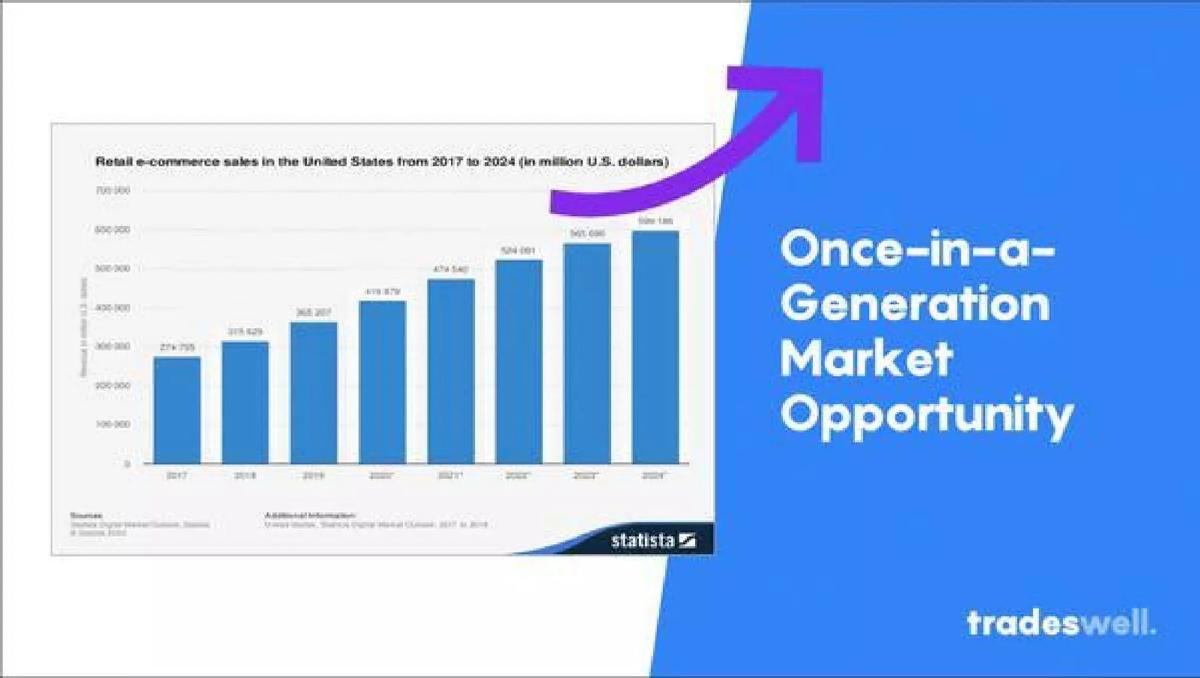
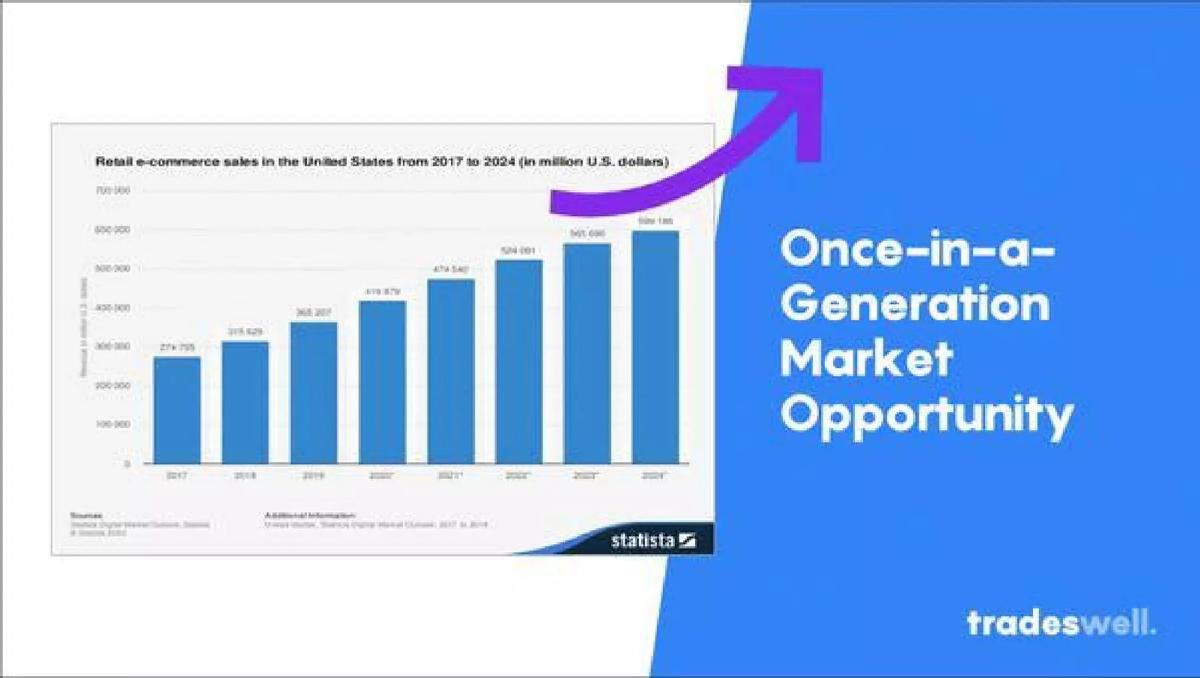
- The deck identifies a 'Once-in-a-Generation' market opportunity based on Statista data showing U.S. retail e-commerce sales projected to exceed $600 billion by 2024 (Slide 1).
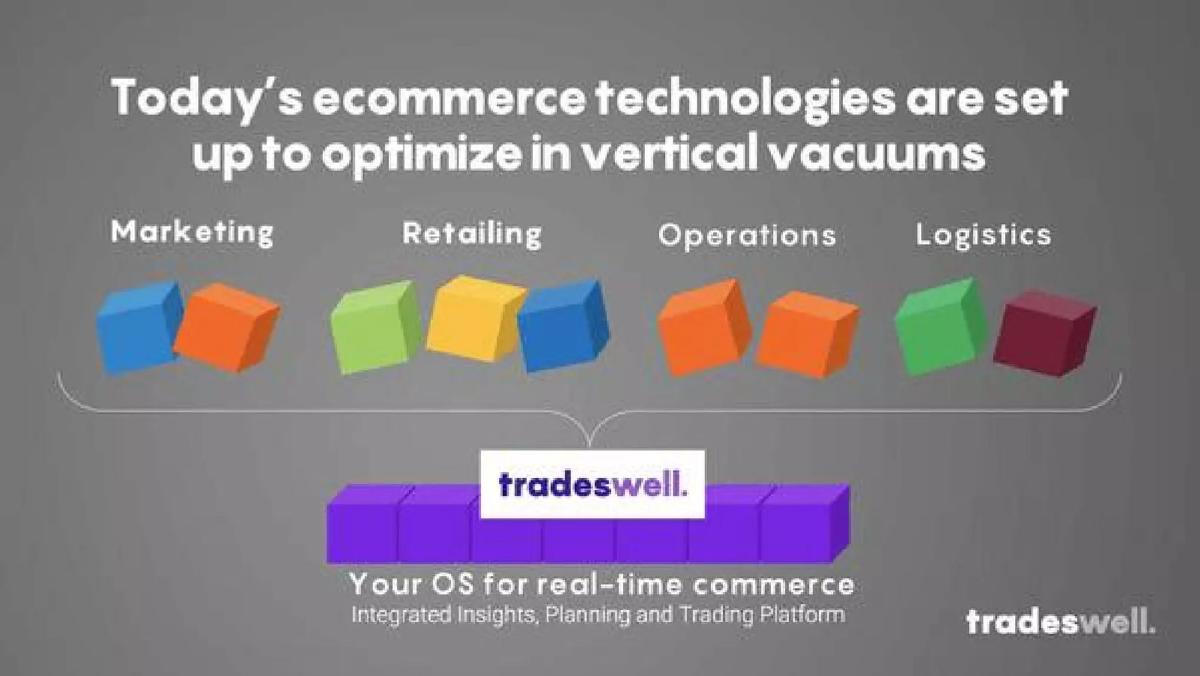
- Tradeswell positions itself as a solution to the 'siloed value chain' where marketing, retailing, operations, and logistics currently exist in vertical vacuums (Slide 4).
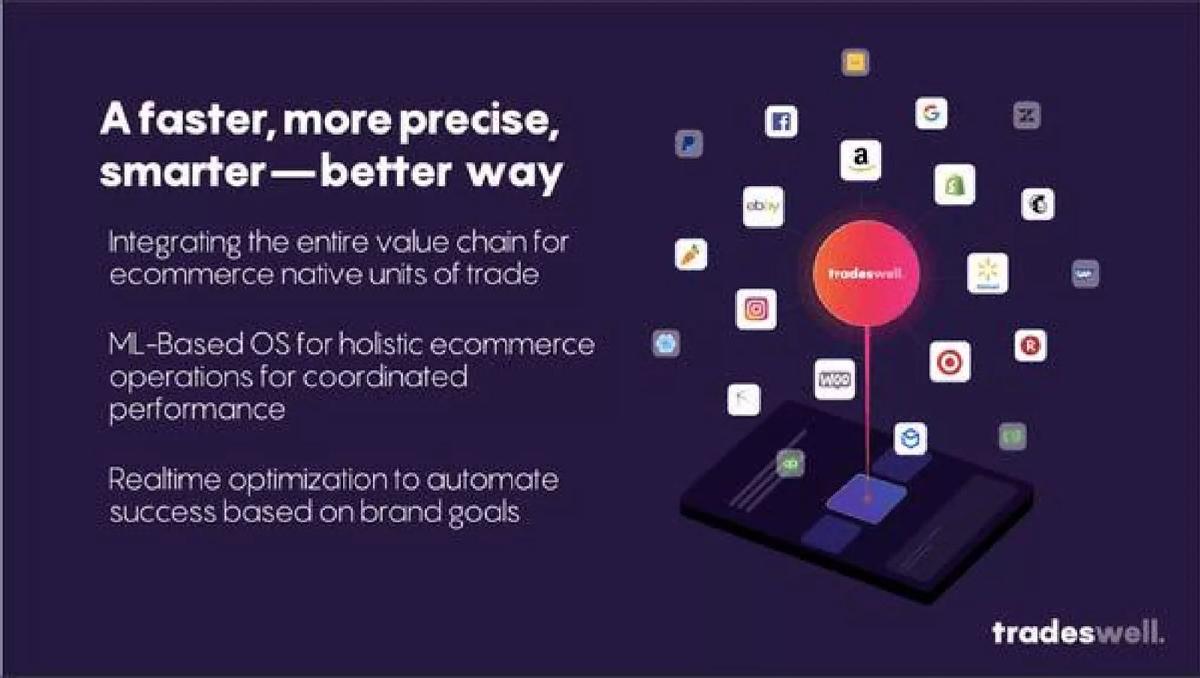
- The platform is described as an ML-based OS that integrates the entire value chain for 'ecommerce native units of trade' (Slide 6).
- Early traction is demonstrated through a customer testimonial claiming a cost reduction from $85,000 (agency fees) to $20,000 (Tradeswell platform) in Q1 (Slide 8).
- The deck highlights a 'stacked network effect' involving brands, growth, results, and data to drive platform defensibility (Slide 9).
- The management team is exceptionally deep for a 10-slide deck, featuring eight leaders with backgrounds from Stanford, AOL, and Millennial Media (Slide 10).
- There is no slide dedicated to the specific funding ask, valuation, or use of proceeds within the 10-slide presentation.
- The deck omits a traditional competitor matrix, choosing instead to frame the 'status quo' of siloed technologies as the primary rival.
The Narrative-First Series A
Tradeswell’s pitch deck is a concise, 10-slide presentation that prioritizes the 'Why Now' and 'Who' over the 'How Much.' In an era where Series A decks often stretch to 20 or 30 slides filled with cohort analysis and CAC/LTV ratios, Tradeswell takes a different path. They focus on the systemic failure of the e-commerce tech stack and position their team as the only group capable of fixing it. This teardown examines how they leveraged a $600 billion market tailwind and a high-pedigree team to secure $18.8 million.
Slides 1-3: The Macro Opportunity and the 'Broken' Market
Slide 1 opens with a classic 'up and to the right' chart from Statista. It shows U.S. retail e-commerce sales growing steadily from $274 billion in 2017 to a projected $599 billion by 2024. The headline, 'Once-in-a-Generation Market Opportunity,' sets a high-stakes tone. By using a third-party source like Statista, Tradeswell establishes immediate credibility for the scale of the problem they are addressing.
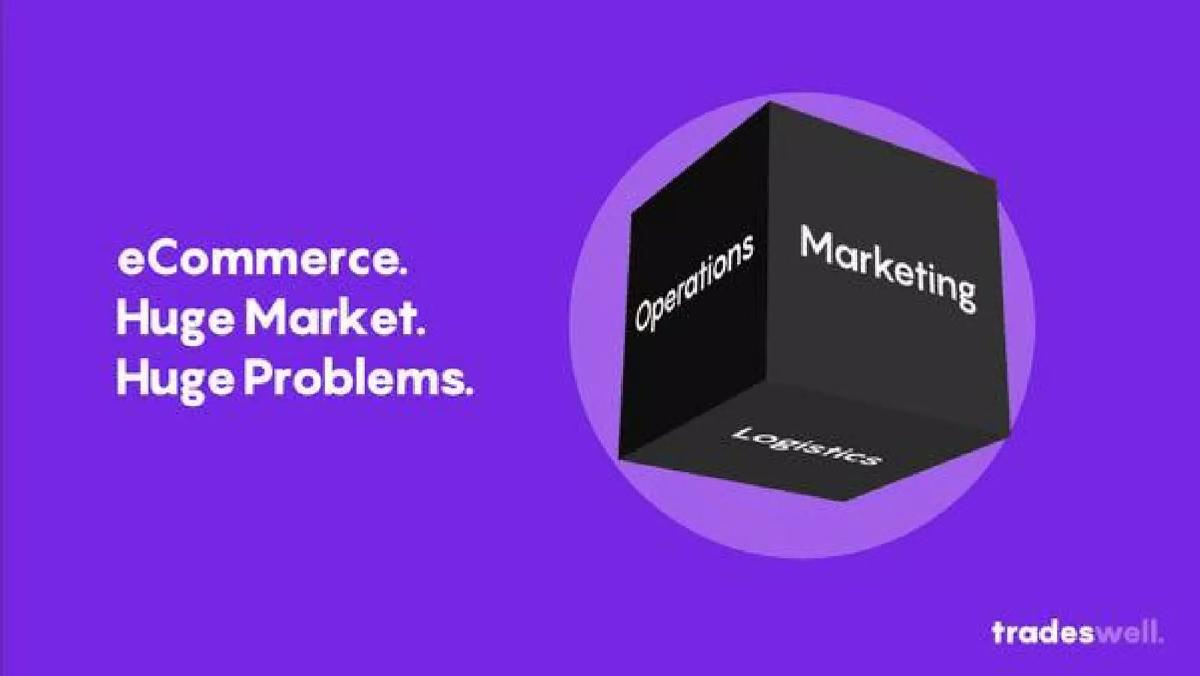
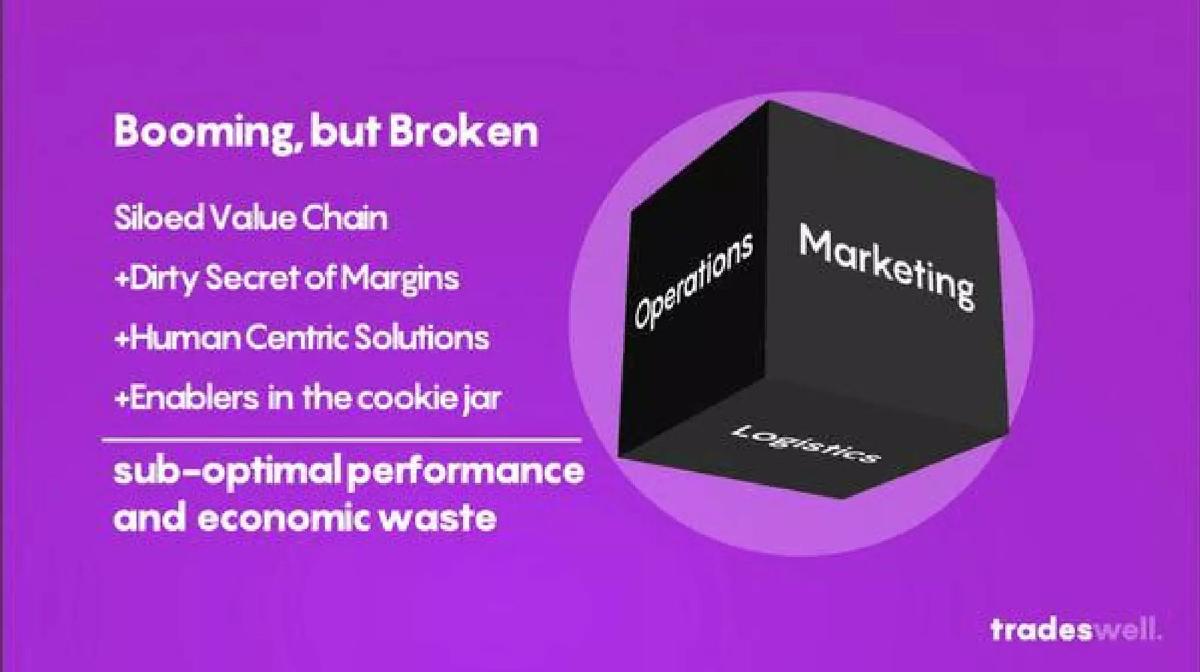
Slide 2 and Slide 3 introduce the conflict. Slide 2 uses a simple graphic of a black cube labeled with 'Operations,' 'Marketing,' and 'Logistics' to represent the complexity of e-commerce. Slide 3, titled 'Booming, but Broken,' lists the specific pain points: a siloed value chain, the 'dirty secret of margins,' and human-centric solutions that lead to 'sub-optimal performance and economic waste.' This is a standard but effective 'Problem' setup—identifying that while the market is growing, the current tools are inefficient.
Slides 4-5: The 'Vertical Vacuum' Problem
Slide 4 is perhaps the most important conceptual slide in the deck. It visualizes the current state of the industry as 'vertical vacuums.' It shows Marketing, Retailing, Operations, and Logistics as separate, disconnected blocks. Below this, the Tradeswell logo is placed over a unified, solid purple bar, labeled as the 'OS for real-time commerce.' This visual metaphor clearly communicates the value proposition: integration.
Slide 5 dives deeper into the technical inhibitors. It lists six specific 'Real-time commerce technology inhibitors,' including fragmented sales information, the difficulty of connecting marketing spend to landed cost data, and the 'explosion of retail data sources.' Notably, it mentions the 'Difficulty in predicting millennial user behavior,' which dates the deck to its 2019 context but highlights the need for predictive analytics.
Slides 6-7: The Solution and Product Capabilities
Slide 6 introduces the 'faster, more precise, smarter—better way.' It features a central Tradeswell node connected to a galaxy of logos including Amazon, Facebook, Google, Shopify, Walmart, and Target. This slide defines the product as an 'ML-Based OS for holistic ecommerce operations.' It promises real-time optimization to automate success based on brand goals.
Slide 7 breaks down the platform's utility into four buckets: Retailing/Channels, Marketing, Intelligent Operations + Logistics, and Digital Shelf. The headline emphasizes that the platform uses 'machine learning to power actions across' these sectors. This is a transition from 'what it is' to 'what it does,' showing that the AI isn't just for insights, but for execution.
Slides 8-9: Traction and the Flywheel
Slide 8 provides the only specific financial metrics in the deck, and they come from a customer testimonial rather than a balance sheet. The slide quotes a customer who moved their trading in-house: 'In Q1, we would have paid our AMZN Agency $85K vs the Tradeswell platform, we have paid $20K.' This 76% cost reduction is a powerful proof point. The slide also features logos for brands like Jocko Fuel, French's, and RedHot , indicating that the 'Tradeswell 0.5' beta had already attracted significant consumer packaged goods (CPG) players.
Slide 9 illustrates the 'stacked network effects.' It’s a circular diagram showing how Brands lead to Data, which leads to Results, which leads to Growth. While 'network effects' is often a buzzword in pitch decks, Tradeswell attempts to ground it in the idea that more data across the value chain leads to better ML-driven results for all brands on the platform.
Slide 10: The Management Team
The deck concludes with Slide 10 , showcasing a 'Proven & experienced management team.' This is an unusually large team slide, featuring eight individuals. The pedigree is significant: Paul Palmieri (CEO) is linked to Millennial Media and Verizon; Haley Ulloa (President) to AOL and Millennial Media; and Gar O'Brien (CTO) to Stanford and Neustar. Other logos include PepsiCo, Stanley Black & Decker, and Opera. For a Series A, this level of executive experience is a strong signal to investors that the company can scale and handle the complexity of the 'OS' they are building.
What Works in the Tradeswell Deck
The primary strength of this deck is its clarity of vision . By framing the entire e-commerce industry as a series of 'vertical vacuums,' Tradeswell creates a 'category of one' for itself. They aren't just another marketing tool or a logistics dashboard; they are the 'Operating System' that connects them all. This is a much larger and more venture-scale narrative than a simple SaaS tool.
The visual consistency is also notable. The use of the 'cube' metaphor and the purple branding creates a professional, cohesive feel. Furthermore, the customer testimonial on Slide 8 is a brilliant way to show ROI without needing a complex table of unit economics. Saving a customer $65,000 in a single quarter is a metric any investor can understand instantly.
What is Missing from the Tradeswell Deck
Despite raising $18.8 million, this deck leaves many questions unanswered. Most notably, there is no 'Ask' slide . We do not know how much they were looking to raise or how they intended to spend the capital. There is also a complete absence of a roadmap . Investors are left wondering what the transition from 'Tradeswell 0.5' to a full 1.0 version looks like.
Furthermore, the deck lacks a competitive landscape . While they argue that current technologies are 'siloed,' they don't name specific competitors or explain how they will win against established players in the marketing or logistics space who might also be trying to expand their footprints. Finally, there are no internal growth metrics —no MRR, no churn rates, and no customer acquisition costs—which are usually standard for a Series A round.
What a Founder Should Copy
Founders should emulate Tradeswell’s ability to sell a 'Systemic Solution' rather than a 'Feature.' By identifying a structural flaw in how an entire industry operates (the siloed data problem), they make their product feel essential rather than optional. If you can convince an investor that the current way of doing business is 'broken' and 'wasteful,' your solution becomes the only logical path forward.
Additionally, the team slide is a model for how to display pedigree. Instead of long bios, they use recognizable logos (AOL, Verizon, PepsiCo) and clear titles. This allows an investor to scan the slide in five seconds and conclude that the team has the 'right to win' in this space. If you have a high-pedigree team, put them front and center—or in this case, use them as the final, powerful closing argument.
Final Verdict: Tradeswell’s deck is a 'Big Idea' deck. It succeeds by making the problem feel massive and the team feel inevitable. While it skips the granular data, the $18.8M outcome proves that at the Series A stage, a compelling narrative backed by an elite team can often outweigh a lack of detailed financial slides.
Frequently asked questions
- How much did Tradeswell raise with this deck?
- According to the catalogue facts, Tradeswell raised $18,800,000 in 2019 during its Series A round. The deck itself does not state the amount raised or the specific ask, which suggests this version of the deck was likely used as a conversational teaser or a high-level narrative tool rather than a full data room summary.
- What is the core problem Tradeswell aims to solve?
- The deck identifies the problem as 'vertical vacuums' in e-commerce technology. Slide 4 and Slide 5 explain that marketing, retailing, operations, and logistics data are fragmented and disconnected. This leads to 'sub-optimal performance and economic waste' because brands cannot easily connect marketing spend to fully loaded landed cost data or predict user behavior in real-time.
- Does the deck provide evidence of product-market fit?
- Slide 8 provides qualitative and quantitative evidence through a beta product testimonial. A customer noted that by moving trading in-house via Tradeswell, they reduced costs from $85,000 to $20,000 in a single quarter. The slide also displays logos from brands like French's, Frank's RedHot, and Reel to signal market validation.
- What is the 'Network Effect' mentioned in the deck?
- Slide 9 illustrates a flywheel where 'Brands' provide 'Data,' which leads to 'Results' (retail, logistics, marketing, financing), which then fuels 'Growth' (profitable and funded). This cycle is intended to show that as more brands join the platform, the data pool grows, improving the ML algorithms and creating a 'stacked network effect' that makes the platform more valuable for all users.
- Who are the key members of the Tradeswell team?
- The team is a major focal point, occupying the final slide. Key members include CEO Paul Palmieri (formerly of Millennial Media and Verizon), President Haley Ulloa (AOL), and CTO Gar O'Brien, PhD (Stanford and Neustar). The team includes five co-founders, suggesting a broad base of technical and operational expertise from the start.