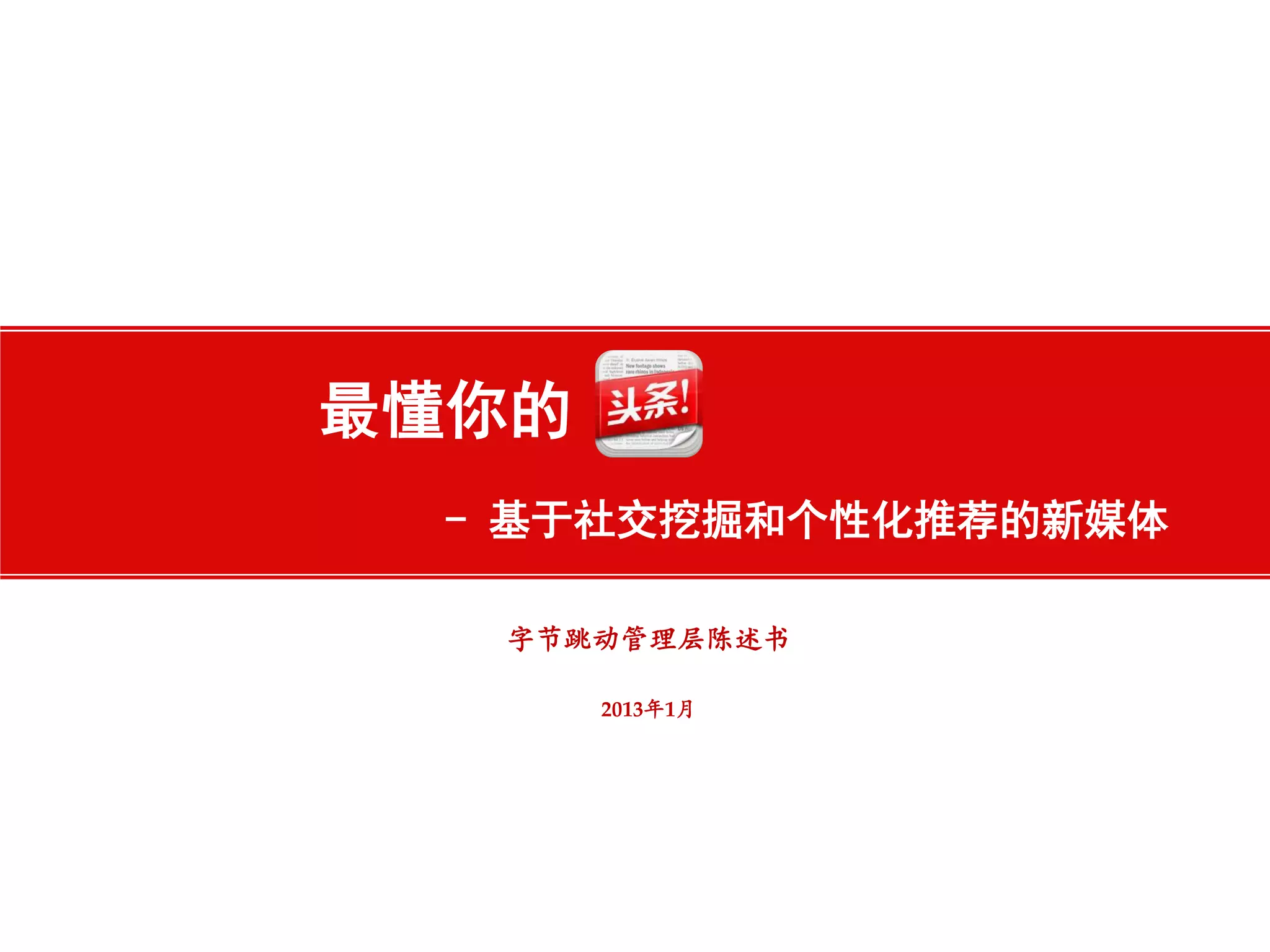
The Toutiao January 2013 Series B deck is a masterclass in technical positioning. At a time when news was still curated by editors, Toutiao (ByteDance) pitched a pure algorithmic play. The deck highlights a transition from PC-based search to mobile-first personalized discovery, backed by a sophisticated data processing framework. With cumulative users crossing 15 million within its first year and a team led by serial entrepreneur Zhang Yiming, the deck successfully argued that content consumption was no longer a search problem, but a recommendation problem. The focus on 'interest graphs' and…
Key takeaways
- The deck identifies a market shift from PC-based editor curation to mobile-based personalized social reading (Slide 4).
- Product features emphasize a 'no subscription' model where content is served immediately upon app launch (Slide 7).
- Growth metrics show cumulative users reaching approximately 20 million by early 2013, with a significant spike in October 2012 (Slide 13).
- The technical architecture includes a complex 'Spider-Extractor-Miner-Recommender' pipeline for real-time processing (Slide 16).
- The recommendation engine updates a user's interest profile within 30 seconds of an action across tens of thousands of dimensions (Slide 19).
- Founder Zhang Yiming is positioned as a serial entrepreneur with deep roots in search and social mining from Kuxun and Fanfou (Slide 22).
- The monetization strategy focuses on 'Ads as Content,' leveraging high frequency and duration of use (Slide 25).
- The deck omits a specific 'Ask' slide or detailed financial projections in the provided 9-slide sample, though it is labeled as a Series B presentation.
Toutiao 2013: The Algorithmic Genesis
The Toutiao Series B deck from January 2013 is a historical artifact of the mobile revolution. At this stage, ByteDance was not yet a global household name, but the blueprint for its dominance—algorithmic recommendation—was already fully formed. This teardown examines the technical and strategic arguments used to secure early-stage funding for what would become one of the world's most valuable private companies.
Slide 1: Title and Positioning
The cover slide introduces Toutiao as a "New Media based on Social Mining and Personalized Recommendation." It is dated January 2013 and attributed to the ByteDance management team. The tagline immediately establishes that this is not a traditional media company, but a technology company operating in the media space. This distinction is critical for the Series B stage, where investors are looking for scalable technology moats rather than content production costs.
Slide 4: Market Transformation
Slide 4, titled "The Pan-Reading Market is Undergoing Change," uses a vertical timeline to contrast the "Past" with the "Present." The past is defined by PC terminals, browsing/searching, and editor-selected continuous reading. The present is defined by mobile terminals, social sharing, and fragmented, personalized reading. By framing the market this way, Toutiao positions itself as the inevitable successor to the search-based and editor-led models of the previous decade. It identifies the core tension: a surplus of diverse content versus the limited screen real estate of mobile devices.
Slide 7 & 10: Product Overview and Social Integration
Slide 7 emphasizes simplicity. The headline "Simple and Rich" explains that users do not need to subscribe or select topics; they simply start the app to receive personalized information. The screenshot shows a feed containing diverse topics like sports, Steve Jobs, and parenting, all aggregated from different sources. Slide 10 expands on the "Interest Community," showing how the app integrates with Social Networking Services (SNS) to facilitate over 100,000 daily shares. This social data feeds back into the recommendation engine, creating a flywheel of data and engagement.
Slide 13: Traction and User Growth
The traction slide is a standard but effective dual-chart layout. The top chart shows cumulative users (gray bars) and new users (red line) from March 2012 to January 2013. Cumulative users reached the 20 million mark in less than a year. The bottom chart tracks launch frequency and active users, both showing steady, linear growth. A note on the slide mentions that a spike in October 2012 was due to a statistical deviation in the Umeng tracking, showing a level of transparency often missing in modern decks.
Slide 16: The Technical Moat
Slide 16 is arguably the most important in the deck for a Series B investor. Titled "Original data processing & recommendation technology framework," it provides a detailed schematic of the Toutiao engine. It tracks the flow from raw web and social data through a "Spider" (crawler), an "Extractor" (handling video, image, and text), a "Miner" (using high-dimension matrix operations), and finally a "Recommender." The inclusion of an "Ad Recommender" block shows that monetization was architected into the product from the beginning, not bolted on later.
Slide 19: Real-Time Personalization
Slide 19 illustrates how the system models user attributes. It shows four different user profiles (including high-profile figures like Kai-Fu Lee) and the web of topics associated with them. The key claim here is the speed of the feedback loop: the system updates a user's interest distribution across tens of thousands of dimensions within 30 seconds of a user action. This level of responsiveness was the primary differentiator against competitors who updated profiles daily or weekly.
Slide 22: The Team
The team slide focuses on technical and entrepreneurial pedigree. Zhang Yiming’s history is detailed, showing a clear progression from software engineering at Nankai University to key roles at Kuxun (search) and Fanfou (social), and finally founding 99fang (mobile real estate). The rest of the team—Huang He, Liang Rubo, and Tu Fengfeng—are presented as having deep experience in R&D and product management at major firms like Microsoft and Oracle. The message is clear: this is a team of search and data experts applying their skills to news.
Slide 25: Monetization Strategy
The final slide in this set, "Considerations for Future Commercialization," outlines the path to revenue. It focuses on two pillars: "Huge Advertising Value" and "Broad Monetization Potential." The deck argues that because the platform has high frequency, high duration, and precise data, ads can be seamlessly integrated as content. It also mentions "Data Output," suggesting the company could provide analytics or components to other media partners, though the primary focus remains on the internal ad engine.
What Works in This Deck
Technical Depth: Unlike many consumer app decks that focus purely on UI/UX, Toutiao spends significant time on the backend architecture. Slide 16 and 19 prove to investors that there is a proprietary engine driving the growth, not just a clever marketing campaign.
Market Timing: The deck perfectly captures the transition from PC to mobile. By highlighting the "fragmented" nature of mobile reading, it justifies why a new, algorithmic approach is necessary to replace the old way of browsing.
Founder-Market Fit: Zhang Yiming’s background in search (Kuxun) and social (Fanfou) is perfectly aligned with a product that combines social mining with content discovery. The deck makes this connection explicit.
What is Missing
The Ask: In this 9-slide sample, there is no mention of how much capital is being raised or the intended use of funds. While this likely appeared in the full 27-slide version, its absence here leaves the narrative unfinished.
Competitor Analysis: The deck does not explicitly name competitors like Sina or Tencent. While it describes the "Past" vs "Present," it avoids a direct head-to-head comparison with other news aggregators that were active in the Chinese market in 2013.
Unit Economics: While user growth is clear, there is no data on Customer Acquisition Cost (CAC) or Lifetime Value (LTV). The deck relies on the "natural growth" narrative, which is compelling but lacks the financial rigor usually expected at Series B.
Founder's Playbook: What to Copy
Visualize the Pipeline: If your startup is built on a complex technical process (AI, biotech, logistics), copy the style of Slide 16. Don't just say you have an algorithm; show the stages of data processing. It builds immense credibility.
Define the Shift: Use the "Past vs. Present" framework from Slide 4. It is the fastest way to explain why your solution is necessary now, rather than five years ago. Focus on the change in user behavior or hardware (in this case, the move to mobile).
Quantify the 'Magic': Toutiao didn't just say they were fast; they said they updated profiles in "30 seconds." If your product has a 'wow' factor, find a specific metric to define it. Whether it's speed, cost reduction, or accuracy, a hard number is more memorable than a vague adjective.
Frequently asked questions
- What was Toutiao's core value proposition in 2013?
- Toutiao positioned itself as a 'new media' platform based on social mining and personalized recommendations. Unlike traditional news apps that required users to follow specific sources or relied on human editors, Toutiao used algorithms to aggregate content from the web and social data, delivering a unique feed to every user based on their behavior and interests.
- How did the deck demonstrate technical superiority?
- Slide 16 provides a detailed 'Original data processing & recommendation technology framework.' It outlines a sophisticated pipeline involving spiders, extractors for video/image/text, and miners that perform high-dimension matrix operations. Crucially, Slide 19 claims the system updates a user's interest distribution within 30 seconds of any action, highlighting a real-time capability that was rare at the time.
- What did the early growth metrics look like?
- According to Slide 13, the company saw 'high-speed natural growth' with minimal promotion. Cumulative users grew from near zero in March 2012 to roughly 20 million by January 2013. Daily active users and launch frequency showed a consistent upward trajectory, indicating strong retention and habit formation among the early mobile user base in China.
- Who were the key team members mentioned?
- The team slide (Slide 22) features CEO Zhang Yiming, highlighting his 2012 founding of ByteDance and previous roles at 99fang, Fanfou, and Kuxun. Other key members include Huang He (Product), Liang Rubo (R&D), and Tu Fengfeng (Business Development), all bringing significant experience from companies like Microsoft, Oracle, and various successful Chinese startups.
- What was the proposed business model?
- The business model centered on the 'huge advertising value' of a high-stickiness platform. Slide 25 explains that because the platform understands user interests so precisely, ads can be treated as content. The strategy involved using data to provide precise ad targeting and potentially exporting data services to other media partners.