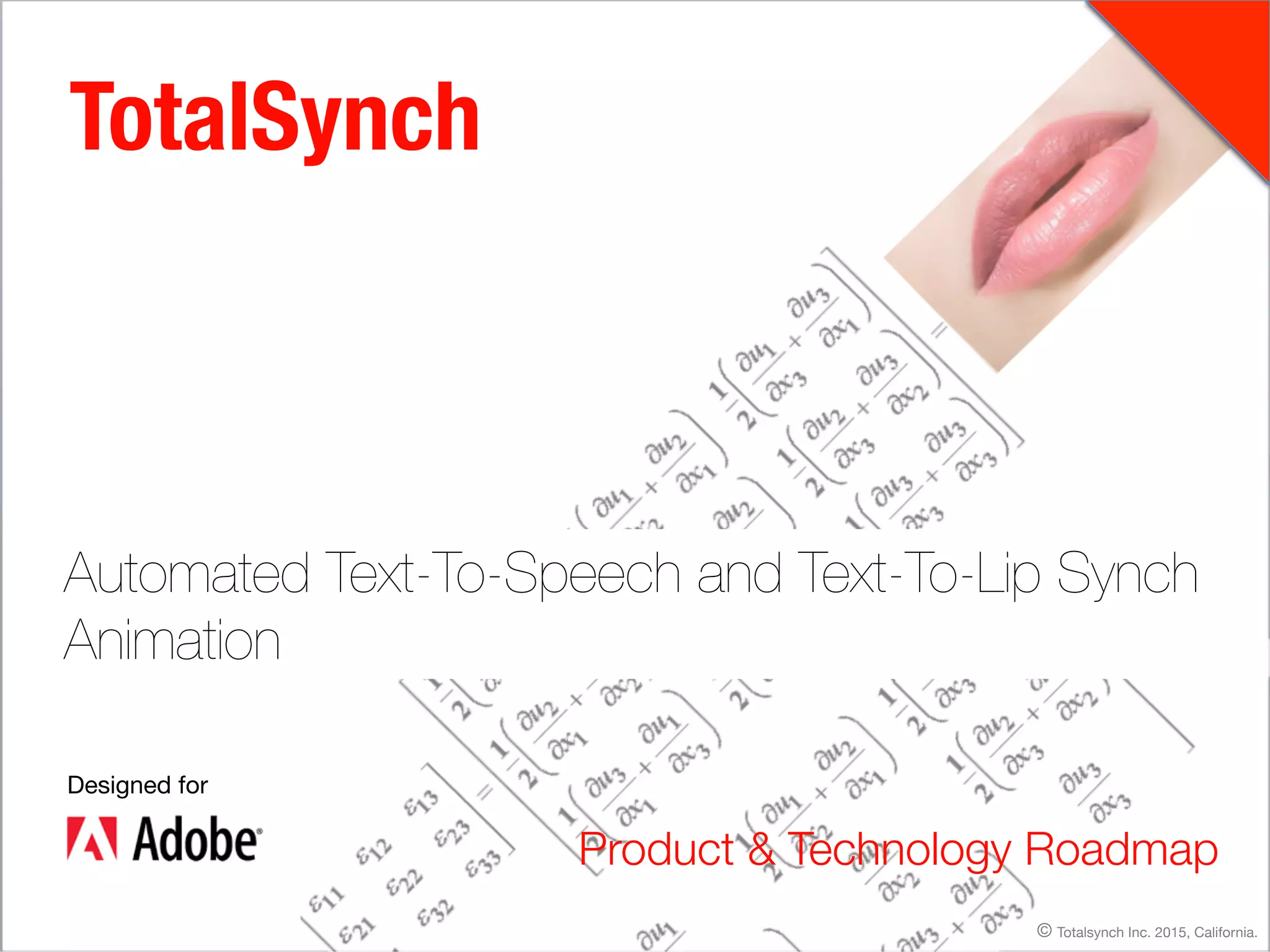
TotalSynch presents a technical solution for automated text-to-speech and lip-synch animation, specifically targeting the 'Uncanny Valley' problem where near-human avatars evoke revulsion. The 2015 deck outlines a process that records every syllable in a language both vocally and visually to create a library of 3D graphic motion graphs. A key technical claim is the identification of 87 distinct vectors for lip movements based on Sanskrit and Tsonga phonetics. While the deck provides a detailed look at the technology and a $4.1 billion market estimate, it lacks a formal team slide, specific un…
Key takeaways
- The company identifies the 'Uncanny Valley' as the primary psychological barrier to realistic human-like animation on slides 4 and 7.
- TotalSynch claims a total estimated market size of $4.1 billion by 2019, with Adult Entertainment ($2.5B) and VR Shopping ($1B) as the largest segments on slide 10.
- The technology relies on a patented process that uses syllables rather than individual phonemes to drive 3D lip-synch animation as detailed on slide 13.
- The engine maps 87 distinct vectors for lip movements, derived from 85 Sanskrit syllables and 2 Tsonga syllables, shown on slide 16.
- The product is positioned as an API that outputs vector data to be integrated with 3D face models on slide 19.
- Slide 22 showcases a software interface for editing dialogue, volume, pitch, and speech pace across multiple characters.
- The company has raised $500,000 to date, consisting of $250,000 from the founder and $250,000 from friends and family as stated on slide 25.
- The deck prominently features an 'Adobe' logo with the text 'Designed for Adobe' on the cover and final slides, suggesting a specific integration or partnership focus.
TotalSynch Pitch Deck Teardown
TotalSynch, a California-based company, produced this deck in 2015 to showcase its automated text-to-speech and lip-synch animation technology. The deck is heavily technical, focusing on the mechanics of how the company intends to solve a long-standing problem in computer animation: the Uncanny Valley. By utilizing a unique linguistic approach to 3D modeling, TotalSynch positions itself as a critical infrastructure layer for the next generation of digital avatars.
Slide 1: Title and Positioning
The cover slide introduces TotalSynch with the subtitle "Automated Text-To-Speech and Text-To-Lip Synch Animation." It features a background of mathematical equations and a close-up of human lips, emphasizing the technical and biological intersection of the product. Notably, the slide includes an Adobe logo with the text "Designed for Adobe," suggesting the company is building a plugin or an integrated tool for the Adobe Creative Cloud ecosystem. The footer indicates the company was incorporated in California in 2015.
Slides 4 and 7: Defining the Uncanny Valley
The deck spends significant time establishing the problem. Slide 4 uses a popular internet meme involving toasters to illustrate the Uncanny Valley, quoting animator Shamus Culhane: "The big problem that one has to face is the fact that everybody in the audience is an expert on how humans move." Slide 7 provides a more formal definition, showing the classic graph where emotional response drops into a 'valley' as anthropomorphism increases but fails to reach perfect realism. TotalSynch identifies this 'revulsion or fear' as the primary barrier for robots, avatars, and non-human humanoids.
Slide 10: Market Size and Patents
TotalSynch quantifies the opportunity by listing eight market segments that would benefit from crossing the Uncanny Valley. The total market is estimated at $4.1 billion by 2019. The breakdown includes:
Adult Entertainment: $2,500 million · VR Shopping Fronts / Salesbots: $1,000 million · Advertising (Personalized): $300 million · Video Game Animation: $150 million · Facebook/Social Media Avatars: $50 million · Internet Avatars: $50 million · 3D tools and plugins (After Effects, etc): $25 million · Film/Television Animation: $25 million
The slide also notes that TotalSynch holds "critical patents till 2025" in this space.
Slide 13: Technology and Process
This slide outlines the company's technical moat. It claims to have the "only patents on text-to-speech/text-to-animation using syllables." The process involves recording every syllable in a language both vocally and visually to create a library of sounds and 3D graphic motion graphs. The engine takes text input (like a script) and a 3D graphic model, then parses the text to create a "syllable map." This map extracts the corresponding sounds and lip-motions from the library, rendering them into synchronized outputs. The deck emphasizes that changes in volume, pace, and pitch automatically drive representative changes in the 3D graphic representation.
Slide 16: The 87 Syllables
Slide 16 provides the linguistic foundation for the technology. It claims there are 87 distinct vectors for lip movements for every possible syllable in the human voice box. TotalSynch identified these by looking at Sanskrit (85 syllables) and Tsonga (2 syllables). The slide displays a grid of Sanskrit characters and their phonetic equivalents, explaining that by mapping these 87 vectors, the engine can cover all possible human lip movements, which is their proposed method for crossing the Uncanny Valley.
Slide 19: API and Vector Output
This slide visualizes the product as an API. It shows a matrix of partial derivatives (representing the vector output) being added to a 3D model of a face. The diagram illustrates how the "Lip Movements Vector Field" translates the mathematical output into physical deformations of the 3D mesh, specifically focusing on the jaw and lip area.
Slide 22: Software Interface
TotalSynch provides a screenshot of its interface, which resembles a non-linear editor or a digital audio workstation. The interface allows users to type dialogue for multiple characters and then adjust parameters such as Syllable, Volume, Pitch, Speech Pace, Expressions, and Gestures on a timeline. The screen shows a "Preview" window with a rendered avatar and a "Render" window showing the wireframe mesh. The dialogue line "So, why can't everything be this simple?" is used as the example.
Slide 25: Company Overview and Funding
The history of the company is described as starting in the video game sector with a vision for immersive Multiplayer Role-Playing Games. The funding section reveals a total of $500,000 raised to date:
$250,000 founder funding · $100,000 funding from founder’s parents · $150,000 from other friends and family
This slide establishes that the company is currently in a 'friends and family' stage of capitalization.
Slide 28: Contact and Adobe Integration
The final slide repeats the "Designed for Adobe" branding and provides contact information for Mangesh Mahajan. It includes a phone number and two email addresses, one for TotalSynch and one for Tractioning.com.
What TotalSynch Does Well
The deck excels at identifying a very specific technical problem—the Uncanny Valley—and proposing a novel, patent-backed solution. By grounding their technology in the phonetics of ancient and specific languages (Sanskrit and Tsonga), they create a narrative of a "complete" solution that covers all possible human movements. The inclusion of a functional-looking UI (Slide 22) suggests that the product is beyond the conceptual stage and has a working toolset. The market slide is also refreshingly honest about where the money is, explicitly listing Adult Entertainment as the largest market driver rather than hiding it behind generic terms like "media."
What is Missing from the Deck
The most glaring omission is a dedicated Team slide. While a contact name is provided at the end, there is no information regarding the founders' backgrounds, their technical expertise in linguistics or 3D animation, or their previous successes. Furthermore, the deck lacks a clear "Ask." It mentions previous funding but does not state how much capital is currently being sought or what the milestones for that capital would be. There is also no mention of unit economics, pricing models, or a go-to-market strategy beyond the "Designed for Adobe" implication. Finally, while the deck mentions patents, it does not list patent numbers or the specific jurisdictions where they are held.
What a Founder Should Copy
Founders building highly technical products should look at how TotalSynch uses Slide 13 and 16 to explain complex processes. Instead of using vague buzzwords like "AI-driven," they explain the specific logic: text to syllable map, syllable map to motion graph library, and motion graph to 3D mesh. The use of a specific linguistic framework (the 87 vectors) gives the technology a sense of proprietary depth that is often missing in early-stage decks. Additionally, the clear segmentation of the market on Slide 10, including the estimated dollar values for each niche, provides a clear roadmap for where the company intends to find its first customers.
Final Analysis
TotalSynch presents a compelling technical case for a niche but vital problem in the animation industry. The deck is a product of its time (2015), leaning heavily on the promise of VR and digital avatars. While the technical explanation is strong, the deck functions more as a product roadmap or a technical white paper than a complete investment vehicle. To be successful with institutional investors, the company would need to supplement this with a strong team narrative and a clear financial plan for scaling the API beyond its initial $500,000 bootstrap phase.
Frequently asked questions
- What is the core problem TotalSynch is trying to solve?
- TotalSynch focuses on the 'Uncanny Valley,' a phenomenon where human-like robots or avatars cause a negative emotional response because they are realistic but not perfectly human. Slide 7 defines this as a point where positive response 'tails off dramatically, evoking revulsion or fear.' The company aims to cross this valley by providing more natural, syllable-based lip-synch animation.
- How does the technology differ from standard lip-synch tools?
- According to slide 13, TotalSynch uses syllables rather than standard audio units. They record every syllable vocally and visually to create a library of 3D motion graphs. The engine then 'marries' the sound and graphic libraries, so changes in volume or pitch automatically update the 3D graphic representation of the spoken syllable.
- What is the significance of Sanskrit and Tsonga in the deck?
- Slide 16 explains that the company identified 87 distinct vectors for all possible lip movements on the human voice box. They found 85 of these in Sanskrit and the remaining 2 in Tsonga (a South African language). By mapping these 87 vectors, they claim to cover the entire database of possible human lip movements.
- What are the primary target markets for this technology?
- Slide 10 lists several markets, but the largest by far is Adult Entertainment at $2.5 billion. Other significant targets include VR Shopping Fronts/Salesbots ($1 billion), Advertising ($300 million), and Video Game Animation ($150 million). The total estimated market size provided is $4.1 billion.
- What is the current financial status of the company according to the deck?
- Slide 25 notes that the company was founded as a video game company. It has been funded with $500,000 total: $250,000 from the founder, $100,000 from the founder's parents, and $150,000 from other friends and family. The deck does not specify a current valuation or a new funding target.