Transcend's Series B deck serves as a blueprint for vertical SaaS companies moving from product-market fit to aggressive scaling. The presentation highlights their Transcend Design Generator (TDG), which automates preliminary engineering for water and power infrastructure—reducing months of planning to mere hours. With over 12,000 designs generated and a clear ROI story for three distinct customer segments (Asset Owners, EPCs, and OEMs), the deck justifies a $20M ask. While some slides contain placeholders for specific financial projections, the narrative effectively leverages a decade of pro…
Key takeaways
- The platform automates 30% of a complete engineering design with no human intervention, significantly reducing project cycles (Slide 4).
- Transcend identifies a $107B total spend by U.S. asset owners on third-party design work, with current targets in water and power representing over $23B (Slide 12).
- The product has a deep history, originating as an internal tool in 2011 before spinning out as an independent entity in 2019 (Slide 8).
- Users have generated over 12,000 designs to date, demonstrating significant platform utility and data accumulation (Slide 5).
- The 'Land and Expand' strategy is supported by a flywheel that moves from generic use cases to client-specific configurations (Slide 11).
- A specific OEM case study shows a 50% reduction in proposal time, moving from 3 days to 1.5 days (Slide 14).
- The $20M raise is explicitly earmarked for team expansion and product build-out to achieve future financial objectives (Slide 16).
- The team features deep domain expertise, including a CEO who was formerly the head of a VC-backed water tech startup (Slide 15).
Transcend Pitch Deck Teardown: Automating the Infrastructure Renaissance
Transcend’s 2023 investor presentation is a comprehensive look at how generative design can disrupt the traditionally slow-moving world of critical infrastructure. The deck, used to secure $20M in Series B funding, focuses on the transition from manual engineering to automated, cloud-based workflows. By targeting the 'root cause' of infrastructure inefficiency, Transcend positions itself as both a climate-tech play and a high-efficiency SaaS tool.
Slides 1-3: The Vision and the Problem
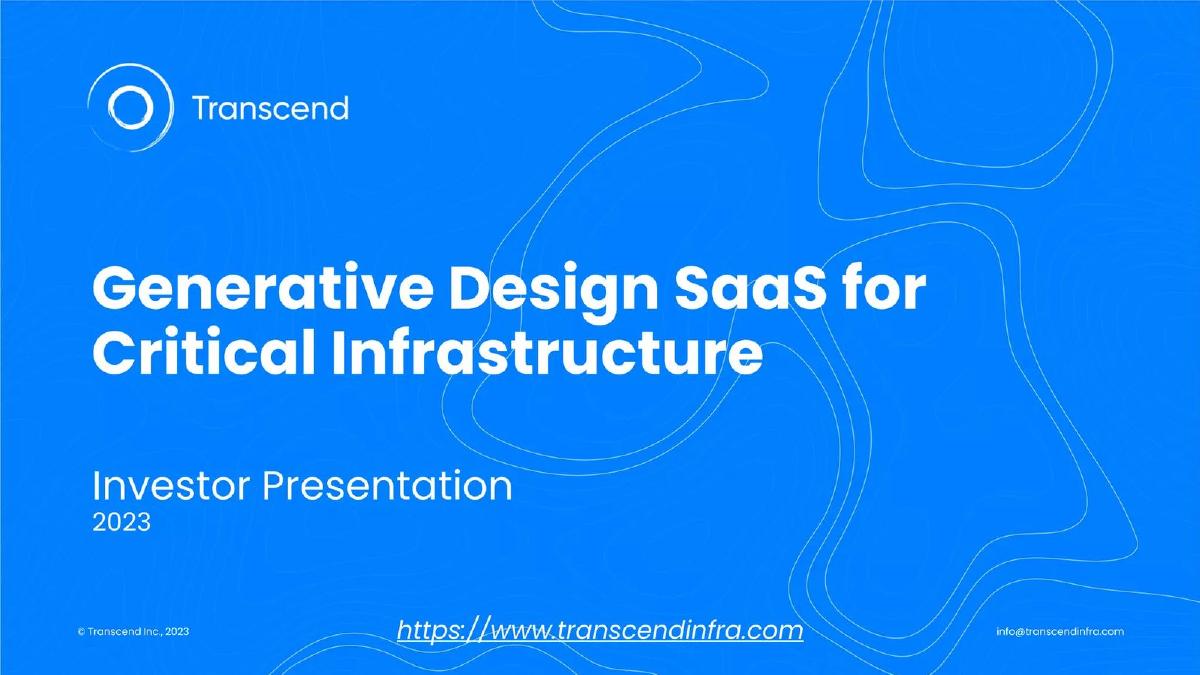
The deck opens with a clear title slide (Slide 1) defining the company as 'Generative Design SaaS for Critical Infrastructure.' This immediate clarity is essential for specialized industrial software. Slide 2 connects the business to the climate crisis, arguing that 'poor planning = unsustainable infrastructure.' It sets a high-level vision where their tool, the Transcend Design Generator (TDG), is used by every major stakeholder in any critical infrastructure project.
Slide 3, titled 'Transcend Enables the Infrastructure Renaissance,' uses a Forbes quote to validate the market's shift from 'slow and steady' to 'dynamic.' It frames the problem quantitatively: $9 trillion in new investment is required by 2025 to support the global population. The solution is presented as a way to leverage over $1 trillion in committed government spending by driving down the costs of preliminary design.
Slides 4-7: Product Capabilities and Early Traction
Slide 4 introduces the TDG as a cloud-based platform that automates the preliminary engineering process. A key metric here is that the software generates '30% of a complete design' with 'no human intervention.' This is a bold claim that addresses the primary bottleneck in engineering: the manual labor required for initial calculations and CAD work.
Slide 5 provides a snapshot of the company's progress. With over 12,000 designs generated, the platform has moved beyond the pilot phase. The slide also breaks down the TAM for current target verticals: >$5B for Water/Wastewater and >$2B for Electrical Substations. It also notes the company's dual-location structure, with HQs in Princeton, NJ, and a dev team in Budapest, Hungary.
Slide 6 is a technical 'how it works' diagram. It shows the flow from 'User Inputs' (feedstock data, site mapping) through the 'Transcend Design Generator' to 'Output Files' (3D BIM models, P&IDs, OPEX estimates). This slide is crucial for technical due diligence, as it lists the specific industry-standard outputs the software provides. Slide 7 is a placeholder for a virtual demo, emphasizing the speed of the tool—designing a facility in 5 minutes.
Slides 8-11: History, Strategy, and Customer Segments
Slide 8 details the '10+ years in the making' history of the product. This is a strong credibility builder, showing that the tool was battle-tested as an internal utility at Organica Water for years before becoming a standalone SaaS product. It tracks the journey from a 2011 POC to a 2019 spin-out and seed round.
Slide 9 outlines 'Five Core Differentiators,' including Product-Led Growth and a 'Land and Expand' sales strategy. Slide 10 and 11 dive deeper into the customer segments. Slide 10 identifies three distinct buyers: Asset Owners, EPCs (Engineering, Procurement, and Construction), and OEMs. Slide 11 illustrates the 'Transcend Flywheel,' showing how the product-led growth model works by moving from generic use cases to client-specific configurations, leading to upsells and increased ROI.
Slides 12-14: Market Opportunity and Case Studies
Slide 12 is the 'Massive Market Opportunity' slide. It uses a bar chart to show that U.S. asset owners spend $107B on third-party design work. It highlights that Transcend’s current verticals (Water and Power) represent a $23B slice of that pie, leaving significant room for expansion into Transportation ($26B) and Building ($27B). Slide 13 is a placeholder for vertical expansion projections, which would typically contain sensitive financial forecasts.
Slide 14 provides a concrete OEM case study. The 'XX Customer' (anonymized) has over 1,000 employees and billion-dollar revenues. The results are impressive: a 50% reduction in proposal time (from 3 days to 1.5 days) and a shift in the application engineering team’s time allocation from 60% to 10% on budgetary proposals. This 'meaningful ROI' is exactly what Series B investors look for to justify a $20M check.
Slides 15-17: Team and The Ask
Slide 15 introduces the leadership team. It highlights Ari Raivetz (CEO) and Adam Tank (CCO), both with backgrounds in water tech and VC-backed startups. The team appears balanced between sales, product, and delivery, with experience at firms like GE, Microsoft, and BofA. The inclusion of board members from Elemental Excelerator and PureTerra Ventures adds further institutional credibility.
Slide 16 is the 'Use of Proceeds' slide. It lists current investors (Aspen Capital Group, Heritage Group Ventures, etc.) and states the ask: '$20M of growth capital.' The slide sets a vision for 2025, aiming for top-tier gross margins and significant CARR (Contracted Annual Recurring Revenue) growth. The deck concludes with a standard 'Thank You' slide (Slide 17).
What Transcend Does Well
Quantified Value Proposition: The deck repeatedly cites time savings (months to hours) and design completion percentages (30% automated), making the efficiency gains tangible. · Segmented ROI: By breaking down the benefits for Asset Owners, EPCs, and OEMs separately, Transcend shows a sophisticated understanding of the complex infrastructure procurement cycle. · Proven History: Highlighting the 10-year development history mitigates the risk often associated with 'new' industrial software. · Market Context: Linking the product to the $1 trillion in government infrastructure spending and the climate crisis provides a strong 'why now' narrative.
What is Missing from the Deck
Specific Financials: Slides 13 and 16 contain placeholders ('x%', '$xxM'). While likely filled in for actual investor meetings, their absence in the public version makes it hard to judge the company's current burn or revenue scale. · Competitive Landscape: There is no slide dedicated to competitors. While they mention 'traditional (manual) design methods,' they don't address other generative design startups or legacy players like Autodesk moving into this space. · Unit Economics: The deck lacks a breakdown of CAC (Customer Acquisition Cost) and LTV (Lifetime Value), which are critical for a Series B 'growth capital' raise.
What Other Founders Should Copy
The Flywheel Diagram (Slide 11): This is an excellent way to show how a product-led growth strategy actually functions in a B2B context. · The Vertical Expansion Chart (Slide 12): Using third-party data (ENR 2021) to show adjacent markets provides a credible roadmap for future growth beyond the initial niche. · The Detailed Team Bios (Slide 15): Instead of just logos, Transcend provides 3-4 bullet points for each key member, emphasizing specific relevant achievements rather than just titles.
Frequently asked questions
- What is the core value proposition of the Transcend Design Generator?
- According to slide 6, the core value is compressing months-long capital planning processes into hours. The TDG takes user inputs like feedstock data and site mapping to automatically generate professional-grade outputs, including 3D BIM models, P&IDs, and equipment BOQs. This allows engineers to evaluate more design options at a lower cost before setting a project budget.
- Who are Transcend's primary target customers?
- Slide 10 categorizes the market into three segments: Asset Owners/Utilities (who control the budgets), EPCs/Consultants (who perform the design work), and Technology OEMs (who sell the equipment). Each segment has a unique ROI; for example, OEMs use the tool to eliminate sales bottlenecks, while EPCs use it to increase margins on fixed-bid work.
- How does Transcend quantify its market opportunity?
- Slide 12 cites ENR 2021 data showing that U.S. asset owners spend $107B annually on third-party design. Transcend currently operates in the Water and Power verticals, which account for over $23B of that spend. The deck suggests significant upside through expansion into other verticals like Transportation and Building, which represent over $50B in additional spend.
- What is the history and origin of the company?
- Slide 8 details a 10-year product history. The software began as an internal tool for Organica Water between 2011 and 2013. It underwent commercial validation with third parties starting in 2017 before officially spinning out as Transcend in December 2019, coinciding with its initial seed financing.
- What are the specific goals for the $20M Series B funding?
- Slide 16 states the $20M will be used to accelerate the build-out of the team and product. The long-term objective is to reach top-tier gross margins and positive cash flow by 2028, positioning the company as the market leader in automated design for critical infrastructure.