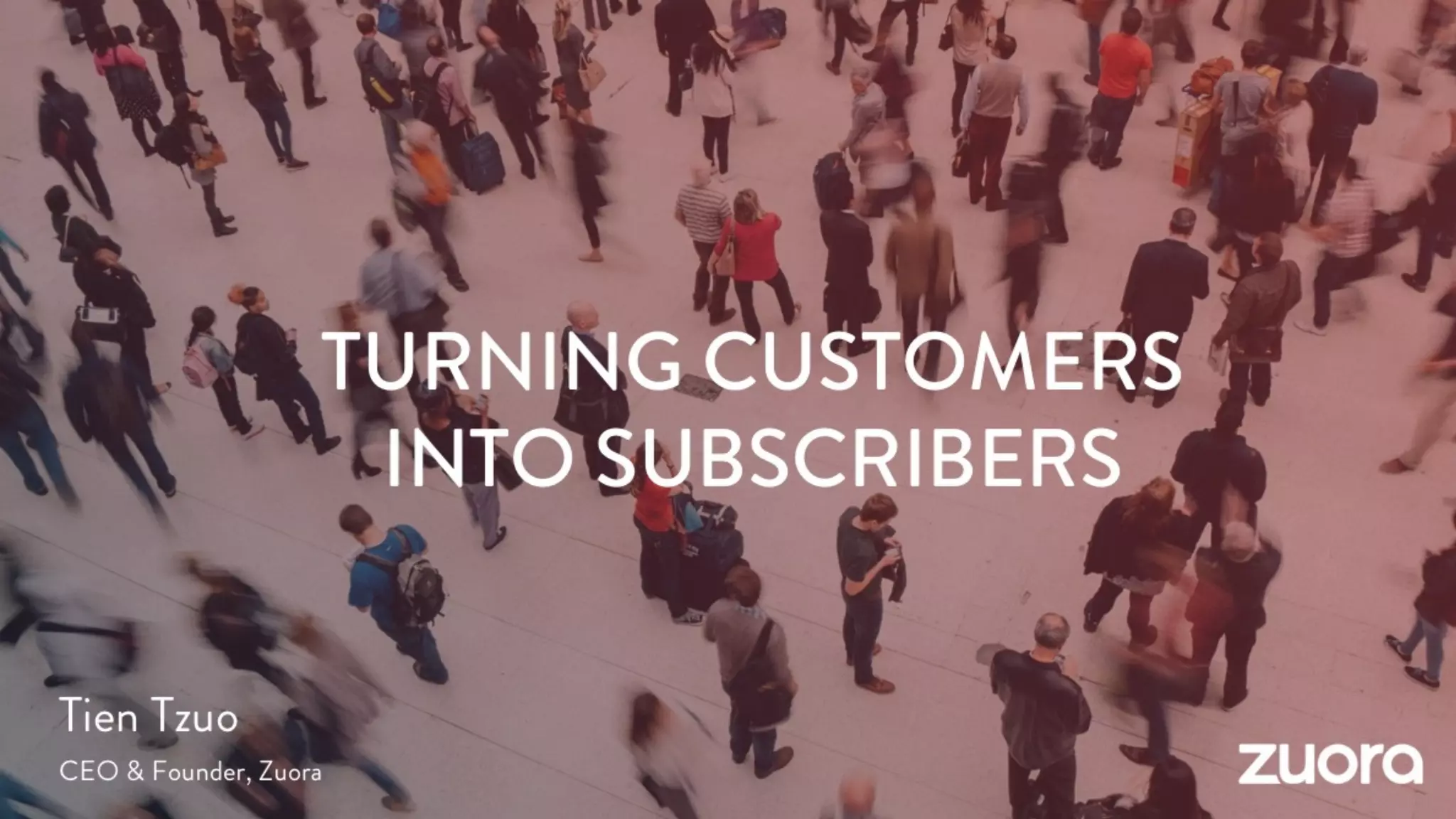
Zuora’s pitch deck is a seminal example of strategic narrative, eschewing the traditional 'problem/solution' framework in favor of a 'change in the world' narrative. The deck, led by CEO Tien Tzuo, argues that the global economy is shifting from product ownership to subscription-based relationships. By highlighting the success of giants like Amazon and Salesforce, and the transformation of legacy players like General Electric, Zuora positions itself not as a mere billing tool, but as the essential infrastructure for this new era. The slides focus heavily on high-level market shifts and custom…
Key takeaways
- The deck leads with a massive shift in consumer behavior rather than a specific pain point, stating that 'The way people buy has changed for good' (Slide 2).
- It defines the new market reality as a move toward 'Outcomes, Customization, and Constant Improvement' over ownership and planned obsolescence (Slide 2).
- Zuora uses high-profile examples like General Electric's transition to digital services to prove that even industrial giants are moving toward subscriptions (Slide 4).
- The narrative categorizes market leaders like Amazon, Google, and Apple as 'The relationship-makers,' aligning Zuora with the world's most successful companies (Slide 5).
- It introduces the concept of 'Subscriber Identity' as a new category of data, contrasting it with the 'Traditional Record' found in old-world CRMs (Slide 7).
- The deck positions the product as a 'beyond CRM' solution, focusing on behavioral and financial data like renewal value and aging balance (Slide 7).
- Social proof is delivered through a high-authority quote from the CTO of the Financial Times, emphasizing global market expansion (Slide 8).
- The visual style relies on full-bleed photography and minimal text to maintain a high-level, visionary tone throughout the presentation.
The Narrative Power of the Subscription Economy
The Zuora pitch deck is frequently cited by venture capitalists and marketing experts as the gold standard for strategic storytelling. Instead of the standard 'Problem, Solution, Market Size' template, Zuora uses a narrative arc that identifies a fundamental shift in the world and positions the company as the only logical partner for navigating that shift. The deck is less about a software tool and more about a new economic philosophy.
Slide 1: The Visionary Opening
The title slide, "Turning Customers into Subscribers," immediately establishes the company's mission. It features CEO and Founder Tien Tzuo and uses a background image of a crowded public space, suggesting a broad, human-centric impact. The branding is clean, and the subtitle acts as a concise value proposition that speaks directly to the desired outcome for any business executive: recurring revenue.
Slide 2: The Irreversible Change
Slide 2 makes a bold claim: "The way people buy has changed for good." This is the 'Change in the World' slide. It lists three new expectations: Outcomes (not ownership), Customization (not generalization), and Constant Improvement (not planned obsolescence). By framing these as 'new expectations,' Zuora makes the viewer feel that if their business isn't meeting these, they are already failing their customers.
Slide 3: The Relationship Pivot
Slide 3 reinforces the shift with the hashtag #allaboutrelationships . The text, "The best companies have reinvented themselves—away from products," is a direct challenge to the traditional manufacturing and retail mindset. It suggests that the 'product' is no longer the hero; the 'relationship' is. This sets the stage for Zuora’s software, which manages those relationships.
Slide 4: The Legacy Transformation
To prove this isn't just for Silicon Valley startups, Slide 4 highlights General Electric . It notes their transition "From light bulbs to digital services" and quotes them as "The digital company. That is also an industrial company." This is a brilliant use of social proof. If a century-old industrial giant like GE is moving to a subscription/service model, the viewer is forced to admit that no industry is safe from this trend.
Slide 5: The Relationship-Makers
Slide 5 lists the current titans of industry: Amazon, Google, Apple, Facebook, and Salesforce . It labels them "The relationship-makers." By grouping these companies together, Zuora implies they all share a secret sauce: the subscription model. It creates an 'us vs. them' dynamic where the 'us' are the most valuable companies on earth.
Slide 6: Defining the Subscription Experience
Slide 6 breaks down what a customer actually wants in this new world. It uses five icons to represent: Ongoing Value, Memorable Experiences, On-demand Fulfillment, Anywhere Real-time, and Personalized Service . This slide acts as a requirements document for the new economy. It tells the prospect, "If you want to be like Amazon or Salesforce, you need to provide these five things."
Slide 7: The Product Logic (Subscriber Identity)
Slide 7 is the closest the deck gets to a technical explanation. It introduces the "Subscriber Identity Record" and uses the hashtag #beyondCRM . It contrasts the "Old world" (Traditional Record: Name, Phone, Email) with the "New world" (Subscriber Identity: Purchases, Local Pricing, Lifetime Value, Renewal Value, Usage metrics). This slide identifies the 'gap' in existing enterprise software (like Salesforce) and explains exactly where Zuora fits in the tech stack.
Slide 8: The Ultimate Validation
The final slide in this sequence provides a testimonial from the Financial Times . CTO John O’Donovan states, "Zuora has given us more presence on the global stage to be able to sell to more markets, to more people." This moves the conversation from theory to results. It shows that Zuora isn't just a billing engine; it is a growth engine that enables global expansion.
What Works in the Zuora Deck
The most effective element of this deck is its inevitability . By the time you reach the product slide, you have been convinced that the world has changed, that the most successful companies have already adapted, and that traditional tools (CRMs) are insufficient for the task. Zuora doesn't have to 'sell' their features because they have sold the 'category' first. If you buy into the Subscription Economy, you have to buy Zuora.
The use of high-level social proof is also masterful. By citing GE and the Financial Times, they bridge the gap between 'new tech' and 'old guard,' making their solution feel safe for conservative enterprise buyers while remaining aspirational.
What is Missing from the Deck
As a fundraising or sales tool, this specific version is missing several key components that would be required for a full due diligence process:
Unit Economics: There is no mention of Customer Acquisition Cost (CAC), Lifetime Value (LTV) ratios, or churn rates. · Market Size (TAM): While the 'Subscription Economy' sounds huge, the deck doesn't quantify the Total Addressable Market in dollars. · Competitive Landscape: The deck ignores other billing platforms or ERPs (like Oracle or SAP) that might claim to handle these functions. · The Team: Aside from the mention of Tien Tzuo on the cover, there is no slide detailing the leadership team's pedigree. · The Ask: There is no slide indicating how much capital is being raised or what the specific milestones for the next 18 months are.
Lessons for Founders
Founders should study this deck to learn how to sell the 'Why' before the 'How.' Most decks start with a narrow problem (e.g., "Billing is hard"). Zuora starts with a global shift ("The way people buy has changed"). This allows them to command a much higher valuation because they are positioning themselves as the infrastructure for an entire economy, not just a utility tool.
Another key lesson is the Old World vs. New World comparison. By creating a table that contrasts traditional records with subscriber identity records, Zuora makes the competitor's product look obsolete without ever having to name a specific competitor. It defines the new standard for the industry, and then claims to be the only one meeting that standard.
Final Verdict: This is a masterclass in category creation. While it lacks the 'meat' of a traditional investor deck in this format, its narrative structure is what allowed Zuora to define an entire sector of SaaS.
Frequently asked questions
- Why does Zuora spend so much time on other companies like GE and Amazon?
- This is a classic 'Strategic Narrative' technique. By showing that the most successful companies in the world have already adopted a specific way of doing business, Zuora makes their software seem like a mandatory requirement for any company that wants to survive. It shifts the conversation from 'Do I need this tool?' to 'Do I want to be left behind by the new economy?'
- Where are the product screenshots and feature lists?
- In this specific version of the deck, they are absent. Zuora focuses on the 'New World' vs. 'Old World' dichotomy. Instead of showing a dashboard, they show the 'Subscriber Identity Record' (Slide 7), which explains the *logic* of the product rather than the interface. This is common in visionary decks meant to secure high-level buy-in from executives or VCs.
- What is the 'Subscription Experience' according to these slides?
- Slide 6 defines it through five pillars: Ongoing Value, Memorable Experiences, On-demand Fulfillment, Anywhere Real-time access, and Personalized Service. By defining these terms, Zuora sets the criteria for success in the new economy—criteria that their software is specifically designed to help companies meet.
- How does Zuora differentiate itself from a standard CRM like Salesforce?
- Slide 7 uses the hashtag #beyondCRM to make this distinction clear. They argue that traditional records only capture basic contact info (Name, Phone, Email), whereas a 'Subscriber Identity Record' captures the financial and behavioral pulse of a relationship, including Lifetime Value, Renewal Value, and Usage metrics.
- Is this deck effective for a seed-stage startup?
- Probably not. Zuora was already an established player when this narrative was perfected. Seed-stage startups usually need more evidence of product-market fit and unit economics. However, the *structure*—starting with a change in the world rather than a problem—is a powerful way for any startup to frame their mission.