Zoe Financial’s 13-slide deck is a textbook example of a marketplace pitch, targeting the 'mass affluent' demographic seeking fiduciary financial advice. The deck identifies a significant gap in how advisors source leads and how clients qualify experts, proposing a 'managed' marketplace model characterized by high curation and revenue sharing. While the deck effectively outlines the $85 trillion market potential and a rigorous 5% advisor acceptance rate, it is heavily redacted in this version. Key metrics, team identities, investor names, and specific revenue percentages are obscured, making…
Key takeaways
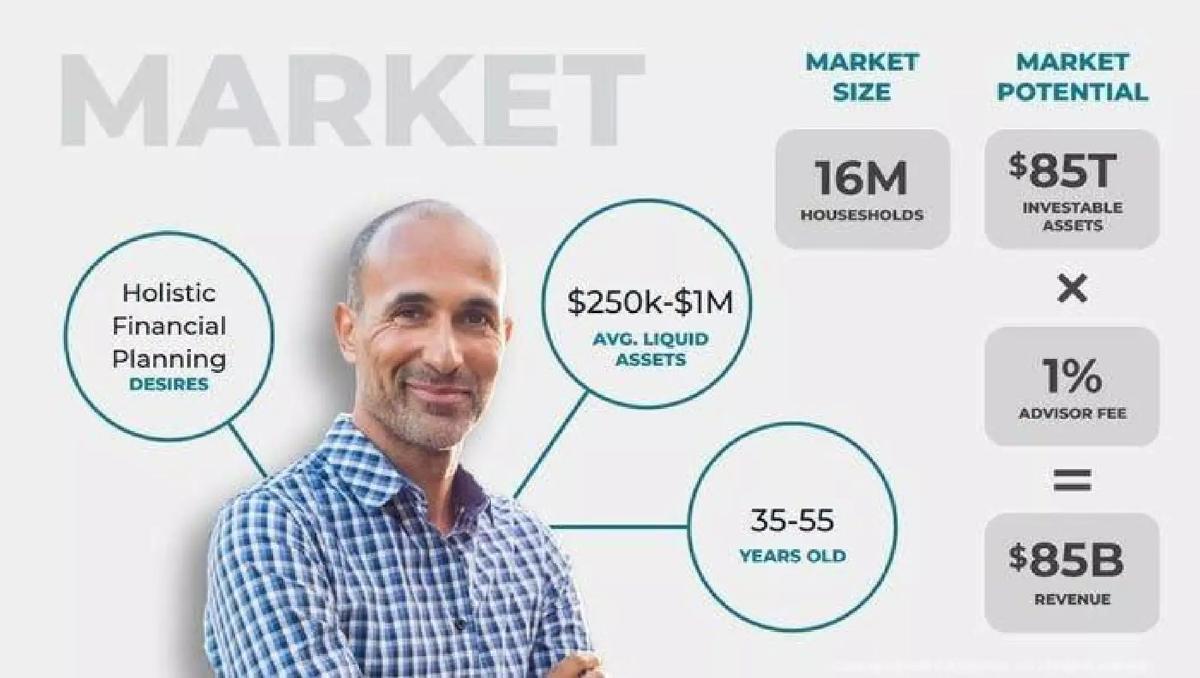
- The company targets the 'mass affluent' market, specifically households with $250k to $1M in liquid assets (Slide 5).
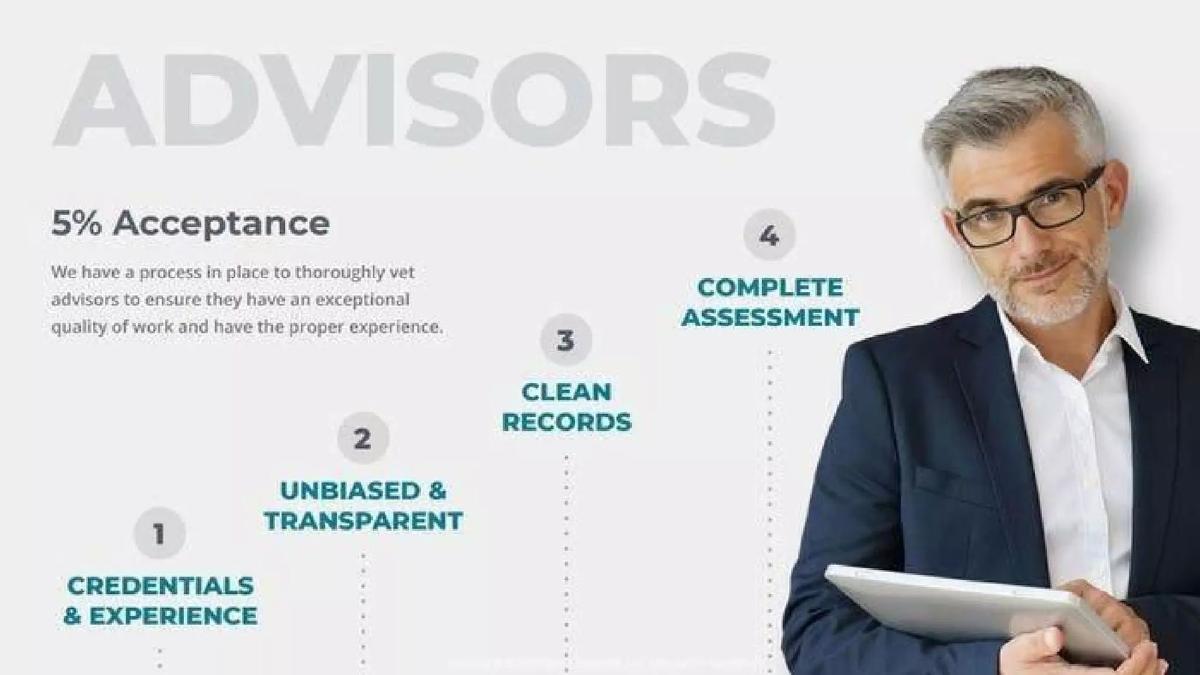
- Zoe Financial employs a highly selective vetting process, resulting in a 5% advisor acceptance rate (Slide 4).
- The business model relies on revenue sharing from the advisor's recurring revenue rather than lead-gen fees (Slide 8).
- The market potential is calculated based on $85T in investable assets and a 1% average advisor fee, totaling an $85B revenue opportunity (Slide 5).
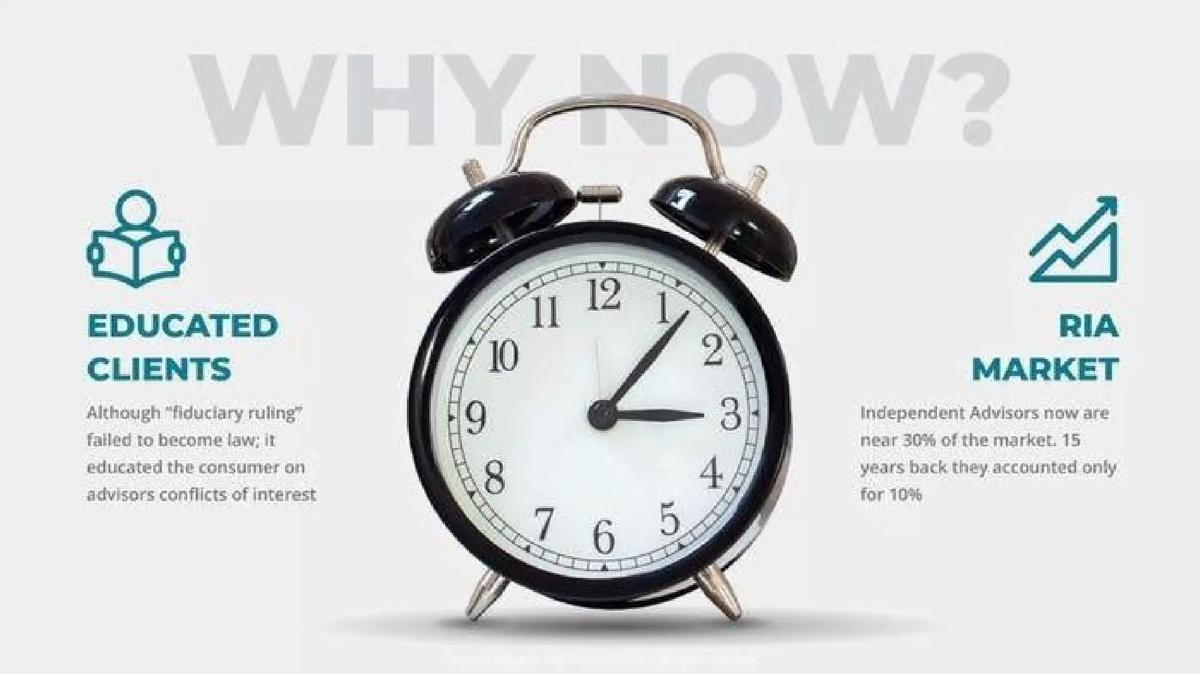
- The 'Why Now' slide highlights that Independent Advisors (RIAs) have grown from 10% to 30% of the market over 15 years (Slide 6).
- Zoe differentiates itself from 'Listings' and 'Lightly Managed' competitors by offering high curation and a superior customer experience (Slide 7).
- The deck omits specific team biographies and investor names, using generic placeholders instead (Slides 10 and 11).
- Marketing efforts are split between social lead generation and educational content like 'How to Interview a Financial Advisor' (Slide 9).
The Marketplace for Fiduciary Trust
Zoe Financial’s pitch deck is a focused, 13-slide presentation that addresses a classic marketplace problem: information asymmetry and high search costs in a high-stakes industry. In this case, the industry is wealth management. The deck positions Zoe as the essential bridge between 'mass affluent' individuals and independent fiduciary advisors. By focusing on curation and revenue alignment, the company attempts to move beyond the 'lead-gen' stigma of traditional financial directories.
Introduction and Problem Statement
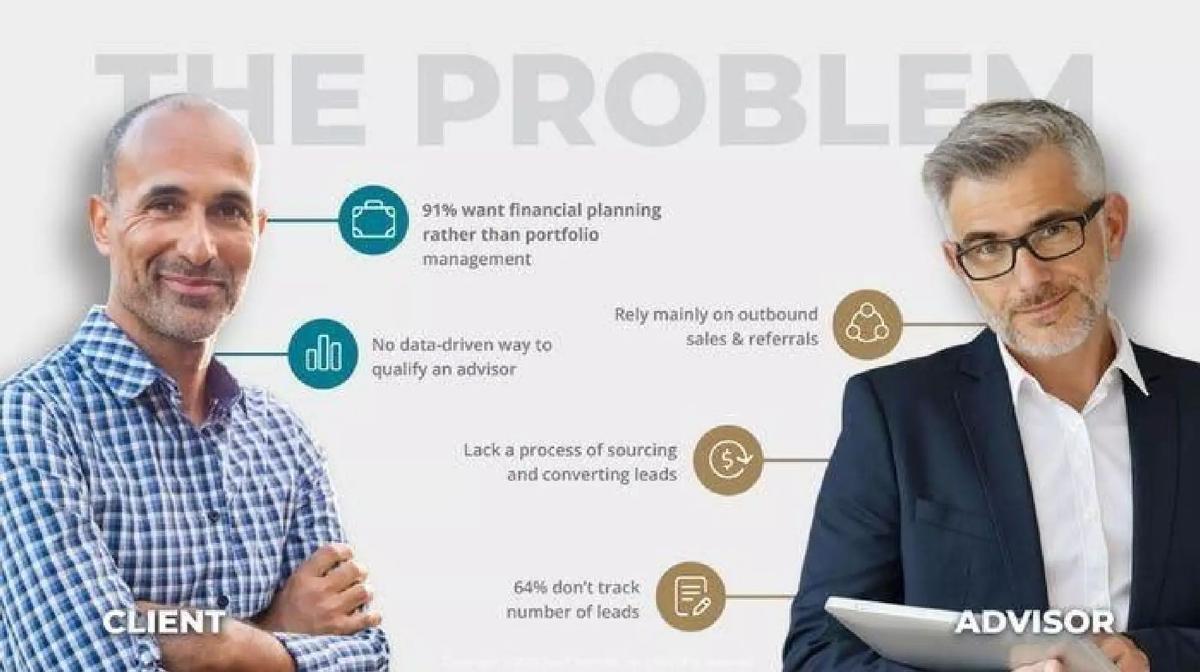
The deck opens with a clear mission statement on Slide 1: 'Matching the mass affluent with financial advisors.' This immediately identifies the target demographic and the service provided. Slide 2, 'The Problem,' uses a split-screen approach to show the pain points for both the 'Client' and the 'Advisor.' For the client, 91% want financial planning over simple portfolio management, yet they have no data-driven way to qualify an advisor. For the advisor, the slide notes a reliance on outbound sales and referrals, a lack of lead-sourcing processes, and the fact that 64% do not even track their number of leads. This establishes the 'double-sided' nature of the marketplace problem Zoe intends to solve.
The Solution and Vetting Process
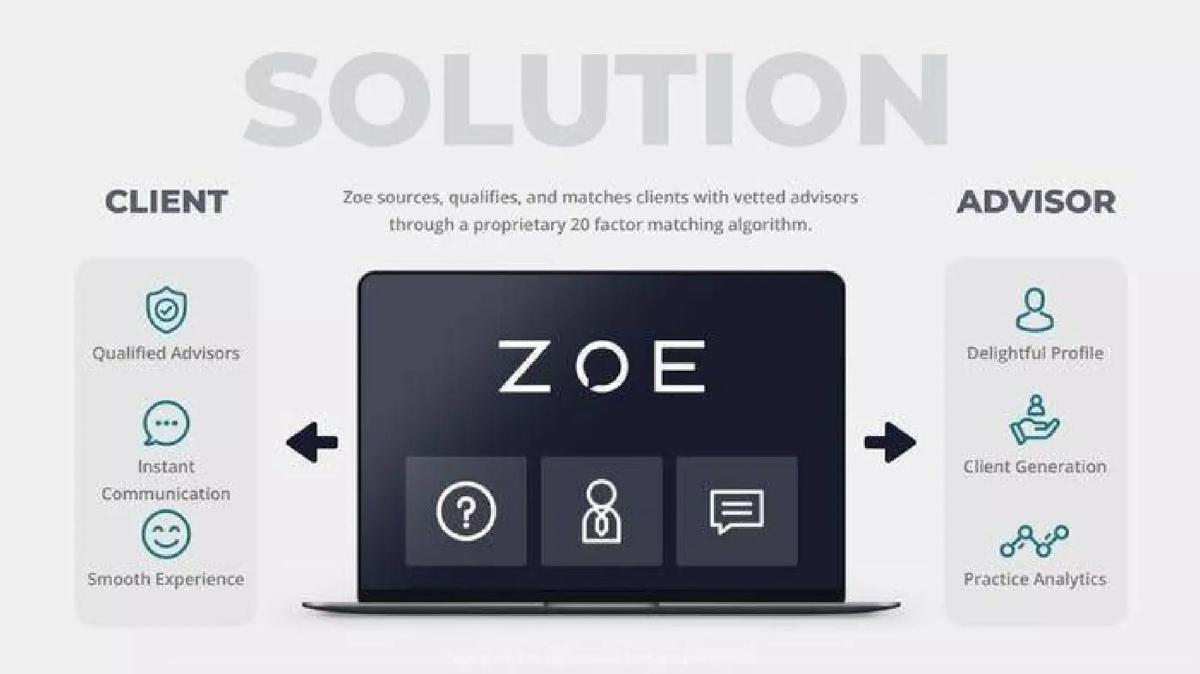
Slide 3 introduces the solution as a proprietary '20 factor matching algorithm' that sources, qualifies, and matches clients. The visual emphasizes a central platform (Zoe) providing value to both sides: 'Qualified Advisors' and 'Smooth Experience' for the client; 'Delightful Profile' and 'Practice Analytics' for the advisor. Slide 4 is perhaps the most critical for establishing trust. It highlights a '5% Acceptance' rate, detailing a four-step vetting process: 1) Credentials & Experience, 2) Unbiased & Transparent, 3) Clean Records, and 4) Complete Assessment. By emphasizing what they reject, Zoe builds the brand of an exclusive, high-quality network.
Market Size and Timing
Slide 5 provides the 'Market' math. It targets 16 million households with $250k-$1M in liquid assets. The 'Market Potential' is calculated by taking $85 trillion in investable assets, applying a 1% advisor fee, and arriving at an $85 billion revenue pool. This is a classic 'Top-Down' market sizing, which, while broad, illustrates the massive scale of the wealth management sector. Slide 6, 'Why Now?', adds urgency. It points to the 'fiduciary ruling' discussions that educated consumers about conflicts of interest and notes that the Registered Investment Advisor (RIA) market has grown from 10% to 30% of the total market in the last 15 years. This suggests a structural shift toward the exact type of advisors Zoe hosts.
Competitive Landscape and Business Model
Slide 7 categorizes the competition into 'Listings' (low curation, low trust), 'Lightly Managed' (pay-per-lead), and Zoe’s 'Managed' model. Zoe claims 'High' curation, trust, and customer experience. Crucially, it lists its revenue model as 'Revenue Sharing.' Slide 8 elaborates on this, showing that Zoe charges a percentage (redacted in this version) of the 'Advisor's Recurring Revenue.' The slide explicitly states 'No Network Fees' and 'No Fee Per Lead.' This is a strategic choice; by taking a cut of recurring revenue, Zoe positions itself as a long-term partner rather than a one-time lead source, which theoretically incentivizes higher-quality matches.
Marketing and Traction
Slide 9 outlines a two-step marketing strategy: Lead Generation via social platforms (Twitter, LinkedIn) and 'Engage & Educate' via content like an ebook titled 'How to Interview a Financial Advisor.' This content-led approach is standard for high-trust financial services. Slides 10 and 11 are placeholders for 'Team' and 'Investors,' respectively. In this version of the deck, names and faces are replaced with generic icons, though the catalogue facts indicate the company eventually raised $16.3 million. Slide 12, 'Milestones,' includes redacted boxes for 'Happy Clients,' 'Managed Assets,' and 'Advisor Applications,' alongside two glowing testimonials from a client and an advisor. The deck concludes with Slide 13, a 'Roadmap' showing a bar chart with upward-trending growth, though specific dates and figures are omitted.
What Works in the Zoe Financial Deck
Clear Segmentation: By defining the 'mass affluent' as those with $250k-$1M in liquid assets, the deck avoids the trap of trying to be everything to everyone. It targets a specific, profitable niche. · Trust as a Product: The 5% acceptance rate (Slide 4) and the focus on fiduciary standards turn 'vetting' into a core product feature rather than just an operational hurdle. · Aligned Incentives: The shift from 'pay-per-lead' to 'revenue sharing' (Slide 8) is a strong selling point for high-quality advisors who are tired of paying for low-intent leads. · Macro Trend Alignment: The 'Why Now' slide (Slide 6) effectively uses the growth of the RIA market to show that Zoe is riding a long-term industry wave.
What is Missing from the Zoe Financial Deck
Specific Unit Economics: While the revenue model is explained, the actual percentage charged is redacted. Investors would need to see the take-rate and the Customer Acquisition Cost (CAC) vs. Lifetime Value (LTV) to judge the business's efficiency. · Team Pedigree: Because Slide 10 is a placeholder, the deck currently lacks the 'founder-market fit' evidence necessary for a high-trust fintech startup. In the financial world, the background of the leadership team is paramount. · Hard Traction Data: Slide 12 and 13 are entirely redacted. Without knowing the current 'Managed Assets' or the number of 'Happy Clients,' it is impossible to tell if the '20 factor matching algorithm' is actually working in the wild. · Technology Deep Dive: The deck mentions a 'proprietary algorithm' but provides no detail on what those 20 factors are or how the technology creates a better match than a human concierge.
What a Founder Should Copy
The 'Managed Marketplace' Comparison: Slide 7 is an excellent way to frame a competitive landscape. Instead of a standard 'feature checklist' grid, it categorizes competitors by their business model and the resulting level of trust. · The Dual-Sided Problem Slide: Slide 2 does a great job of showing that a marketplace must solve problems for both the buyer and the seller simultaneously. · Educational Lead Magnets: Using a guide like 'How to Interview a Financial Advisor' (Slide 9) is a brilliant way to capture high-intent leads while positioning the brand as a neutral, helpful authority. · Top-Down Market Math: Slide 5 shows how to take a massive headline number ($85T) and logically narrow it down to a serviceable revenue opportunity ($85B) using simple, defensible assumptions like a 1% fee.
Frequently asked questions
- What is Zoe Financial's primary value proposition for clients?
- According to Slide 3, Zoe Financial provides clients with access to qualified, vetted advisors through a proprietary 20-factor matching algorithm. The goal is to offer a 'smooth experience' and 'instant communication,' solving the problem of clients having no data-driven way to qualify an advisor on their own.
- How does Zoe Financial generate revenue?
- Slide 8 explicitly states that Zoe Financial does not charge network fees or fees per lead. Instead, the business model is built on taking a percentage of the 'Advisor's Recurring Revenue.' This aligns the company's success with the long-term retention of the client by the advisor.
- What specific market segment is the company targeting?
- Slide 5 defines their target market as the 'mass affluent,' specifically individuals aged 35-55 with average liquid assets between $250,000 and $1,000,000. They estimate there are 16 million households fitting this profile in their target market.
- How does Zoe Financial vet the advisors on its platform?
- Slide 4 outlines a four-step vetting process: checking credentials and experience, ensuring the advisor is unbiased and transparent, verifying clean regulatory records, and completing a final assessment. This rigorous process leads to a 5% acceptance rate for advisors applying to the platform.
- What are the key market drivers mentioned in the deck?
- Slide 6 identifies two main drivers: 'Educated Clients' and the growth of the 'RIA Market.' It notes that while fiduciary rulings failed to become law, they educated consumers on conflicts of interest. Additionally, the independent advisor market share has tripled from 10% to 30% over the last 15 years.