Zing Coach's 12-slide Series A deck is a data-driven argument for the scalability of AI in the consumer fitness space. The company reported $7M in annual gross revenue run rate for 2023, significantly outperforming their $4M plan (Slide 7). The narrative centers on solving the 'fitness churn' problem by using behavioral science and AI to drive engagement. A standout feature of the deck is the direct head-to-head retention comparison against major incumbents like Peloton and Fitbod, where Zing claims superior Day 1 and Day 7 metrics (Slide 7). The deck concludes with a roadmap for an AI Assist…
Key takeaways
- Zing Coach reported a $7M annual gross revenue run rate in 2023, exceeding their initial $4M target (Slide 7).
- The company claims a Day 1 retention rate of 36%, which they state places them in the top-3 fitness apps by retention (Slide 7).
- The deck targets a $200M company valuation based on expected future cash flows and a projected $32.3M revenue for 2024 (Slide 9).
- Zing identifies 'Lack of motivation' (36%) and 'Lack of energy' (26%) as the primary health barriers for Gen Z (Slide 5).
- The 2024 strategy includes a heavy focus on the US market, which currently accounts for 95% of their user base (Slide 9).
- The product roadmap emphasizes an AI Assistant that integrates lifestyle factors like weather, travel, and busy schedules into workout plans (Slide 11).
- Zing highlights the acquisition of Zenia CV to enhance their computer vision capabilities for body scanning and motion tracking (Slide 7).
- The deck omits a dedicated team slide, cap table details, and specific unit economics like Customer Acquisition Cost (CAC).
Zing Coach: Scaling AI Fitness through Retention and Behavioral Science
Zing Coach’s Series A deck is a masterclass in using comparative data to validate a product’s market position. Raising $10M in a crowded consumer fitness space requires more than just a 'better' app; it requires proof that the app can keep users longer than the multi-billion dollar incumbents. Zing addresses this head-on by leading with retention benchmarks and aggressive revenue growth figures.
Slide 1: Title and Vision
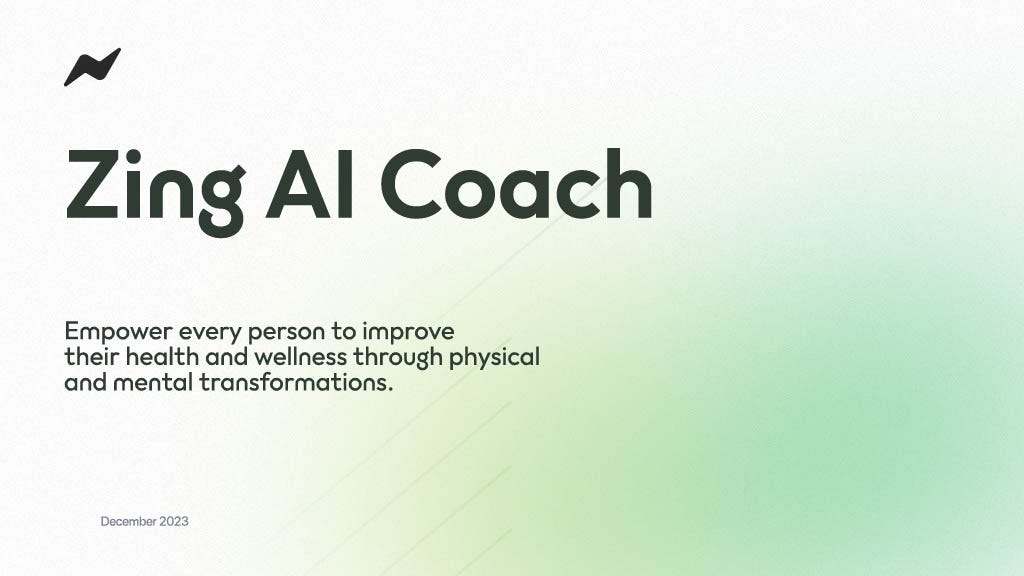
The deck opens with a clean, minimalist title slide. It establishes the brand as 'Zing AI Coach' and sets a broad mission: 'Empower every person to improve their health and wellness through physical and mental transformations.' The inclusion of 'December 2023' dates the deck, providing context for the 2024 projections that follow.
Slide 3: Market Opportunity
Slide 3 defines the playground. Zing identifies a $42bn Personal Fitness Trainer market and a $5bn Fitness Apps market. The slide notes that the United States dominates the personal coaching market with a 29.0% share, which aligns with Zing's current user concentration. Key industry trends cited include the rise of AI-driven innovation, Millennials using fitness apps twice as much as men, and strength training overtaking cardio in popularity. The slide uses a collage of headlines to suggest a 'new wave' of digital health technology that Zing is positioned to lead.
Slide 5: Problem & Solution
Zing frames the problem around 'fitness churn.' They note that while spending on fitness has grown, penetration rates have remained stagnant. A critical observation on this slide is that US gym penetration spiked to 30% post-COVID but fell back to normal levels within months. They blame a business model that relies on 'sleeper members' and aggressive sales rather than user success. To back this up, they include a chart of 'Gen Z Top Health Barriers,' where Lack of motivation (36%) and Lack of energy (26%) are the primary hurdles. The solution, according to Slide 5, is utilizing behavioral and exercise science to create 'long lasting behaviours.'
Slide 7: 2023 Performance and Retention Benchmarks
This is the 'meat' of the deck. Zing reports that their 2023 financial results exceeded goals, reaching a $7M Annual Gross Revenue run rate against a $4M plan. They also highlight the closing of the Zenia CV deal, which brought in-house computer vision technology for their 'CV Scanner.' The right side of the slide features a 'Retention (Daily)' table comparing Zing to Fitbod, Peloton, and Strong Gym. Zing claims a 36% Day 1 retention and 12% Day 7 retention . While their Day 60 retention (5%) lags behind Peloton (8%), the early-funnel strength is used to justify their 'top-3 fitness apps' claim.
Slide 9: Company Strategy 2024
Slide 9 outlines the path to a $200M valuation . The financial targets are ambitious: $32.3M Gross Annual Revenue for 2024 (a 400% YoY increase) and positive EBITDA by 2025. The strategy is divided into three pillars:
Product: Building a 'moat' through AI features and expanding into stretching, yoga, and pilates. · Growth: Diversifying revenue through organic channels and targeting 30% of revenue from upsells. · Segments and Geos: Expanding beyond their 95% US base into the UK, AU, CA, and LATAM, while adding segments for pregnancy and post-natal care.
Slide 11: AI Assistant Roadmap
The final content slide focuses on the 'AI Assistant.' The goal for 2024 is to develop a coach that 'demonstrates signs of an ideal human coach.' This includes proactive messaging, open dialogue for workout scheduling, and adjustments based on external factors like weather or a user's 'busy days.' The slide includes UI mockups showing a chat-based interface where the AI asks about energy levels and offers personalized training plans.
What Works in This Deck
Direct Competitor Benchmarking: Most startups shy away from naming names. Zing’s decision to put their retention numbers side-by-side with Peloton and Fitbod is a high-conviction move. It tells investors exactly where the company wins (early engagement) and where they have room to grow (long-term stickiness).
Clear Revenue Over-Performance: Showing that you beat your own 2023 plan by 75% ($7M actual vs $4M planned) is the strongest possible signal for a Series A. It suggests that the founders know how to forecast and, more importantly, how to execute.
Focus on Behavioral Science: By identifying 'Lack of motivation' as the #1 barrier, Zing moves the conversation away from 'features' and toward 'outcomes.' This framing makes their AI Assistant feel like a necessity rather than a gimmick.
What Is Missing
The Team Slide: In the provided 12-slide summary, there is no mention of the founders' backgrounds or the engineering talent behind the AI. For a Series A, the 'why this team' is usually just as important as the 'what.'
Unit Economics: While the deck mentions revenue and growth, it omits Customer Acquisition Cost (CAC) and Lifetime Value (LTV). In consumer apps, these are the 'make or break' metrics. Investors would want to know if that $32.3M revenue target is being bought at a loss or generated efficiently.
The Ask: The deck outlines the strategy and the valuation target but does not explicitly state the amount being raised in this specific round (though publisher reports confirm it was $10M). A clear 'Use of Funds' slide is a standard expectation that is absent here.
What a Founder Should Copy
The 'Focus Areas' Structure: Slide 9 is an excellent template for showing how a company will scale. By breaking it down into Product, Growth, and Segments/Geos, Zing provides a comprehensive view of their levers for success without cluttering the slide.
Using External Research to Frame the Problem: Slide 5 uses a study by Katy Milkman and data from 24h Fitness to validate the 'gym churn' problem. Using third-party data to support your problem statement adds immediate credibility and saves you from having to 'prove' the market exists from scratch.
The Roadmap as a Vision: Slide 11 doesn't just list features; it describes a 'goal' (an ideal human coach). Founders should copy this approach of selling the experience the technology will eventually provide, rather than just the technical specifications of the AI itself.
Frequently asked questions
- What is Zing Coach's primary value proposition?
- Zing Coach positions itself as an AI-driven alternative to traditional gyms and human personal trainers. According to Slide 5, they use behavioral and exercise science to create a 'fully conceptualized fitness journey' that addresses the high churn rates seen in the gym industry. Their technology includes computer vision for body composition and motion tracking, paired with an AI Assistant that provides proactive coaching.
- How does Zing Coach compare its performance to competitors?
- On Slide 7, Zing provides a direct retention comparison. They claim a 36% Day 1 retention rate, compared to 28% for Fitbod, 26% for Peloton, and 29% for Strong Gym. While their Day 30 and Day 60 retention rates (5% each) are lower than Peloton's (8%), the deck uses these metrics to argue they are a top-tier fitness app in terms of early engagement.
- What are the company's financial projections for 2024?
- As stated on Slide 9, Zing Coach projected $32.3M in Gross Annual Revenue for 2024, representing a 400% year-over-year growth rate. They also stated an intention to reach positive EBITDA by 2025. This aggressive growth is intended to support a target valuation of $200M.
- What specific AI features are highlighted in the roadmap?
- Slide 11 details the 'AI Assistant Roadmap,' which focuses on developing a coach that 'demonstrates signs of an ideal human coach.' Key features include proactive post-workout scenarios, open dialogue for workout generation, support for different tones of voice, and lifestyle adjustments that account for a user's travel, local weather, and energy levels.
- Which markets is Zing Coach targeting for expansion?
- Currently, 95% of Zing's user base is in the USA (Slide 9). However, their 2024 strategy includes expanding into new geographies, specifically naming the UK, Australia (AU), Canada (CA), and Latin America (LATAM). They also plan to add new user segments such as beginners, pregnancy, and post-natal fitness.