The Zoom pitch deck is a concise 11-slide presentation for a mobile-first activewear shopping platform. It identifies a clear friction point in 2014-era e-commerce: the transition from massive physical retail stores and cluttered desktop websites to the small screen of a smartphone. The solution leverages a binary 'like/dislike' interface—reminiscent of early dating apps—to curate a personalized wish list. While the deck successfully establishes a large market opportunity ($225 billion U.S. apparel market) and a clear revenue model through affiliate partnerships with major brands like Nike an…
Key takeaways
- The deck identifies a specific pain point in mobile shopping by contrasting a cluttered desktop UI with a simplified mobile interface (Slide 2 vs Slide 4).
- Zoom utilizes a binary swipe-style interaction for product discovery, featuring red and green directional buttons (Slide 4).
- The revenue model is strictly based on affiliate partnerships, listing major brands like The North Face, Adidas, and Lululemon (Slide 7).
- The total addressable market for U.S. Apparel is cited at $225 billion, with a specific focus on the $6 billion E-Commerce Sports Apparel segment (Slide 8).
- The deck highlights a massive 47% growth in M-Commerce (mobile commerce) during Q2 2014 compared to just 10% for general E-Commerce (Slide 9).
- Competitors are identified visually as Dick's Sporting Goods, Sports Authority, and Scheels, emphasizing their more traditional retail approaches (Slide 10).
- The presentation completely omits a team slide, failing to establish the founders' expertise or technical capability.
- There is no 'Ask' slide, leaving investors without information on the capital required or the valuation sought.
Executive Summary: The Mobile Discovery Gap
The Zoom pitch deck, likely produced around 2014 based on the retail growth data provided, addresses the 'fatigue' of mobile shopping. At the time, most e-commerce sites were simply shrunken versions of desktop sites, requiring users to navigate complex filters and tiny grids. Zoom proposed a 'Tinder-for-Activewear' model, focusing on high-speed discovery and affiliate monetization. While the product vision is clear, the deck functions more as a design prototype than a comprehensive investment proposal due to the absence of team and financial data.
Slide 1: Title Slide
The deck opens with the Zoom logo: a bold, black sans-serif font with a green circular arrow icon pointing right. The tagline is 'Interactive shopping for active people.' The branding is minimalist and suggests movement and efficiency, aligning with the sports apparel theme.
Slide 2: The Problem - Information Overload
This slide displays a screenshot of a traditional e-commerce website (likely Nike or a similar retailer). A red circle highlights a filter showing 'Men's (751)' items. The slide visually communicates the problem: a user on a mobile device cannot effectively browse 751 items using a traditional grid and sidebar filter system. It sets the stage for a simplified solution.
Slide 3: The Context - Physical Retail
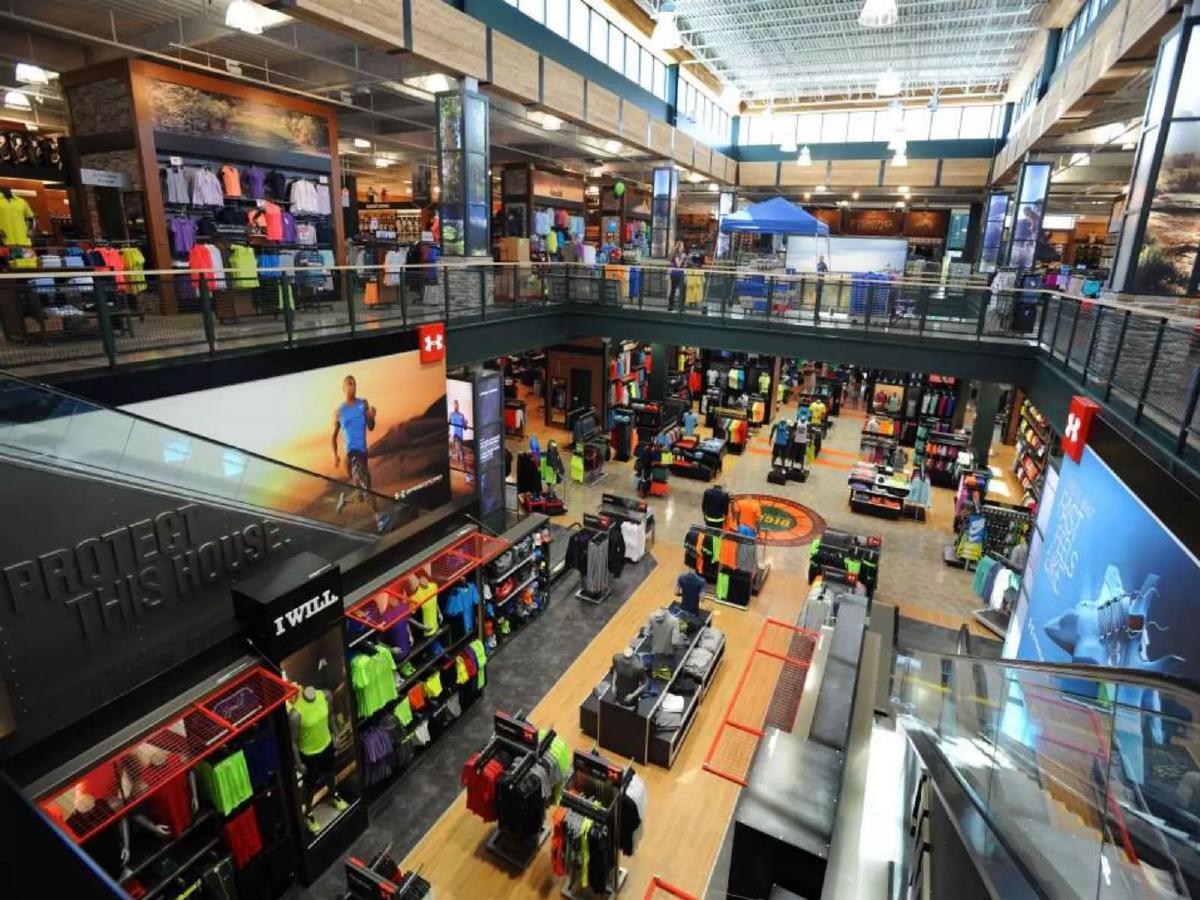
A high-resolution photo of a large multi-level sporting goods store (resembling a Dick's Sporting Goods or Scheels). This slide serves to remind the investor of the sheer volume of inventory in the sports apparel world and the difficulty of translating that massive physical experience into a digital one.
Slide 4: The Solution - The Zoom Interface
This is the core product slide. It shows a smartphone mockup featuring a single Nike running jacket priced at $150. Below the image are two large buttons: a red downward chevron and a green upward chevron. This confirms the 'interactive' nature mentioned on the title slide—a binary choice model designed to reduce cognitive load for the shopper.
Slide 5: User Personalization
The mockup shows a user profile for 'Xavier Imperial.' It lists three main navigation points: 'Today's Like,' 'My Wish List,' and 'My Shopping Cart.' This slide demonstrates how the binary swiping action translates into a curated shopping experience, moving items from discovery to intent-to-purchase.
Slide 6: Preference Filtering
A screenshot showing a 'Preferences' menu with options for Price, Brand, Type, Size, and Material. This indicates that while the front-end experience is simple, the back-end allows for granular filtering so the 'interactive' feed remains relevant to the specific user's needs.
Slide 7: Revenue Model
The slide is titled 'REVENUE' with the subtitle 'Affiliate Partnerships.' It features logos for The North Face, Adidas, Puma, Under Armour, Nike, and Lululemon. This is a crucial slide as it defines the business as a lean, no-inventory platform that monetizes through referral fees from established giants.
Slide 8: Market Size
Using an inverted triangle, the deck visualizes the market opportunity using Statista data. It starts with the U.S. Apparel market at $225 Billion, narrows to Workout Apparel at $68 Billion, and identifies the immediate target as E-Commerce Sports Apparel at $6 Billion. It notes a 10% Year-Over-Year growth for this segment.
Slide 9: The 'Why Now' - M-Commerce Growth
This bar chart titled 'Q2 Retail Spending Growth 2014' provides the urgency. It compares Total Discretionary Retail (+3%) and E-Commerce (+10%) against the explosive growth of M-Commerce (+47%). This slide justifies why a mobile-only interactive shopping app is a timely investment.
Slide 10: Competition
The slide visually groups competitors: the Dick's Sporting Goods mobile app, the Sports Authority website, and a Scheels retail location. By showing these side-by-side, Zoom implies that the incumbents are either stuck in physical retail or have suboptimal mobile experiences compared to Zoom's 'one-item-at-a-time' flow.
Slide 11: Closing Slide
A repetition of the title slide with the logo and tagline. There is no contact information, call to action, or summary of the investment opportunity.
What Works in This Deck
Visual Storytelling: The deck does an excellent job of showing, not just telling. The contrast between the cluttered desktop site on Slide 2 and the clean mobile interface on Slide 4 immediately communicates the value proposition without needing heavy text.
Market Timing: Slide 9 is the strongest slide in the deck. By highlighting the 47% growth in mobile commerce, the founders tap into a 'macro trend' that investors in 2014 would have been highly attuned to. It makes the case that the platform is riding a massive wave of consumer behavior change.
Focus: The deck doesn't try to be everything to everyone. It specifically targets 'active people' and 'sports apparel.' This niche focus makes the affiliate model more believable, as a specialized discovery engine is often more valuable than a general one.
What Is Missing from This Deck
The Team: This is the most glaring omission. Investors back people, especially at the early stage. There is no information on who is building this, their background in retail, or their technical ability to build a high-performance mobile app.
The Ask: A pitch deck is a tool to raise money. This deck fails to mention how much capital is being raised, what the milestones for that capital are, or what the current valuation expectations are.
Unit Economics: While the revenue model is 'affiliate,' the deck doesn't explain the expected take rate (commission percentage) or the Customer Acquisition Cost (CAC). In a crowded app market, how Zoom will acquire users cheaply enough to make affiliate commissions profitable is a major unanswered question.
Roadmap: There is no indication of where the product stands. Is it a mockup? A beta? Are there any existing affiliate agreements in place? Without a timeline, the deck feels like a theoretical exercise rather than a business in motion.
Founder's Guide: What to Copy and What to Avoid
Copy the 'Problem/Solution' visual pair: Using screenshots to show how bad the current user experience is compared to your proposed solution is highly effective. It creates immediate empathy for the user's pain point.
Copy the Market Funnel: The inverted triangle on Slide 8 is a standard but effective way to show that you understand your Total Addressable Market (TAM) versus your Serviceable Obtainable Market (SOM).
Avoid the 'Logo Soup' without context: Slide 7 lists major brands, but it doesn't clarify if these are actual partners or just 'target' partners. Founders should always distinguish between 'Partners we have' and 'Brands we can access through public affiliate networks.'
Avoid omitting the Team slide: Never send a deck without a team slide. Even if you are a solo founder, your pedigree and 'why you' are the most important parts of the pitch.
Frequently asked questions
- What is the core product functionality of Zoom?
- Zoom is a mobile application designed for 'interactive shopping for active people.' It simplifies the browsing experience by showing one item at a time. Users interact with the product through a binary choice system—likely swiping or clicking red and green arrows—to either reject an item or add it to a personalized wish list and shopping cart.
- How does Zoom plan to make money?
- According to slide 7, the company relies entirely on affiliate partnerships. By acting as a discovery layer for established brands like Nike, Under Armour, Puma, and Adidas, Zoom earns a commission on sales referred through the app. The deck does not mention direct inventory holding or private label sales.
- What market data does the deck use to justify the opportunity?
- The deck uses 2014 data to show a shift toward mobile. It cites a $225 billion U.S. apparel market, narrowing down to a $6 billion e-commerce sports apparel niche. Crucially, it highlights that while total discretionary retail grew by 3%, mobile commerce (M-Commerce) grew by 47% in Q2 2014.
- Who are the main competitors listed in the deck?
- The deck identifies traditional sporting goods retailers as the primary competition. Slide 10 shows the mobile app for Dick's Sporting Goods, the desktop site for Sports Authority, and a physical storefront for Scheels. The implication is that these incumbents have not optimized for the 'interactive' mobile experience Zoom offers.
- What are the most significant missing elements in this pitch?
- This is a 'concept deck' rather than a full business plan. It lacks a Team slide (who is building this?), a Roadmap (what is the development timeline?), and an Ask slide (how much money is needed?). Furthermore, there are no details on user acquisition strategy or how they will compete for attention against the brands' own apps.