Zyudly Labs' 11-slide deck is a study in minimalist, visual-led storytelling. Eschewing the typical text-heavy problem/solution slides, the company relies on evocative imagery and high-fidelity product mockups to convey the 'scary' nature of cyber threats and the sophistication of their response. While the deck succeeds in establishing a high-tech brand identity and showcasing a 'Proven Leadership Team' with impressive pedigrees (Slide 10), it leaves significant gaps for a Seed stage investor. There is no explicit 'Ask' slide, no detailed business model, and no competitive landscape analysis.…
Key takeaways
- The deck uses a phonetic pronunciation guide ('Zoo-dlee') on the title slide to immediately address brand recall (Slide 1).
- A three-slide visual sequence (Slides 2-4) uses metaphorical imagery to establish the threat of hacking and financial loss without using a single word of text.
- The technical solution is framed as an 'AI-Powered Intelligence Engine' that ingests Dark Web Mining, Threat Intel Feeds, and Internal Systems (Slide 5).
- Product capability is demonstrated through four consecutive dashboard slides, highlighting specific features like 'Top Threats' and 'Top Exploits' (Slides 6-9).
- The dashboard mockups specifically reference real-world threats like 'GRIZZLY STEPPE' and 'Dyn DDoS Attack' to ground the technology in current events (Slide 6).
- The 'Proven Leadership Team' slide leverages logos from Cisco, Akamai, and Booz Allen Hamilton to establish immediate domain authority (Slide 10).
- Traction is clearly stated as $179K in revenue and a $1.2M pipeline, though the timeframe for these figures is not specified (Slide 11).
- The deck completely omits a formal investment 'Ask,' use of funds, or a roadmap for future development.
The Minimalist Approach to Cyberintelligence
Zyudly Labs, a FinTech-focused cybersecurity firm founded in 2016, utilized a pitch deck that leans heavily on the 'show, don't tell' philosophy. In an industry often bogged down by dense technical jargon and terrifying statistics, Zyudly opted for a high-concept visual narrative. This teardown explores how an 11-slide deck can successfully communicate value through product design and team pedigree, even while omitting standard financial and structural slides.
The Hook and the Threat (Slides 1-4)
Slide 1 introduces the brand with a phonetic guide: 'Zoo-dlee' Labs. This is a small but vital detail for companies with non-obvious names, ensuring that investors don't stumble over the name during follow-up meetings. The subtitle, 'AI-Powered Cyberintelligence,' immediately buckets the company into two high-growth categories of the 2016 era: Artificial Intelligence and Cybersecurity.
Slides 2, 3, and 4 are entirely wordless. This is a bold choice. Slide 2 shows a hooded figure surrounded by code and a world map, Slide 3 depicts a network of individuals connected to a central 'locked' hub, and Slide 4 shows falling hundred-dollar bills. Together, these slides create a visceral 'Problem' narrative: hackers are targeting global networks, leading to massive financial loss. By using imagery instead of bullet points, Zyudly forces the presenter to narrate the urgency, keeping the audience's attention on the speaker rather than a wall of text.
The Solution and Technical Architecture (Slide 5)
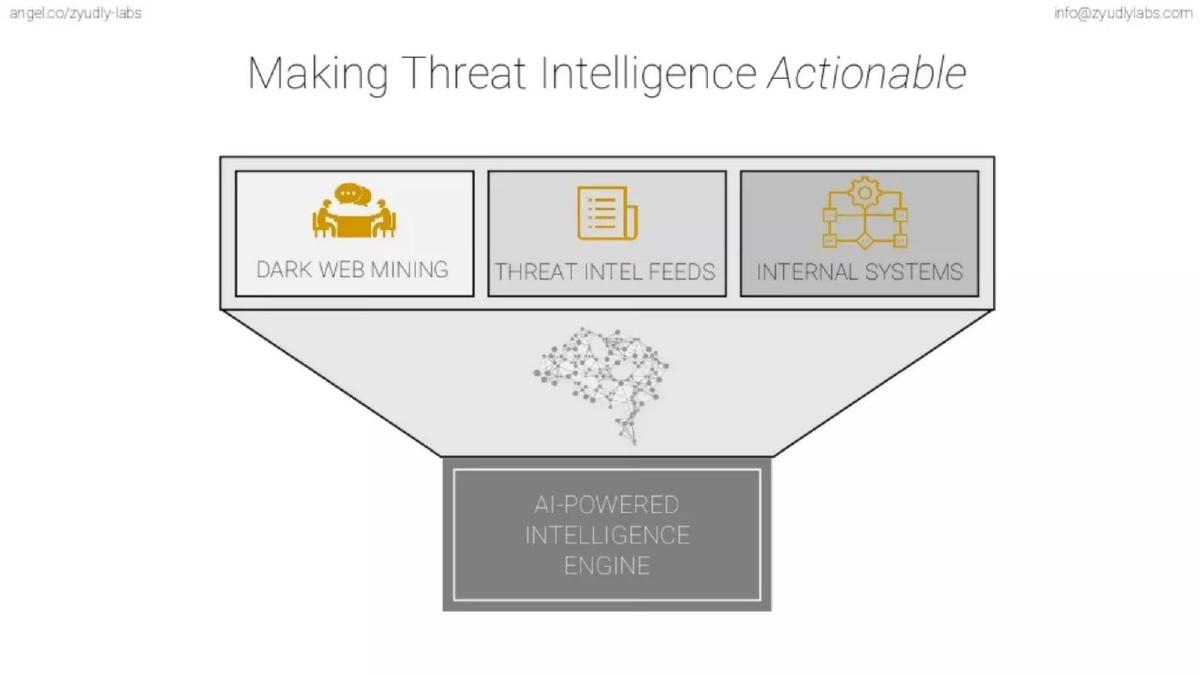
Slide 5 , titled 'Making Threat Intelligence Actionable,' is the first slide to explain the 'How.' It presents a funnel-style diagram where three data sources—Dark Web Mining, Threat Intel Feeds, and Internal Systems—are processed by an 'AI-Powered Intelligence Engine.' This slide is critical because it positions Zyudly not just as a data aggregator, but as a processing layer that turns raw data into 'actionable' intelligence. It addresses the 'so what?' of cybersecurity: companies have plenty of data, but they don't know what to do with it.
Product Deep-Dive: The Dashboard (Slides 6-9)
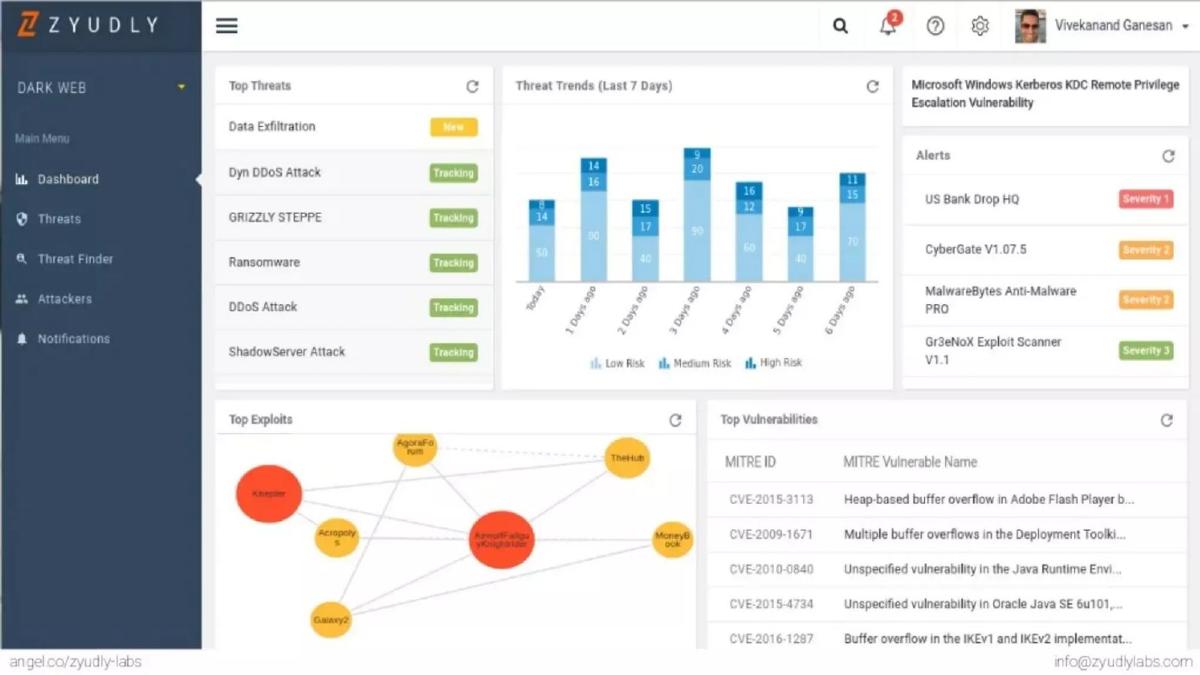
The core of the deck is a four-slide sequence showing the product in action. Slide 6 provides a full-view mockup of the Zyudly dashboard. It is clean, modern, and looks like a finished enterprise product. Key features visible include 'Top Threats,' 'Threat Trends,' 'Top Exploits,' and 'Top Vulnerabilities.'
Slides 7, 8, and 9 use a 'spotlight' technique, blurring out the rest of the dashboard to focus on specific modules. Slide 7 highlights 'Top Threats,' listing real-world examples like 'GRIZZLY STEPPE' (a known Russian hacking operation) and 'Dyn DDoS Attack.' This grounding in reality suggests the product is currently functional and capable of tracking high-profile incidents.
Slide 8 focuses on 'Alerts,' showing a severity-ranked list (Severity 1 to 3) including 'US Bank Drop HQ.' This targets the FinTech sector specifically, showing how a bank might see a high-priority threat. Slide 9 highlights 'Top Exploits' using a node-and-link visualization, which emphasizes the 'Deep Learning' and 'AI' aspects of the company's pitch by showing how they map relationships between different threat actors and methods.
The Human Capital and Momentum (Slides 10-11)
Slide 10 , 'Proven Leadership Team,' is perhaps the strongest slide in the deck for a Seed-stage investor. The three executives—Vivek Ganesan, Suhas Ghante, and Prasath Venkatraman—are backed by a formidable array of corporate logos. Names like Cisco, Akamai, Booz Allen Hamilton, and Innovaccer provide 'borrowed credibility.' For an AI startup, the pedigree of the engineering and operations team is often more important than the initial product itself, and this slide communicates that they have the experience to build for the enterprise.
Slide 11 concludes the deck with 'We’re Just Getting Started...' This slide provides the only hard metrics in the presentation: $179K Revenue and a $1.2M Pipeline . In the context of a Seed round, having nearly $200k in revenue proves product-market fit and technical viability. The pipeline figure suggests scalability. However, the deck ends abruptly here. There is no 'Ask' slide detailing how much capital is being raised or what the valuation expectations are.
What Works
Visual Storytelling: The use of high-quality imagery in the first four slides creates a cinematic opening that sets a serious, professional tone. · Product Maturity: The dashboard mockups are detailed and reference real-world cybersecurity terminology (MITRE IDs, CVE codes, specific threat names). This makes the 'AI' claim feel tangible rather than like vaporware. · Phonetic Branding: Including the pronunciation of the company name on the title slide is a clever way to reduce friction in brand recognition. · Logo Soup: The team slide effectively uses well-known logos to validate the founders' expertise without requiring long biographies.
What is Missing
The Ask: This is the most glaring omission. A pitch deck is a fundraising tool; failing to state the amount being raised, the terms (if applicable), or the milestones the funding will achieve is a missed opportunity. · Business Model: There is no mention of how Zyudly makes money. Is it a subscription? A per-node fee? A percentage of fraud prevented? Investors need to know the 'unit economics' of the business. · Competition: The cybersecurity space is incredibly crowded. The deck does not explain how Zyudly differs from incumbents or other AI-driven startups like Darktrace or CrowdStrike (which were active in 2016). · Market Size: There is no TAM/SAM/SOM slide. While the problem is visually established, the scale of the financial opportunity is not quantified.
What a Founder Should Copy
The 'Spotlight' Product Walkthrough: Instead of showing four different dashboard screens, Zyudly shows one screen and highlights different sections. This is an excellent way to walk an investor through a complex UI without losing the context of the overall platform. · Minimalist Text: This deck is designed to be presented, not read as a standalone document. By keeping text to a minimum, the founders ensure the audience is listening to their expertise. · Traction vs. Pipeline: Showing both realized revenue and a future pipeline is a great way to show both current stability and future growth potential on a single slide.
Frequently asked questions
- What is the core product of Zyudly Labs?
- Based on Slide 5 and the product mockups, Zyudly Labs provides an 'AI-Powered Intelligence Engine' that aggregates data from the dark web, external threat feeds, and a company's internal systems. The goal is to make threat intelligence 'actionable' by identifying specific exploits, vulnerabilities (citing MITRE IDs), and active threat actors through a centralized dashboard.
- How much revenue did Zyudly Labs have at the time of this deck?
- According to Slide 11, the company had generated $179,000 in revenue. They also claimed a sales pipeline of $1.2 million, indicating significant early-stage commercial interest for a Seed-stage startup in 2016.
- Who are the founders and what is their background?
- The leadership team consists of Vivek Ganesan (CEO), Suhas Ghante (COO), and Prasath Venkatraman (VP Engineering). Their backgrounds include experience at high-profile firms such as Cisco, Innovaccer, Booz Allen Hamilton, Akamai, and Flipkart, as shown on Slide 10.
- Does the deck explain the business model?
- No. The deck is entirely focused on the problem (visually), the product (via mockups), and the team. It does not disclose pricing structures, sales cycles, or whether the product is sold as a SaaS platform or a managed service.
- What is missing from this pitch deck?
- The deck is missing several standard components: a competitive analysis, a detailed market size (TAM/SAM/SOM), a clear 'Ask' (how much money they are raising), a use of funds breakdown, and a forward-looking roadmap or milestones.