The Daily Hundred pitch deck from 2014 presents a solution to the declining effectiveness of mobile banner ads by leveraging social proof and user-generated content. The platform allows businesses to run photo contests and 'shoutout' campaigns where users earn small cash rewards for sharing brand messages to their personal social networks. With a focus on the trust gap—citing that 90% of people trust friend recommendations over ads—the company showcases early traction with brands like Domino's and Southern Comfort. The deck concludes with a $1.5 million to $2.5 million funding ask to scale th…
Key takeaways
- The company identifies a core problem in mobile advertising where traditional banner ads do not translate well to mobile devices (Slide 2).
- The platform utilizes 'Instant Reward Shoutouts' where users earn rewards, such as $1.00, for sharing brand messages to Facebook and Twitter (Slide 3).
- A trust-based value proposition is central to the pitch, claiming 90% of people trust brand recommendations from friends (Slide 5).
- Case study data from a Domino's campaign shows an 18% increase in sales and 250 orders generated from users (Slide 6).
- The startup has secured early partnerships with major brands including Susan G. Komen, Southern Comfort, and Edible Arrangements (Slide 7).
- Future growth is tied to Apple's iBeacon technology for passive rewards and real-time brick-and-mortar analytics (Slide 8).
- The funding ask is specifically for $1.5 - $2.5 million through the sale of preferred stock (Slide 9).
- The deck omits a team slide, detailed financial projections, and a competitive landscape analysis in the provided selection.
Daily Hundred Pitch Deck Analysis
The Daily Hundred pitch deck is a classic example of a mid-2010s ad-tech presentation. It focuses heavily on the shift from desktop to mobile and the inherent distrust consumers have for traditional advertising. By positioning itself as a 'peer-to-peer' marketing tool rather than an advertising platform, Daily Hundred attempts to solve the problem of low engagement in mobile banner ads. The deck relies on social proof, both in the form of user psychology and early brand traction, to justify a multi-million dollar seed or Series A round.
Slide 1: Title Slide
The title slide is minimalist, featuring the company logo—a dollar sign surrounded by refresh arrows—and the name 'The Daily Hundred.' It explicitly states it is a 'Deck for Prospective Investors.' The branding suggests a focus on the flow of money or rewards, which aligns with their core product of incentivizing user actions with cash.
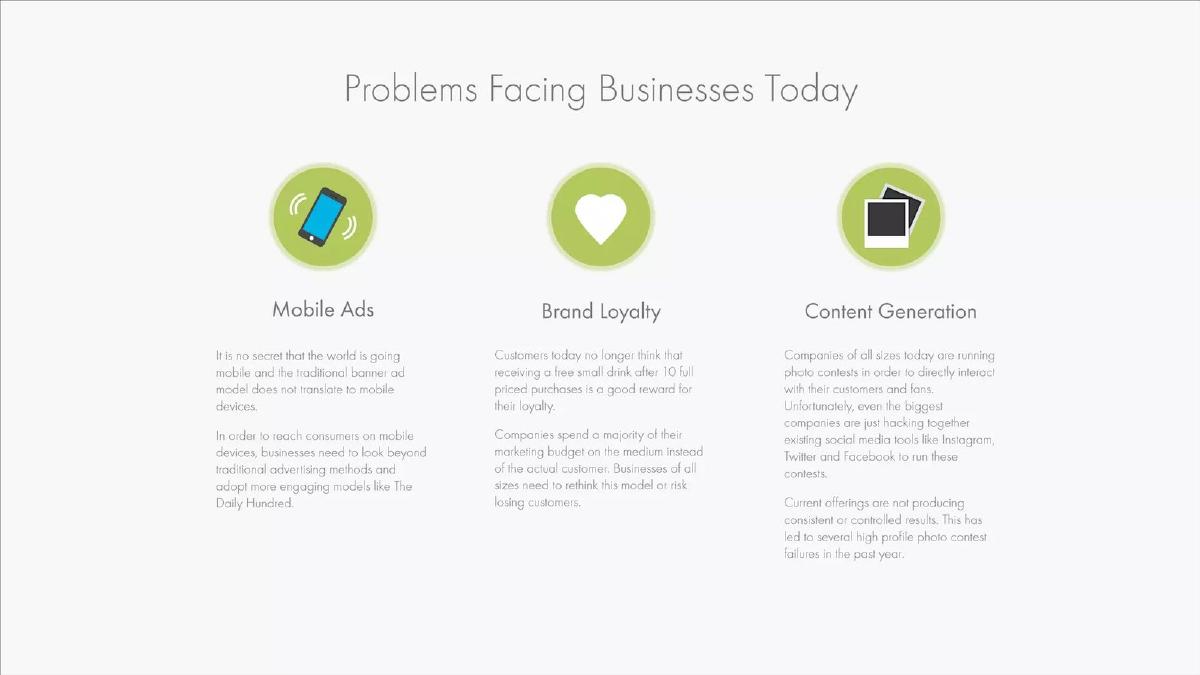
Slide 2: Problems Facing Businesses Today
This slide identifies three pain points: Mobile Ads, Brand Loyalty, and Content Generation. The narrative is that traditional banner ads don't work on mobile, loyalty programs (like 'buy 10 get 1 free') are outdated, and companies are currently 'hacking together' social media tools to run photo contests. By grouping these three, Daily Hundred sets itself up as a unified solution for mobile-first engagement that produces authentic content.
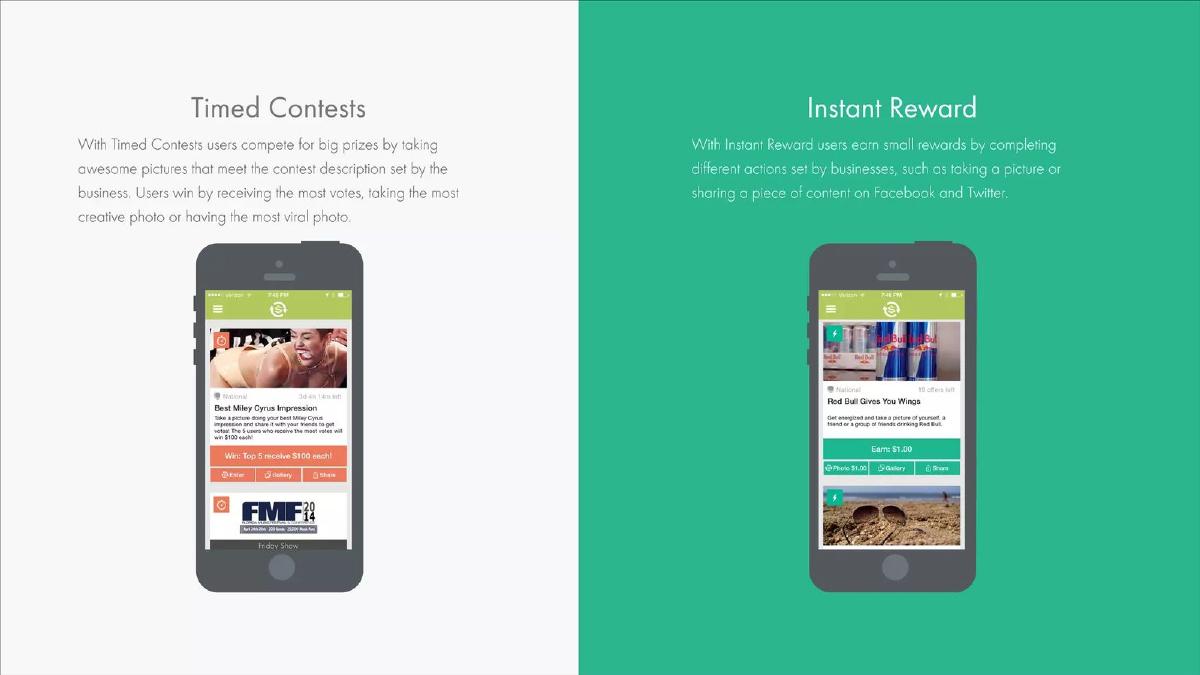
Slide 3: Instant Reward Shoutouts
Slide 3 explains the user flow. It breaks the process into three steps: 1) Users click 'Share' in the app to post a brand message to Facebook and Twitter; 2) The user's friends see the message as a personal recommendation; 3) The user receives an instant reward (shown as $1.00 in the mockup). This slide is crucial because it demonstrates the 'instant gratification' loop that drives user retention on the platform.
Slide 4: The Components
This slide illustrates the dual-sided nature of the platform. For consumers, there is an iPhone, Android, and Web app. For businesses, there is a 'robust client portal.' The visual includes a screenshot of the business dashboard, showing a 'Cost Per 1k Impressions (CPM)' of $7.49 and tracking metrics like entries, shares, votes, and views. This shows the platform is ready for enterprise-level reporting.
Slide 5: Why Us?
The 'Why Us?' slide leans on psychological statistics. It claims that 75% of people don't accept advertisements as truth, while 90% trust brand recommendations from friends. The slide argues that Daily Hundred empowers customers to become an 'extension of your marketing team.' This is a strong emotional hook for investors who are wary of the diminishing returns of traditional digital spend.
Slide 6: Domino's Campaign Results
Traction is proven here through two specific campaigns for 'Gator Domino's.' Campaign #1 resulted in an 18% increase in sales and 250 orders. Campaign #2 resulted in a 35% increase in likes and a massive 1,533% increase in 'people talking about' the brand on Facebook. Providing hard numbers on sales increases is far more persuasive than just social media engagement metrics.
Slide 7: Daily Hundred Customers
This is a standard 'logo slide.' It features Susan G. Komen, Southern Comfort, Domino's, Publishers Clearing House, Edible Arrangements, and Coupaw. The text at the bottom notes they have '50 awesome small businesses' as well. This indicates that the product is scalable from local mom-and-pop shops to national franchises.
Slide 8: iBeacon Integration
Slide 8 looks toward the future. It discusses Apple's iBeacon technology, which was a major trend in 2014. The company plans to use iBeacons for 'Passive Rewards' (rewarding users just for walking in), 'Brick and Mortar Analytics' (tracking in-store behavior), and 'Real-Time Marketing.' This slide is intended to show the 'moat' and the long-term tech vision beyond just a simple sharing app.
Slide 9: Investment Opportunity
The final slide in this selection is the 'Ask.' The company is seeking $1.5 - $2.5 million through the sale of preferred stock. It includes a disclaimer that financial projections are available upon request. This is a significant ask for 2014, suggesting the company was looking to move past the seed stage and into a growth phase.
What Works in This Deck
The deck is visually clean and follows a logical progression from problem to solution to proof. The use of a specific case study (Domino's) is the strongest element, as it ties social media activity directly to revenue—something many social platforms struggle to do. The focus on 'trust' as a metric is a clever way to differentiate from Google or Facebook ads. Furthermore, the inclusion of future-looking tech like iBeacons shows that the founders are thinking about how to bridge the gap between digital interactions and physical retail presence.
What Is Missing
The most glaring omission in this set of slides is the Team slide. Investors invest in people, especially at the early stages, and there is no information here about who is building the company. Also missing is a detailed breakdown of the competitive landscape; in 2014, there were many 'social loyalty' and 'referral marketing' startups. Finally, while the Domino's slide is good, there is no mention of the company's own unit economics—how much does it cost Daily Hundred to acquire a user, and what is the lifetime value of a business client?
Founder Takeaways
Quantify Social Impact: If your product is social, don't just show 'likes.' Show how those likes lead to dollars, as seen on Slide 6. · Address the Trust Gap: In a crowded market, explaining why your method is more 'trusted' than the incumbent (Slide 5) is a powerful way to frame the problem. · Show the Future: Don't just pitch what you have today. Use a slide like the iBeacon slide (Slide 8) to show how you will stay relevant as technology evolves. · Be Clear on the Ask: Slide 9 is unambiguous. It states the amount and the instrument (preferred stock). Never leave an investor guessing what you want.
Frequently asked questions
- What is the primary product offered by Daily Hundred?
- Daily Hundred is a mobile and web platform that facilitates incentivized word-of-mouth marketing. It allows businesses to create campaigns where consumers are paid small rewards (e.g., $1.00 to $5.00) to share brand messages or take photos of products. The goal is to turn customers into a brand's marketing team by leveraging their personal social media connections on Facebook and Twitter.
- How does Daily Hundred measure success for its clients?
- The platform provides a web dashboard for businesses to track metrics such as entries, shares, votes, and views. In a featured case study for Domino's, the company tracked specific outcomes including an 18% increase in sales, 250 direct orders, and a 1,533% increase in social media 'people talking about' metrics, demonstrating a clear link between digital activity and physical sales.
- What technology does the company plan to use for future expansion?
- The deck highlights Apple's iBeacon technology as a key component of their future strategy. By using iBeacons, Daily Hundred intends to offer 'Passive Rewards' for simply walking into a store, 'Brick and Mortar Analytics' to track customer movement and dwell time, and 'Real-Time Marketing' to send targeted offers to users based on their specific location within a business.
- What is the investment ask and structure?
- Daily Hundred is seeking to raise between $1.5 million and $2.5 million. The investment is structured as the sale of preferred stock. The deck notes that detailed financial projections are not included in the main presentation but are available upon request, which is a common tactic to encourage direct engagement from prospective investors.
- Who are the early adopters of the Daily Hundred platform?
- The company lists several high-profile clients, including Susan G. Komen, Southern Comfort, Domino's, Publishers Clearing House, Edible Arrangements, and Coupaw. Additionally, the deck mentions that they are working with approximately 50 other small businesses, indicating a mix of national brand recognition and local market penetration.