Arrcus, founded in 2016 and headquartered in San Jose, uses this 10-slide deck to position itself as the 'New OEM' for the 5G and hyperconnected era. The deck relies heavily on the 'Control Plane' narrative, arguing that as data traffic scales toward 175 zettabytes by 2025, legacy networking must be replaced by hardware-agnostic, software-defined solutions. While the deck lacks specific revenue figures or a detailed team slide, it compensates with an extraordinary list of advisors from Cisco, Google, and Juniper. The core product, ArcOS, is marketed as a carrier-grade Network Operating System…
Key takeaways
- The company positions its mission as democratizing the networking industry through flexible consumption models and lower TCO (Slide 2).
- Arrcus leverages significant social proof by listing board investors from Lightspeed, General Catalyst, and Clear Ventures alongside advisors from Cisco, Google, and Oracle (Slide 2).
- The macro-thesis is built on the '5G Revolution' and a projected 5X increase in connected devices by 2025 (Slide 3).
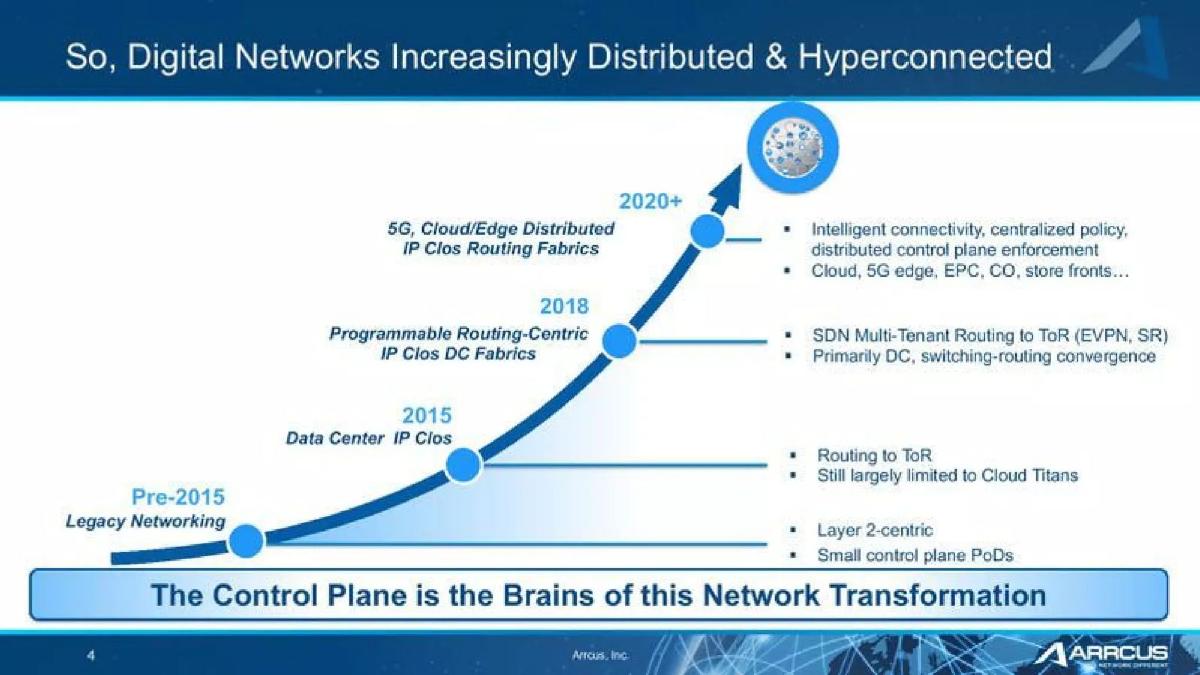
- The deck identifies the 'Control Plane' as the critical intelligence layer for modern distributed networks (Slide 4).
- Arrcus defines its competitive edge through 'Open Integration,' allowing its ArcOS to run on any silicon or hardware, specifically naming compatibility with Intel, Broadcom, and AMD (Slide 8).
- The value proposition is distilled into three pillars: Superior Performance, Flexible Deployment, and Lower TCO (Slide 9).
- The deck introduces ArcIQ, an AI-driven network operations center, as a secondary SaaS/Cloud offering (Slide 10).
- There is a complete absence of financial metrics, current customer names, or a specific funding 'ask' in this summary version of the deck.
The Arrcus Pitch Deck: Selling the 'New OEM' Paradigm
The Arrcus deck, dated August 2019, is a concise 10-slide summary that focuses on the structural shifts in global networking infrastructure. Rather than focusing on the minutiae of a specific product feature, the deck sells a vision of 'Network Different.' It positions the company at the intersection of the 5G revolution and the move toward hardware-agnostic software. For a startup founded in 2016, the deck displays a high degree of confidence, largely backed by the pedigree of its investors and advisors.
Slide 1: Title Slide
The deck opens with a clean, corporate aesthetic. The logo features a stylized 'A' and the tagline 'Network Different.' The title 'Arrcus Company Summary' and the date 'August 2019' establish this as a high-level overview rather than a deep-dive technical briefing. The background imagery of a connected globe reinforces the scale of the industry they are addressing.
Slide 2: Company Overview and Pedigree
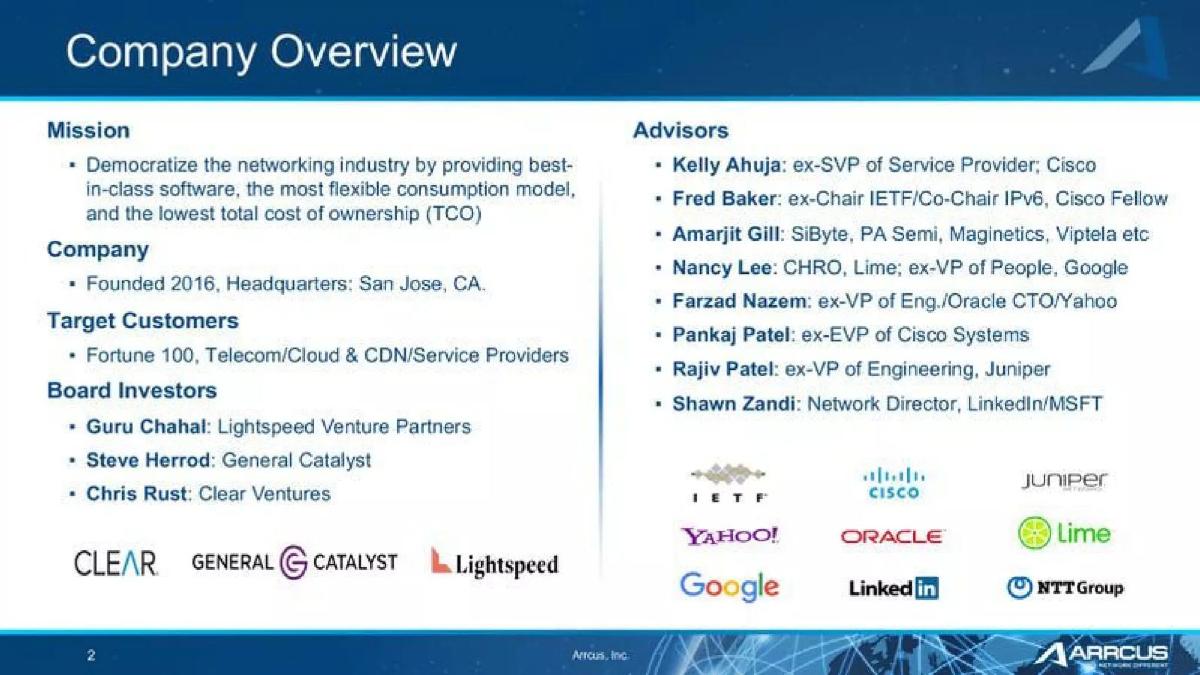
This is arguably the most important slide in the deck for establishing credibility. Arrcus lists its mission: 'Democratize the networking industry by providing best-in-class software, the most flexible consumption model, and the lowest total cost of ownership (TCO).'
However, the real weight of the slide is in the names. Under 'Board Investors,' they list Guru Chahal (Lightspeed), Steve Herrod (General Catalyst), and Chris Rust (Clear Ventures). The 'Advisors' column is a 'who's who' of networking history, including Kelly Ahuja (ex-SVP, Cisco), Fred Baker (Cisco Fellow), and Rajiv Patel (ex-VP Engineering, Juniper). By leading with these names, Arrcus signals to potential partners and investors that they are 'insiders' disrupting an industry they helped build.
Slide 3: The Macro Opportunity
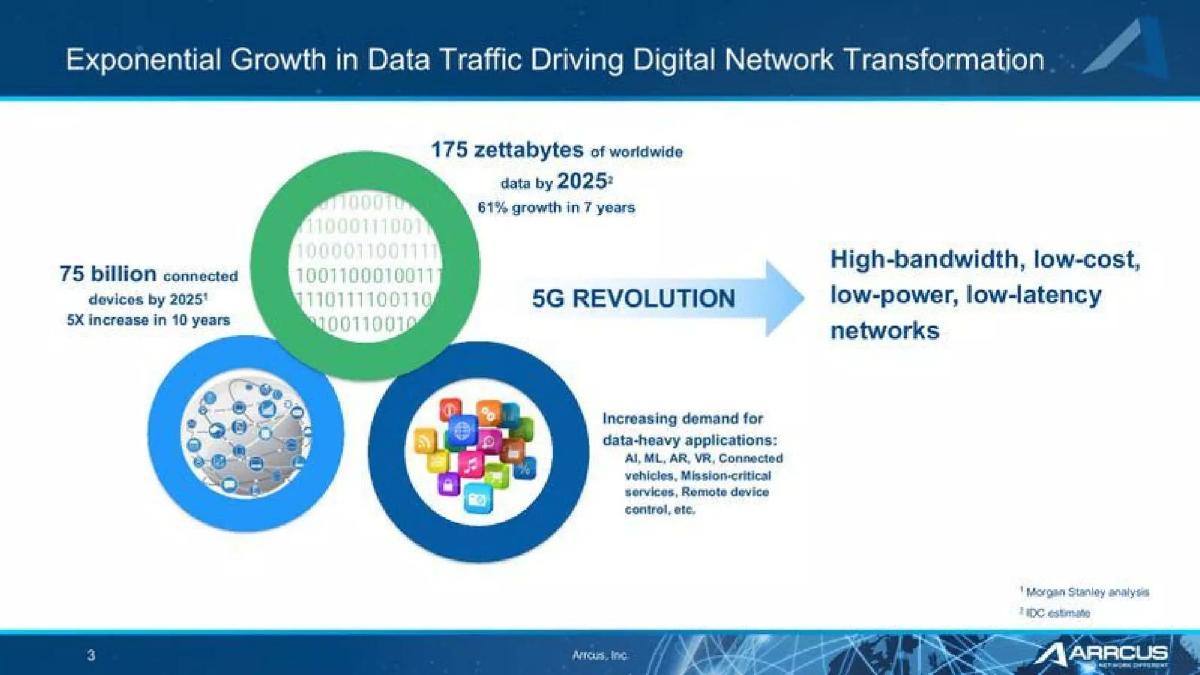
Slide 3 utilizes third-party data to justify the need for Arrcus. It cites a Morgan Stanley analysis projecting 75 billion connected devices by 2025 and an IDC estimate of 175 zettabytes of worldwide data by the same year. The slide identifies the '5G REVOLUTION' as the catalyst that demands 'High-bandwidth, low-cost, low-power, low-latency networks.' This slide serves to prove that the market is not just large, but is undergoing a phase shift that legacy systems cannot handle.
Slide 4: The Evolution of Digital Networks
This slide provides a timeline of network transformation. It moves from 'Pre-2015 Legacy Networking' through '2018 Programmable Routing-Centric' to '2020+ 5G, Cloud/Edge Distributed IP Clos Routing Fabrics.' The key takeaway is the blue banner at the bottom: 'The Control Plane is the Brains of this Network Transformation.' This is a strategic positioning move; Arrcus is telling the audience that the hardware (the body) is becoming a commodity, while the software (the brains/control plane) is where the value lies.
Slide 5: High-Performance Routing as 'Table Stakes'
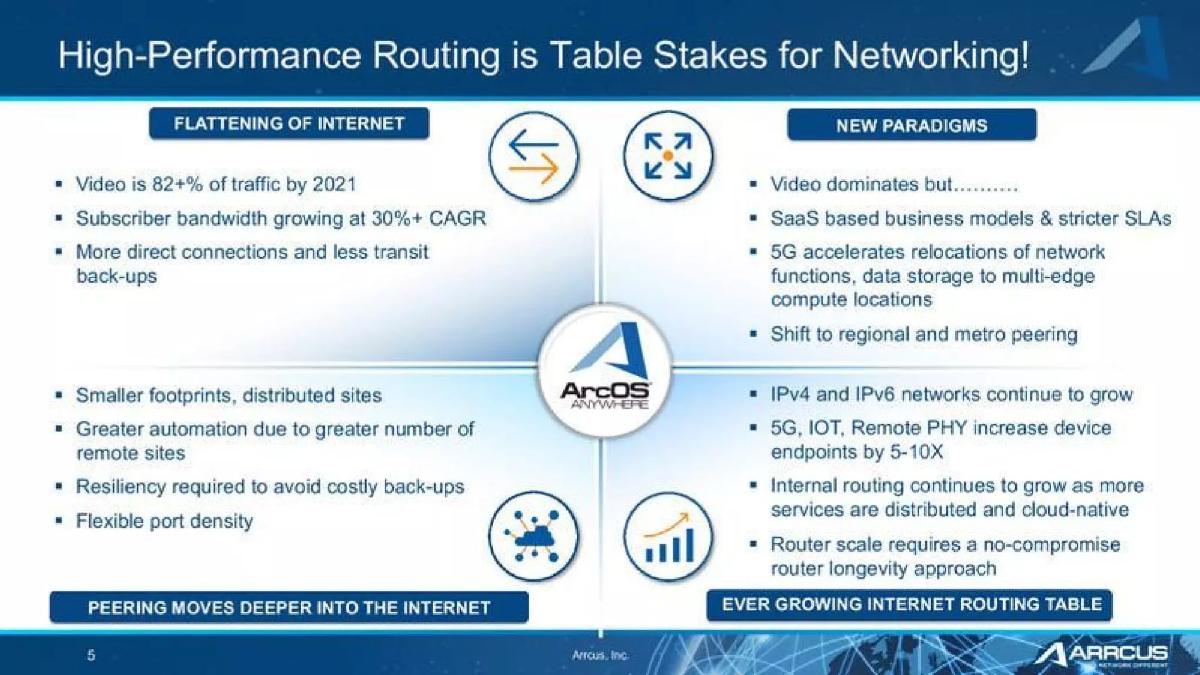
Slide 5 breaks down the current state of the internet. It notes that video will be 82+% of traffic by 2021 and subscriber bandwidth is growing at a 30%+ CAGR. It contrasts 'Flattening of Internet' with 'New Paradigms' like SaaS-based business models and multi-edge compute locations. The central graphic, 'ArcOS Anywhere,' positions their product as the solution that bridges these two worlds, handling everything from IPv4/IPv6 growth to IoT device endpoints.
Slide 6: Foundational Elements
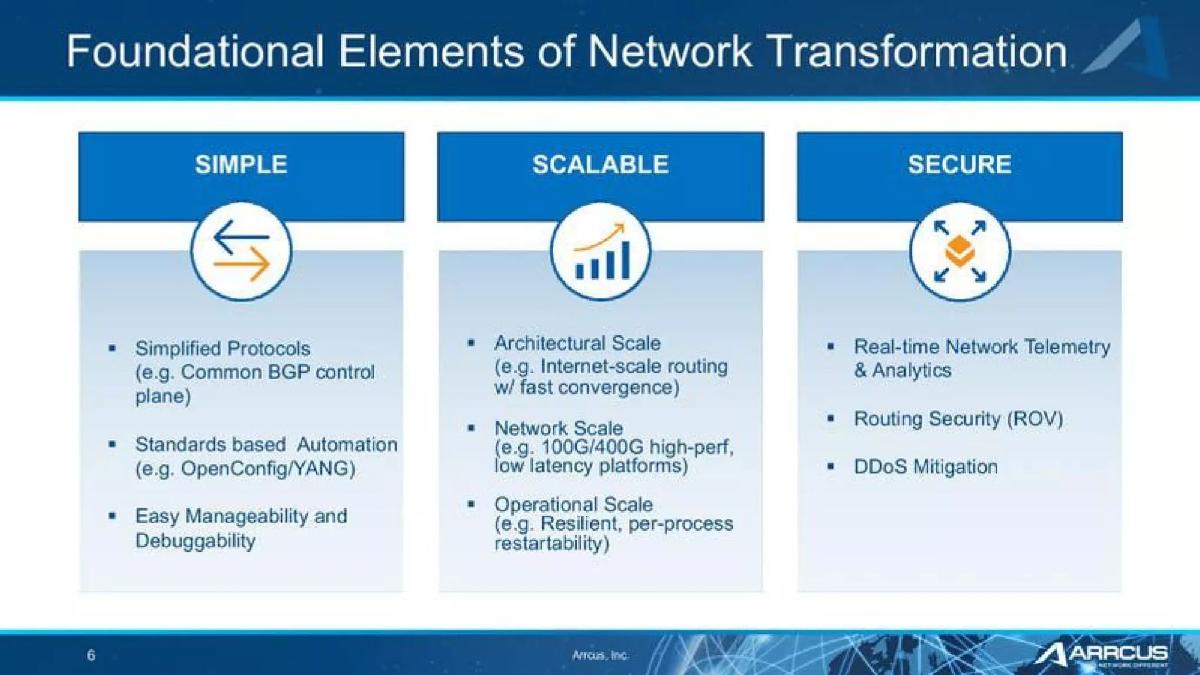
This slide categorizes the Arrcus value proposition into three buckets: Simple, Scalable, and Secure.
Simple: Focuses on simplified protocols (BGP control plane) and standards-based automation (OpenConfig/YANG). · Scalable: Mentions internet-scale routing and support for 100G/400G high-performance platforms. · Secure: Highlights real-time network telemetry, routing security (ROV), and DDoS mitigation.
This slide translates the high-level vision into specific technical requirements that a CTO or Network Architect would be looking for.
Slide 7: Arrcus as 'The New OEM'
Slide 7 introduces the concept of Arrcus as 'The New OEM.' The graphic shows ArcOS sitting on top of 'Any Hardware' and 'Any Silicon.' The core message is 'Select the Right Software with the Right Hardware at the Right Costs.' This is a direct challenge to the traditional OEM model (like Cisco) where the software and hardware are inseparable.
Slide 8: Enabling Choice through Open Integration
This slide is the 'competitive' slide, though it doesn't name competitors in a traditional grid. Instead, it contrasts 'Proprietary Vertical Integration' (referencing Arista, Cisco, and Juniper) with 'Open Integration.' It shows that while legacy players lock you into their ecosystem, Arrcus (ArcOS) allows you to use hardware from HP, Dell, Edgecore, QCT, Celestica, or Delta , and silicon from Intel, Broadcom, AMD, Barefoot, Mellanox, Marvell, Cavium, or Innovium. This visualizes the 'democratization' mentioned on Slide 2.
Slide 9: Key Customer Benefits
Slide 9 is a simple summary slide. It distills the entire pitch into three circles: Superior Performance, Flexible Deployment, and Lower TCO. While visually sparse, it serves as a 'recap' for the executive summary, ensuring the three main selling points are remembered.
Slide 10: Ready to Scale
The final slide summarizes the product portfolio and company readiness. It introduces ArcOS (the NOS) and ArcIQ (the AI-Driven Network Operations Center). It reiterates that they have a 'Proven Experienced Team' and 'Expansive Use Cases.' The slide ends on a note of momentum, suggesting the company is prepared for the next stage of growth.
What Arrcus Does Well
The Arrcus deck is a masterclass in narrative positioning . It doesn't just say 'we make a better router'; it says 'the world is changing because of 5G and Zettabytes of data, and the old way of buying networking gear is dead.' By framing the problem as a historical inevitability, they make their solution seem like the only logical choice.
The use of social proof is also exceptional. For a company that was only three years old at the time of the deck, the list of advisors and board members is staggering. This immediately removes the 'startup risk' in the eyes of a Fortune 100 buyer or a Series B/C investor. If the people who built Cisco and Juniper are advising Arrcus, the technology is assumed to be sound.
What is Missing from the Deck
As a 'Company Summary,' this deck is intentionally light on specifics. However, a few key omissions would be necessary for a full investment round:
Financials and Traction: There is no mention of revenue, number of deployments, or even pilot programs. While they target 'Fortune 100,' they don't list a single current customer by name. · The Founders: While the advisors are listed, the actual founders and management team are absent. In a startup, the 'who' is often as important as the 'what.' · The Ask: The deck does not state how much money they are looking for or what the specific milestones for the next 18 months are. · Unit Economics: While they claim 'Lower TCO,' they don't provide a case study or a comparative cost breakdown to prove it.
Founder Takeaways: How to Copy the Arrcus Strategy
1. Sell the 'Shift,' Not the 'Feature': Arrcus spends four slides (3, 4, 5, and 6) explaining why the world has changed before they even show their product architecture. Founders in complex technical spaces should spend more time defining the 'New Paradigm' to make their product's existence feel necessary.
2. Borrow Credibility: If you don't have 10 years of revenue, you need 10 years of pedigree. Arrcus uses its advisor list to bridge the 'trust gap.' If you have high-profile investors or advisors, put them on Slide 2, not Slide 12.
3. Use 'Open' as a Competitive Weapon: In industries dominated by 'walled gardens' (like enterprise networking), positioning your product as the 'Open' alternative is a powerful way to frame yourself as the customer's ally against vendor lock-in.
4. Consistent Visual Language: The deck uses a consistent blue and white palette with professional iconography. It looks like a document produced by a company that understands the enterprise market. For B2B startups, 'looking the part' is a form of silent due diligence.
Conclusion: The Arrcus deck is a highly effective high-level summary. It successfully moves the conversation away from 'speeds and feeds' and toward 'architecture and economics.' While it lacks the hard data required for a final investment decision, it is an excellent 'door opener' designed to secure a second meeting with a technical or financial stakeholder. Regardless of the lack of a team slide, the sheer density of industry expertise represented on Slide 2 makes this a formidable pitch.
Frequently asked questions
- What is the primary product Arrcus is selling?
- The primary product is ArcOS, a carrier-grade Network Operating System (NOS). As detailed on Slide 10, it is designed to be open, composable, and micro-services based, supporting physical, virtual, and cloud environments. It aims to replace proprietary network operating systems with a software layer that can run on any hardware or silicon.
- Who are the target customers for Arrcus?
- According to Slide 2, Arrcus targets Fortune 100 companies, Telecom/Cloud providers, and CDN/Service Providers. The deck emphasizes that high-performance routing is now 'table stakes' for these entities as they deal with video dominating 82% of traffic and subscriber bandwidth growing at a 30%+ CAGR (Slide 5).
- How does Arrcus differentiate itself from legacy networking giants like Cisco or Juniper?
- Arrcus differentiates through 'Open Integration.' Slide 8 contrasts 'Proprietary Vertical Integration' (where the OS, hardware, and silicon are bundled by one vendor) with the Arrcus model. Arrcus allows customers to choose their own switch/router (e.g., HP, Dell, Edgecore) and silicon (e.g., Broadcom, Intel, Cavium) while using ArcOS as the unified software layer.
- What market trends is Arrcus capitalizing on?
- The deck highlights three main trends: the 5G revolution, the explosion of data-heavy applications like AI and VR, and the shift toward distributed/hyperconnected networks. Slide 3 cites an IDC estimate that worldwide data will reach 175 zettabytes by 2025, necessitating high-bandwidth, low-latency, and low-power networks.
- Is there a team slide in this deck?
- No, there is no dedicated team slide featuring the founders or executive leadership. Instead, Slide 2 features a 'Company Overview' that lists Board Investors and an extensive list of 'Advisors' with high-level titles from major tech firms like Cisco, Juniper, and LinkedIn. This suggests a strategy of leading with institutional and industry validation.