DalaWorks is a Cape Town-based 'App Lab' and accelerator that sought to capitalize on the rapid growth of mobile connectivity in Africa circa 2013. The deck outlines a dual-track program: one for app developers and another for digital media producers. With a lean annual operating budget of $296,900, the organization aimed to provide training, mentorship, and job placement. The pitch is heavily grounded in market data from 2012, highlighting that 96% of African mobile connections were prepaid and that women reinvest 90% of their income into their families. While the deck provides a clear opera…
Key takeaways
- The company identifies as an 'App Lab' based in Cape Town, South Africa (Slide 1).
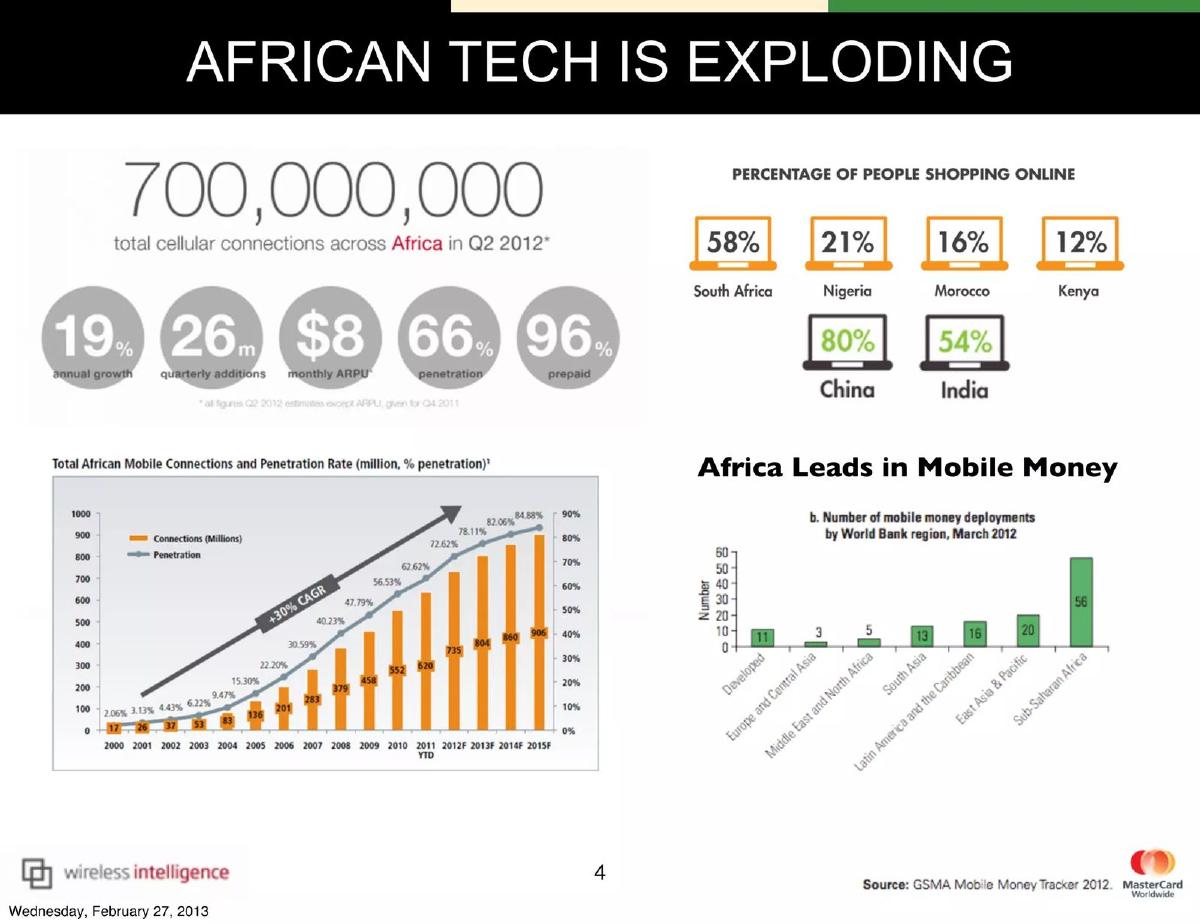
- Macro data from Q2 2012 shows 700 million total cellular connections across Africa with 19% annual growth (Slide 4).
- South African internet access is overwhelmingly mobile, with 84% of adults owning a mobile phone compared to 18% owning a computer (Slide 5).
- The program structure is a 6-month cycle including basic training, app building, and a 'Reverse job fair' (Slide 13).
- The annual operating budget is precisely calculated at $296,900, with staff costs being the largest line item at $155,000 (Slide 16).
- DalaWorks partners with RLabs to act as a talent feeder and provide physical facilities for entrepreneurs (Slide 19).
- A dedicated track for 'Producers' offers 6 months of training in digital media and documentary production (Slide 22).
- The deck emphasizes a 'Focus on Women,' noting that 168 million women are active in sub-Saharan African economies (Slide 25).
Executive Summary: The Mobile-First Thesis
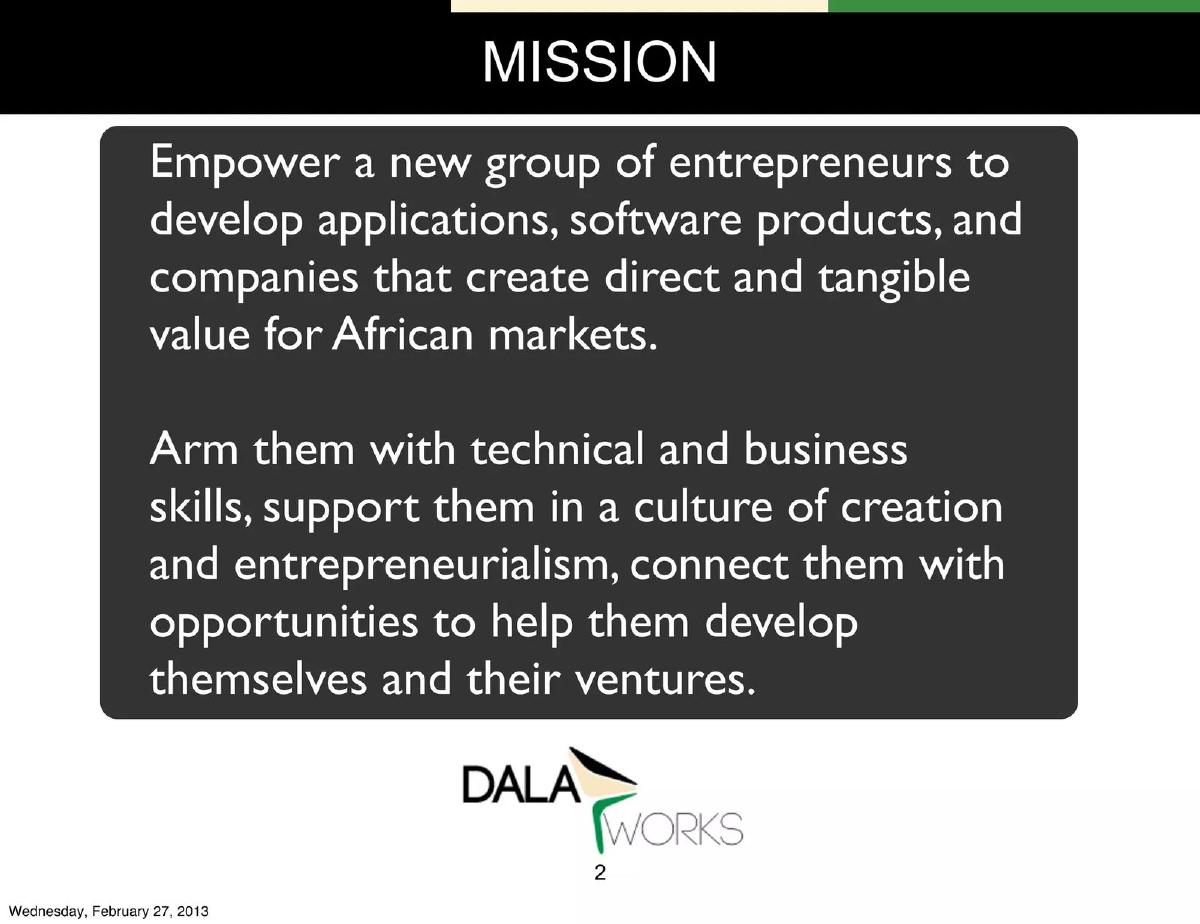
DalaWorks emerged in early 2013 with a pitch deck that serves as a time capsule for the African 'mobile-first' explosion. Based in Cape Town, the organization positioned itself as an 'App Lab' designed to bridge the gap between the massive growth in mobile connectivity and the lack of localized digital content and applications. The deck is less of a venture capital ask and more of a program blueprint, detailing how a $296,900 annual budget could be deployed to train developers and media producers.
Slide 1: Title and Identity
The cover slide introduces the brand 'DalaWorks' with the tagline 'App Lab Cape Town.' It includes a translation of the word 'Dala,' which means 'Create' in Xhosa. This immediately establishes the company's geographic focus and cultural alignment with the South African market. The date at the bottom, February 27, 2013, sets the context for all subsequent market data.
Slide 4: The African Tech Explosion
This slide is a data-heavy justification for the accelerator's existence. It cites 700,000,000 total cellular connections across Africa as of Q2 2012. Key metrics include a 19% annual growth rate and a staggering 96% prepaid market share. Crucially, it highlights that Sub-Saharan Africa leads the world in mobile money deployments (56), significantly outpacing developed regions (11). This data builds a narrative that while the infrastructure is present, the ecosystem for applications is ripe for development.
Slide 5: South African Internet Dynamics
DalaWorks narrows its focus to its home market, showing that South African internet is synonymous with mobile. The slide compares computer ownership (18%) to mobile phone ownership (84%). A bar chart illustrates that mobile internet usage in South Africa (ZA) is higher than in many other emerging and developed markets, including Brazil, Mexico, and the UK. This slide serves to prove that the 'App Lab' is targeting the primary gateway through which South Africans access the digital world.
Slide 10: The Value Proposition for Partners
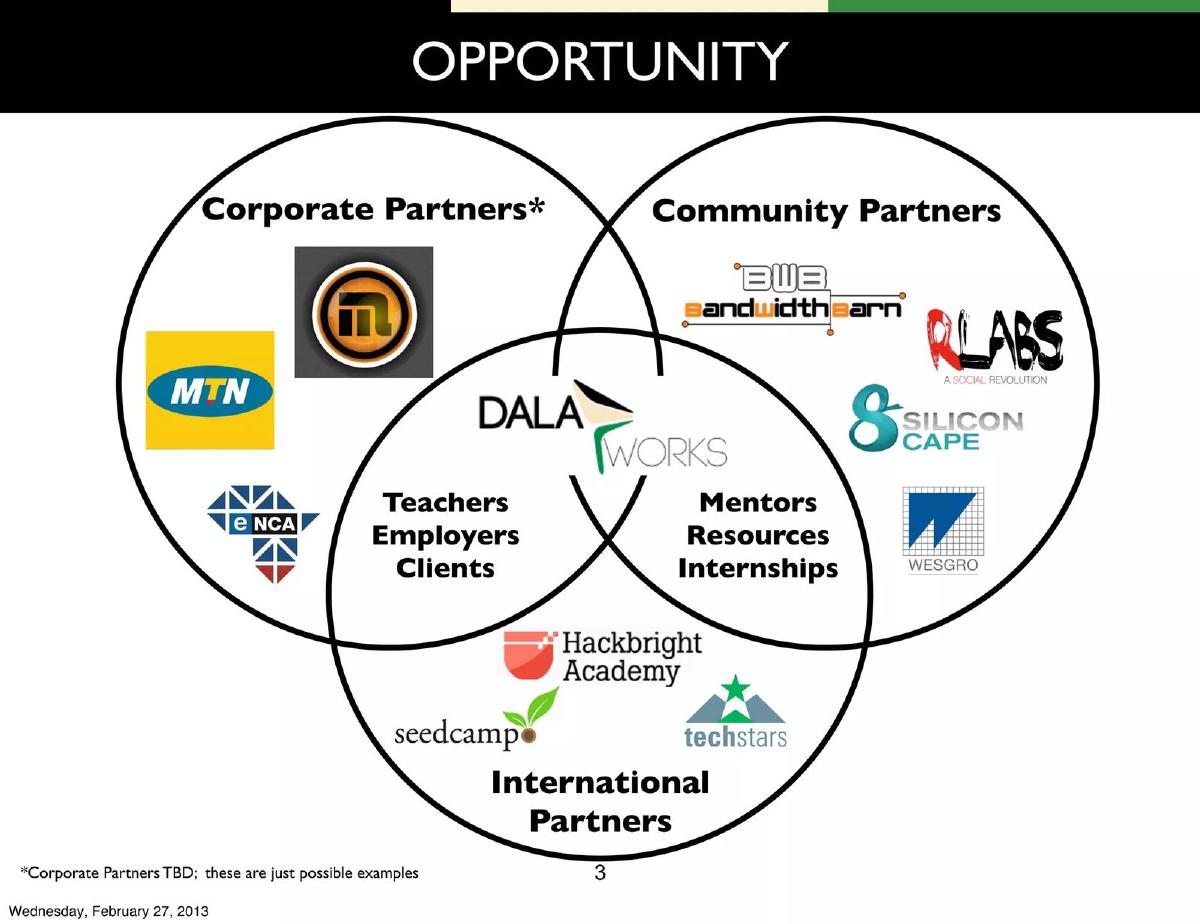
Slide 10 outlines the 'Partners and Investors' framework. Contributions sought include investment/sponsorship for a three-cycle accelerator, scholarships, equipment, and mentors. In return, DalaWorks offers 'Benefits' such as on-the-ground market intelligence, branded apps, and access to acquisition targets (IP and talent). The language here suggests a B2B service or corporate social responsibility (CSR) model rather than a pure equity-play investment.
Slide 13: The Six-Month Program Structure
The operational heart of the deck is the program timeline. It is divided into three main phases: Month 1-2 (Basic training and project selection), Months 3-4 (Building and testing apps), and Month 5 (Pitch development and a 'Reverse job fair'). Month 6 focuses on continued support and international placements. This structured approach demonstrates that the founders have thought through the logistics of talent development beyond just 'writing code.'
Slide 16: The Annual Operating Budget
Transparency in cost is a highlight of this deck. Slide 16 presents a 'DW Apps Annual Budget' totaling $296,900 . The breakdown is as follows: staff costs at $155,000, rent at $17,400, events/marketing at $67,500, legal/admin at $37,000, and travel at $20,000. For a startup accelerator in a major hub like Cape Town, these figures represent a lean, execution-focused budget.
Slide 19: Strategic Partnership with RLabs
DalaWorks highlights its relationship with RLabs (Reconstructed Living Lab). RLabs acts as a 'feeder' to the program, attracting and filtering talent with marketable ideas. It also provides physical facilities and a potential seed fund for graduating companies. This slide is vital because it shows DalaWorks is not operating in a vacuum but is integrated into the existing Cape Town tech ecosystem.
Slide 22: The Media Production Track
Unique among accelerators, DalaWorks includes a track for 'Producers.' This 6-month program covers the entire lifecycle of digital media and documentary production. The 'Outcomes' listed include marketable skills in storytelling, a production reel, and credits on full-scale documentary productions. This suggests DalaWorks viewed content creation as equally important to software development in the African context.
Slide 25: The Gender-Focused Thesis
The deck dedicates a slide to 'Focus on Women,' citing that 2/3 of new mobile subscribers in the next five years will be women. It uses data from 'ONE' to show that women reinvest 90% of their income into their families, compared to 30-40% for men. It also includes a chart showing that companies with female board representation outperform those without by 26% over six years. This slide positions DalaWorks as an impact-oriented investment.
Slide 28: Contact and Leadership
The final slide provides contact information for Elizabeth Gould and Philip Kiracofe. Elizabeth is listed with a DalaWorks email, while Philip is linked to Horizen Partners. While it provides Twitter and Skype handles, it notably lacks a summary of their professional achievements, which is a standard requirement for most modern pitch decks.
What Works in This Deck
The market timing and data usage are the strongest elements of the DalaWorks deck. By 2013, the 'Africa Rising' narrative was in full swing, and the deck does an excellent job of using third-party data (Accenture, GSMA, World Bank) to validate the mobile-first opportunity. The inclusion of a specific, line-item budget (Slide 16) provides immediate clarity on what the founders intend to do with the capital. Furthermore, the dual-track approach (Apps and Media) recognizes that a digital economy requires both technical infrastructure and compelling content.
What Is Missing
The most glaring omission is a traditional 'Team' slide. While names are provided at the end, there is no information regarding the founders' history in tech, education, or previous successful ventures. Additionally, the deck lacks a clear revenue model for the accelerator itself. It is unclear if DalaWorks intends to take equity in the startups, charge a management fee to sponsors, or operate as a non-profit. Finally, there is no specific 'Ask'—the deck mentions needing 'Partners and Investors' but does not specify the amount of capital being raised in this specific round or the terms of that investment.
Founder's Takeaway: Copy the Structure, Update the Content
Founders should look at Slide 13 (Program Structure) as a model for explaining service-based or accelerator businesses. It clearly defines the 'customer journey' for the participants. The use of macro-economic data to frame a local problem (Slides 4 and 5) is also a best practice for startups operating in emerging markets. However, modern founders must ensure they include a robust 'Team' slide early in the deck to build credibility, and a clear 'Ask' slide at the end to ensure investors know exactly what is being requested.
Frequently asked questions
- What is the primary business model of DalaWorks?
- Based on the slides, DalaWorks operates as an accelerator and training facility rather than a software company. It seeks 'Partners and Investors' to provide sponsorship, equipment, and scholarships in exchange for market intelligence, branded apps, and access to talent. There is no mention of taking equity in the startups or charging tuition, suggesting a non-profit or sponsorship-driven model.
- How does DalaWorks justify the market opportunity in Africa?
- The deck uses 2012 data to show that Africa leads in mobile money deployments (56 deployments compared to 20 in East Asia) and that mobile penetration reached 84.88% by 2015 projections. It highlights that the South African internet market is uniquely mobile-first, creating a massive demand for localized apps and digital content that the accelerator aims to produce.
- What are the specific components of the annual budget?
- The budget on Slide 16 totals $296,900. It is broken down into Staff ($155,000), Rent & Utilities ($17,400), Events & Marketing ($67,500), Legal & Admin ($37,000), and Travel ($20,000). This suggests a lean operation focused primarily on human capital and community building rather than expensive infrastructure.
- What is the 'Producers' track mentioned in the deck?
- Unlike many tech accelerators that focus solely on coding, DalaWorks includes a track for digital media and documentary production. Participants receive 6 months of training in pre-production, camera work, and post-production. The goal is to provide 'marketable skills in digital video' and connections to international production networks, as shown on Slide 22.
- Who are the key people behind DalaWorks?
- Slide 28 lists Elizabeth Gould and Philip Kiracofe as the primary contacts. Elizabeth uses a DalaWorks email, while Philip is associated with Horizen Partners. The deck does not include a traditional 'Team' slide detailing their professional backgrounds, previous exits, or specific expertise in the South African tech sector.