Vidcaster’s 20-slide deck from 2011 represents a specific era of the web where brands were struggling to move beyond YouTube embeds. The company positioned itself as an 'end-to-end solution' for full video websites rather than just players (Slide 2). The narrative is heavily anchored by a deep-dive case study of Airbnb, demonstrating how moving from YouTube to a branded domain (tv.airbnb.com) increased viewership and SEO control (Slides 5-7). While the deck is light on financial modeling and market sizing, it excels at demonstrating technical SEO 'wins' and social proof, featuring logos like…
Key takeaways
- The product is defined as a 'full video website' solution to differentiate from standalone players (Slide 2).
- The deck leverages massive social proof early, listing Airbnb, Twilio, and Zendesk as paying customers (Slide 3).
- A '3x viewership growth' metric is cited as a direct result of maximizing convertible viewership (Slide 7).
- The core problem identified is that free video sites are 'not ideal environments' for brands seeking control (Slide 8).
- A multi-slide 'SEO Missed Opportunity' sequence uses Virgin America as a negative example of losing traffic to YouTube (Slides 9-12).
- Vidcaster claims a '5x new user signup' increase since implementing an instant signup feature (Slide 18).
- The team slide highlights a lean four-person core supported by high-profile advisors like Dave McClure and Paul Singh (Slide 19).
- The fundraising ask on the final summary slide is explicitly stated as $500k (Slide 19).
Executive Summary: The Transition from Embeds to Destinations
Vidcaster’s 2011 pitch deck is a artifact of a time when 'Video SEO' was a burgeoning field. The company’s core thesis was that brands were making a strategic error by hosting their premium video content on YouTube. By doing so, brands were giving away their SEO equity and allowing third-party platforms to control the user experience. Vidcaster proposed a 'white-label' alternative that allowed companies to build entire video-centric subdomains. This teardown examines how the founders used a narrative of 'control' and 'ownership' to secure early-stage funding.
Slides 1-4: The Hook and Social Proof
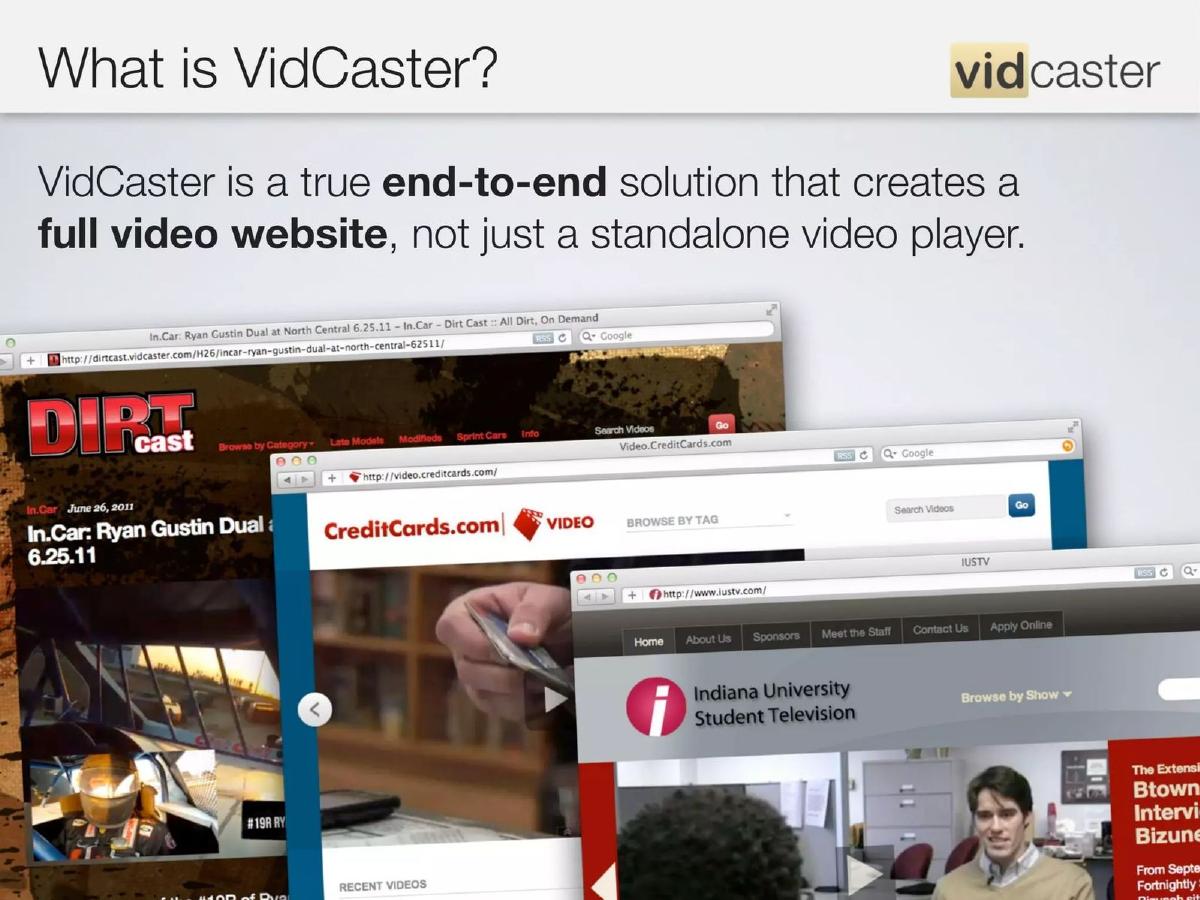
Slide 1 is a minimalist title slide featuring the Vidcaster logo. It establishes a clean, professional aesthetic that carries through the deck. Slide 2 immediately defines the product: 'Vidcaster is a true end-to-end solution that creates a full video website, not just a standalone video player.' This is a crucial distinction. In 2011, many companies offered players (like Brightcove or Ooyala), but Vidcaster was selling the entire site architecture. They reinforce this with screenshots of 'Dirt Cast,' 'CreditCards.com,' and 'Indiana University Student Television.'
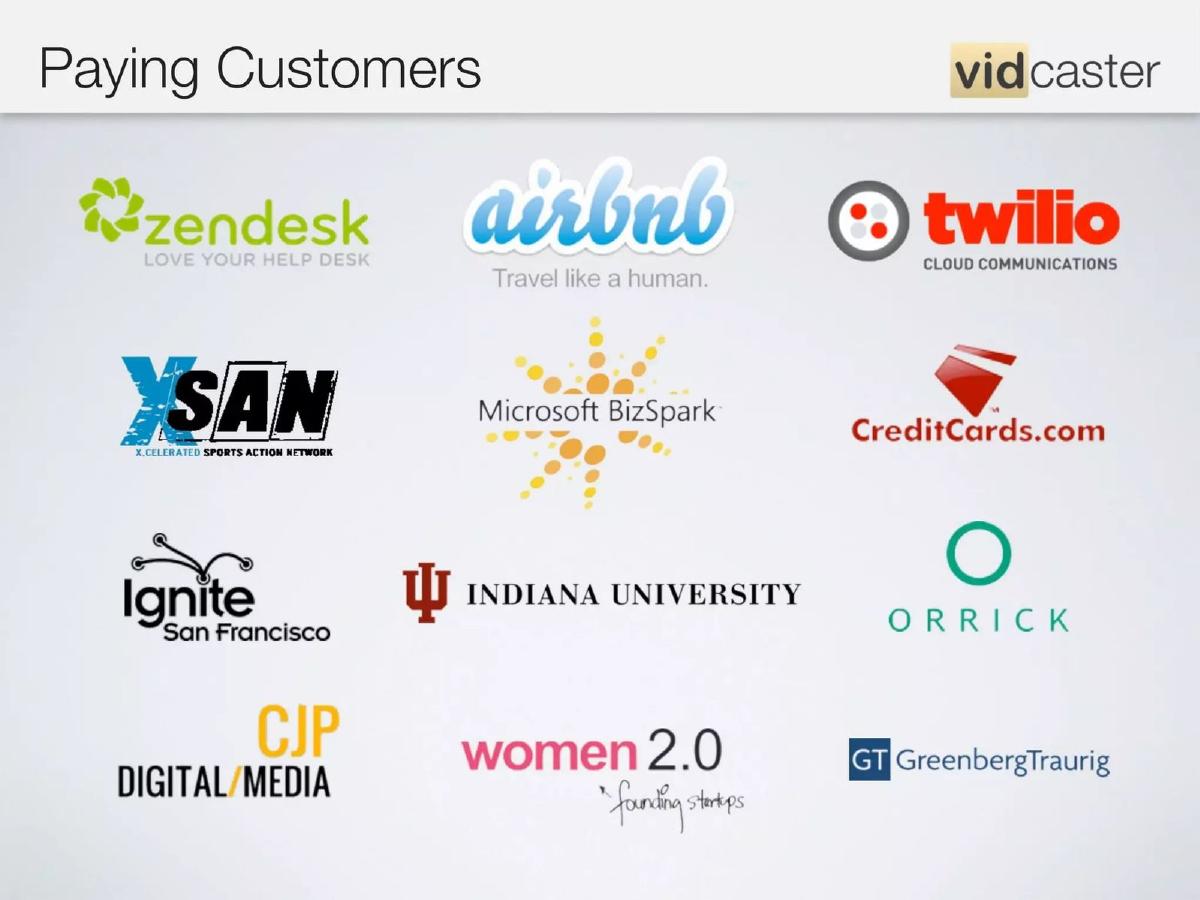
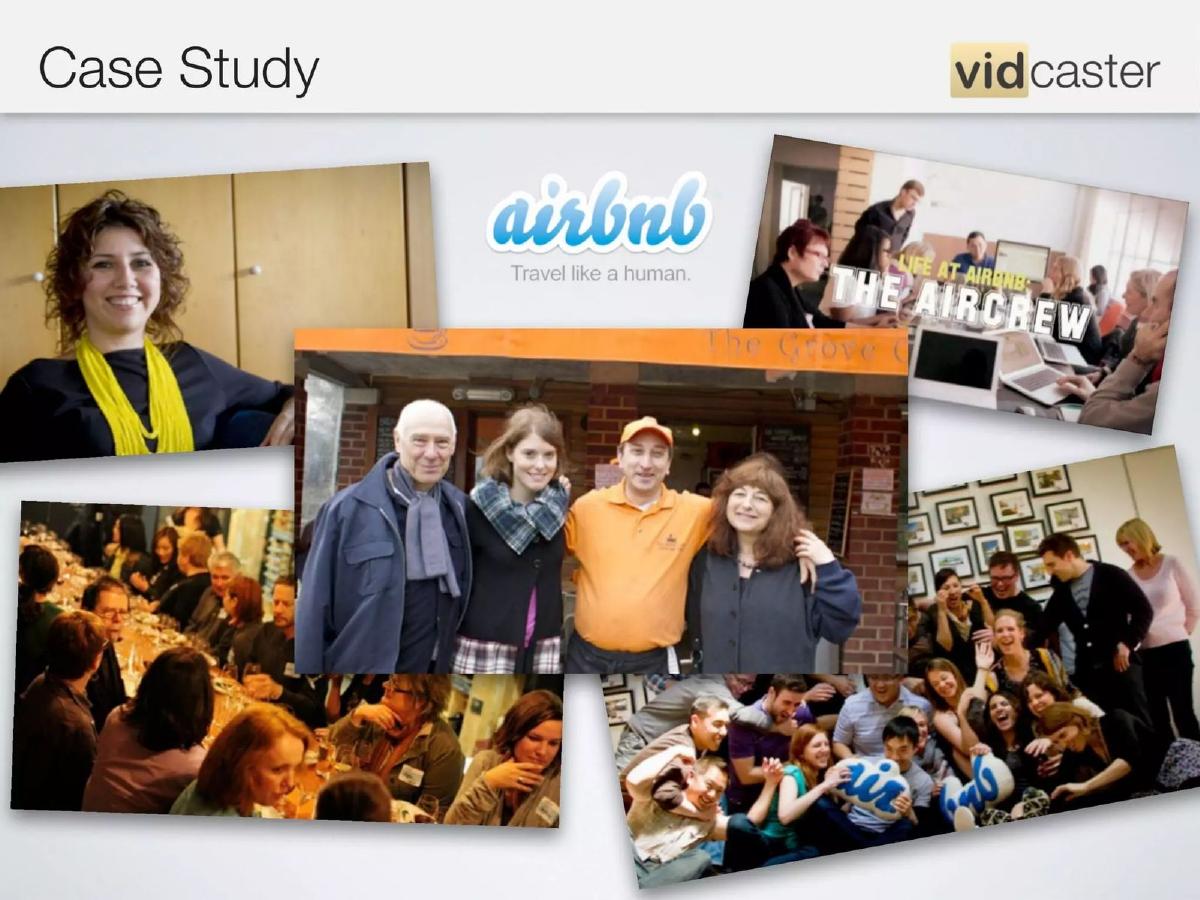
Slide 3 is the 'Traction' or 'Social Proof' slide. It is exceptionally strong for an early-stage company, featuring logos for Zendesk, Airbnb, Twilio, Microsoft BizSpark, and Indiana University. By placing this at the front of the deck, Vidcaster answers the 'who else is using this?' question before the investor can even ask it. Slide 4 introduces a case study format, specifically focusing on Airbnb. The slide is purely visual, showing the 'human' side of the Airbnb brand, setting the stage for a problem/solution narrative.
Slides 5-8: The Problem and The Solution
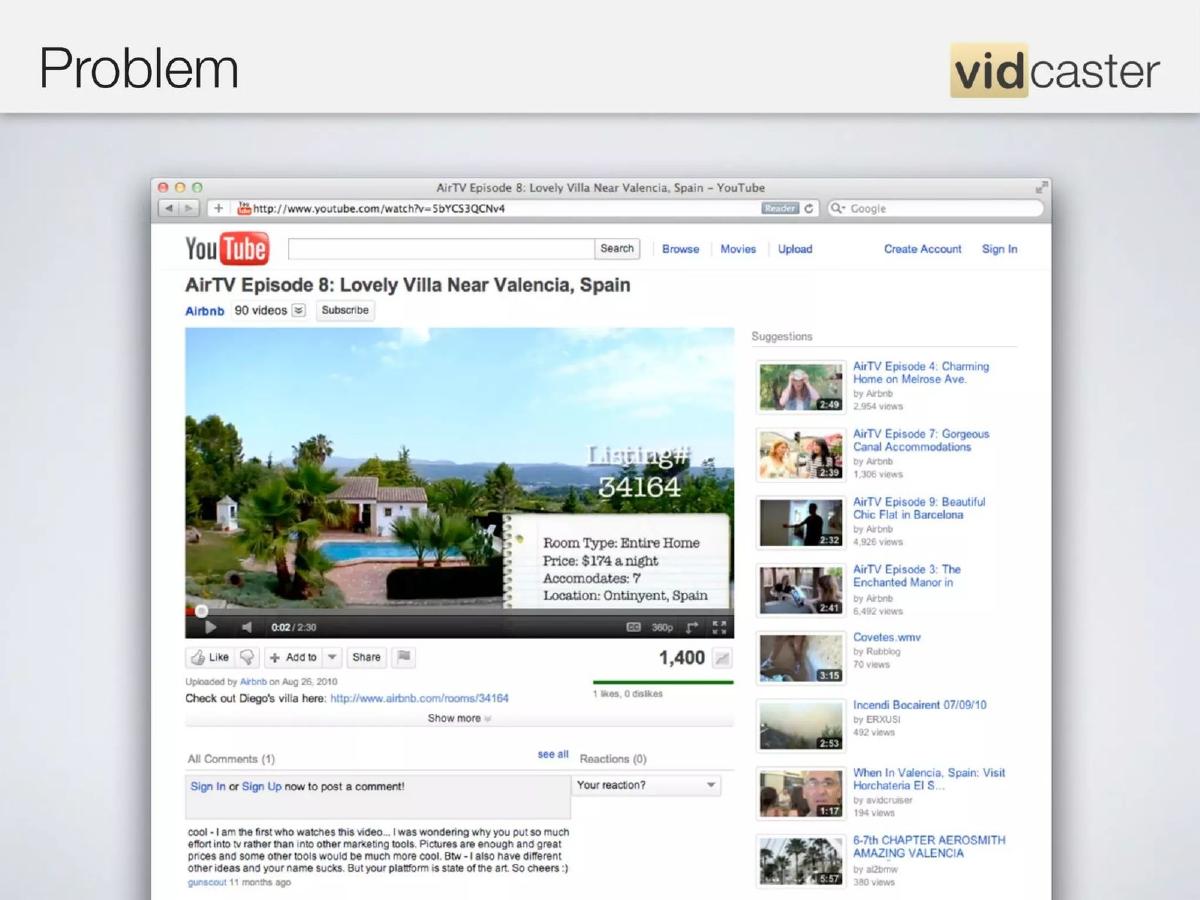
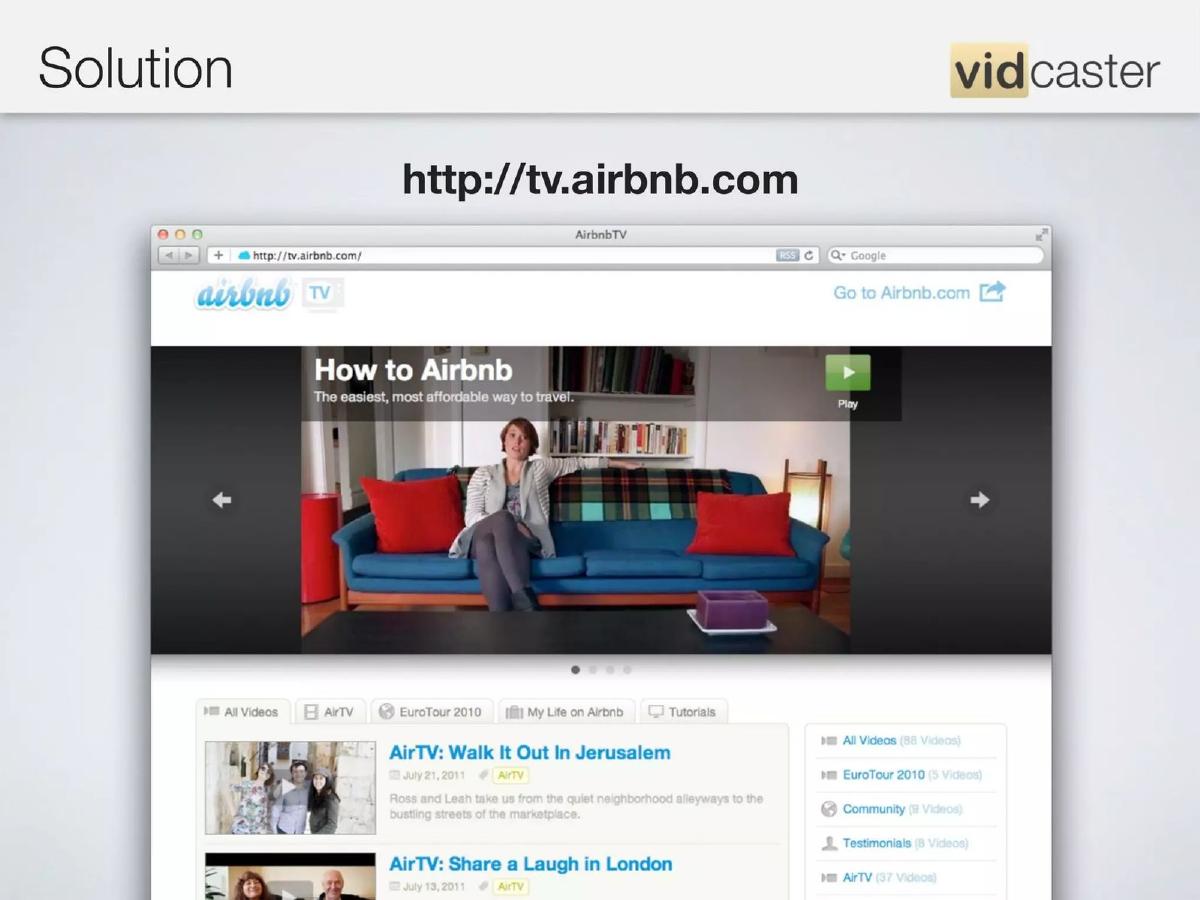
Slide 5 illustrates the 'Problem' using Airbnb’s then-current YouTube presence. The screenshot shows a standard YouTube page for 'AirTV Episode 8.' The implicit problem is the clutter: YouTube branding, related videos from other creators, and a lack of direct integration with the Airbnb booking engine. Slide 6 presents the 'Solution': tv.airbnb.com. This is a dedicated, branded portal. The contrast is stark; the Vidcaster-powered site is clean, focused, and keeps the user on an Airbnb-controlled domain.
Slide 7 provides the data to back up the visual change. It claims '3x viewership growth' and shows a bar chart where 'Your Site' accounts for 54% of viewing methods, compared to YouTube at 19%. This slide attempts to prove that a branded destination actually performs better than a social platform. Slide 8 summarizes 'What We’ve Learned,' stating that video drives action but free sites are not ideal. They define the 'Ideal' as a branded environment on the company's own domain with full control.
Slides 9-13: The SEO Missed Opportunity
This section ( Slides 9 through 12 ) is a deep dive into a specific pain point: Search Engine Optimization. Vidcaster uses Virgin America as a 'missed opportunity' example. Slide 9 shows a Google search for 'Virgin America.' Slide 10 shows that the video results for the brand lead to YouTube and Vimeo, not VirginAmerica.com. Slide 11 and 12 drive the point home by showing that a user clicking these links ends up on a YouTube page with 'Techie Diva' branding or, worse, the 'Keyboard Cat' video. The message is clear: brands are losing their audience to the 'black hole' of YouTube's algorithm.
Slide 13 flips the script to 'Video SEO Success,' using 'Hackers and Founders' as the example. Here, the search results for 'Hackers and Founders' lead directly to 'hackersandfounders.tv,' which is a Vidcaster-powered site. This allows the brand to capture the traffic directly.
Slides 14-17: Expanding the Success Narrative
Slides 14, 15, and 16 continue the 'Success' narrative. Slide 14 shows a Google search result for Naval Ravikant speaking at a Hackers and Founders event, which links to the branded TV site. Slide 15 shows the actual video page, which features a prominent 'Microsoft BizSpark' sponsorship. This demonstrates how the platform allows for direct monetization or sponsorship opportunities that are difficult to manage on YouTube. Slide 16 shows the integration back to the Microsoft BizSpark site, completing the 'loop' of user engagement.
Slides 17-20: Growth, Team, and The Ask
Slide 17 , titled 'Steady Growth,' shows two charts: 'Total Videos' and 'Total Users' over the past 6 months. Both show a clear upward trend. The slide highlights a '5x new user signup since switching to instant signup,' suggesting that the company is optimizing its own conversion funnels. Slide 18 introduces the team. It features four core members: Kieran (CEO), Ray (Marketing), Steve (Design), and Jiang (Development). Below them is a list of 'Advisors and Investors' including high-profile names like Dave McClure, Christine Tsai, and Paul Singh, which adds significant institutional credibility.
Slide 19 is the 'In Summary' and 'Fundraising' slide. It boils the pitch down to three points: 'Proven product,' 'Unique approach,' and 'Driven team.' It explicitly states they are 'Now raising $500k.' Slide 20 is the contact slide, providing an email address, AngelList link, and Twitter handle.
What Works in This Deck
The 'Before and After' Strategy: By using Airbnb as a case study and contrasting their YouTube presence with their Vidcaster site, the founders made the value proposition tangible and easy to understand. · Specific SEO Pain Points: The 'Keyboard Cat' slide (Slide 12) is a brilliant way to illustrate the lack of control on YouTube. It uses humor and a well-known meme to highlight a serious business problem. · Early Traction: Having 12 paying customers, including several high-growth startups, is a very strong signal for a seed or early Series A round. · Advisor Bench: Listing Dave McClure and the 500 Startups team provides a 'stamp of approval' that mitigates the perceived risk of a small founding team.
What is Missing from This Deck
Market Sizing: There is no mention of the Total Addressable Market (TAM). Investors usually want to see how big this could become—is it a $100M opportunity or a $10B opportunity? · Business Model: The deck never explains how Vidcaster makes money. Is it a SaaS subscription? Is it based on bandwidth? Is there a setup fee? This is a significant omission for a fundraising deck. · Competition: While they position themselves against YouTube, they don't mention other white-label video providers like Brightcove, Vimeo Pro, or Wistia, which were active at the time. · Financial Projections: There are no forward-looking statements regarding revenue or burn rate.
What a Founder Should Copy
The Case Study Focus: Instead of talking about features in the abstract, show how one specific, recognizable customer used your product to solve a problem. · Visual Evidence of Success: Use screenshots of search results and analytics charts to prove your claims. Don't just say 'we improve SEO'; show the Google search page. · The 'Missed Opportunity' Narrative: Frame your competitor (in this case, YouTube) not as 'bad,' but as a 'missed opportunity' for the customer. This is a more sophisticated and persuasive way to position a product. · Clean Design: The deck uses a consistent, high-contrast design that makes the text easy to read and the images the star of the show.
Frequently asked questions
- What was Vidcaster's primary value proposition?
- Vidcaster positioned itself as an 'end-to-end' solution for creating full video websites. Unlike competitors that provided only a video player to be embedded on existing pages, Vidcaster allowed brands to host video content on their own domains (e.g., tv.airbnb.com). This approach focused on brand control, SEO ownership, and keeping viewers within the brand's ecosystem rather than losing them to YouTube's suggested videos.
- How did the deck demonstrate product-market fit?
- The deck used a combination of high-tier logos and specific growth metrics. By Slide 3, they show 12 recognizable customers including Airbnb and Microsoft. They followed this with a detailed case study of Airbnb, showing a transition from a cluttered YouTube page to a clean, branded portal. They also provided charts showing '3x viewership growth' and '5x new user signups' to prove the platform's efficacy.
- What competitive threat did Vidcaster address?
- The primary 'competitor' addressed wasn't another SaaS company, but rather the reliance on free hosting platforms like YouTube and Vimeo. The deck argued that these platforms represent a 'missed opportunity' for SEO because search results for a brand's video would lead to YouTube.com instead of the brand's own site, often exposing viewers to unrelated or distracting content (Slide 12).
- Who were the key people involved in the company at this stage?
- The core team consisted of Kieran (CEO), Ray (Marketing), Steve (Design), and Jiang (Development). However, the deck placed significant weight on its 'Advisors and Investors' section, which featured prominent Silicon Valley figures such as Dave McClure (500 Startups), Paul Singh, and Christine Tsai, signaling strong institutional backing early on.
- What is missing from this pitch deck?
- The deck is notably missing a traditional 'Market Size' (TAM/SAM/SOM) slide and a detailed 'Business Model' or pricing slide. There are no financial projections or mentions of CAC (Customer Acquisition Cost) and LTV (Lifetime Value). It functions more as a product and traction deck intended to prove that the technology works and that reputable brands are willing to pay for it.