The Video54 Series A deck from 2004 is a highly technical document that prioritizes engineering pedigree and performance metrics over market size or financial projections. The company, which later rebranded to Ruckus Wireless, identifies a specific failure in existing 802.11 standards: the inability to handle simultaneous high-bandwidth media streams across a typical home environment. By quantifying the 'Total house' requirement at 13-31 Mbps with less than 50ms jitter, Video54 sets a clear benchmark that their 'Hyper-Diversity' antenna technology claims to solve. The deck is notable for its…
Key takeaways
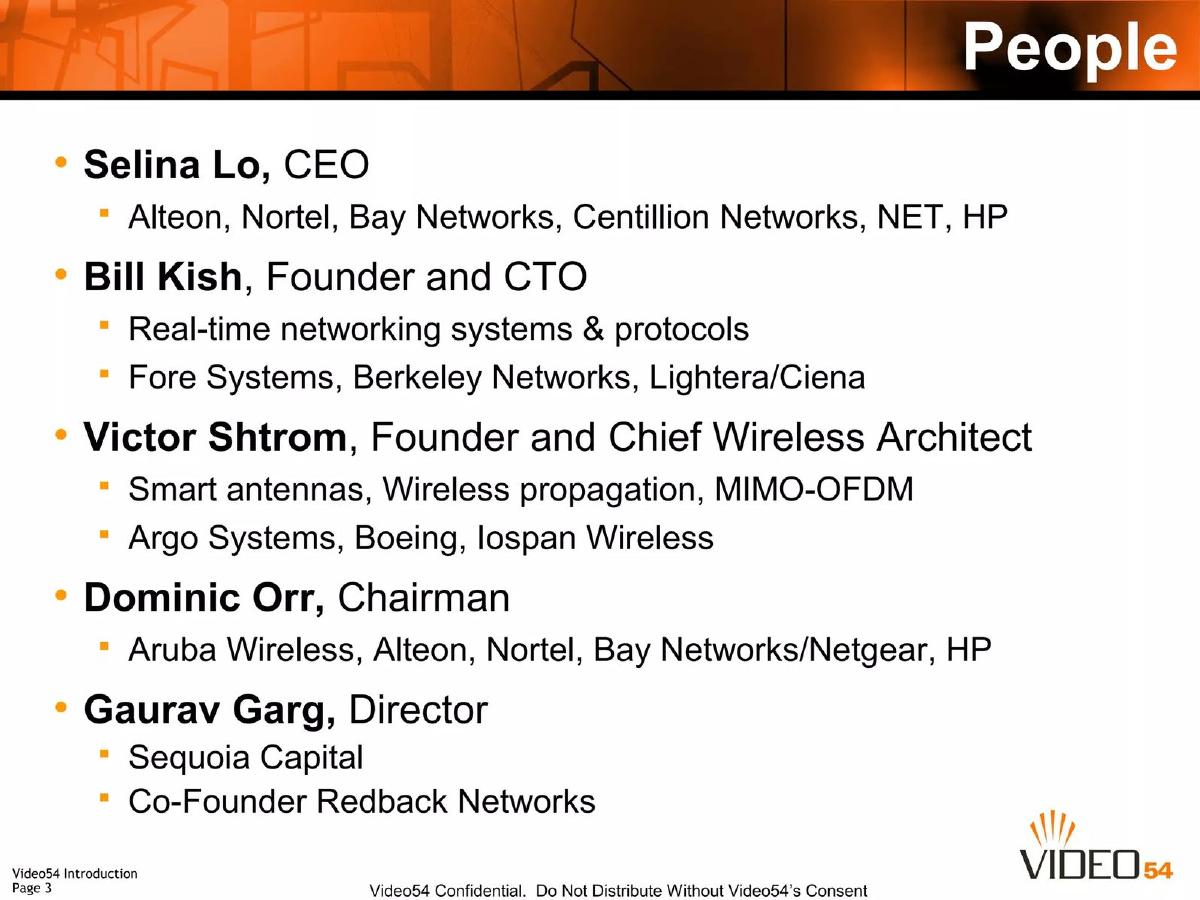
- The leadership team features deep domain expertise from Alteon, Nortel, and Berkeley Networks, with Sequoia Capital already represented on the board (Slide 3).
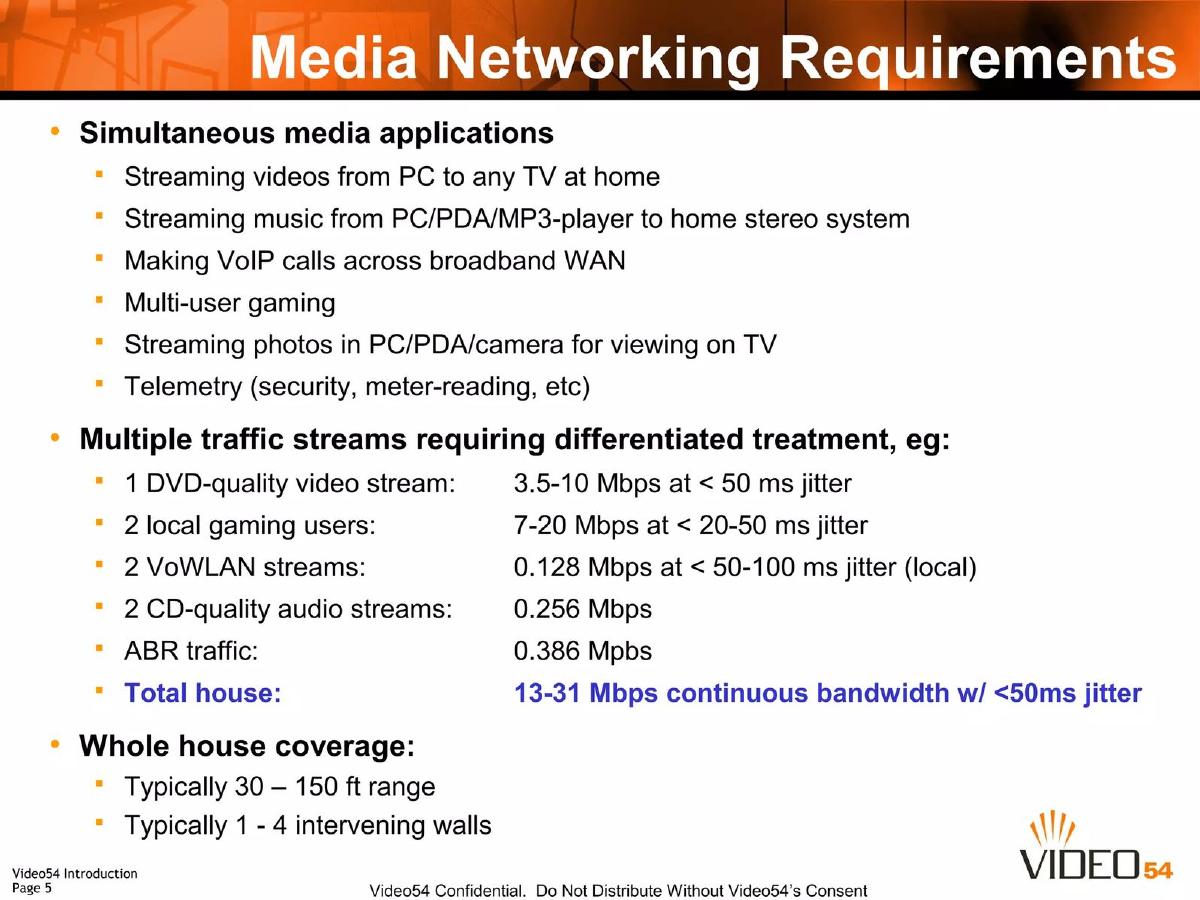
- The deck defines the problem through specific technical requirements, citing a need for 13-31 Mbps continuous bandwidth for a 'Total house' (Slide 5).
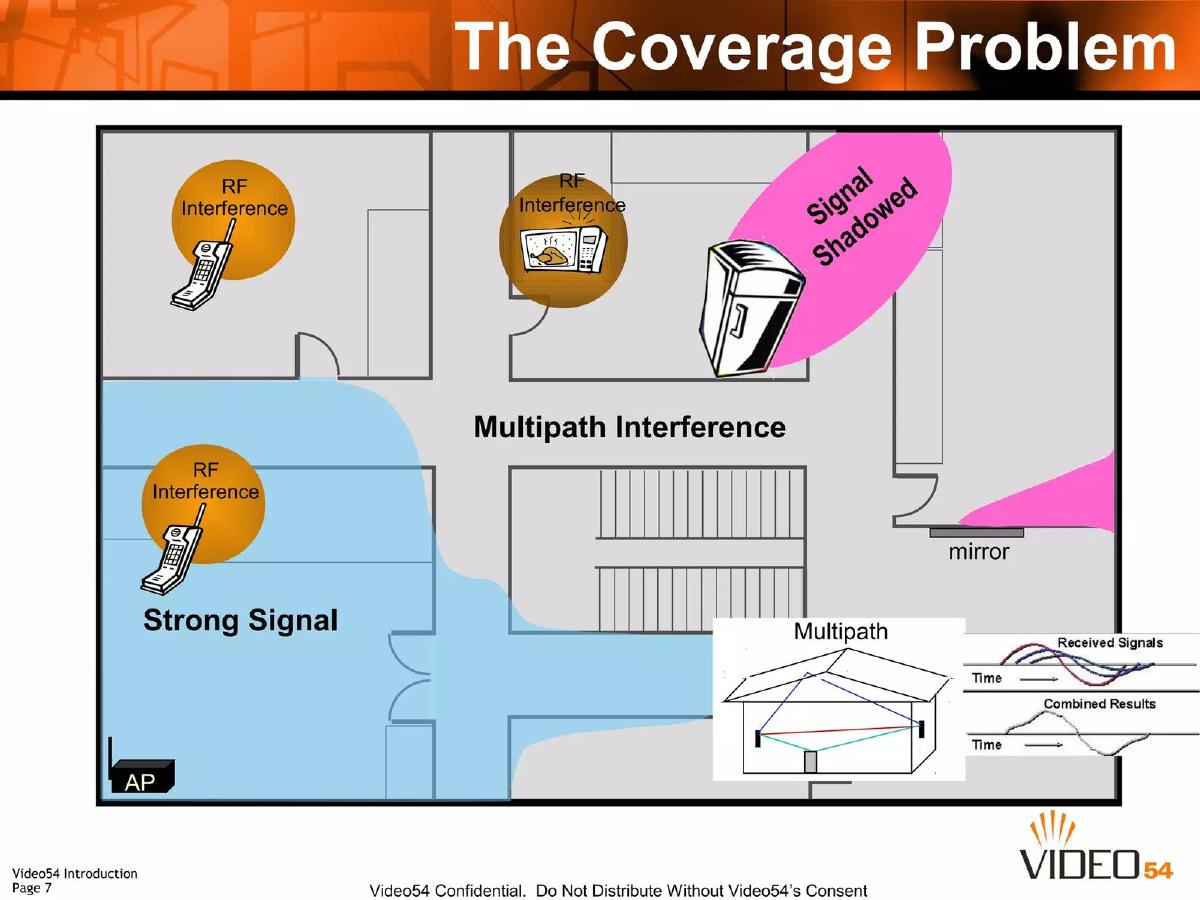
- Visual aids are used effectively to illustrate 'Multipath Interference' and 'Signal Shadowing' caused by common household items like refrigerators and mirrors (Slide 7).
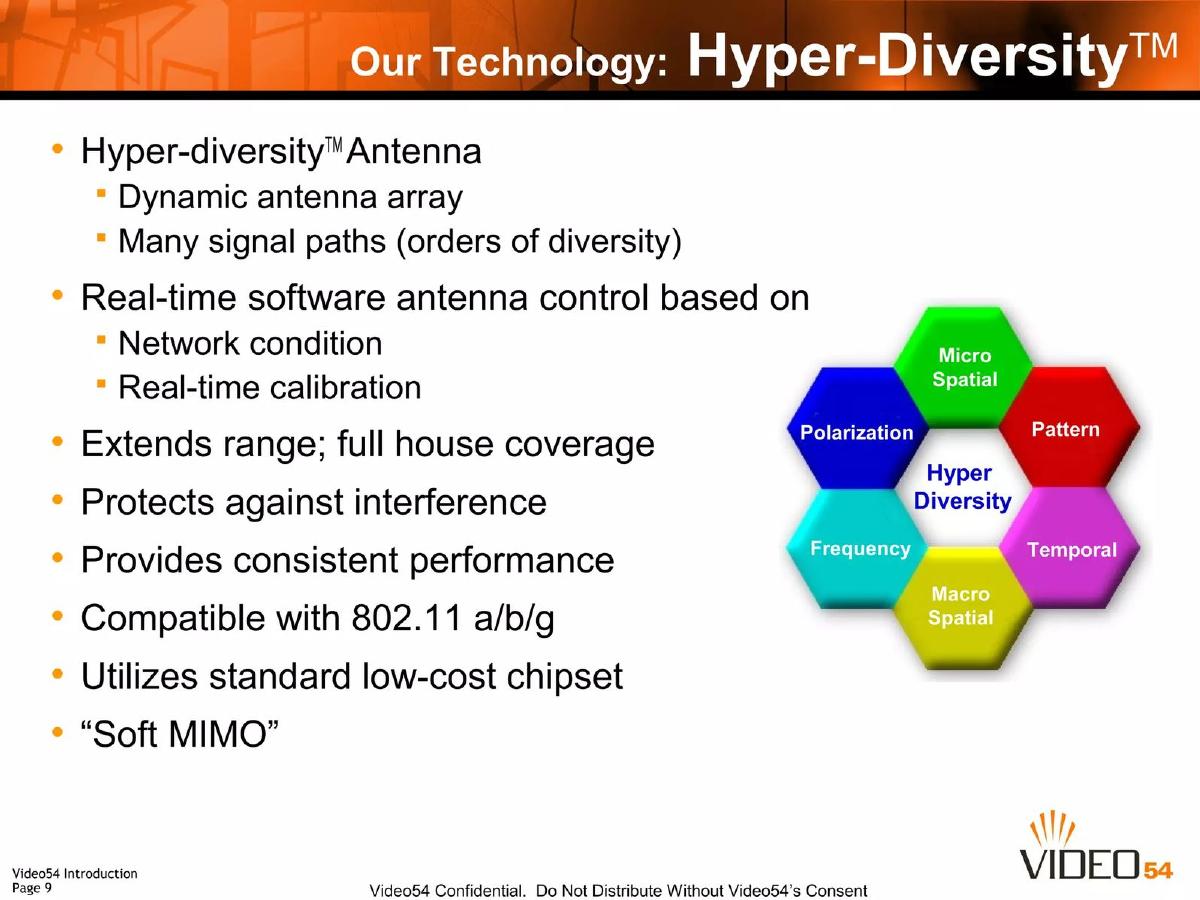
- The core value proposition is 'Hyper-Diversity,' a dynamic antenna array that provides 'Soft MIMO' using standard low-cost chipsets (Slide 9).
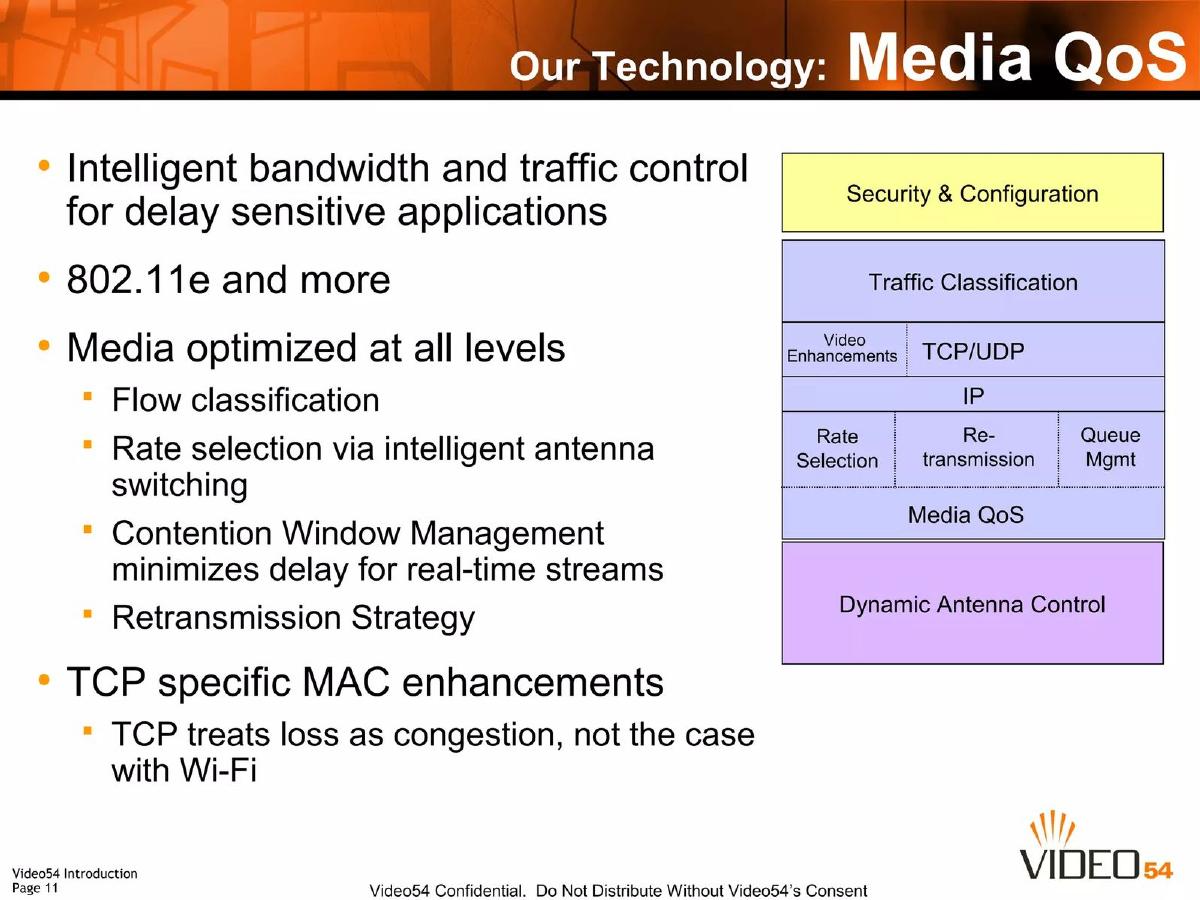
- Technical differentiation is furthered by 'Media QoS' which includes intelligent antenna switching and retransmission strategies (Slide 11).
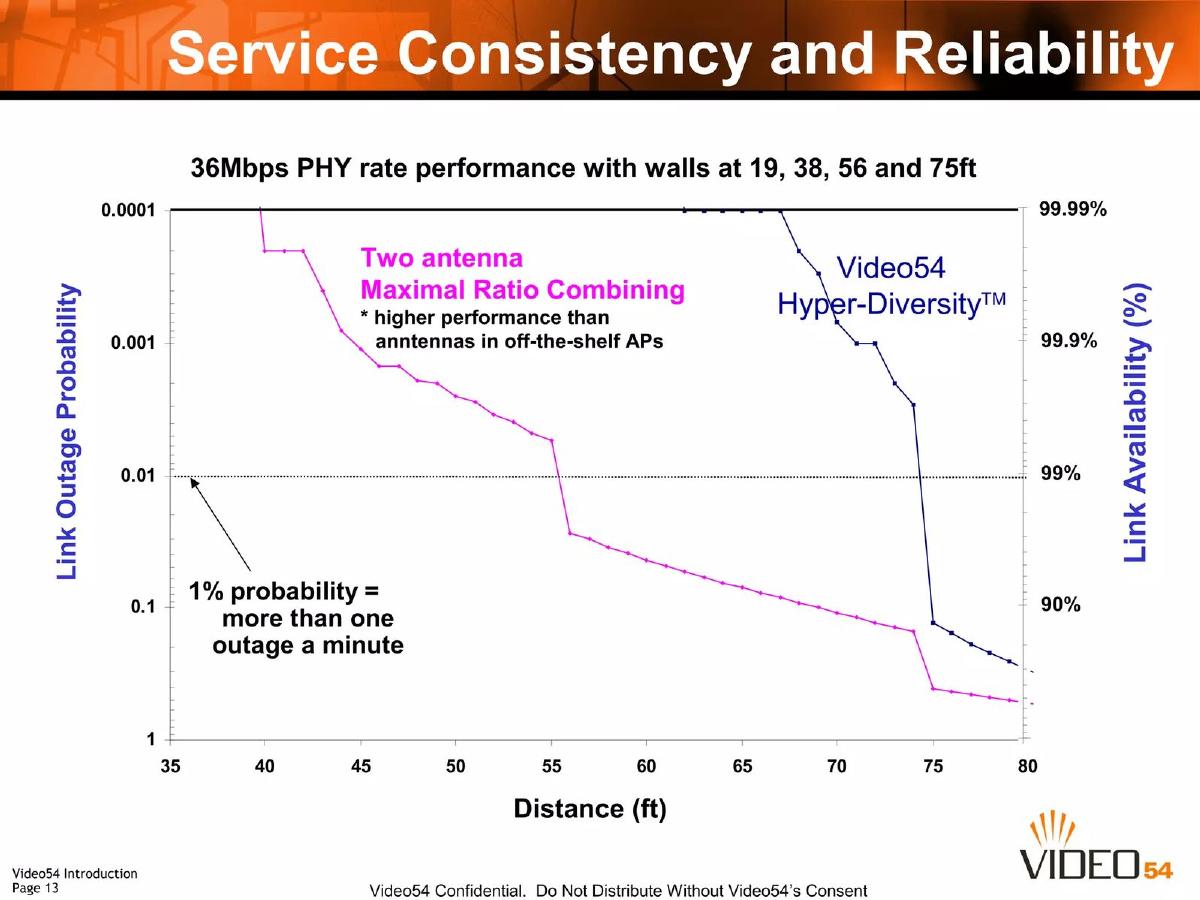
- Performance is validated through a comparison chart showing Video54 maintaining 99.9% link availability at 70 feet, where standard two-antenna systems drop below 90% (Slide 13).
- A competitive matrix positions Video54 as 'Excellent' across QoS, Cost, Adoption, and Support, outperforming 802.11x, UWB, and HomePlug (Slide 15).
- The go-to-market strategy is split between standalone access points and integrated client systems, targeting a Q4 2004 launch (Slide 17).
Executive Summary: A Technical Deep Dive into Wireless Infrastructure
The Video54 Series A deck is a relic of a time when hardware innovation was the primary driver of Silicon Valley venture capital. Unlike modern decks that lead with 'social proof' or 'explosive growth,' Video54 leads with engineering specifications. The company, which would later become Ruckus Wireless, focuses entirely on the physics of radio frequency (RF) and the limitations of the then-current 802.11 standards. The deck is 19 slides in total, with the 10 provided slides covering the team, the technical problem, the proprietary solution, and the competitive landscape.
Slide 1: Title Slide
The title slide is minimalist, featuring the Video54 logo and the tagline 'Wi-Fi for Digital Media.' It establishes the company's focus immediately: this is not general-purpose networking, but networking specifically optimized for the high-bandwidth, low-latency demands of digital media. The footer contains a standard confidentiality notice.
Slide 3: The Pedigree of the Team
Slide 3, titled 'People,' is perhaps the most important slide for a Series A hardware company in 2004. It lists a 'who's who' of networking history. CEO Selina Lo and Chairman Dominic Orr are linked to Alteon and Nortel, companies central to the build-out of the internet backbone. CTO Bill Kish and Architect Victor Shtrom bring the deep technical expertise in protocols and MIMO-OFDM (Multiple Input, Multiple Output - Orthogonal Frequency Division Multiplexing). The inclusion of Gaurav Garg from Sequoia Capital as a Director signals that the company already has top-tier institutional backing, which serves as a powerful validation for other potential investors.
Slide 5: Quantifying the Media Networking Requirements
On Slide 5, Video54 moves from the 'who' to the 'what.' They define the requirements for a modern (2004) home. They list specific applications: streaming video from PC to TV, multi-user gaming, and VoIP. Crucially, they quantify these needs. They state that a 'Total house' requires '13-31 Mbps continuous bandwidth w/ <50ms jitter.' By providing these exact figures, they set a technical bar that they will later show their competitors cannot meet. They also define 'Whole house coverage' as a 30-150 ft range through 1-4 intervening walls.
Slide 7: Visualizing the Coverage Problem
Slide 7 uses a floor plan diagram to illustrate 'The Coverage Problem.' It identifies three main enemies of Wi-Fi: RF Interference (from cordless phones and microwaves), Signal Shadowing (caused by large metal objects like refrigerators), and Multipath Interference (signals bouncing off mirrors and walls). The diagram shows a 'Strong Signal' area in blue, but highlights how quickly the signal degrades or is blocked in a standard home layout. This visualizes the 'why' behind the technical requirements mentioned on the previous slide.
Slide 9: The Solution - Hyper-Diversity
Slide 9 introduces the company's core intellectual property: 'Hyper-Diversity.' They describe it as a 'Dynamic antenna array' that offers 'Soft MIMO.' The key takeaway here is that the technology is 'Compatible with 802.11 a/b/g' and 'Utilizes standard low-cost chipsets.' This is a critical business point; it suggests that Video54 can achieve superior performance without needing to manufacture their own expensive custom silicon, which significantly lowers the barrier to entry and improves potential margins.
Slide 11: Media QoS and Software Intelligence
Moving beyond just the antenna, Slide 11 discusses 'Media QoS' (Quality of Service). This slide explains the software layer that manages the hardware. It mentions 'Intelligent bandwidth and traffic control' and 'TCP specific MAC enhancements.' The diagram on the right shows a stack where 'Dynamic Antenna Control' sits at the base, supporting various layers of traffic classification and rate selection. This reinforces the message that Video54 is a systems company, not just an antenna company.
Slide 13: Performance Validation through Data
Slide 13 provides the 'proof.' It features a line graph comparing 'Link Outage Probability' against 'Distance.' The chart shows a standard 'Two antenna Maximal Ratio Combining' system (the pink line) seeing a sharp increase in outages after 55 feet. In contrast, the 'Video54 Hyper-Diversity' system (the blue line) maintains a near-zero outage probability until approximately 70 feet. The slide explicitly notes that a 1% probability equals 'more than one outage a minute,' framing the competitor's performance as unacceptable for media streaming.
Slide 15: The Competitive Landscape
Slide 15 is a classic competitive matrix. It compares Video54 against 802.11x, UWB, HomePNA, Coax (MOCA), HomePlug, and 1394c. The matrix uses a color-coded 'Good/Fair/Excellent' scale across metrics like Bandwidth, Reach, QoS, Cost, and Consumer Adoption. Video54 is the only row that is entirely green (Excellent) or 'Good+.' The 'Notes' column for competitors highlights their flaws, such as 'poor whole-home AV networking' for UWB or 'little market success' for HomePlug. Video54 is noted as 'Available Q4 2004.'
Slide 17: Go-to-Market Strategy
Slide 17 outlines the path to revenue. The strategy is to start with a 'Standalone AP' (Access Point) to build the brand, then move into 'CE Integrated AP or Client systems.' The final bullet point, 'Partner for mass distribution,' suggests an OEM or licensing model. This is a standard hardware rollout strategy: prove the tech with a high-end branded product, then scale through integration into third-party devices like televisions or set-top boxes.
Slide 19: The Video54 Advantages
The final slide summarizes the pitch. It hits four pillars: Maximize customer experience (eliminating variability), Performance (HDTV-ready Wi-Fi), Availability (Q4 2004 launch, no need for new standards), and Low cost (off-the-shelf components). It serves as a closing argument, reiterating that the company offers a high-performance solution that is ready now and won't break the bank.
What Works and What is Missing
What Works: The deck is exceptionally strong at defining a technical problem and proving a technical solution. The use of specific metrics (Mbps, ms jitter, feet of range) makes the claims verifiable and grounded. The team slide is world-class for the sector, providing immediate credibility. The competitive matrix is well-researched, citing 'In-stat/MDR 4/04' as a source, which adds an extra layer of objectivity to their self-positioning.
What is Missing: The deck is almost entirely devoid of business and financial data. There is no mention of the total market size (TAM), which would usually be a requirement for a Series A pitch. There are no financial projections, no discussion of the manufacturing supply chain, and no 'Ask' slide detailing how much money they are raising or how they will spend it. While the technical 'how' is answered, the business 'how'—how they will acquire customers and what the unit economics look like—is left unaddressed in these slides.
Founder Takeaways: Lessons from Video54
Lead with Expertise: If you have a team with a track record of exits or deep technical contributions in a complex field, put them at the front. Video54 used their team slide to tell investors, 'We have built the backbone of the internet; we can certainly fix home Wi-Fi.'
Quantify the Pain: Don't just say the current solution is 'bad.' Video54 defined exactly how much bandwidth a home needed and exactly where the current solutions failed. This makes the 'Problem' slide an objective reality rather than a subjective opinion.
Visual Proof: The graph on Slide 13 is a powerful tool. It takes a complex concept (link availability) and turns it into a clear visual win for the company. Founders should always look for ways to turn their technical advantages into a 'higher and to the right' or 'lower and to the left' visual representation.
Focus on Integration: By emphasizing that their tech works with 'standard low-cost chipsets' and 'existing 802.11 devices,' Video54 removed a major risk factor for investors: the need for industry-wide adoption of a new standard. Showing how your innovation fits into the existing ecosystem is often more persuasive than trying to replace it entirely.
Frequently asked questions
- What was the primary technical problem Video54 aimed to solve?
- Video54 targeted the unreliability of early Wi-Fi for multimedia. As shown on Slide 5, they identified that a typical home required 13-31 Mbps of continuous bandwidth with less than 50ms of jitter to support simultaneous video, gaming, and VoIP. Existing 802.11 standards suffered from 'Signal Shadowing' and 'Multipath Interference' caused by physical obstacles and other RF devices, which Video54 aimed to overcome with their antenna technology.
- How did Video54 differentiate its technology from standard Wi-Fi?
- The company introduced 'Hyper-Diversity,' a dynamic antenna array system. According to Slide 9, this 'Soft MIMO' technology utilized real-time software control to adjust to network conditions. Unlike standard hardware that relied on fixed paths, Video54’s system used multiple signal paths and real-time calibration to maintain performance using standard, low-cost chipsets, rather than requiring expensive, specialized silicon.
- Who were the key people behind Video54 at the time of this deck?
- The team was composed of networking veterans. CEO Selina Lo and Chairman Dominic Orr both had backgrounds at Alteon and Nortel. CTO Bill Kish came from Berkeley Networks and Fore Systems, while Chief Wireless Architect Victor Shtrom had experience with MIMO-OFDM at Iospan Wireless. Notably, Gaurav Garg of Sequoia Capital was already listed as a Director on Slide 3.
- What was the company's go-to-market strategy?
- As outlined on Slide 17, the strategy was multi-pronged. They planned to launch a standalone Access Point (AP) to establish the Video54 brand in the high-performance niche. Simultaneously, they sought to integrate their technology into Consumer Electronics (CE) client systems and partner with larger entities for mass distribution. The deck targeted a product availability date of Q4 2004.
- What critical business information is missing from this pitch deck?
- This is a purely technical and strategic deck. It lacks all standard financial metrics, including current burn rate, revenue projections, and the specific dollar amount requested for the Series A. Furthermore, there is no mention of the Total Addressable Market (TAM) or a detailed breakdown of the unit economics for their hardware.