VideoPlaza’s 2008 seed deck is a focused pitch targeting the then-nascent online video advertising sector. The company positioned itself as a bridge between publishers and advertisers, claiming its non-intrusive ad formats could triple revenues for customers. The deck is notable for its clear two-phase strategy: starting as a technology provider (a $400m opportunity) before expanding into a full ad sales marketplace (a $2.8bn opportunity). With a specific ask of €350k to cover operations from Q3 2008 to Q2 2009, the deck provides granular financial projections, including headcount growth and…
Key takeaways
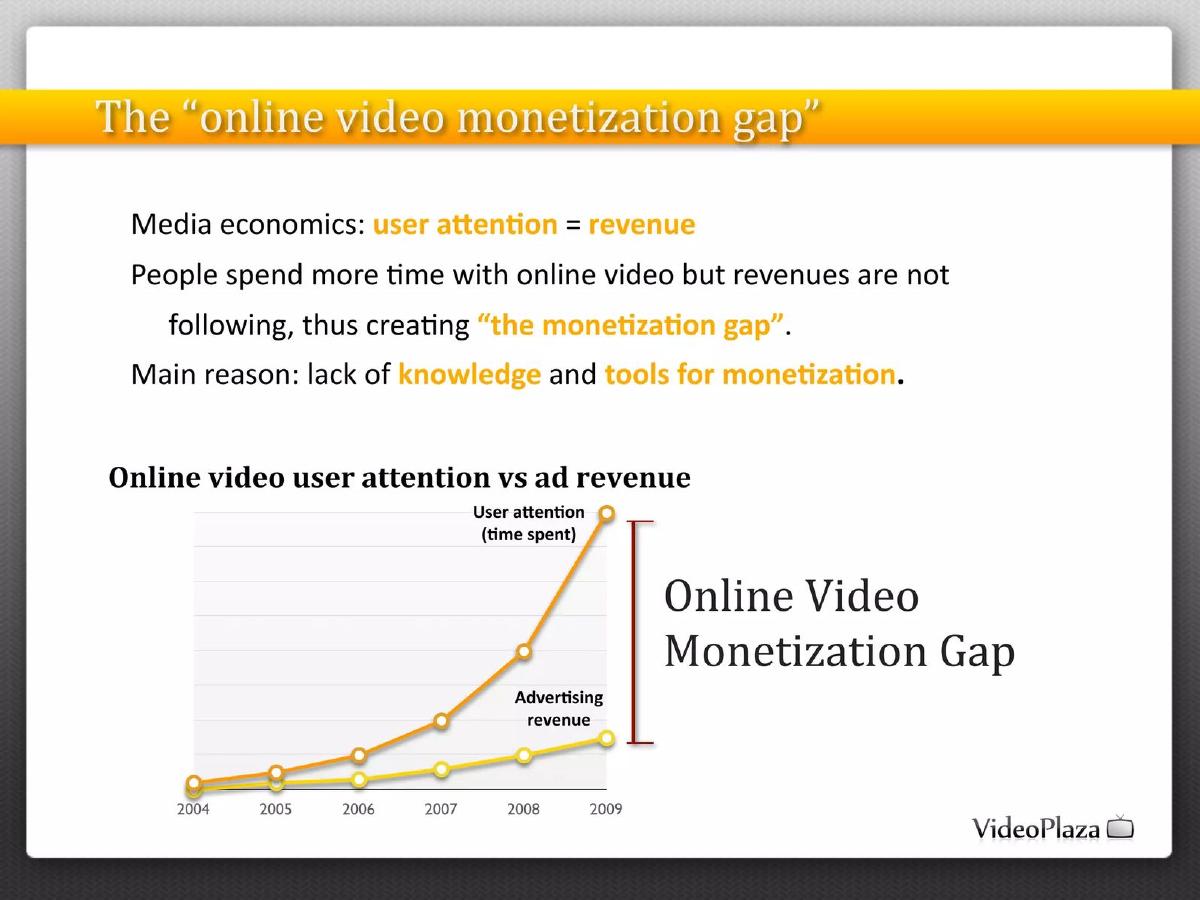
- The company claims its non-intrusive ad formats are proven to almost triple advertising revenues for customers (Slide 2).
- VideoPlaza identifies a total online video advertising spend of $8 billion by 2012, with their specific addressable market reaching $2.8 billion in Phase 2 (Slide 4).
- Early traction is demonstrated through a 'pipe' of high-profile customers including MTG, Eurosport Sweden, and Bonnier Tidskrifter (Slide 5).
- The product vision involves moving from simple distribution to a 'cloud of inventory' featuring advanced behavioral targeting (Slide 7).
- Financial projections for 2008 show a total investment of €306k against revenue of €54k (Slide 9).
- The specific capital requirement is stated as €350k to fund the business from Q3 2008 until Q2 2009 (Slide 9).
- The deck projects a significant team expansion in 2009, growing from roughly 3.5 total staff units to 25 units by the end of the year (Slide 9).
- The business model relies on three key values: customer understanding, technological brilliance, and aggressive sales (Slide 6).
Introduction and Value Proposition
Slide 1: Title Slide
The deck opens with a minimalist title slide featuring the VideoPlaza logo and the tagline "monetizing online video." The branding uses a yellow and orange color palette with a simple television icon. There are no mentions of the specific funding round or date on this slide, though the source listing identifies it as a 2008 seed deck.
Slide 2: The Mission
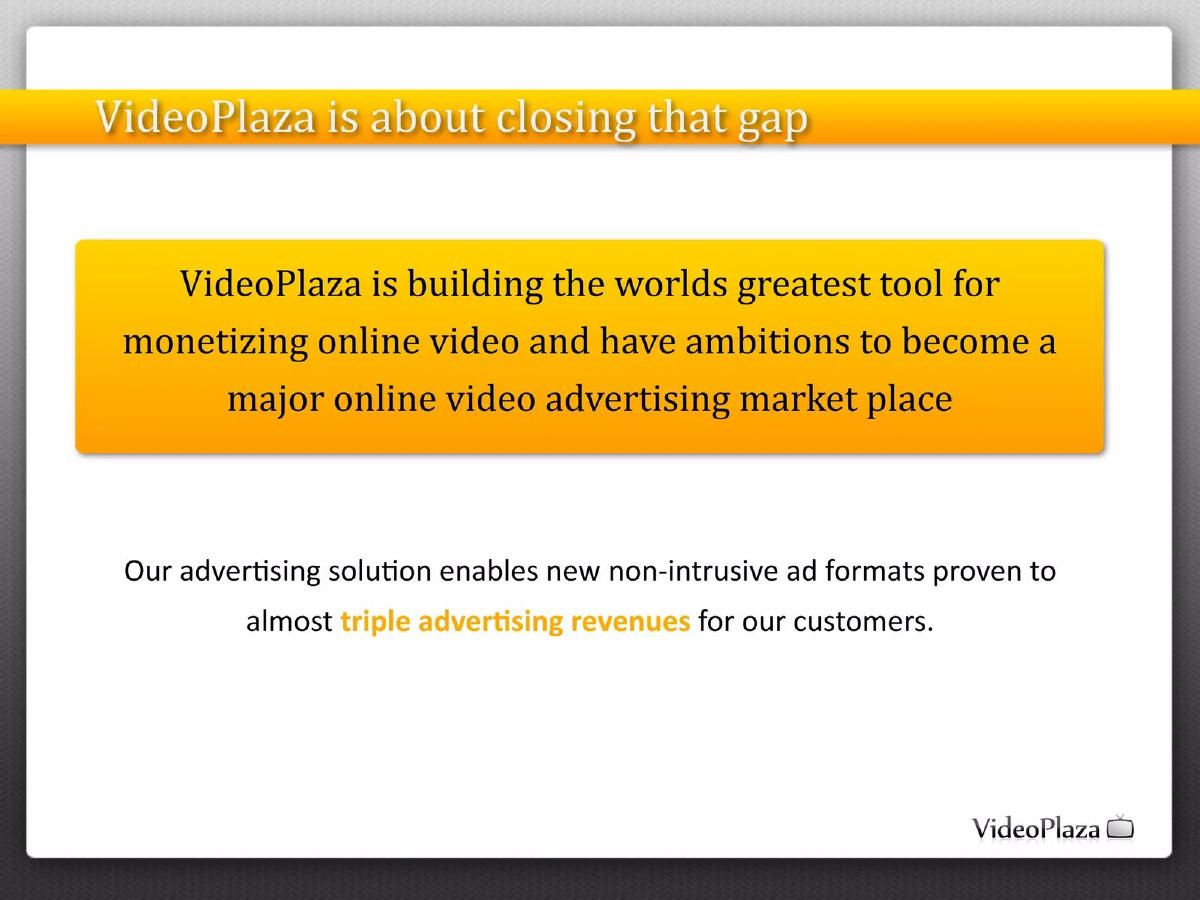
Slide 2 states that "VideoPlaza is about closing that gap." It defines the company's ambition to build the "worlds greatest tool for monetizing online video" and to become a "major online video advertising market place." Crucially, it includes a specific performance claim: their non-intrusive ad formats are "proven to almost triple advertising revenues for our customers."
Product and Market Opportunity
Slide 3: Product Demo
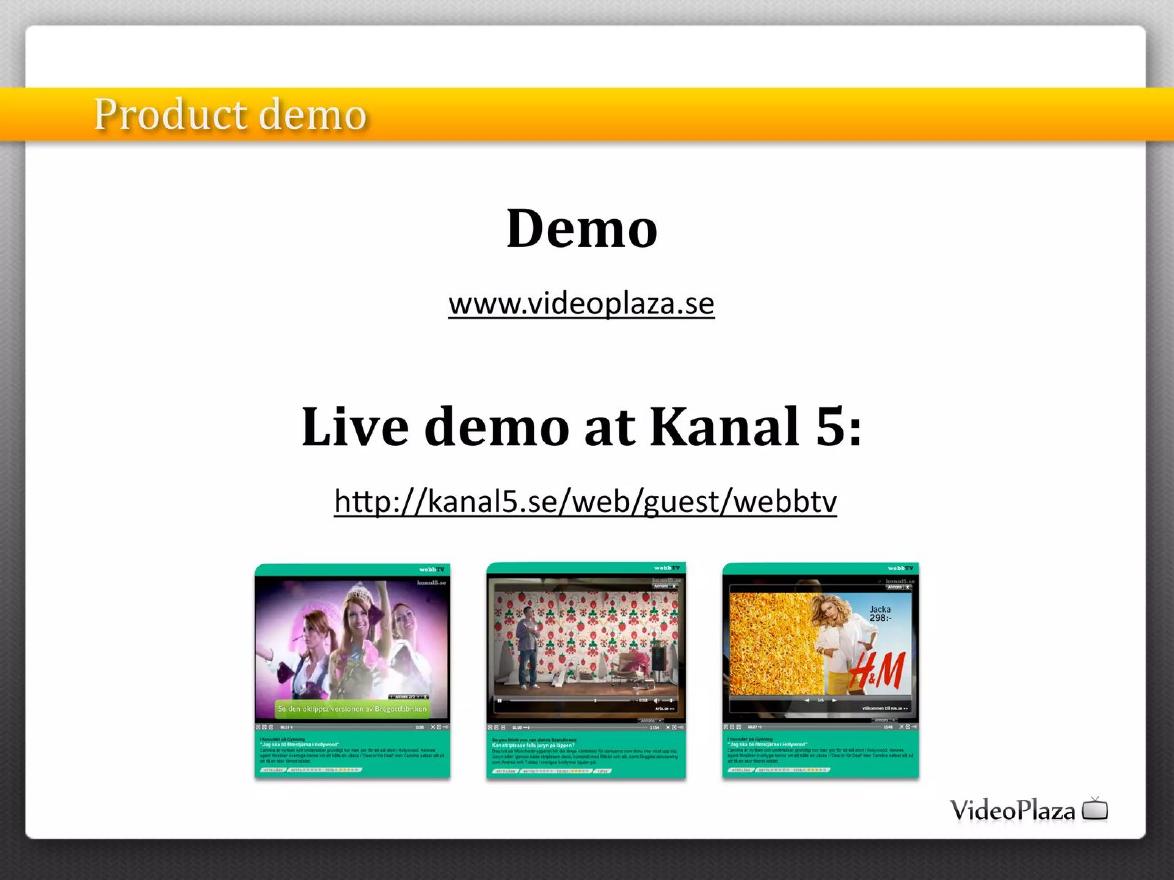
This slide serves as a placeholder for a live demonstration. It provides a URL (www.videoplaza.se) and a link to a live implementation at Kanal 5 . Three screenshots show the ad technology in action, appearing to display overlay ads and side-bar integrations within a web-based video player. The screenshots feature brands like H&M and Arla, demonstrating real-world application.
Slide 4: Market Size and Phases
VideoPlaza uses slide 4 to quantify the opportunity. They cite a total online video advertising spending of $8 billion by 2012 . A pie chart breaks this down by actor: Site owners (65%), Ad sales (30%), and Ad technology (5%). The slide outlines a two-phase growth strategy:
Phase 1: Focus on the technology product, valued at a $400m opportunity. · Phase 2: A combination of technology and ad sales, targeting a $2.8bn opportunity.
Traction and Strategy
Slide 5: Customer Pipeline
This slide lists several high-profile media companies described as being "in the pipe." The list includes:
MTG - TV3, TV6, TV8 and ZTV · Eurosport Sweden · MTV Nordic - MTV & Nickelodeon in Nordic countries · Expressen - Sweden’s second largest tabloid · Power Challenge - Worldwide online gaming site · Bonnier Tidskrifter - Largest magazine publisher in Sweden
The inclusion of these logos provides significant social proof for a seed-stage company, indicating strong regional market penetration in Sweden and the broader Nordic region.
Slide 6: Key Values
Slide 6 outlines the internal pillars of the company: 1- Customer understanding, 2- Technological brilliance, and 3- Aggressive sales. This is a standard strategic slide intended to communicate the culture and operational focus of the founding team.
Slide 7: Future Vision
Titled "Future cloud of opportunities," this slide contrasts the "Today" model with the "Tomorrow" model. The current model is a linear distribution from publisher inventory through VideoPlaza technology to publisher sales. The future model envisions VideoPlaza as a central hub (an ad network) that performs "cross site data collection," "advanced behavioral targeting," and creates a "cloud of inventory from many publishers" for smart trading with advertisers and media agencies.
Financials and The Ask
Slide 8: Finance Section Header
A simple transition slide marking the fourth section of the presentation: Finance. It uses a numbered list (1 Business, 2 Market, 3 Strategy, 4 Finance) to show the deck's progression.
Slide 9: Investments and Capital Need
This is the most data-dense slide in the deck, providing a full breakdown of costs and revenue projections for 2008 and 2009. Key figures include:
2008 Projections: Total investment of €306k against revenue of €54k , resulting in a net loss of €252k . · 2009 Projections: Total investment of €1.3m against revenue of €836k , resulting in a net loss of €464k . · Headcount: The team is projected to grow from 3.5 units in Q1/Q2 2008 to 25 units by Q3/Q4 2009 (comprising 5 Business, 10 Sales, and 10 Development). · Capital Need: The slide explicitly asks for €350k to fund operations from Q3 2008 until Q2 2009.
The slide also notes a 30% salary increase planned for 2009 and a monthly salary cost unit of 4 (presumably €4k per month per head).
What Works and What is Missing
What Works
The deck is exceptionally clear about its market positioning . By breaking the $8bn market into segments and identifying exactly which segments they are targeting in Phase 1 versus Phase 2, the founders demonstrate a sophisticated understanding of the value chain. The traction slide is also a major strength; for a seed round, having names like MTV and Bonnier in the pipeline suggests high product-market fit. Finally, the financial transparency on slide 9 is rare for a seed deck. It doesn't just ask for money; it shows exactly how many people will be hired in which departments and what the expected revenue offset will be.
What is Missing
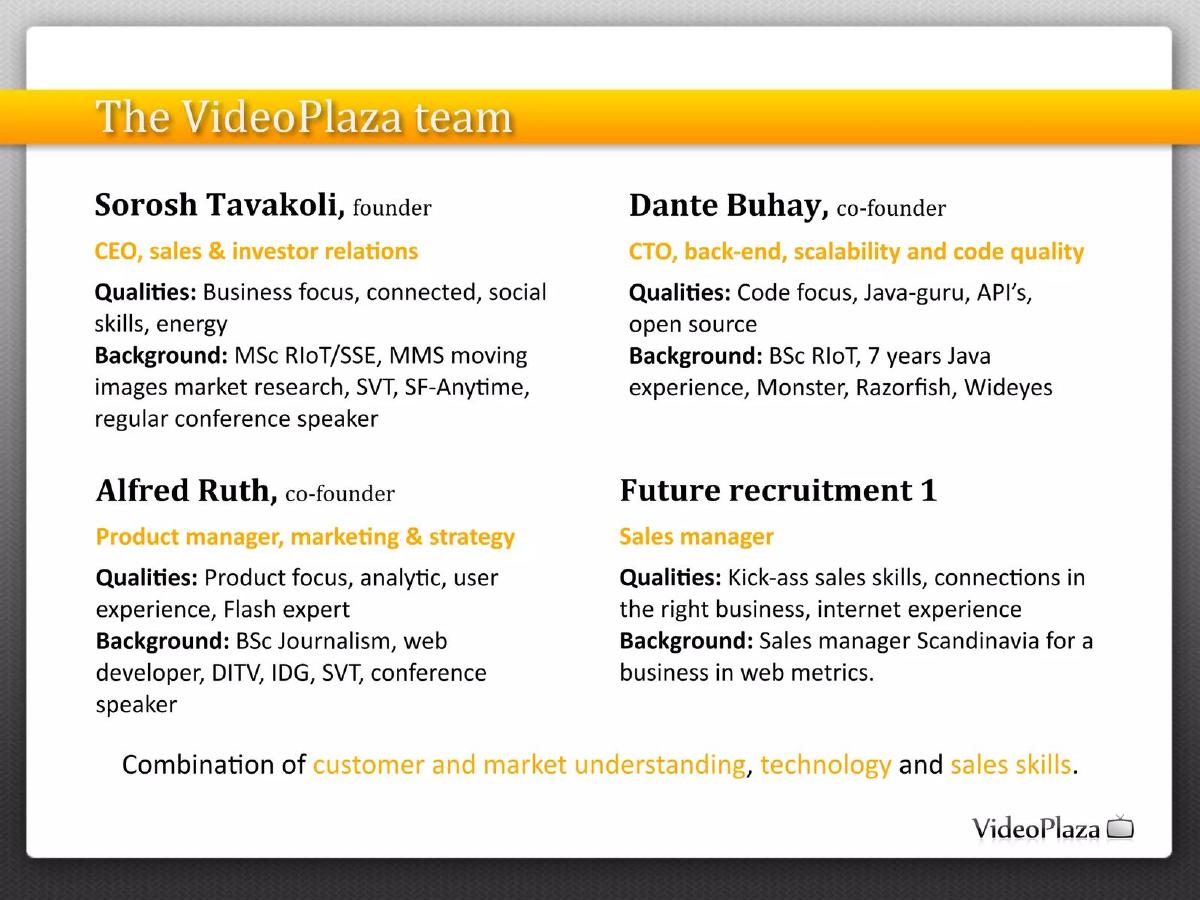
The most significant omission in this 9-slide selection is a Team Slide . While the source listing mentions this is a 27-slide deck, the absence of the founders' backgrounds in this core set makes it difficult to assess execution risk. There is also no Competitor Analysis . In 2008, the online video space was becoming crowded, and failing to mention how VideoPlaza differed from existing ad servers or early video platforms is a gap. Additionally, while "non-intrusive ad formats" are mentioned, there is no technical detail on how these formats work or why they are difficult for competitors to replicate.
Founder Takeaway: The Two-Phase Strategy
Founders should study slide 4 as a masterclass in TAM/SAM/SOM visualization . Instead of just claiming a multi-billion dollar market, VideoPlaza identifies the specific niche they can win today (Ad Tech - 5%) and explains the bridge to the larger opportunity (Ad Sales - 30%). This makes a massive market claim feel grounded and achievable. Furthermore, the explicit capital need tied to a specific timeframe (Q3 2008 to Q2 2009) is a best practice that removes ambiguity for investors regarding the runway the investment provides.
Frequently asked questions
- What was VideoPlaza's core value proposition in 2008?
- VideoPlaza focused on 'monetizing online video' by providing non-intrusive ad formats. According to slide 2, their solution was designed to close the gap in the market and was proven to nearly triple advertising revenues for their customers. They positioned themselves as a tool that would eventually evolve into a major online video advertising marketplace.
- How did VideoPlaza segment their market opportunity?
- On slide 4, the company broke down the $8 billion online video ad market into three segments: Site owners (65%), Ad sales (30%), and Ad technology (5%). VideoPlaza's strategy involved a two-phase approach. Phase 1 focused on the $400m technology segment, while Phase 2 aimed for a $2.8bn opportunity by combining technology with ad sales.
- What kind of traction did the company have at the time of the pitch?
- Slide 5 lists several major media entities 'in the pipe,' suggesting strong regional traction in the Nordic market. Notable names include MTG (TV3, TV6, TV8, ZTV), Eurosport Sweden, MTV Nordic, Expressen (Sweden's second-largest tabloid), and Bonnier Tidskrifter (Sweden's largest magazine publisher).
- What were the financial requirements and projections for the seed round?
- As shown on slide 9, VideoPlaza sought €350k to cover the period from Q3 2008 to Q2 2009. They projected 2008 revenues of €54k against €306k in investments, resulting in a €252k loss. For 2009, they projected a significant revenue jump to €836k, though losses were expected to widen to €464k due to increased hiring.
- What was the long-term product vision described in the deck?
- Slide 7 illustrates a 'Future cloud of opportunities.' The vision was to move from a simple distribution model to a 'smart trade' system. This involved using VideoPlaza technology for cross-site data collection and advanced behavioral targeting, ultimately creating a 'cloud of inventory from many publishers' to serve advertisers and media agencies.