Vibranium Labs secured $4.6M in Seed funding in 2024 by positioning their product, Vibe AI, as a 24/7 autonomous incident engineer. The deck relies heavily on the 'Team' slide, featuring founders with experience at Google, Amazon, and FiscalNote, which likely served as the primary trust signal for investors. The narrative focuses on the transition from reactive to proactive Site Reliability Engineering (SRE), using relatable industry tropes like the 'This is Fine' meme to anchor the problem space. While the deck excels at identifying specific operational bottlenecks—such as the 53% of respond…
Key takeaways
- The team slide (Slide 2) is the deck's strongest asset, featuring a CEO who led Vertex AI for Google's private cloud and a Chairman who founded a $1B+ legal SaaS company.
- Vibranium identifies 'Diagnosing the problem' as the primary pain point, cited by 53% of survey respondents on Slide 5.
- The product claims to solve the '60% incident coverage' ceiling of generic AI models by training on proprietary incident data (Slide 6).
- The deck uses a 'This is Fine' meme on Slide 3 to build emotional resonance with the 'midnight pager' experience common in DevOps.
- Slide 7 provides a functional UI preview showing Vibe AI generating SQL queries to analyze table growth patterns during a disk space crisis.
- The closing slide (Slide 8) introduces hypothetical or early-stage metrics, including a 'Reduced Critical Incident Impact' value of $585,000.
- There is no explicit 'Ask' slide or valuation mention in the provided 15-slide sequence, which is atypical for a Seed deck.
- The deck omits a formal competitor landscape, choosing instead to focus on internal 'Defensible AI Differentiation' (Slide 6).
Vibranium Labs: The SRE Pedigree Play
Vibranium Labs entered the 2024 fundraising market with a specific mission: automating the most painful part of a software engineer's job. As reported by Business Insider, the company raised $4.6M in a Seed round. The deck they used is a masterclass in 'Founder-Market Fit,' leaning heavily on the professional history of its leadership team to justify a high-valuation entry into the crowded AI agent space. By focusing on the 'Incident Engineer' persona, Vibranium avoids the trap of being a 'generic' AI tool, instead targeting a high-value, high-pain enterprise niche.
Slide 1: The Hook
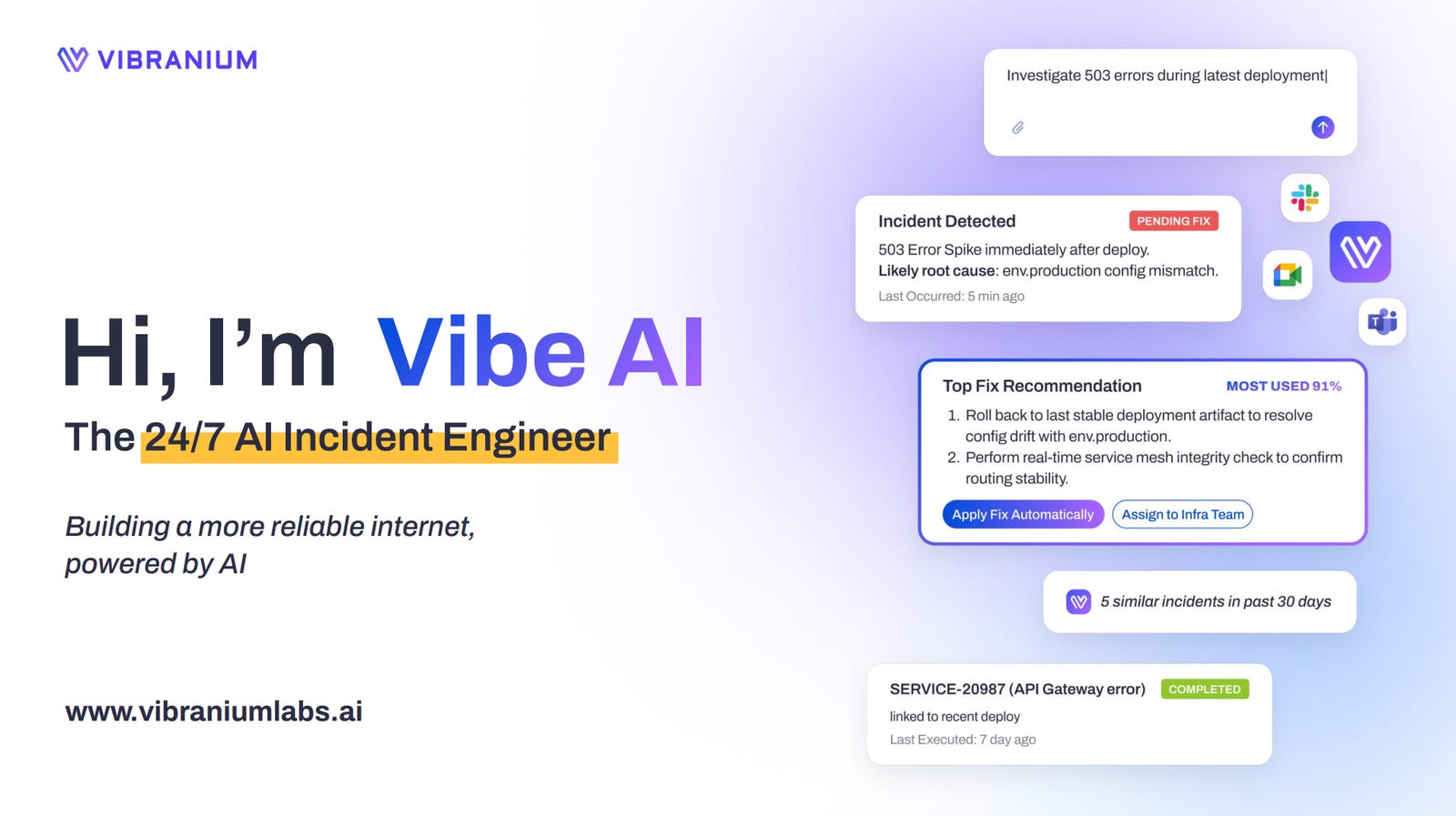
The title slide introduces 'Vibe AI' as the '24/7 AI Incident Engineer.' The visual design is clean, featuring a floating UI stack that shows an incident detection notification ('530 Error Spike') alongside a 'Top Fix Recommendation.' This immediately communicates the product's utility: it doesn't just tell you something is broken; it tells you how to fix it. The tagline 'Building a more reliable internet, powered by AI' sets a high-level vision, though the primary focus remains on the specific persona of the 'Incident Engineer.'
Slide 2: The Powerhouse Team
In a Seed round, the team slide is often the most important, and Vibranium places it second. This is a strategic move. CEO Sang Lee brings direct credibility from Google’s Vertex AI and Amazon. Chairman Tim Hwang adds 'Unicorn' credibility as the founder of FiscalNote ($1B+ valuation). CTO Charles Kim and COO Tanny Kang round out the group with experience from Instacart, Workday, and major law firms. For an investor, this slide mitigates the risk of execution; these are individuals who have seen scale and understand the enterprise environment.
Slide 3: The Emotional Anchor
Slide 3 uses the famous 'This is Fine' dog meme to illustrate 'A Software Engineer’s Worst Nightmare.' While memes can sometimes feel unprofessional in a pitch, here it serves as a shorthand for a very specific, expensive problem: the midnight pager alert. By showing a screenshot of a mobile pager app with a 'P0' (Priority 0) incident, the founders are signaling to investors that they understand the visceral pain of their target customer. This emotional connection is a bridge to the more analytical 'Problem Space' slide that follows.
Slide 4: The Problem Space
This slide breaks down the 'why' into three logical pillars: Operational Overload, Inefficient Work Processes, and Resource Constraints. It highlights 'Knowledge Silos' and 'Alert Fatigue' as primary drivers of burnout. The text is dense but specific, mentioning that 'skilled SREs spend time firefighting basic incidents.' This is a key economic argument: if a company can move its most expensive engineers away from Tier 1 tasks, the ROI of the software is self-evident.
Slide 5: Quantifying the Pain
Vibranium uses data points to validate their focus. According to the charts on Slide 5, 'Diagnosing the problem' is the most difficult part of an incident for 53% of respondents. Furthermore, 47% of organizations believe they could improve most by 'emphasizing learning versus fixing.' These statistics are crucial because they justify why Vibe AI focuses on 'Root Cause Analysis' and 'Action Items' rather than just simple monitoring. It positions the product as a solution to the specific bottlenecks identified by the industry.
Slide 6: The Competitive Edge
Slide 6, 'What Sets Us Apart,' addresses the 'AI Moat' question. The founders claim that generic models stop at ~60% incident coverage. Their 'Defensible AI Differentiation' is based on training on proprietary incident data. They also introduce the concept of 'Full Lifecycle Coverage,' moving from detection to prevention. By claiming to build a 'self-reinforcing knowledge engine,' they are pitching a product that theoretically becomes more valuable (and harder to replace) the longer an enterprise uses it.
Slide 7: The Product in Action
The 'Vibe AI Demo' slide provides a high-fidelity look at the dashboard. It shows a 'New Relic Alert' regarding database disk space. The AI generates a hypothesis ('Rapid growth in ordershistory') and provides the exact SQL command to verify it. This is a critical slide for technical investors. It proves the AI isn't just chatting; it is interacting with the infrastructure. The inclusion of a 'Confidence Level: 95%' and specific table sizes (15.2 GB, etc.) makes the demo feel grounded in reality.
Slide 8: The Economic Outcome
The final slide in the provided set serves as a contact page but also includes a 'Vibe in Action' dashboard. It lists impressive figures: 'FTE Saving $84,240' and 'Reduced Critical Incident Impact $585,000.' While these numbers are likely illustrative or based on a single pilot, they provide a framework for how the company intends to measure success. The slide also shows an 'Incident Trend' chart, suggesting that the tool helps reduce the frequency of high-severity (Sev0/Sev1) events over time.
What Works in the Vibranium Labs Deck
The deck's greatest strength is its specificity of persona . By naming the product an 'AI Incident Engineer,' they avoid the vagueness that plagues many AI startups. They are not 'AI for DevOps'; they are a digital teammate for a specific role. This makes the sales motion and the product roadmap much clearer to an investor.
The Team Slide is arguably in the top 1% of Seed decks. Having a founder who has already taken a company to a $1B+ valuation (Tim Hwang) significantly lowers the perceived risk of the investment. When combined with the CEO's deep technical background at Google and Amazon, the 'Founder-Market Fit' is undeniable.
Finally, the use of industry-specific data on Slide 5 is excellent. Instead of using broad market size (TAM) numbers, which are often inflated and ignored, they use process-oriented data. Identifying that 53% of the struggle is in 'diagnosis' allows them to point directly at their product's features as the solution.
What is Missing from the Vibranium Labs Deck
The most glaring omission is a Go-To-Market (GTM) strategy . While the product looks impressive, selling into enterprise IT and SRE teams is notoriously difficult due to security concerns and 'tool sprawl.' The deck does not explain how they plan to land their first 10–20 enterprise customers or what their pricing model looks like.
There is also a lack of a Competitor Landscape . The SRE and observability space is crowded with giants like Datadog, New Relic, and PagerDuty, as well as well-funded startups like incident.io. While Slide 6 touches on 'Generic Models,' it doesn't address how Vibe AI integrates with or replaces existing heavyweights in the stack.
Lastly, the 'The Ask' is missing . In a standard pitch deck, there is usually a slide detailing how much capital is being raised and exactly how it will be spent (e.g., 50% engineering, 30% sales, 20% ops). While we know from external reports they raised $4.6M, the deck itself doesn't state the funding goal or the milestones they intend to reach with that capital.
Founder Takeaways: What to Copy
Lead with your strengths: If you have a high-pedigree team, put them at the front of the deck. Vibranium didn't wait until Slide 12 to show their credentials; they used them to build immediate trust. · Anchor the problem in emotion: The 'This is Fine' meme works because it resonates with the actual lived experience of the customer. Use visuals that make the investor 'feel' the pain you are solving. · Show, don't just tell: The UI screenshot on Slide 7 is effective because it shows the AI performing a technical task (SQL querying) rather than just showing a chat bubble. · Use process metrics: If you don't have $1M in ARR yet, use survey data or industry benchmarks to prove that the specific problem you are solving is the one the market cares about most. · Define your 'Moat' early: In the age of LLMs, every investor will ask why OpenAI won't just build your product. Vibranium's answer—proprietary incident data and full-lifecycle coverage—is a solid starting point for that conversation.
Frequently asked questions
- What is the core value proposition of Vibe AI?
- Vibe AI is positioned as a '24/7 AI Incident Engineer.' According to Slide 6, it moves organizations from reactive to proactive reliability by ingesting multimodal data—logs, tickets, and chat—to surface instant context and recommended actions. It aims to cover the full incident lifecycle: detect, respond, resolve, and prevent, rather than just alerting.
- How does Vibranium Labs differentiate itself from other AI tools?
- On Slide 6, the company claims that generic AI models stop at approximately 60% incident coverage. Vibranium differentiates by training on proprietary incident data from real-world environments. This creates what they call a 'self-reinforcing knowledge engine' that documents actions and updates runbooks automatically, theoretically increasing autonomy over time.
- What specific problems in incident response does the deck highlight?
- Slide 4 categorizes the problem space into three pillars: Operational Overload (alert fatigue), Inefficient Work Processes (poor documentation), and Resource Constraints (skilled SREs doing Tier 1 work). Slide 5 backs this up with data, noting that 47% of organizations want to improve 'learning versus fixing' and 53% struggle with diagnosis.
- Who are the founders of Vibranium Labs?
- The team (Slide 2) includes CEO Sang Lee (former Google SRE/AI Engineer), Chairman Tim Hwang (Founder of FiscalNote), CTO Charles Kim (formerly of Workday and Instacart), and COO Tanny Kang (former M&A attorney at Freshfields). The combination of deep technical SRE experience and proven unicorn-scale leadership is a central theme.
- What metrics does the deck use to show traction?
- The deck is light on hard traction metrics. Slide 8 shows a dashboard with figures like 'FTE Saving $84,240' and 'Avg Response Time 4.2 minutes,' but these appear to be illustrative of the platform's output rather than aggregate company growth figures. No revenue or user growth charts are present in the provided slides.