Customer Interviews in a Pitch Deck: Who You Asked, What
How to present customer interviews in a pitch deck so they count as evidence: who you interviewed, how often each finding came up, what you changed.
Customer Interviews: Show Who You Asked, What Recurred, and What It Led To
"30 interviews." "~1,000 interviews with top remote managers." "We conducted 20 interviews with customers." "200+ user interviews across 7+ industries." Early founders often have no revenue yet, but they have talked to a lot of potential customers. Interviews can be real evidence that a problem exists and that you understand it. On a slide, though, a count of conversations proves only that conversations happened. This guide shows how four companies presented interviews, what an investor can and cannot check on each slide, and how to turn your own interviews into a slide that supports a decision.
TL;DR
A customer-interview slide needs four things beside the count. Who you spoke to: role, segment and how you found them. What recurred: the few findings that came up most, with how many interviews raised each. What you did: the product or pricing decision the interviews changed. And what happened next: sign-ups, pilots or payments from the people you interviewed. A count alone, or a wall of quotes, shows effort but not evidence.
Four real customer-interview slides
Each slide below is shown as it appears in the company's original deck, with what it says, what we checked and what an investor still cannot tell. They run from the slide that ties interviews to a next step, to the one that leans most on a large count.
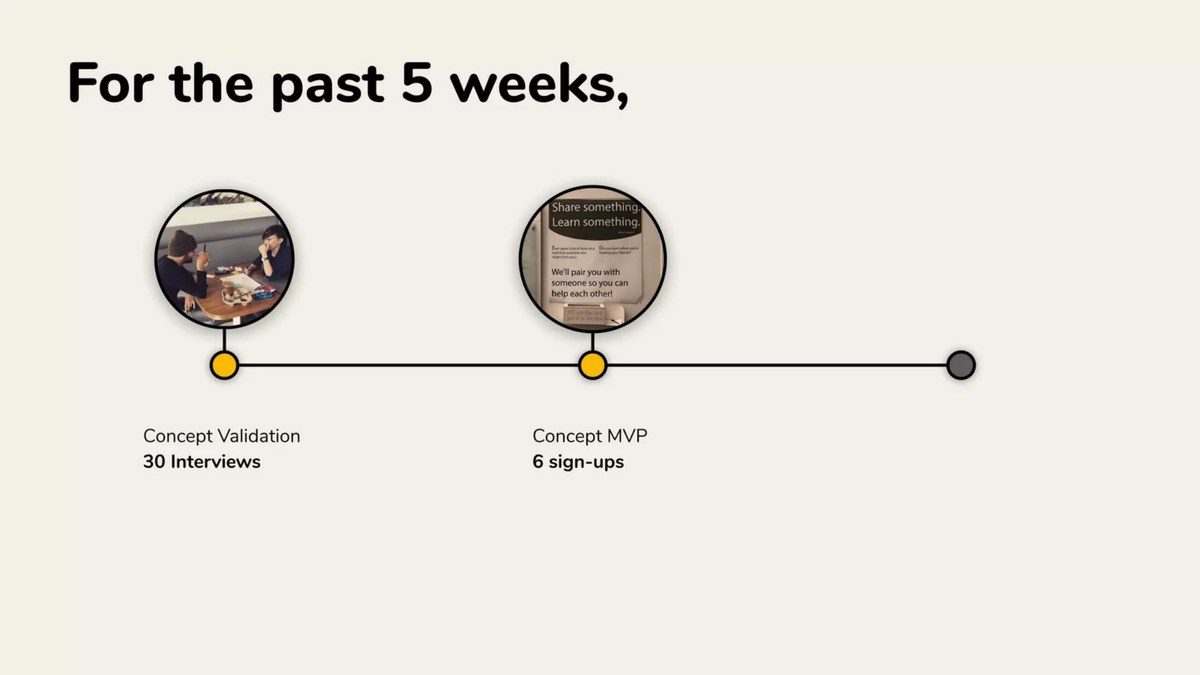
Hatch customer research slide — slide 26
Student skill-sharing concept (pairing students to teach each other); page 26 of a long early deck that builds the same timeline over pages 25 to 27.
Hatch deck, slide 26. Exact stored slide matched to this analysis.
Our analysis: This is the only slide of the four that puts interviews in a sequence with something people did afterwards, over a stated period. That structure is the right one. What it lacks is the content of the interviews: a reader learns the team talked to 30 people but not what those people said or how it shaped the MVP.
Evidence and limitation: Our check: 6 of 30 is 20%, if the sign-ups came from the people interviewed; the slide doesn't say whether they did. It also doesn't say who the 30 were, what was learned, or what the sign-ups committed to.
What a founder can adapt: "5 weeks: 30 interviews ([who]) → top finding [x]/30 → MVP → 6 sign-ups ([of whom n were interviewees])."
Supporting analysis
What the deck claims: Headline "For the past 5 weeks,". A timeline with two filled points: "Concept Validation — 30 Interviews" (photo of an in-person conversation) and "Concept MVP — 6 sign-ups" (photo of a printed flyer), with a third point not yet filled.
Presentation choice: It shows interviews placed as a step before a behaviour, over a stated period.
When it does not fit: Don't leave it unclear whether the sign-ups came from the people you interviewed.
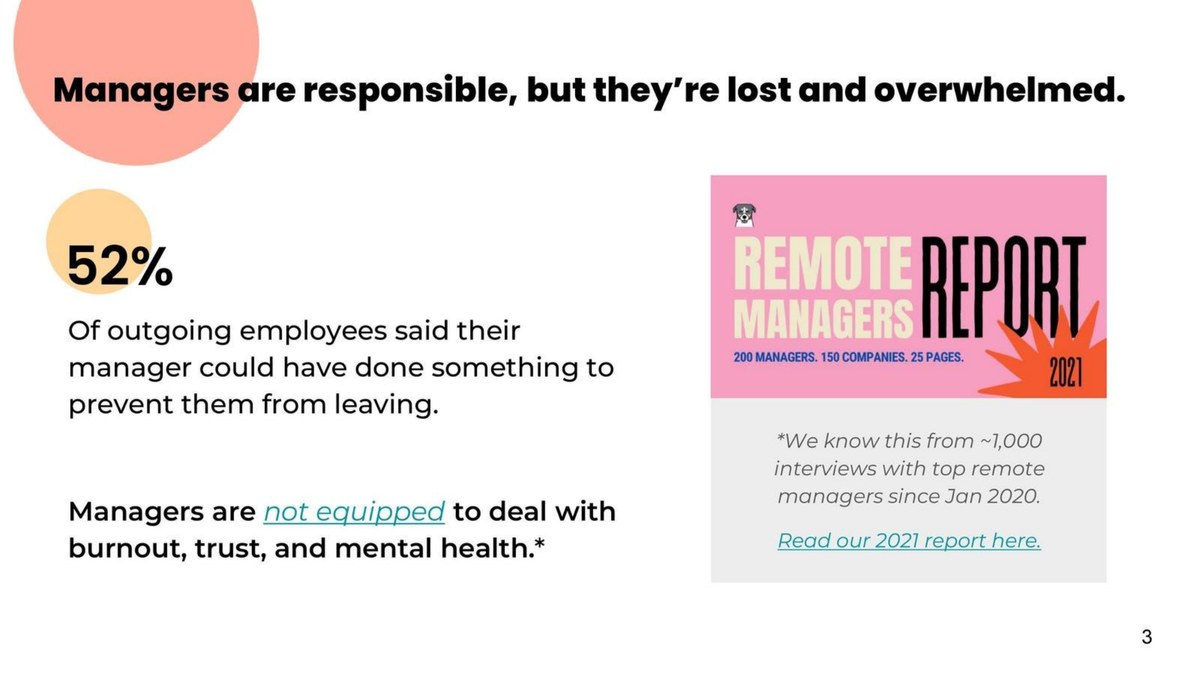
Team well-being tool for remote managers; page 4 (printed number 3), the problem slide.
Kona deck, slide 4. Exact stored slide matched to this analysis.
Our analysis: Using interviews as the footnote behind a problem claim is a sensible placement, and publishing a report gives an investor somewhere to check. But the slide mixes three populations: employees in the 52% figure, about 1,000 interview conversations, and 200 managers in the report. Giving each its own source and count would make the claim easier to trust.
Evidence and limitation: Our checks: the report cover says 200 managers and the footnote says about 1,000 interviews; the slide doesn't explain the difference (repeat conversations, or interviews beyond the report). The 52% figure has no source on the slide and describes outgoing employees, a different group from the managers interviewed.
What a founder can adapt: "From [n] interviews with remote managers ([period], [how recruited]): [x]/[n] said they lacked tools for burnout conversations. Full findings: [report, sample]."
Supporting analysis
What the deck claims: Headline "Managers are responsible, but they're lost and overwhelmed." "52% Of outgoing employees said their manager could have done something to prevent them from leaving." "Managers are not equipped to deal with burnout, trust, and mental health.*" Beside it, the cover of Kona's "Remote Managers Report 2021 — 200 managers. 150 companies. 25 pages." Footnote: "*We know this from ~1,000 interviews with top remote managers since Jan 2020." Link: "Read our 2021 report here."
Presentation choice: It shows interviews used as the source for a problem claim, with a published report behind them.
When it does not fit: Don't place a statistic from one group next to interviews with another without saying where each comes from.
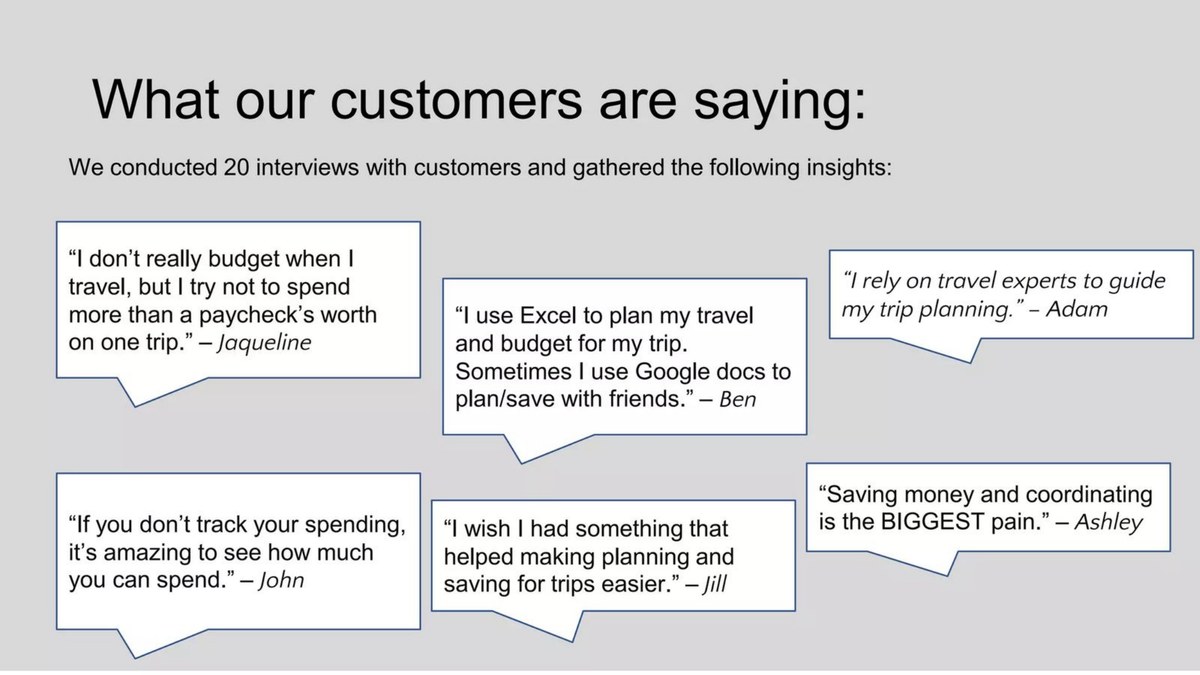
Group travel budgeting and planning app; page 8, "What our customers are saying".
Sliver deck, slide 8. Exact stored slide matched to this analysis.
Our analysis: Some quotes are the useful kind: Ben describes what he does today (Excel and Google Docs), which shows the workaround a product would replace. Others are wishes ("I wish I had something..."), which cost the speaker nothing. Grouping the quotes under two or three findings with counts, and labelling each speaker by traveller type, would turn the wall into evidence.
Evidence and limitation: Our checks: six quotes from 20 interviews, attributed by first name only. The slide calls the interviewees "customers" but doesn't say whether they had used the product. It doesn't say how many of the 20 shared each view.
What a founder can adapt: "20 interviews with [traveller type]: [x]/20 budget in spreadsheets today ("I use Excel..." — group traveller); [y]/20 named coordinating payments the biggest pain."
Supporting analysis
What the deck claims: "We conducted 20 interviews with customers and gathered the following insights:" Six quotes, each with a first name, for example "I use Excel to plan my travel and budget for my trip. Sometimes I use Google docs to plan/save with friends." — Ben; "Saving money and coordinating is the BIGGEST pain." — Ashley; "I wish I had something that helped making planning and saving for trips easier." — Jill.
Presentation choice: It shows quotes as interview evidence, and the difference between behaviour quotes and wish quotes.
When it does not fit: Don't fill the slide with quotes that only say a product like yours would be nice.
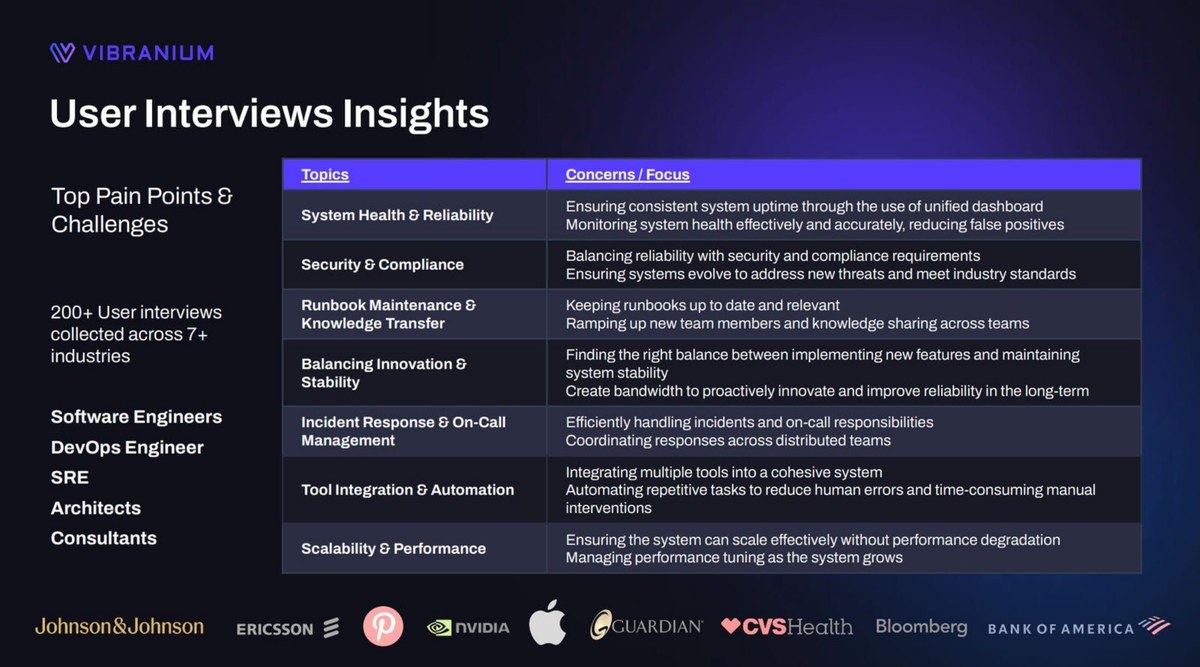
Reliability and incident-response software for engineering teams; page 10, "User Interviews Insights".
Vibranium Labs deck, slide 10. Exact stored slide matched to this analysis.
Our analysis: This is the most organised of the four: roles, breadth and a synthesis table. But seven themes of equal weight read like a description of the engineering field, not a finding. Adding a count to each row, and showing which one the product addresses first, would tell an investor what the interviews decided.
Evidence and limitation: Our checks: the slide names the roles interviewed, which most interview slides don't. It doesn't say how many interviews raised each of the seven topics, whether the list is ranked, or what the logos represent; we read them as interviewees' employers, but the slide doesn't label them.
What a founder can adapt: "200+ interviews (SREs [n], DevOps [n], architects [n]): incident response raised in [x]%, runbook upkeep [y]%. We built [z] first."
Supporting analysis
What the deck claims: Left: "Top Pain Points & Challenges"; "200+ User interviews collected across 7+ industries"; roles "Software Engineers, DevOps Engineer, SRE, Architects, Consultants". Table of seven topics with concerns, including "System Health & Reliability", "Runbook Maintenance & Knowledge Transfer", "Incident Response & On-Call Management" and "Tool Integration & Automation". A row of company logos along the bottom (Johnson & Johnson, Ericsson, Pinterest, NVIDIA, Apple, CVS Health, Bloomberg, Bank of America and others).
Presentation choice: It shows interviews synthesised into themes with the roles named.
When it does not fit: Don't put company logos under an interview slide without saying they are interviewees' employers, not customers.
After: 5 weeks: 30 interviews with [student segment] → [x]/30 said [finding] → MVP → 6 sign-ups ([n] were interviewees).
What improved: Built from Hatch's page 26. The segment, finding and overlap are placeholders the slide does not give.
Illustrative example 2 — written by us
Before: 200+ User interviews collected across 7+ industries.
After: 200+ interviews (SREs [n], DevOps [n], architects [n]): incident response raised in [x]%; we built incident tooling first.
What improved: Built from Vibranium Labs' page 10. The role counts, percentage and decision are placeholders.
What interviews can prove, and what they can't
Interviews are good at three things investors care about early: showing that a specific group has a specific problem, showing how they handle it today, and showing that the founder has learned something an outsider wouldn't know. They are weak at proving demand. People are polite in interviews, and saying a product sounds useful costs them nothing.
That is why an investor reading an interview slide looks past the total. Thirty interviews with the right buyers, with a clear finding that most of them raised unprompted, can be more convincing than a thousand loosely described conversations. The question is not how many people you talked to, but whether the slide lets a reader judge who they were and what they said.
The survey side of customer research, including sample sizes and how much weight a survey can carry, is covered in the customer research slide guide. This guide is only about interviews: open conversations where you didn't fix the answers in advance. It is not legal or investment advice.
Say who you talked to and how you found them
Start with the people. Name the roles (for example operations managers at fleets of 10 to 50 trucks), the segments you covered, and roughly how many came from each. If you interviewed buyers and users separately, say so: the person who feels the problem and the person who signs the cheque often answer differently.
Then say how you recruited them. Friends and early fans will be kinder than strangers found through industry events or cold outreach. You don't need a methods section, but a short line such as "recruited through two industry associations and LinkedIn outreach; none were existing contacts" tells an investor how much to trust the answers.
Logos of the interviewees' employers can help, but only if you say what the logos mean. A row of large-company logos under an interview slide can be read as customers. If they are employers of people you interviewed, label them that way.
Report how often each finding came up
Most interview slides list themes. A list tells the reader what you heard, but not how often. The step that turns a list into evidence is counting: how many of your interviews raised each theme, preferably without being prompted. "23 of 30 operations managers described rebuilding the schedule by hand at least weekly" is a finding; "scheduling is painful" is an opinion.
You don't need statistics. Code each interview after the call: note which themes came up and whether the person raised them first. Then rank the themes by frequency and show the top three with their counts. If one theme came up in nearly every interview and the rest in a few, that ranking is itself useful: it tells an investor what to build first.
Keep interviews and surveys separate. If you ran 10 interviews and a 55-person survey, say "10 interviews, 55 survey responses", and attach each finding to the method that produced it. Merging them into "we talked to 65 people" makes both weaker.
Choose quotes that show behaviour, not approval
Quotes make a slide human, but they need to do work. The most useful quotes describe what people do today and what it costs them: the spreadsheet they maintain, the hours they lose, the money they spend on a workaround. The least useful are compliments about your idea or wishes for a product like yours.
This matches standard advice on interviewing. Y Combinator's "How to Talk to Users" session, drawing on Rob Fitzpatrick's book The Mom Test, tells founders to talk about the customer's life rather than the idea and to ask about specifics rather than hypotheticals, for example "tell me about the last time you encountered that problem". Quotes collected that way are the ones worth putting on a slide.
Attribute each quote to a role and segment, not just a first name. "Ops manager, 30-truck fleet" lets a reader see whether the quote comes from your target customer. (Y Combinator Startup School (Eric Migicovsky))
Show what changed because of the interviews
The strongest evidence that you listened is a decision. Did the interviews change who you sell to, what you built first, how you price, or what you stopped doing? One line such as "Interviews showed the buyer is the finance lead, not IT; we rewrote our pitch and pricing for finance" shows the interviews mattered.
This also answers a question investors often have about early teams: will they adjust when evidence disagrees with their plan? A slide that shows a hypothesis, what interviews found, and what you changed answers it directly.
Connect interviews to what people did next
Interviews are a first step. The next steps are things people do rather than say: join a waitlist, try a prototype, agree to a pilot, pay a deposit. If you can count how many interviewees took each step, show it as a short sequence: 30 interviewed, 12 tried the prototype, 6 signed up. That sequence turns talk into early behaviour.
If none have taken a step yet, say what the next step is and when you expect results. Don't present interview enthusiasm as demand. The pre-revenue traction guide covers pilots, waitlists and letters of intent in detail.
Worked example: from interview notes to one slide (hypothetical)
This is our illustration, not a figure from any deck. A founder building scheduling software for small trucking fleets runs 30 interviews: 22 operations managers and 8 owners, recruited through two state trucking associations, none previously known to the team.
After coding the notes: 23 of 30 described rebuilding the weekly schedule by hand (19 raised it unprompted); 17 of 30 named driver no-shows as the most costly problem; 9 of 30 mentioned fuel cards. Owners cared most about no-shows; managers about the manual schedule. The team drops a planned fuel-card feature and builds the schedule first.
Weak version: "30 customer interviews. Fleets hate scheduling." Strong version: "30 interviews (22 ops managers, 8 owners; association outreach). 23/30: rebuild schedule by hand weekly. 17/30: no-shows the costliest problem. Changed: dropped fuel cards; schedule first. Next: 12 tried the prototype, 6 signed up."
Common mistakes
Count without people. A number of interviews without roles or segments can't be judged.
Themes without frequency. An unranked list reads as a description of the field, not a finding.
Wish quotes. "I wish something existed" costs nothing to say; quote behaviour and cost.
Mixed populations. A statistic about one group beside interviews with another needs separate sources.
Unlabelled logos. Interviewees' employers can be mistaken for customers.
No decision. If interviews changed nothing, the slide shows effort, not learning.
Diagnostic checklist
Roles, segments and recruitment method are stated.
Interviews and survey responses are counted separately.
The top findings each show how many interviews raised them.
Quotes describe current behaviour or cost and are attributed by role.
Any logos are labelled for what they represent.
The slide names a decision the interviews changed.
A next step taken by interviewees is shown, or the planned step is stated.
Frequently asked questions
How many customer interviews should I put in a pitch deck?
There's no set number. Investors care more about who you interviewed and how consistently a finding came up than about the total. Thirty interviews with your exact buyer, with a finding most of them raised, can carry more weight than hundreds of loosely described conversations.
Should interviews go on the problem slide or a separate slide?
Either. Use a footnote on the problem slide when interviews back one claim. Use a separate validation slide when you have several findings, a decision they changed and a next step to show.
Can I use customer quotes from interviews?
Yes, if they describe what people do today and what it costs them, and you attribute them by role and segment. Quotes that only praise your idea add little.
What questions should I ask in customer interviews?
Ask about the customer's recent, specific experience rather than your idea. Y Combinator's "How to Talk to Users" session suggests questions such as "Tell me about the last time you encountered that problem" and "What, if anything, have you done to try to solve the problem?" (Y Combinator Startup School (Eric Migicovsky))
How we chose these examples
Discovery (2026-10-04, run 122): we counted guides by slide type and found customer research thinly covered. The existing customer research slide guide says it covers survey and interview evidence, but all its examples and its comparison table are surveys; the PMF survey draft covers the "very disappointed" survey. We searched the corpus for interview counts ("[0-9]+ interviews") and read the closest content: customerResearchSlide.ts, drafts/tractionPmfSurvey.ts, problemSlide.ts, preRevenueTraction.ts and testimonialSlide.ts.
Four pages from four decks were read from images rendered from the original deck files: Hatch 26, Kona 4, Sliver 8 and Vibranium Labs 10. All are published teardowns, none is excluded, and none is a public-company deck. Choreosity, Educate Me, Westrive and Alpe also mention interviews; they were not used because their interview evidence is a passing line or appears in a roadmap. All four images were prepared at 1,200 pixels wide, uploaded and re-fetched byte-identical.
Ratios were recalculated from the printed figures. The worked example is our illustration. Company figures are reported as printed and not verified. The Y Combinator source was read in its published slide transcript. Slide readings and analysis are an AI editorial model review, not human-checked.