Dash App, originally branded as Spektra, raised $5.5M in 2021 behind a deck that leaned heavily on the 'Super App' narrative. The company identified a critical friction point in the African fintech landscape: while mobile money is the predominant payment method, the ecosystem is fragmented across 200+ non-interoperable providers. The deck presents impressive early traction, showing a Total Processing Volume (TPV) growth from $315K to $3.4M monthly in just eight months. By focusing on a B2C model that is free for consumers but charges businesses 2.5%, Dash positioned itself as the connective t…
Key takeaways
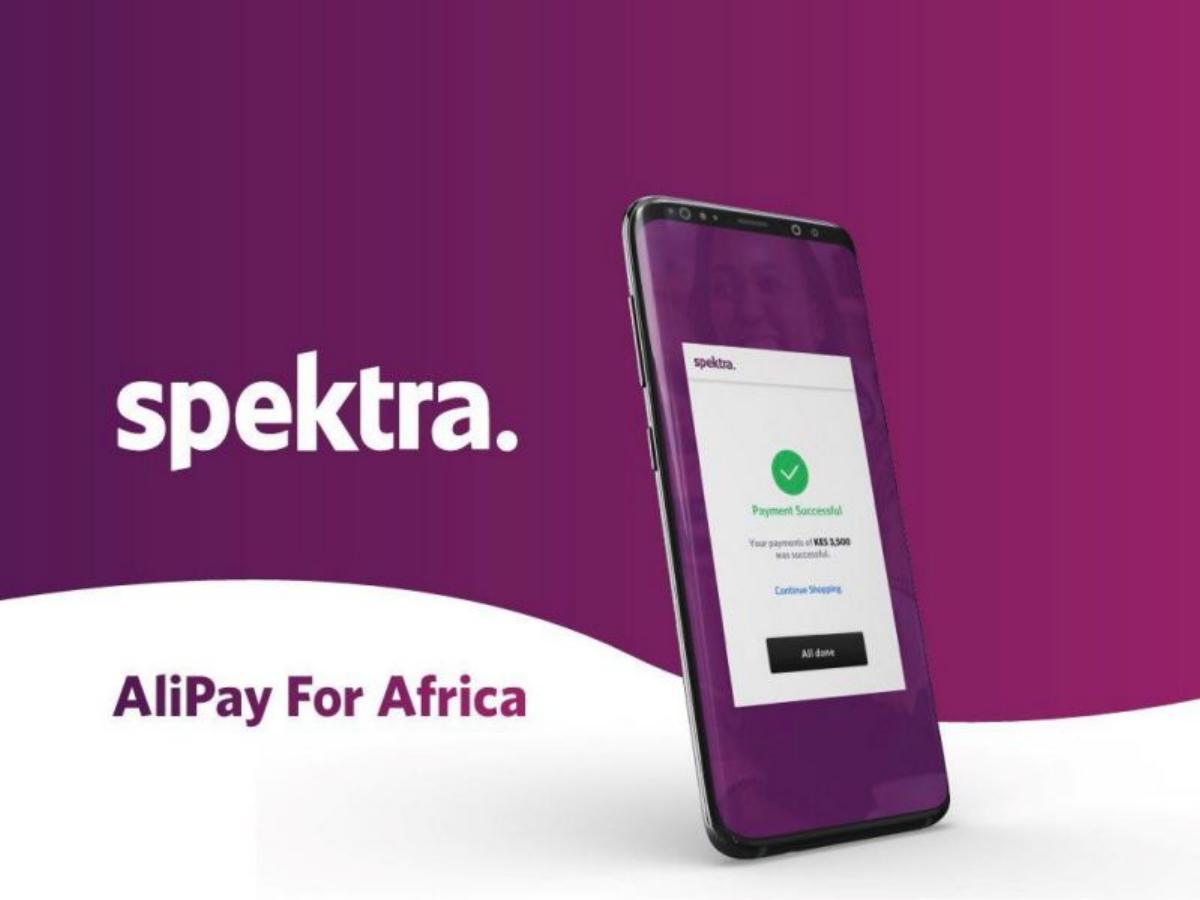
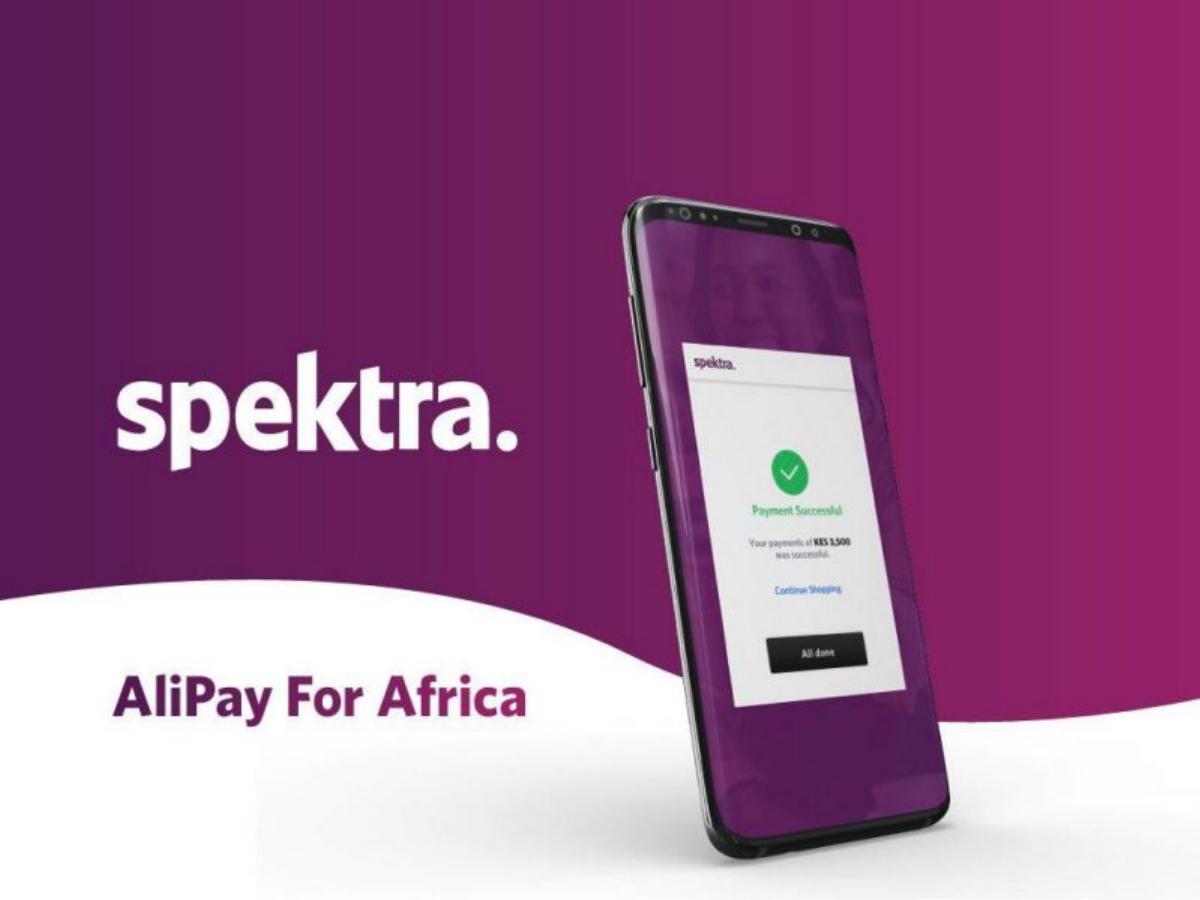
- The deck uses a powerful 'X for Y' hook on Slide 1, branding the startup as 'AliPay For Africa' to instantly communicate scale and utility.
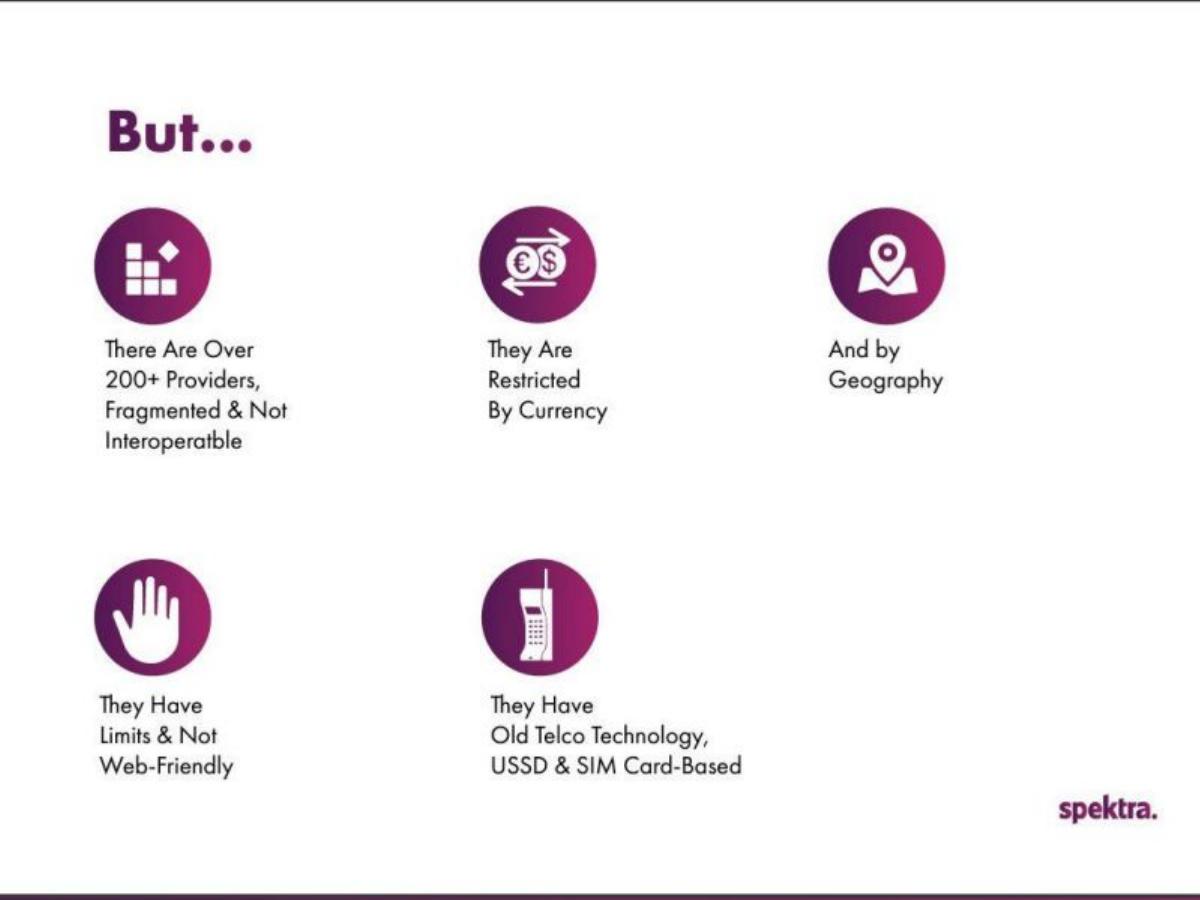
- Market fragmentation is the core problem, with Slide 3 citing 200+ providers that are not interoperable and restricted by geography.
- The opportunity is quantified by the massive disparity between card and mobile money; Slide 8 shows mobile money transactions at $1.9 billion daily versus $2 billion quarterly for cards.
- Traction is the deck's strongest asset, with Slide 10 reporting a total of 13,062 users acquired within six months of launch.
- Financial velocity is demonstrated on Slide 11, showing a cumulative TPV of $11,717,313.94 since launch.
- The revenue model is a simple transactional split: consumers use the app for free, while businesses are charged 2.5% (Slide 13).
- The product roadmap on Slide 14 outlines an aggressive expansion into wealth management, travel, and merchant tools within a single calendar year.
- The team slide (Slide 16) focuses almost exclusively on the CEO, Prince Boakye Boampong, leaving the other four founding members unnamed and without bios.
The Hook: Positioning for Global Scale
Slide 1: Title Slide
The deck opens with the original branding, Spektra . The most important element here is the sub-headline: "AliPay For Africa." This is a classic fundraising tactic. By tethering a new venture to a proven, multi-billion dollar entity like AliPay, the founders immediately signal the intended scale and the 'Super App' nature of the product. The visual is a simple smartphone mockup showing a successful payment of KES 3,500.
Defining the African Payment Gap
Slide 2: The Context
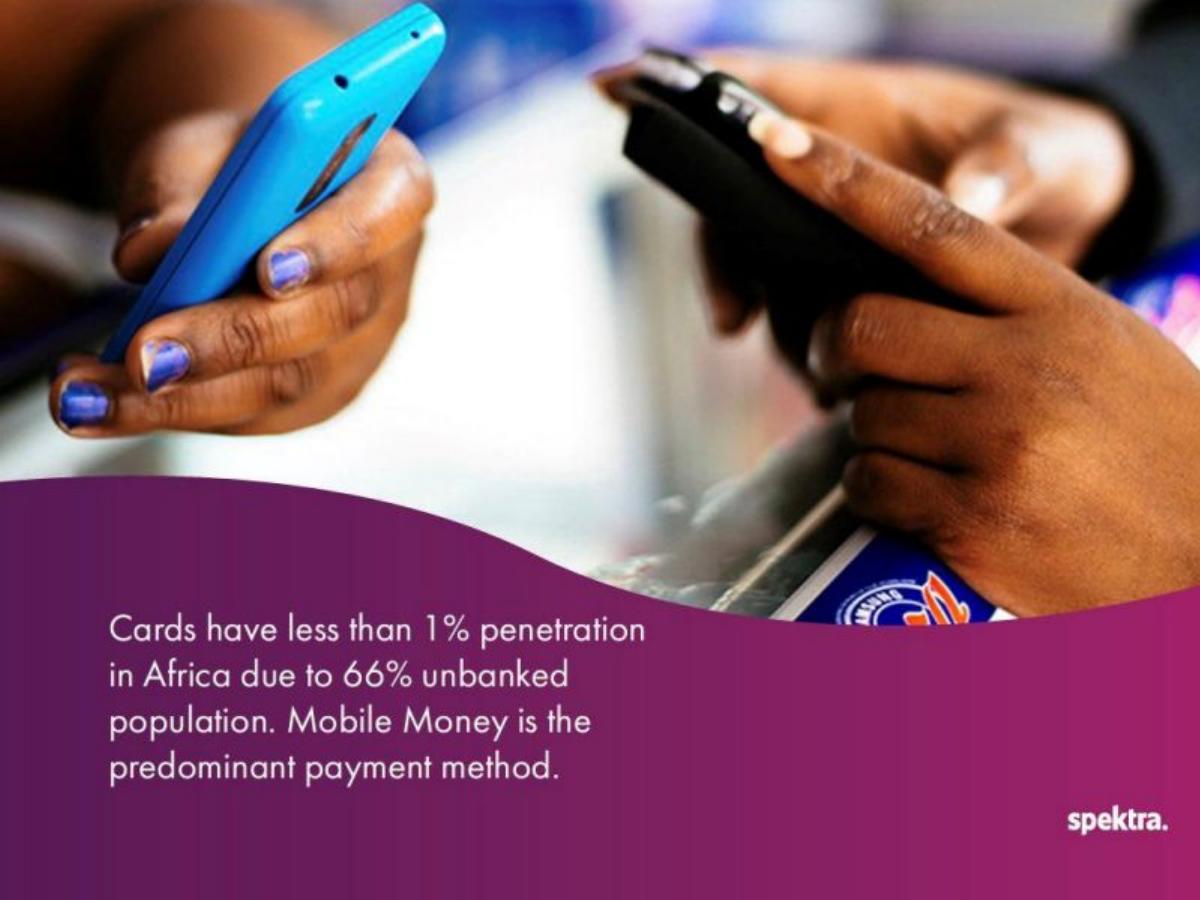
Slide 2 sets the stage with a stark statistic: "Cards have less than 1% penetration in Africa due to 66% unbanked population." It establishes Mobile Money as the predominant payment method. This slide is crucial because it tells the investor that a Western-style fintech solution (focused on credit cards) will not work here; the solution must be mobile-first.
Slide 3: The Problem ("But...")
This slide identifies the friction. Despite the popularity of mobile money, the system is broken. The deck lists five core pain points: 200+ fragmented providers, currency restrictions, geographical limitations, lack of web-friendliness, and reliance on "Old Telco Technology" like USSD and SIM cards. This sets up the need for a modern software layer to sit on top of these fragmented services.
Slide 4: The Solution
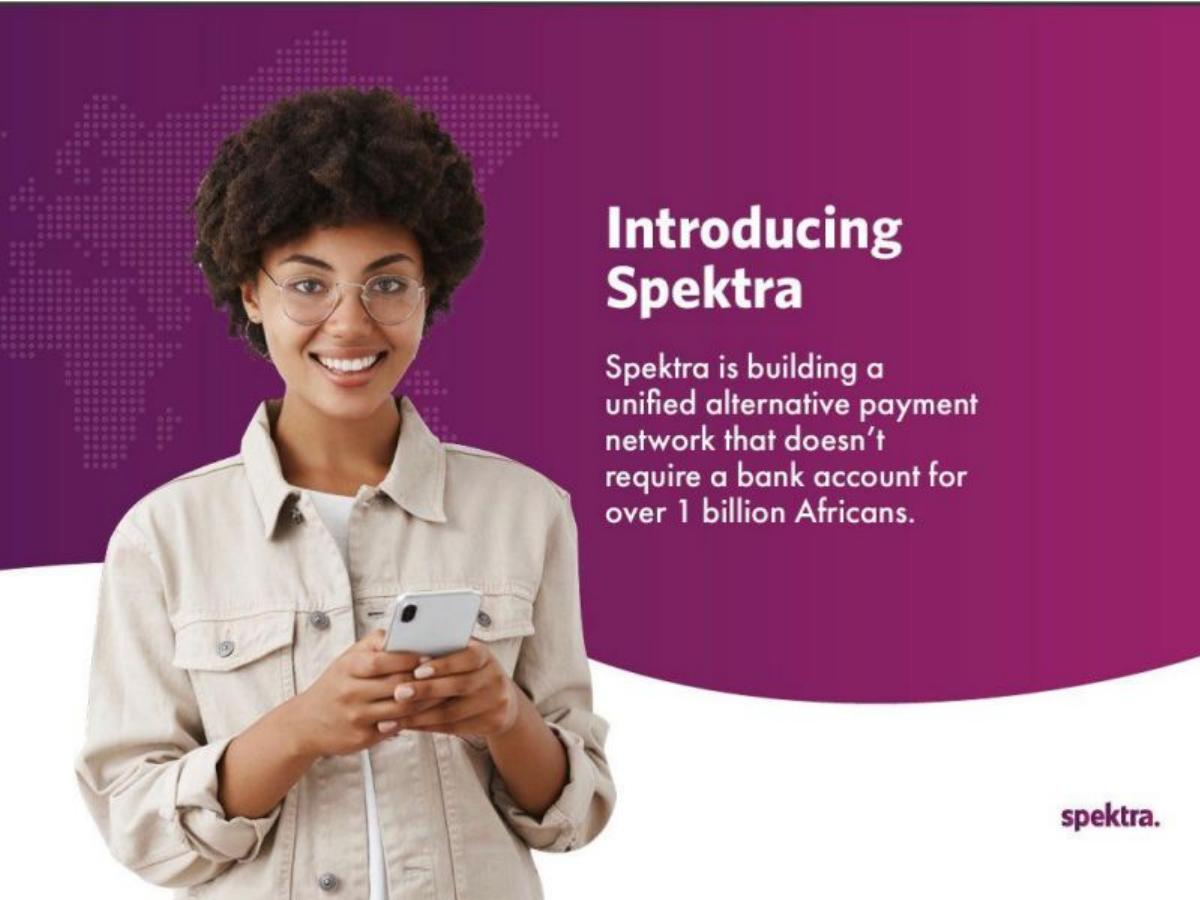
Spektra is introduced as a "unified alternative payment network" that does not require a bank account. The value proposition is accessibility for over 1 billion Africans. The imagery shifts to a smiling user, humanizing the technology.
Product and User Experience
Slide 5: Features
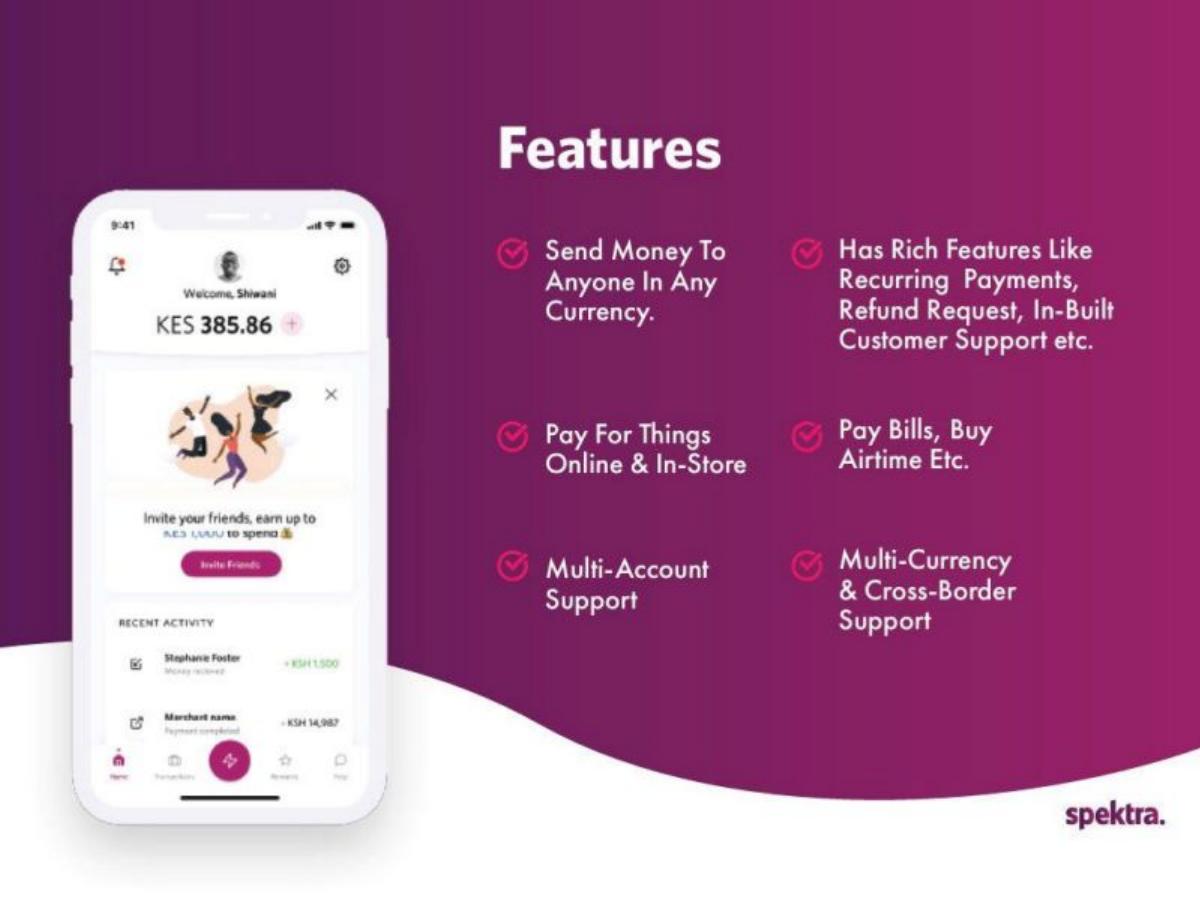
This slide lists the functional capabilities of the app. Key features include sending money in any currency, paying for things online and in-store, multi-account support, and cross-border support. It also mentions "Rich Features" like recurring payments and refund requests, which are standard in developed markets but often missing in fragmented mobile money ecosystems.
Slide 6: How it works
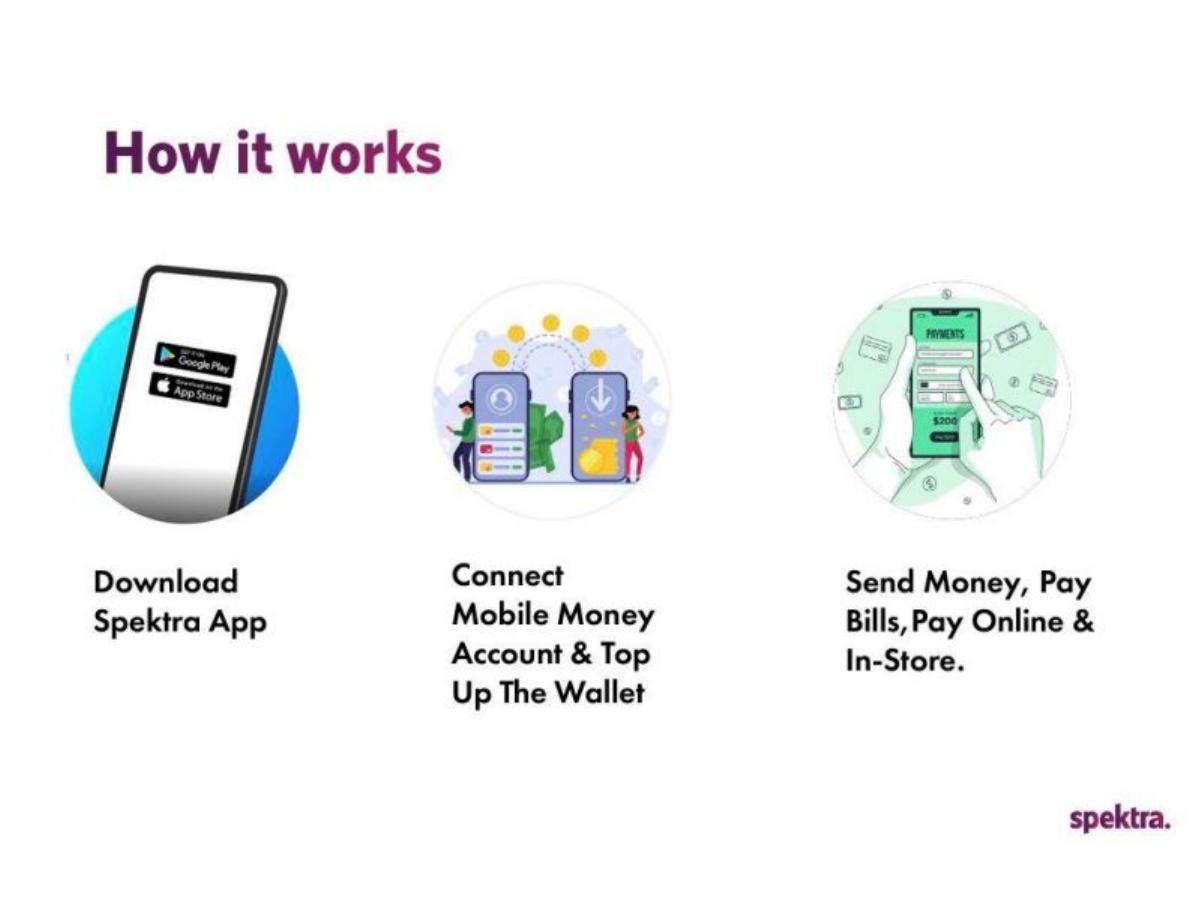
A simple three-step process is shown: Download the app, connect a mobile money account to top up the wallet, and then use that wallet to pay bills or send money. This clarifies that Spektra is a digital wallet that aggregates existing mobile money accounts rather than trying to replace the underlying telco providers immediately.
Market Opportunity and Data
Slide 7: Opportunity
The deck quantifies the market with four circles: Over 1 Billion Mobile Money Users, 600M Smartphone Users, 95 Countries, and "$1.9 Billion Transacted Each Day." This slide justifies why a VC should care—the volume is already there; it just needs to be captured by a better interface.
Slide 8: Cards Vs. Mobile Money
This is one of the most effective visual slides in the deck. It uses a bubble chart to show the massive disparity in volume. Cards process $2 Billion Quarterly , while Mobile Money processes $1.9 Billion Daily . The visual makes the card market look insignificant, reinforcing the 'AliPay for Africa' thesis.
Traction: The Core of the Pitch
Slide 9: User Growth (6 Months)
The traction slides are where the $5.5M round was likely won. This slide shows a steady upward curve from May '20 to October '20. It lists a Total of 13,062 users since launch . The monthly additions are highlighted (+1,353 in May, growing to +3,085 in October), showing accelerating growth.
Slide 10: Total Processing Volume (Last 8 Months)
Volume is the lifeblood of fintech. This slide shows a cumulative TPV of $11,717,313.94 . The monthly growth is impressive: starting at +$315K in March '20 and hitting +$3.4M in October '20 . This 10x growth in monthly volume over eight months provides the 'hockey stick' graph that VCs look for.
Slide 11: Product Progress
A timeline shows the speed of execution. Between January 2020 and August 2020, the team launched P2P, Cross-Border P2P, Rewards, Bill Payments, Recurring Payments, and Dispute Resolution. This demonstrates a high shipping velocity.
Business Model and Future Vision
Slide 12: Revenue Model
The model is Transactional . It is FREE for Consumers , which lowers the barrier to entry and aids viral growth. The revenue comes from Businesses at 2.5% . This is a standard merchant processing fee, making the business model easy for investors to understand and model.
Slide 13: Upcoming Features (The Super App)
This slide outlines the transition from a wallet to a "Super App." It lists four phases for 2021: Wealth (Savings/Insurance), Passport (Ticket booking), Travel (Hotel booking), and O2O (Merchant tools like QR codes and APIs). This is the roadmap to becoming the 'AliPay' mentioned on Slide 1.
Slide 14: Competitive Landscape
The competition is mapped out. Spektra differentiates itself from Payment Gateways (Paystack/Flutterwave) by not being merchant-only, and from Mobile Money Operators (M-Pesa/MTN) by being unified and multi-currency. It positions itself in the fourth quadrant as the only "Unified, Modern & Feature-Rich" player that "Owns & Controls The Wallet & B2B2C Flow."
The Team and Conclusion
Slide 15: Team
The deck states there is a 5-member founding team with 28 years of combined experience. However, it only provides a bio for Prince Boakye Boampong (Founder & CEO) . His background is strong: a Software Engineer with 13 years of experience, a former consultant for Standard Bank, and a founder of a YC-backed company (OMG Digital). The omission of the other four founders' names or backgrounds is a notable gap.
Slide 16: Thank You
What Works and What is Missing
What Works
The Comparison: Using 'AliPay for Africa' immediately frames the opportunity in a way that global VCs can grasp. · The Data Disparity: Showing daily mobile money volume vs. quarterly card volume is a powerful way to prove market fit. · Traction Velocity: The TPV growth from $315k to $3.4M monthly is the strongest evidence of product-market fit in the deck.
What is Missing
The Ask: There is no slide stating how much money is being raised or how it will be spent. While we know from catalogue facts it was $5.5M, a pitch deck usually includes this to set the terms of the conversation. · The Full Team: Mentioning a 5-member team but only showing one person creates a 'key man risk' perception. Investors generally want to see the CTO and COO in a Seed round. · Unit Economics: While the 2.5% fee is mentioned, there is no data on Customer Acquisition Cost (CAC) or Lifetime Value (LTV), which are critical for B2C apps.
What a Founder Should Copy
The Problem/Solution Flow: The deck does an excellent job of moving from a macro problem (unbanked population) to a specific friction (fragmentation) to a clear solution (unified app). · Visualizing Volume: Use bubble charts or comparative scales to show why your chosen market (mobile money) is superior to the traditional market (cards). · Shipping Velocity: The product timeline slide is a great way to prove that your team can execute quickly.
Frequently asked questions
- How much did Dash App raise with this deck?
- According to the catalogue facts, Dash App (Spektra) raised $5.5M in a Seed round in 2021. The lead investor was Global Founders Capital, with participation from several other VCs including Techstars and Everywhere Ventures.
- What was the primary business model described?
- Slide 13 outlines a transactional revenue model. The service is free for consumers to encourage adoption and network effects, while businesses are charged a 2.5% fee on transactions. This aligns with a B2C customer model aiming for high volume.
- What specific problem was Dash App trying to solve?
- As shown on Slides 2 and 3, the problem is the inefficiency of the African payment landscape. While 66% of the population is unbanked, mobile money is fragmented across 200+ providers that do not talk to each other, are restricted by currency, and rely on 'old telco technology' like USSD.
- Was there a clear competitive analysis in the deck?
- Yes, Slide 15 provides a competitive landscape quadrant. It categorizes competitors into Payment Gateways (Flutterwave, Paystack), Card Networks (Visa, Mastercard), and Mobile Money Operators (MTN, M-Pesa). Dash positions itself as the only 'Unified' solution that works with existing infrastructure while being multi-currency and developer-friendly.
- What is missing from the Dash App pitch deck?
- The deck lacks a formal 'Ask' slide, which usually specifies the amount being raised and the milestones it will fund. Additionally, while Slide 16 mentions a 5-member founding team, it only provides details for the CEO, omitting the backgrounds of the other four members.