Ditto’s 13-slide deck presents a compelling argument for the 'AI-native' era of social networking. The company positions itself as the successor to Tinder and Hinge by moving away from 'static profiles' toward 'live agents' that interact on a user's behalf. The deck focuses heavily on the product experience—specifically how AI agents run thousands of simulations to find compatible matches and then directly schedule real-world dates. While the deck is light on traditional business metrics like CAC or LTV, it leans into the technical 'reasoning' capabilities of its agentic system and social pro…
Key takeaways
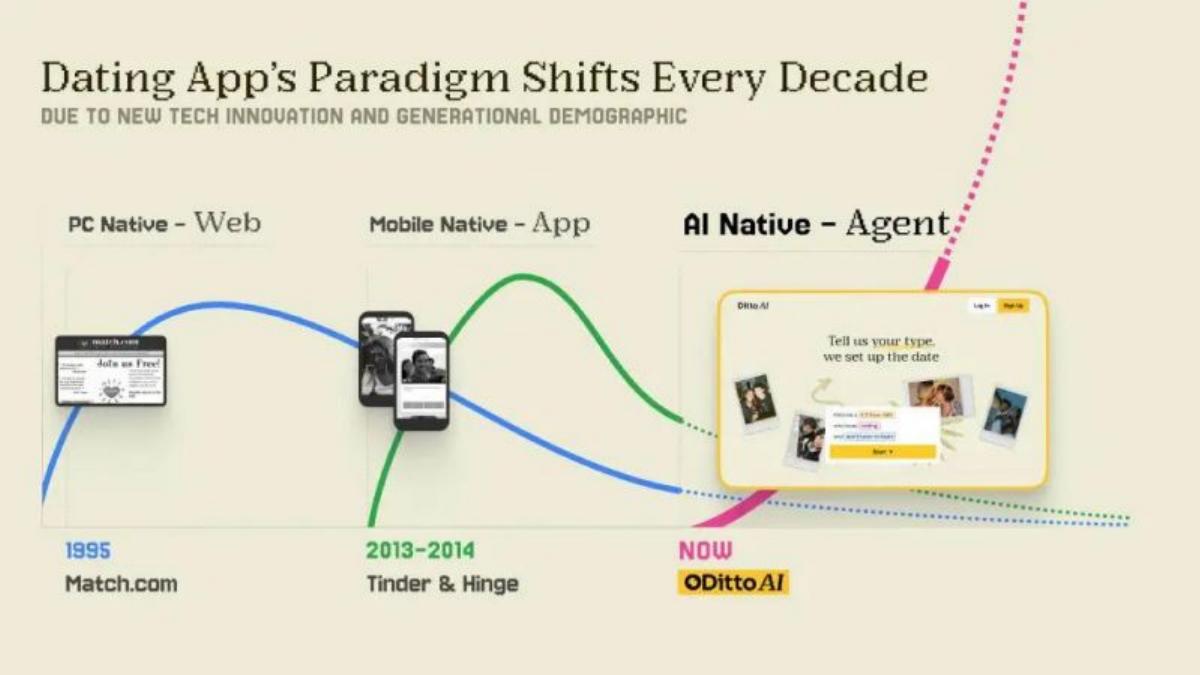
- The deck identifies a paradigm shift from PC-native web dating (1995) and mobile-native apps (2013) to AI-native agents (Slide 2).
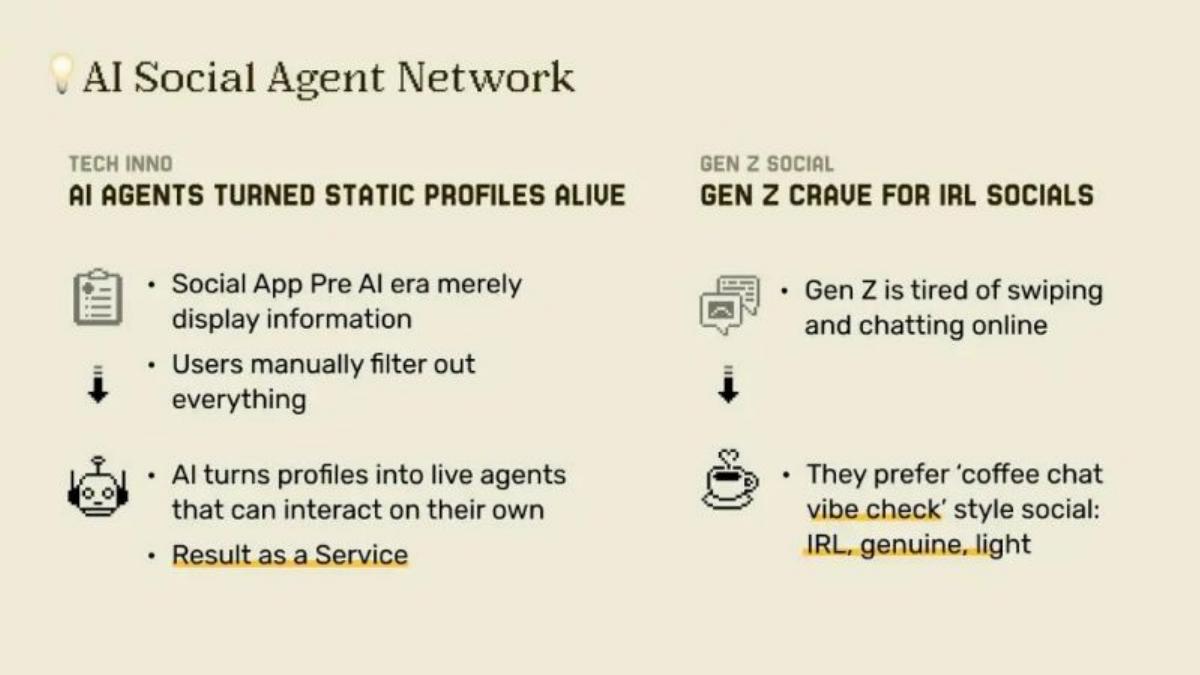
- Ditto defines its value proposition as 'Result as a Service,' moving beyond merely displaying information to taking action (Slide 3).
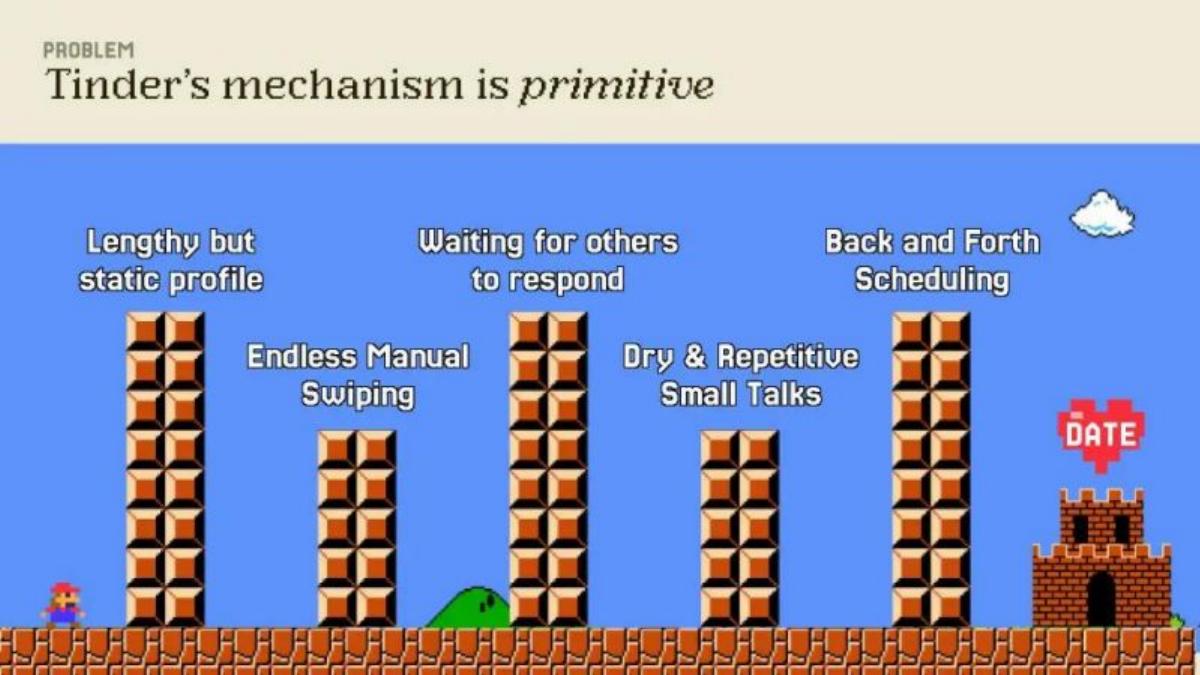
- The 'Problem' slide uses a Super Mario-themed visual to highlight five friction points: static profiles, manual swiping, waiting for responses, small talk, and scheduling (Slide 4).
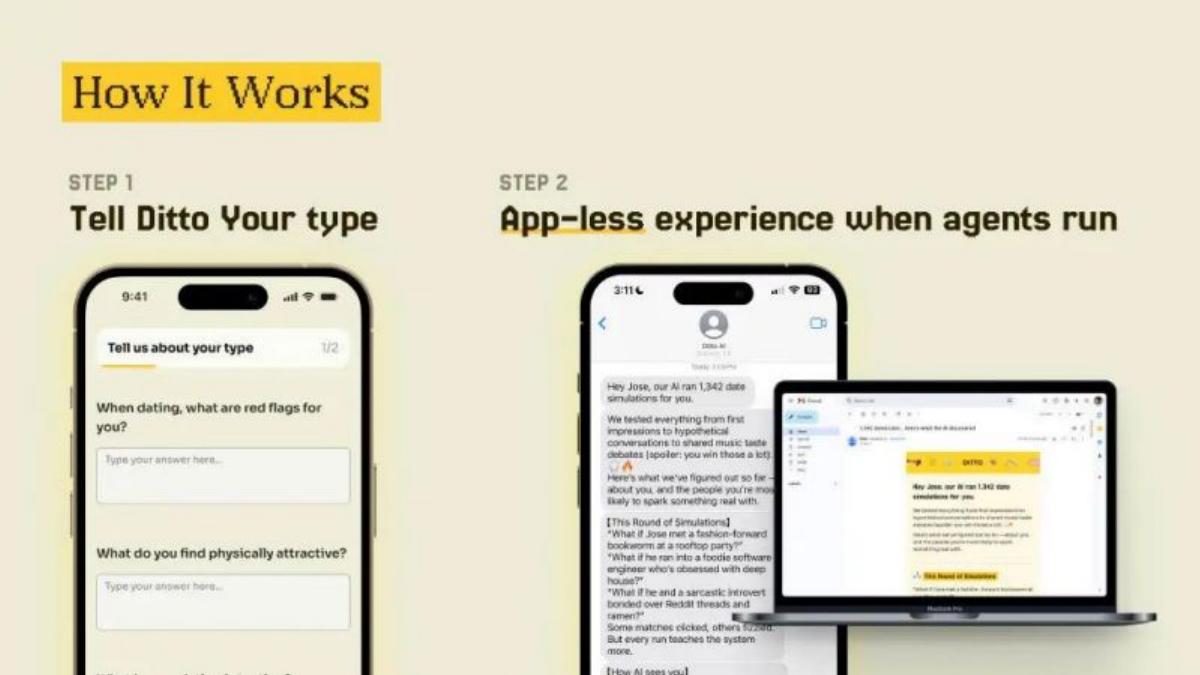
- The product workflow is 'app-less,' where agents run simulations and deliver results via email or text rather than a traditional interface (Slide 6).
- Ditto claims its AI can run 1,342 date simulations for a single user to find the best match (Slide 6).
- The matching logic is based on 'Vibe,' using AI to connect non-obvious traits like 'Adventurous & Expressive' or 'Depth Beneath the Surface' (Slide 10).
- The technical architecture involves a multi-agent system including Analysis, Matchmaking, Simulation, Ranking, and Planning agents (Slide 11).
- The deck contains no financial projections, team bios, or specific market sizing data (Slides 1-12).
The Vision: AI Agents as the End of the Swipe
Ditto’s pitch deck is a masterclass in narrative-driven product positioning. Instead of starting with market size or revenue, it starts with a fundamental shift in how humans interact with technology. The core thesis is that we are moving from an era of 'tools' (apps where we do the work) to an era of 'agents' (software that does the work for us). In the context of dating, this means the end of the 'swipe' and the beginning of the 'automated date.'
Slide 1: Title Slide
The deck opens with a simple, bold claim: "The first AI Social Agent" with the subtitle "start with dating." This suggests that while dating is the initial go-to-market strategy, the company views its technology as a broader social platform. The branding is minimalist, using a soft cream background and serif typography.
Slide 2: The Paradigm Shift
Slide 2 provides the historical context for Ditto’s existence. It charts the evolution of dating technology: 1995 was 'PC Native - Web' (Match.com), 2013-2014 was 'Mobile Native - App' (Tinder & Hinge), and 'NOW' is "AI Native - Agent." This slide is designed to make the current market leaders look like relics of a previous technological era. It uses a wave chart to show the decline of old paradigms as new ones emerge.
Slide 3: AI Social Agent Network
This slide breaks down the 'Tech Inno' and 'Gen Z Social' drivers. On the tech side, it claims AI agents turn "static profiles alive," moving from manual filtering to "Result as a Service." On the social side, it notes that Gen Z is "tired of swiping and chatting online" and prefers "coffee chat vibe check" style interactions that are "IRL, genuine, light."
Slide 4: The Problem
Using a nostalgic Super Mario Bros. visual, Slide 4 lists the hurdles of current dating apps: "Lengthy but static profile," "Endless Manual Swiping," "Waiting for others to respond," "Dry & Repetitive Small Talks," and "Back and Forth Scheduling." By framing these as obstacles in a game, Ditto emphasizes how much 'work' the user currently has to do to reach 'The Date' (represented by the castle at the end of the level).
Slide 5: The Solution
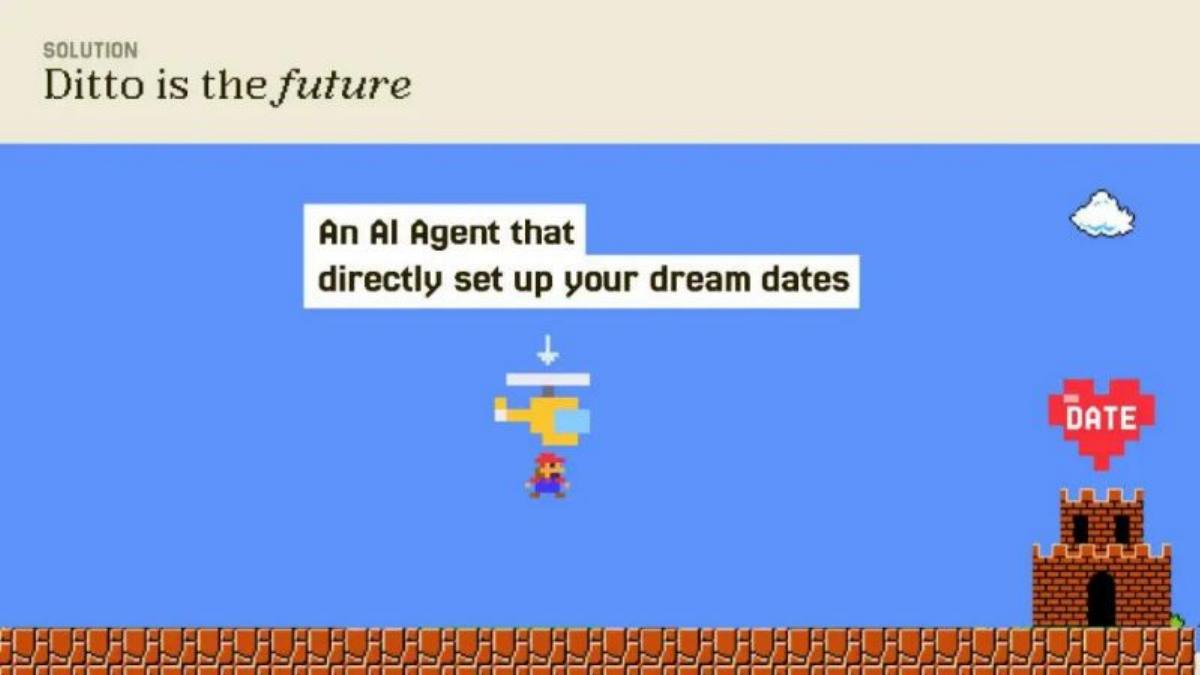
The solution slide continues the Mario theme, showing the character being airlifted by a helicopter over all the obstacles directly to the castle. The text is simple: "An AI Agent that directly set up your dream dates." This is the 'Aha!' moment of the deck—promising the outcome without the effort.
Slide 6: How It Works (Steps 1 & 2)
Slide 6 introduces the user flow. Step 1: "Tell Ditto Your type." The screenshot shows a simple text-based interface asking about red flags and physical attraction. Step 2: "App-less experience when agents run." This is a critical differentiator. The slide shows an email notification stating, "our AI ran 1,342 date simulations for you." It lists hypothetical scenarios the AI tested, such as "What if Jose met a fashion-forward bookworm at a rooftop party?"
Slide 7: How It Works (Step 3)
Step 3: "AI customized date invite." This slide shows the output of the matching process. Instead of a standard profile, users receive a "collage" style invite. The examples shown (Ayush, Isaiah, Angelina, etc.) feature a mix of photos and personality tags like "Wilderness Wanderer" or "Queen of Good Times." The visual style is very much aligned with Gen Z aesthetic trends.
Slide 8: How It Works (Steps 4 & 5)
Step 4: "Direct to IRL Date." The AI doesn't just match; it schedules. The slide shows a calendar invite for "Victory Point Cafe" at "6:30PM, Wed Feb 29." It even provides "Dating tips" based on the simulations, such as "Ask her about her 17 tattoos." Step 5: "Feedback -> More & Better Dates." The user provides feedback (e.g., "Older 25-30 Years old and white" ) to refine future simulations.
Slide 9: AI’s Reasoning Ability
This slide attempts to explain the 'magic' behind the matching. It uses a metaphor of a "Compost Heap" and an "Atomic Bomb" both being connected by the concept of a "Chain Reaction." The claim is that Ditto’s AI "connects the hidden dots" that humans or basic algorithms might miss.
Slide 10: Vibe is All You Need
Slide 10 applies the reasoning logic to a real match between 'Gavin, 22' and 'Emily, 21.' It maps their photos and interests to 'Hidden Vibes' like "Adventurous & Expressive," "Depth Beneath the Surface," "Artistic & Individualistic," and "Sense of Humor & Realness." This visualizes how the AI moves beyond surface-level filters to find deeper compatibility.
Slide 11: The Agentic System
This is the most technical slide in the deck. It maps out the "agentic system" architecture. It includes:
Analysis Agent: Image analysis, attractiveness analysis, profile tagging. · Matchmaking Agent: Vibe check, hobby match, tag check. · Date Simulation Agent: Simulates first impressions, conversation flow, humor alignment, and shared values. · Rank & Approve Agent: Filters the best simulations. · Date Planning Agent: Collage making, communication, and scheduling. · Feedback Agent: Memorizes and iterates for the next round.
Slide 12: Social Proof
The final content slide, titled "People Love Us," is a collage of testimonials. Many are from .edu email addresses (UCSD, Berkeley), suggesting a successful initial launch on college campuses. Quotes include: "exclusive relationship with my date now," "the AI made good hit," and "I would describe Ditto as the only dating tool that has actually worked for me." One humorous inclusion is a user saying, "I fear this is my ex LOL," which serves as an unintentional validation of the AI's accuracy in finding the user's 'type.'
What Works in This Deck
The Narrative Arc: The deck does an excellent job of positioning Ditto as an inevitable evolution of technology. By framing the history of dating apps in decades, it makes the 'Agent' era feel like the logical next step rather than just another app.
Focus on the 'Result': Most dating app decks focus on the 'matching algorithm.' Ditto focuses on the "Result as a Service." The promise of skipping the 'small talk' and going straight to a scheduled date is a powerful value proposition for a burnt-out user base.
Visual Storytelling: The use of the Mario theme and the collage-style date invites makes the product feel tangible and culturally relevant to its target demographic (Gen Z).
What is Missing
The Team: There is no team slide in this 13-slide deck. For a $9.2M Seed round, the founders' backgrounds (likely in AI or consumer social) would have been a major factor for investors like Peak XV and Gradient.
p> Business Model: The deck never mentions how Ditto makes money. Is it a subscription? A per-date fee? Lead generation for the venues where dates are scheduled? This is a significant omission for a Seed deck.
Market Size and Competition: There is no TAM/SAM/SOM analysis, nor is there a competitive landscape slide. While it mentions Tinder and Hinge as 'primitive,' it doesn't address other AI-dating startups or how it will defend against incumbents adding agentic features.
What a Founder Should Copy
The 'Paradigm Shift' Slide: Slide 2 is a perfect example of how to use a historical timeline to create a sense of urgency and inevitability for your product.
The Multi-Agent Architecture: Slide 11 is a great way to visualize a complex AI backend. Instead of just saying 'we use AI,' breaking it down into specific 'Agents' with distinct roles (Analysis, Simulation, Planning) makes the technology feel more robust and proprietary.
Outcome-Oriented Screenshots: Instead of showing a login screen or a settings page, Ditto shows the output —the scheduled date and the simulation report. Founders should always prioritize showing the 'value delivered' over the 'interface used.'
Frequently asked questions
- How much did Ditto raise and who are the investors?
- According to the catalogue facts, Ditto raised $9.2M in a Seed round. The round was led by Peak XV (formerly Sequoia India & SEA), with participation from Alumni Ventures, Gradient (Google’s AI-focused fund), Scribble Ventures, and others.
- What is the core problem Ditto is trying to solve?
- As shown on Slide 4, Ditto targets the 'primitive' mechanisms of current dating apps. It specifically aims to eliminate the time-consuming manual labor of swiping, the boredom of repetitive small talk, and the logistical friction of back-and-forth scheduling.
- How does the AI matching actually work according to the deck?
- The process is detailed on Slide 11. It uses a multi-agent system: an Analysis Agent builds a persona from user data, a Matchmaking Agent performs a 'vibe check,' and a Simulation Agent runs hypothetical scenarios (like conversation flow and humor alignment) before a Planning Agent schedules the date.
- Is there a mobile app for Ditto?
- Slide 6 describes an 'App-less experience.' While there is an onboarding interface to 'Tell Ditto Your Type,' the actual agentic work and date invitations are delivered through external channels like SMS and email, emphasizing a hands-off user experience.
- What is missing from this pitch deck?
- The 13-slide deck is notably missing a Team slide, a Business Model/Monetization slide, a Market Size (TAM) slide, and a Competition slide. It focuses almost entirely on the product vision, the technology, and user testimonials.