DiversyFund’s Series A deck positions the company as 'Crowdfunding 2.0,' distinguishing itself from competitors like Fundrise and RealtyMogul through vertical integration. While traditional platforms act as brokers for third-party sponsors, DiversyFund serves as the developer for its own offerings, capturing developer fees and asset appreciation profits. The deck highlights a portfolio with a $94M completed value and $21M in estimated profits. The company is seeking $6M via secured convertible notes with a 12% interest rate and a $60M valuation cap, targeting a 10x return upon a planned IPO o…
Key takeaways
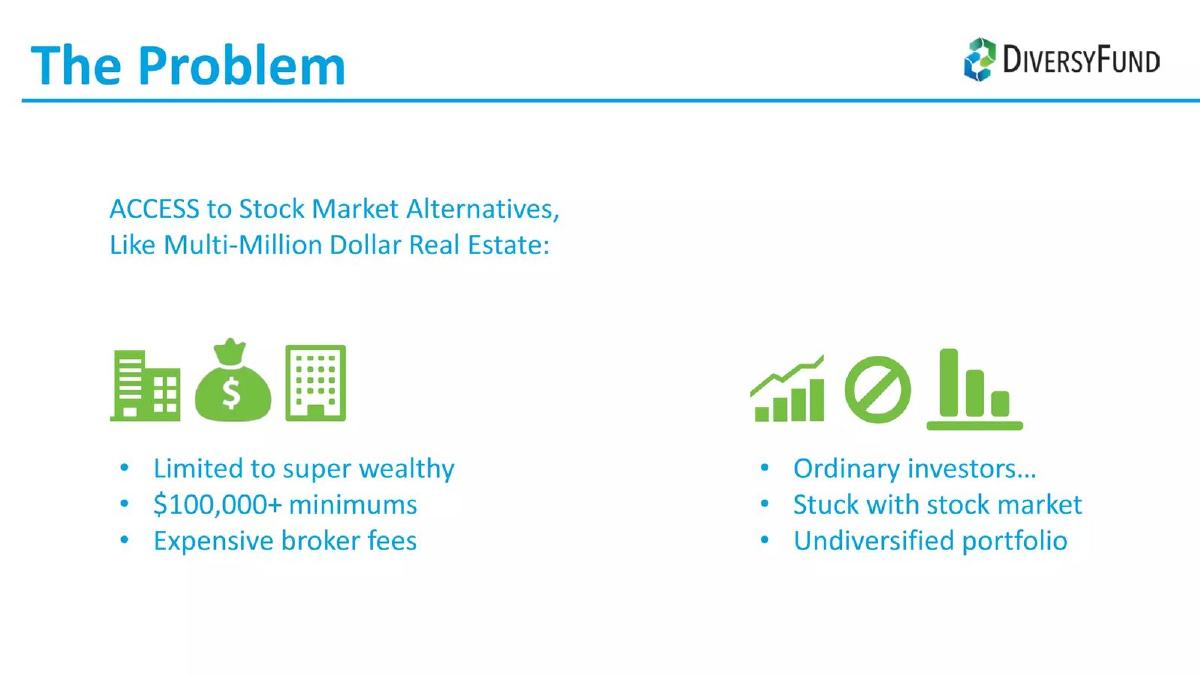
- The company identifies a market gap where multi-million dollar real estate is limited to the 'super wealthy' with $100,000+ minimums (Slide 2).
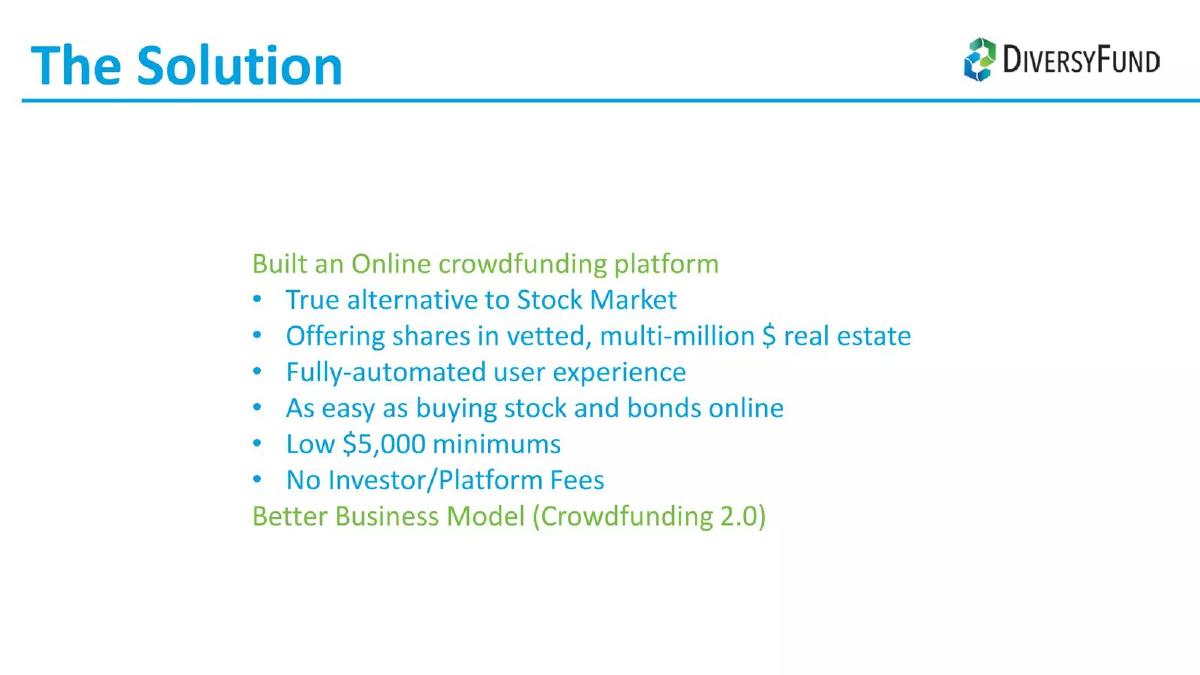
- DiversyFund lowers the barrier to entry for ordinary investors with a $5,000 minimum investment and zero platform fees (Slide 3).
- A core differentiator is vertical integration; DiversyFund acts as the sponsor and developer, utilizing an in-house construction management team (Slide 4).
- The revenue model claims to generate $400,000 to $3.2 million per $1M raised, which is stated to be up to 100x more than broker-style platforms (Slide 5).
- The deck showcases seven specific California-based assets under development with a total completed value of $94M (Slide 6).
- Customer retention is high, with 65% of investors reinvesting immediately after a full-cycle investment (Slide 7).
- The company is seeking $6M in capital, positioning itself against competitors who have raised between $7.2M and $55.5M (Slide 8).
- The investment offer consists of secured convertible notes with a 12% annual interest rate and a 20% discount to the Series B round (Slide 9).
Executive Summary: The Vertical Integration Play
DiversyFund’s Series A deck is a masterclass in positioning a company against an established field of competitors by changing the fundamental business model. While the first wave of real estate crowdfunding (referred to in the deck as 'The Other Guys') focused on the marketplace model, DiversyFund argues that the real value lies in owning the supply chain. By acting as the developer, the company shifts from a low-margin fee business to a high-margin asset appreciation business. The deck is structured to prove that this 'Crowdfunding 2.0' approach is not just more efficient, but significantly more profitable for the platform owner.
Slides 1-3: The Problem and the '2.0' Solution
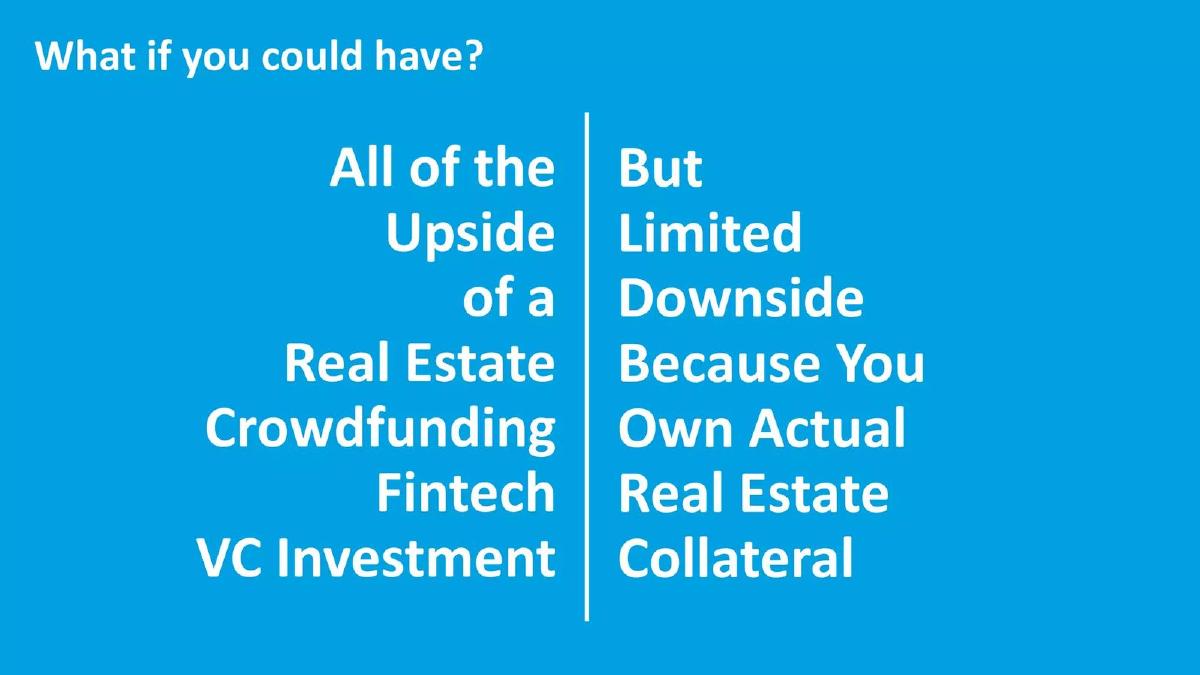
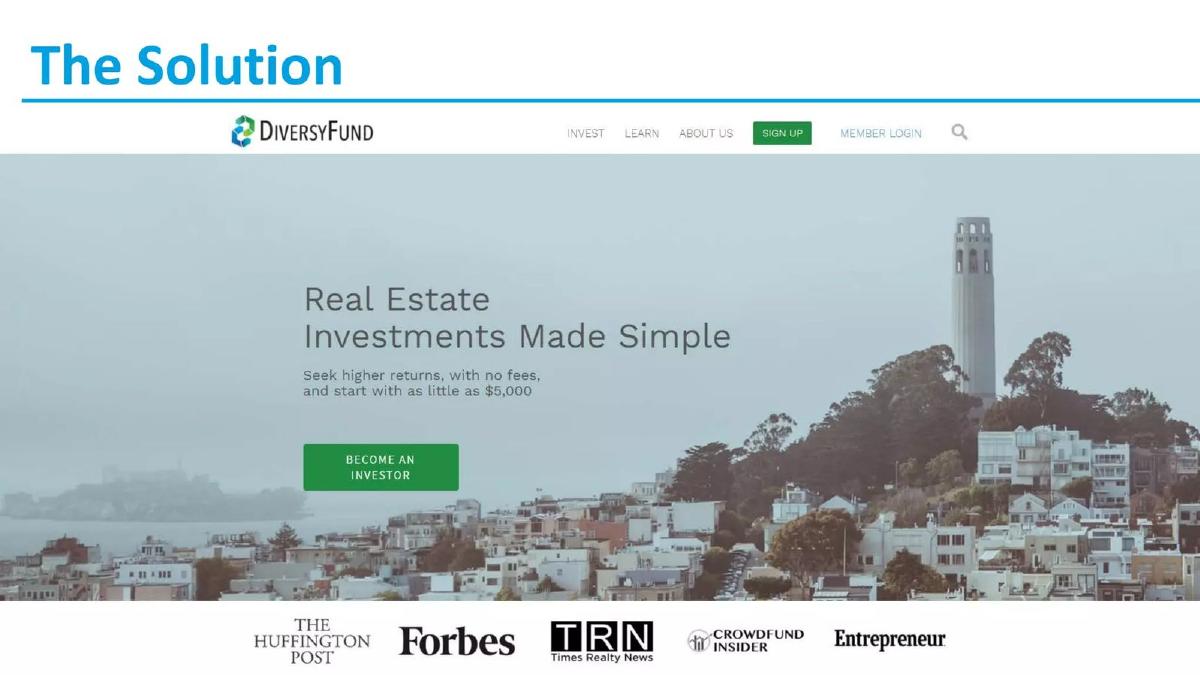
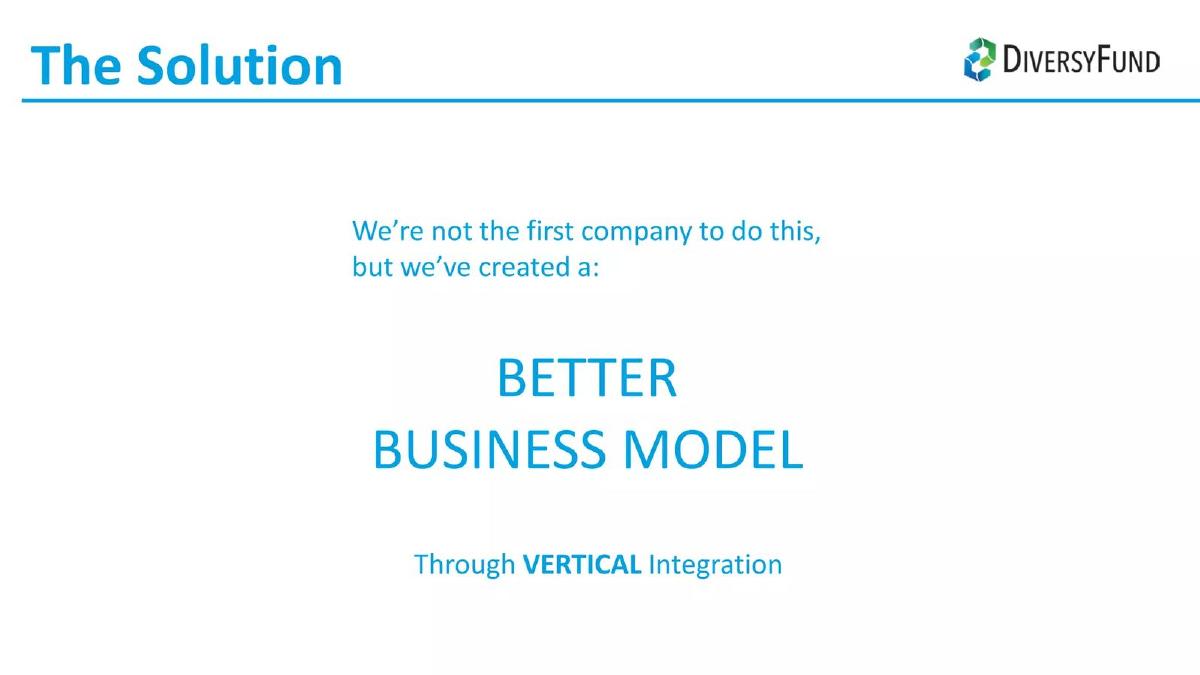
The deck opens with a clear contrast between the 'old' way of investing and the DiversyFund model. Slide 2 identifies the problem: high-quality real estate is locked behind $100,000 minimums and expensive broker fees, leaving ordinary investors stuck with an undiversified stock market portfolio. Slide 3 introduces the solution: an automated online platform that offers shares in vetted real estate with a much lower $5,000 minimum and, crucially, no investor or platform fees. This sets the stage for the 'Better Business Model' claim, which is the central theme of the presentation.
Slide 4: Defining Vertical Integration
Slide 4 is perhaps the most important slide for understanding the company's operations. It uses a simple 'VS' diagram to show that while competitors function as 'Broker' platforms with no control over projects or visibility into problems, DiversyFund is the sponsor and developer. They highlight their 'own licensed construction mgmt team,' which grants them full control over the real estate projects. This slide addresses a common risk in crowdfunding—platform-sponsor misalignment—by asserting that DiversyFund's interests are fully aligned with the project's success because they are the ones building it.
Slide 5: The Economics of the Model
Slide 5 translates the operational differences into financial ones. It compares the revenue generated from every $1M raised on the platform. The 'Other Guys' are capped at $25,000 to $60,000 in fees. DiversyFund, by forgoing platform fees in favor of developer fees ($100k-$200k) and profits from asset sales ($300k-$3M), claims a total profit potential of $400,000 to $3.2 million per $1M raised. The slide uses the bold claim that this 'can be 100x more revenue per dollar raised,' a powerful metric for venture capital investors looking for scalable unit economics.
Slide 6: The Portfolio Proof Point
To ground these theoretical economics in reality, Slide 6 showcases 'Assets Under Development.' It lists seven specific projects in La Jolla, San Diego, Los Angeles, Coronado, and Monterey. The slide aggregates these to a '$94M Completed Value' with 'Est. Profits: $21M.' This slide serves as the 'traction' and 'product' slide simultaneously, showing that the company is already executing on its developer-led strategy across high-value California markets. The use of specific project names and completed values adds a layer of transparency and credibility to their claims.
Slide 7: Customer Retention and Lifetime Value
Slide 7 focuses on the investor side of the marketplace. It reports that after a 'Recent Full-Cycle Investment,' 65% of investors reinvested immediately. Even more impressively, 50% of those who reinvested increased their investment amount. This is a critical metric for a fintech platform, as it suggests high trust and a low cost of customer acquisition for subsequent funds. It proves that the 'fully-automated user experience' mentioned earlier is successfully converting one-time users into long-term capital sources.
Slides 8-9: The Ask and the Exit
Slide 8 places DiversyFund in the context of the broader fintech landscape, showing the venture capital raised by competitors like Fundrise ($55.5M) and RealtyMogul ($45M). DiversyFund is 'Seeking $6M,' which, by comparison, looks like a lean and efficient raise given the portfolio they have already built. Slide 9 details the investment vehicle: a secured convertible note. The terms are aggressive: 12% interest, a 2-year term, and a $60M valuation cap. The slide concludes with a bold '10X' graphic, explicitly stating the goal of an IPO or M&A exit within 2-4 years at ten times the current valuation.
What DiversyFund Does Well
The deck excels at differentiation through business model innovation . Instead of trying to be a 'better' broker, they argue that the broker model is inherently flawed and that vertical integration is the only way to capture true value. This is a sophisticated argument that appeals to Series A investors who are looking for more than just incremental growth.
The transparency regarding the portfolio is also a strength. By listing specific addresses and completed values, they move beyond abstract concepts and show that they are a real estate firm as much as a software firm. Finally, the investor retention metrics (65% reinvestment rate) provide a strong signal of product-market fit and platform trust.
What is Missing from the Deck
The most glaring omission in the provided slides is a Team Slide . In a business that requires both high-level software engineering and boots-on-the-ground construction management, the pedigree of the founders and the construction team is paramount. Investors would want to see who is managing the $94M in assets and who built the 'fully-automated' platform.
Additionally, there is no detailed financial history . While the deck projects profits per $1M raised, it does not show the company's actual P&L or burn rate. The 'Est. Profits' of $21M are marked with an asterisk, but the corresponding footnote is not visible, leaving the timing and certainty of those profits unclear. There is also a lack of a regulatory/compliance slide , which is vital for a company operating in the highly regulated space of retail investment crowdfunding.
Founder's Guide: What to Copy
Founders should emulate the 'Revenue Comparison' table found on Slide 5. If your startup is entering a crowded market with a new business model, you must show—in dollars and cents—why your model is superior to the incumbents. DiversyFund doesn't just say they are better; they show that they capture significantly more value from the same unit of activity (in this case, $1M raised).
Another element to copy is the visual representation of the ecosystem on Slide 4. Using simple ovals and lines to explain 'Vertical Integration' vs. 'Broker Platforms' makes a complex structural advantage immediately understandable to an investor who may not be an expert in real estate law or construction management. Keep the diagrams simple and focus on the flow of control and capital.
Frequently asked questions
- What is DiversyFund's primary competitive advantage according to the deck?
- The primary advantage is vertical integration. Unlike 'broker' platforms that match investors to third-party developers, DiversyFund is the developer and sponsor for all its projects. This allows them to maintain full control over real estate projects, gain real-time visibility into issues, and capture developer fees and profits from asset sales that would otherwise go to third parties.
- How does DiversyFund's revenue model compare to other crowdfunding platforms?
- Traditional platforms typically earn 2.5-6% in fees, resulting in $25,000-$60,000 per $1M raised. DiversyFund claims to earn $0 in platform fees but captures $100,000-$200,000 in developer fees and $300,000-$3M in profit from asset sales. This totals $400,000-$3.2M per $1M raised, which they claim is up to 100x more revenue per dollar than competitors.
- What are the specific terms of the Series A investment offered in the deck?
- DiversyFund is seeking $6M through secured convertible notes. These notes are secured by the company's real estate assets and offer a 12% accrued interest rate per year. The notes have a 2-year term, a 20% discount to the Series B venture capital round, and a valuation cap of $60 million.
- What evidence of market traction does the deck provide?
- Traction is demonstrated through two main areas: asset volume and investor behavior. The deck lists $94M in completed asset value across seven projects in California. Additionally, it highlights that 65% of investors reinvested immediately following a full-cycle investment, and 50% of those reinvesting increased their investment amount.
- What is the planned exit strategy for DiversyFund?
- The deck explicitly states a plan for an IPO or M&A exit within a 2-4 year timeline. The company is specifically 'seeking to IPO at 10x Current Valuation,' positioning the Series A as a 'Pre-IPO Investment' opportunity for venture investors.