Legion M’s 2022 pitch deck is specifically engineered for equity crowdfunding, focusing heavily on emotional resonance and the power of collective ownership. Rather than relying on traditional venture capital metrics like CAC or LTV, the deck leans into the 'competitive advantage' of a built-in audience of 35,000+ investors (Slide 6). The narrative effectively bridges the gap between fan passion and financial upside, using a 'diversified business model' (Slides 10-11) that spans financing, production, distribution, and merchandise. While the deck lacks a traditional 'Ask' slide with specific…
Key takeaways
- The company defines its long-term goal as uniting 1 million fans as shareholders to become a major Hollywood influence (Slide 1).
- Legion M reports raising over $16M from more than 35k investors prior to this 2022 update (Slide 6).
- The deck claims a combined social reach of 1.7 billion impressions through its investor base (Slide 6).
- Annual revenue is shown growing from near zero in 2016 to over $1,050,000 in 2021 (Slide 12).
- The business model is split into four distinct revenue pillars: Financing, Production & Live Events, Distribution & Release, and Merchandise & Licensing (Slides 10-11).
- Social proof is heavily emphasized with quotes from the late Stan Lee and billion-dollar producers Dean Devlin and Michael Uslan (Slides 13-14).
- The team slide lists 14 core members across development, community, marketing, finance, and operations (Slide 15).
- The deck uses a 'Flywheel' diagram to explain how shareholder engagement leads to market success and further project support (Slide 9).
Executive Summary: The Power of the Crowd
Legion M occupies a unique space in the entertainment industry. Rather than seeking a handful of high-net-worth individuals or venture capital firms, they have built a business around the concept of 'Fan-Owned Entertainment.' This 2022 pitch deck is a tool for equity crowdfunding, designed to convert casual moviegoers into equity stakeholders. The narrative focuses on the systemic power shift from studios to fans, leveraging the emotional connection people have with film and television to drive investment.
Slide 1: The Founders' Manifesto
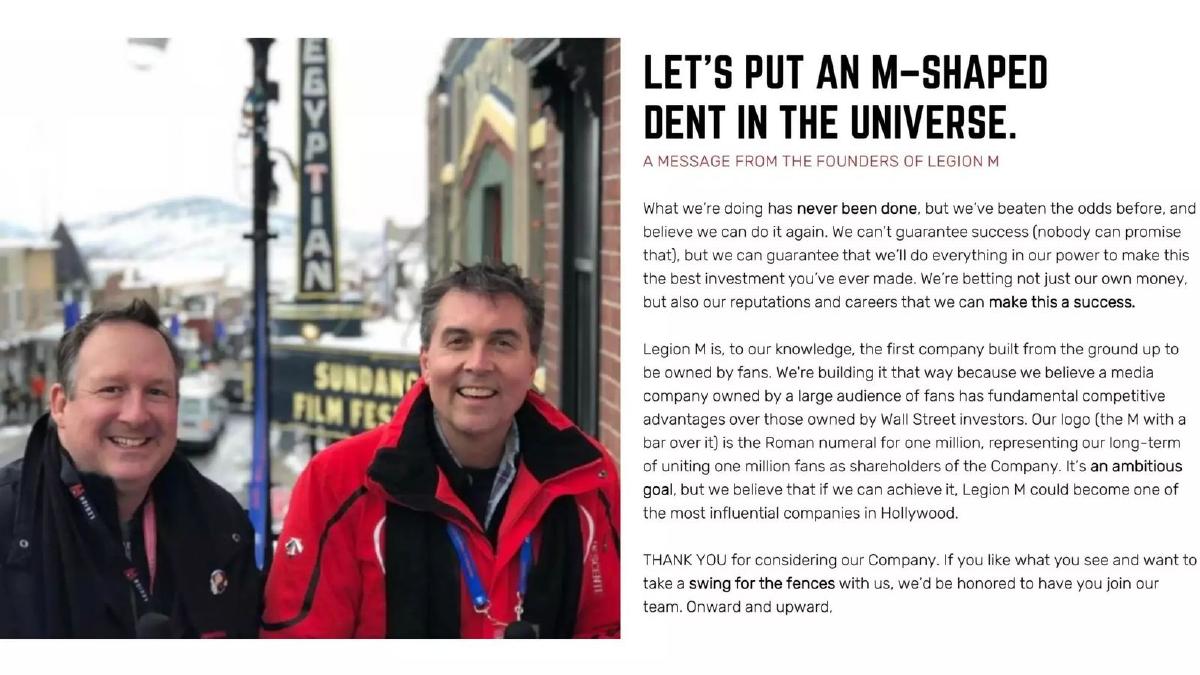
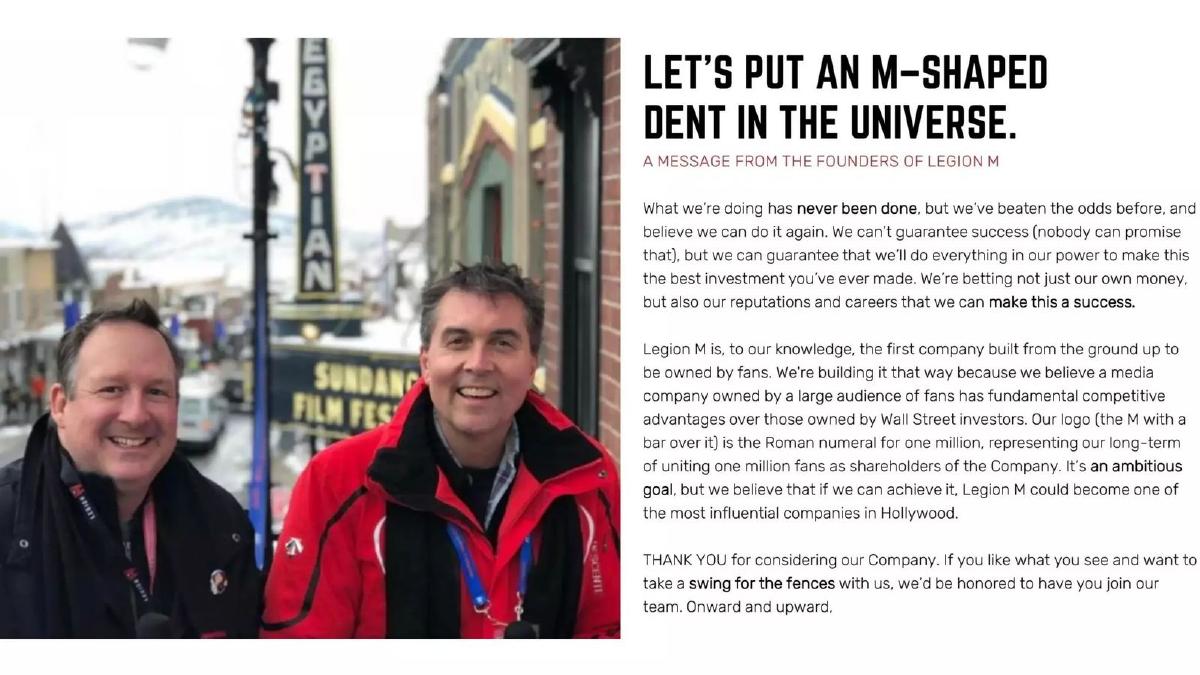
The deck opens with a personal letter from founders Jeff Annison and Paul Scanlan. This is a departure from the standard 'Problem/Solution' opening. It establishes the 'M-shaped dent in the universe'—a play on Steve Jobs' famous quote. Key data point: The logo (an M with a bar over it) is the Roman numeral for one million, representing their goal of uniting 1 million fan-shareholders. This slide sets an ambitious, mission-driven tone, emphasizing that they are betting their 'reputations and careers' on the venture.
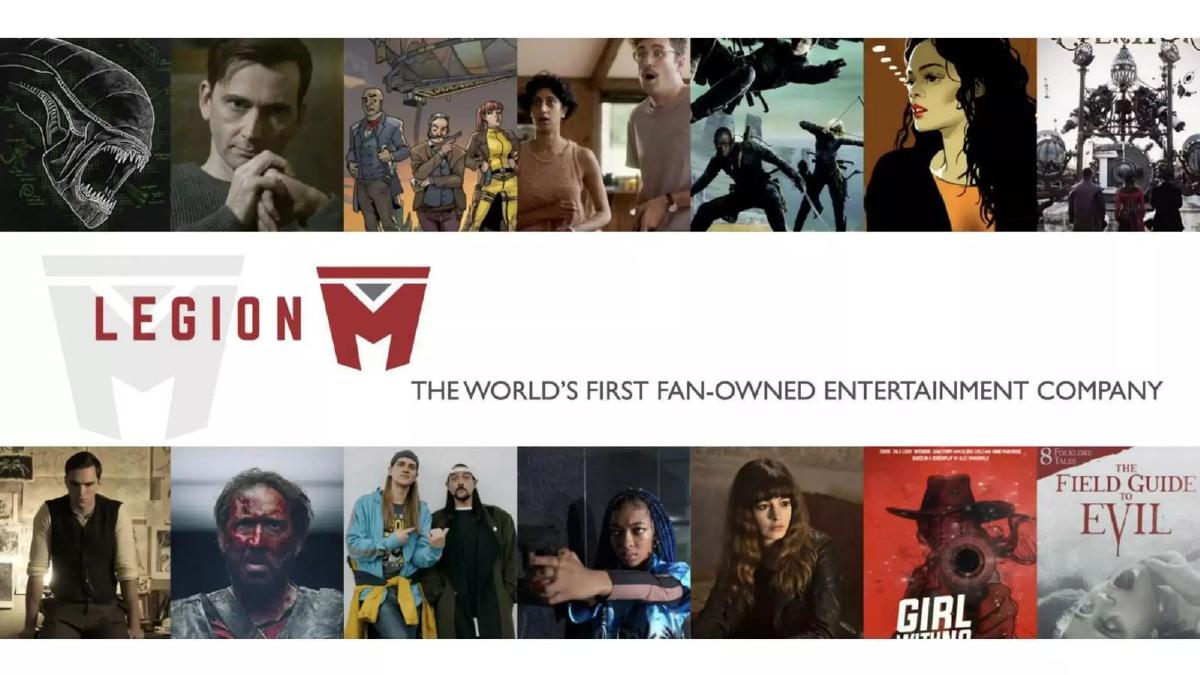
Slide 2: Visual Portfolio
Slide 2 is a montage of projects including 'Mandy,' 'Jay and Silent Bob Reboot,' and 'Archenemy.' It serves as immediate proof of concept. By showing recognizable faces like Nicolas Cage, Kevin Smith, and David Tennant, Legion M signals that they are already operating at a professional Hollywood level, not just 'playing' at making movies.
Slide 3-5: The Problem and the Power Shift
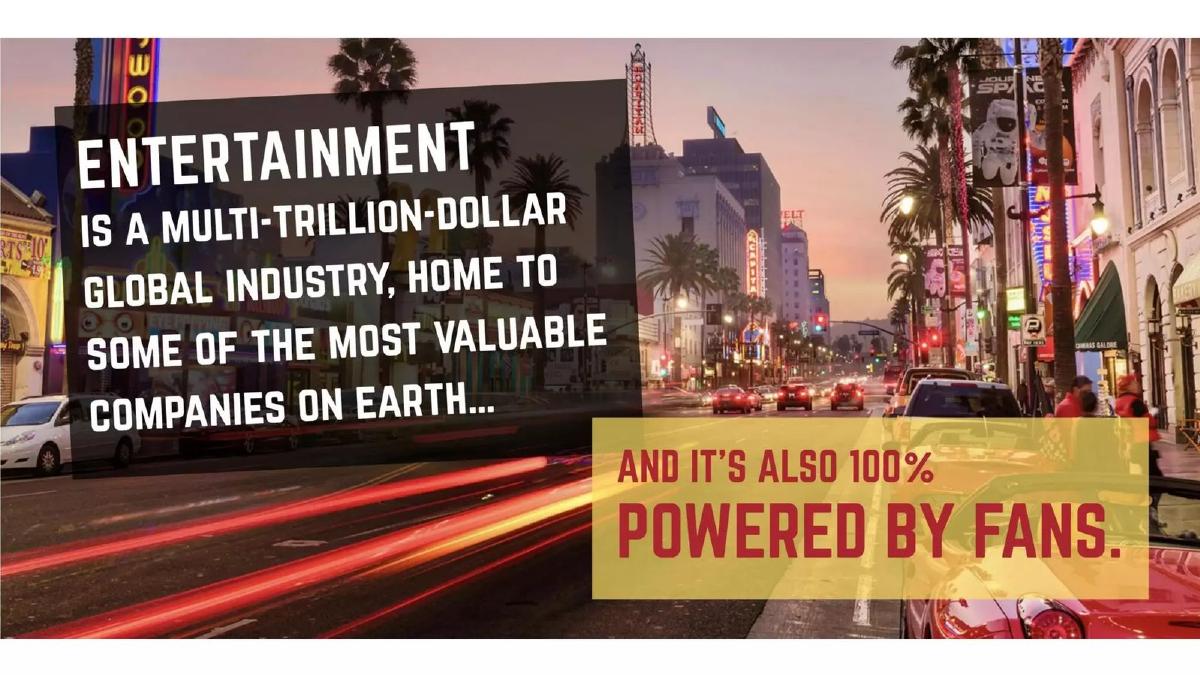
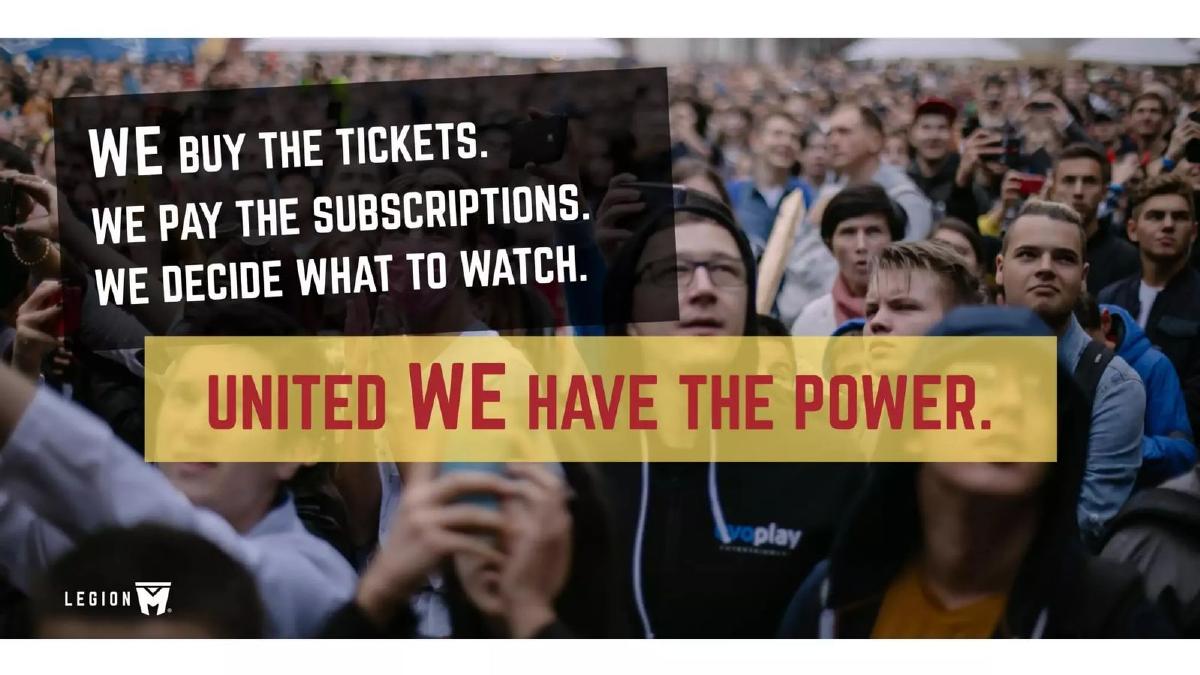
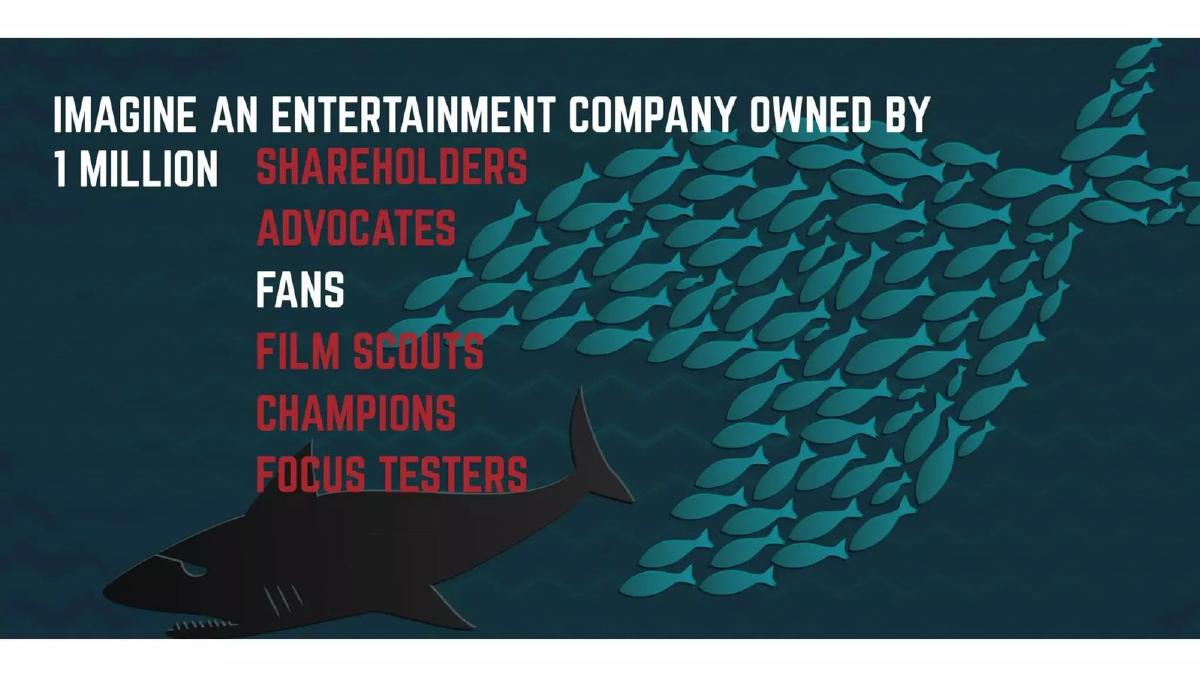
These slides frame the market opportunity. Slide 3 identifies entertainment as a 'multi-trillion-dollar global industry' that is '100% powered by fans.' Slide 4 uses a 'We' narrative ('We buy the tickets,' 'We pay the subscriptions') to build a sense of collective identity. Slide 5 uses a visual metaphor of a school of small fish forming a larger shape to intimidate a shark, representing how 1 million shareholders can disrupt the traditional studio 'sharks.' This is a classic 'David vs. Goliath' narrative that works exceptionally well in crowdfunding.
Slide 6: The Competitive Advantage
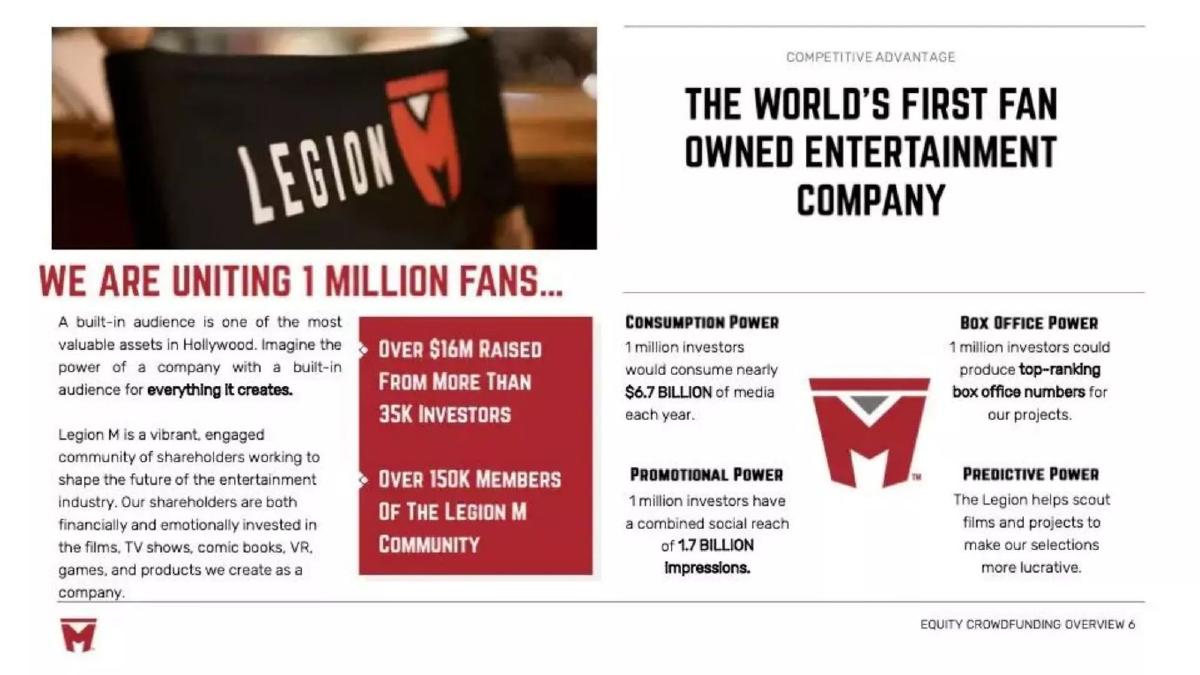
This is the most data-dense slide in the first half of the deck. It defines their 'Competitive Advantage' through four types of power: Consumption, Promotional, Box Office, and Predictive. Key figures cited: Over $16M raised from 35k+ investors and a community of 150k members. They project that 1 million investors would have a combined social reach of 1.7 billion impressions and consume nearly $6.7 billion of media annually. This quantifies the 'fan power' mentioned in previous slides.
Slide 7: Proprietary Tools
Legion M introduces three 'Wisdom of the Legion' tools: Film Scout (real-time analytics at festivals), MeetupMaker (shareholder-organized events), and M Pulse (feedback loops). This slide demonstrates that the 'crowd' isn't just a source of money; they are a functional part of the company's operations, acting as a massive, free focus group.
Slide 8: Case Study - Mandy
The deck uses the 2018 film 'Mandy' to prove the model works. It highlights a Business Insider headline: 'The Surprise Theatrical Success of Mandy has the Industry Rethinking Release Strategies.' They list specific wins: selling out the Egyptian Theatre in hours and creating custom merchandise like 'Cheddar Goblin' mac and cheese. This slide bridges the gap between 'cool idea' and 'profitable execution.'
Slide 9: The Flywheel
The 'How Having Fun Translates to Good Business' slide uses a circular diagram to show their growth strategy: Shareholder Engagement leads to Project Support, which leads to Market Success, which creates more Engagement Opportunities. It’s a simple, effective way to explain their business logic to non-professional investors.
Slide 10-11: Diversified Business Model
These slides break down their revenue streams into four categories. Financing: Titles like 'Mandy' and 'The Field Guide to Evil.' Production & Live Events: Including the Stan Lee 'Excelsior!' tribute. Distribution & Release: Titles like 'Colossal' and 'Save Yourselves!' Merchandise & Licensing: Showing a wide array of posters and products. This breadth is intended to de-risk the investment by showing they aren't dependent on a single 'hit' film.
Slide 12: Financial Traction
The 'Growth Through Accumulating Revenue' slide provides the hard numbers. Annual Revenue: The chart shows a climb from near $0 in 2016 to $1,050,000 in 2021. There is a notable peak in 2017 (attributed to a 'Stan Lee one-time event') followed by a dip in 2018, and then consistent growth from 2019 through 2021. The right side of the slide shows a 'Year Over Year Revenue Streams' stack, visualizing how projects accumulate value over time.
Slide 13-14: Social Proof
Legion M leans heavily on industry validation. Slide 13 features quotes from Dean Devlin (Independence Day) and Michael Uslan (Batman franchise), both described as 'Billion-dollar' producers. Slide 14 is a full-page tribute to the late Stan Lee, quoting him as saying the fan-owned model is a 'wonderful idea.' For a company targeting 'geek culture' fans, this is the ultimate endorsement.
Slide 15: The Team
The team slide features 14 individuals. Founders Jeff Annison and Paul Scanlan are front and center. The rest of the team is categorized by function: Development (4 people), Community (3 people), Marketing (2 people), Finance (1 person), and Merchandise/Operations (2 people). Notably, they use titles like 'Jedi of Operations' and 'Growth Hacker,' which aligns with their brand voice but might be seen as less professional in a traditional VC setting.
What Works in This Deck
1. Emotional Hook: The deck does an excellent job of making the investor feel like part of a movement. By using words like 'Unite,' 'Power,' and 'Legion,' they transform a financial transaction into a social identity.
2. Visual Proof: The use of high-quality film stills and recognizable celebrities provides instant credibility. It proves that despite their unconventional funding model, the output is indistinguishable from major studio productions.
3. Transparency on Revenue: Slide 12 is particularly honest. It points out a one-time revenue spike in 2017 and the subsequent dip. This level of transparency builds trust with retail investors who might be wary of 'up-and-to-the-right' charts that look too perfect.
What Is Missing
1. The 'Ask' Details: There is no slide detailing the current valuation, the price per share, or the specific use of funds for the $11M round. While this is often handled by the crowdfunding platform's landing page (e.g., Wefunder or StartEngine), its absence in the deck makes the 'business' side feel incomplete.
2. Exit Strategy: There is no mention of how investors might eventually see a return. While 'dividends' or 'IPO' are mentioned as possibilities in general crowdfunding risks, the deck doesn't outline a specific path to liquidity.
3. Competitor Analysis: The deck ignores other fan-centric or independent studios (like A24 or Neon) or other crowdfunding-heavy entertainment ventures. It positions Legion M as the 'world's first,' which is a strong claim that could benefit from a competitive landscape comparison.
Founder's Guide: What to Copy
The 'Flywheel' Visualization: If your business relies on community or network effects, copy Slide 9. It clearly explains why more users/investors make the business fundamentally better and more profitable.
The Accumulation Chart: Slide 12's 'Year Over Year Revenue Streams' is a brilliant way for content-heavy businesses to show how back-catalogues create a 'floor' of revenue that grows as new projects are added. This is much more effective than a simple bar chart.
Heavy Social Proof: If you have industry titans backing you, don't hide them on the team slide. Give them full-page quotes as Legion M did on Slides 13 and 14. In the absence of traditional 'moats,' reputation is a powerful proxy for security.
Frequently asked questions
- How much has Legion M raised in total?
- According to Slide 6 of the 2022 deck, Legion M had raised over $16M from more than 35,000 investors. Catalogue facts from Failory indicate that specifically in 2022, they raised an additional $11M through crowdfunding. This cumulative total demonstrates a high level of sustained interest from their community over several years.
- What is Legion M's primary business model?
- Legion M utilizes a multi-pronged revenue strategy. As detailed on Slides 10 and 11, they generate income through film financing, production and live events (like the Stan Lee handprint ceremony), distribution and release of titles, and a robust merchandise and licensing arm that includes products like Funko Pops and even 'Cheddar Goblin' mac and cheese.
- Who is on the leadership team?
- The company was co-founded by Jeff Annison (President) and Paul Scanlan (CEO). Their broader team, shown on Slide 15, includes specialists like Terri Lubaroff (COO & Head of Content) and David Baxter (VP of Development), supported by departments dedicated to community management, growth hacking, and merchandise licensing.
- What kind of traction does the deck show?
- Traction is presented through both community growth and financial performance. Slide 6 notes a community of 150,000 members, while Slide 12 displays an annual revenue chart showing a climb from approximately $175,000 in 2018 to over $1,050,000 in 2021, despite a dip in 2018 following a one-time event peak in 2017.
- What is missing from this pitch deck?
- Because this is a crowdfunding deck intended for a broad audience, it lacks several items found in a typical VC deck. There is no 'The Ask' slide detailing the specific valuation or share price for the current round. It also omits detailed unit economics, burn rate, or a specific 5-year financial projection table.