Recraft raised €11M in a Series A round led by Khosla Ventures in 2024, supported by a high-signal group of angels including Nat Friedman and Elad Gil. The 23-slide deck succeeds by positioning the company not just as another 'image generator,' but as a professional design tool capable of producing true vector art—a significant technical moat. The deck leans heavily on early traction, showing a rapid climb to 75,000 users since their May 2023 launch. By showcasing superior 'generation quality' against incumbents like Adobe and Midjourney, Recraft makes a compelling case for a specialized foun…
Key takeaways
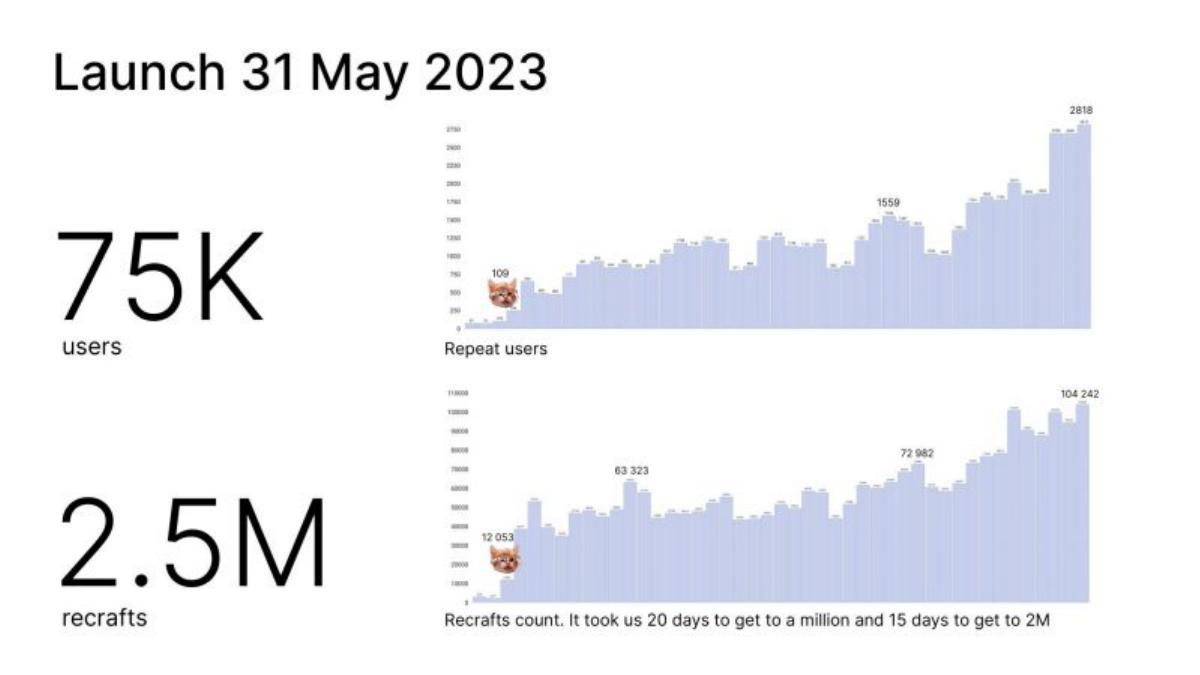
- The company achieved 75,000 users and 2.5 million 'recrafts' within approximately five months of launch (Slide 3).
- Recraft differentiates itself by generating 'true vector' art with editable nodes, rather than just raster images (Slide 8).
- The deck explicitly compares its output quality to Adobe, highlighting 'smooth gradients' versus 'broken gradients' (Slide 9).
- A clear monetization strategy is outlined, transitioning from 'Early Recrafter' subscriptions to tiered Enterprise 'Brand' packages (Slide 20).
- The 'Ask' slide specifies a $10M raise with granular cost breakdowns, including $350k per training run and $25k/month for inference (Slide 21).
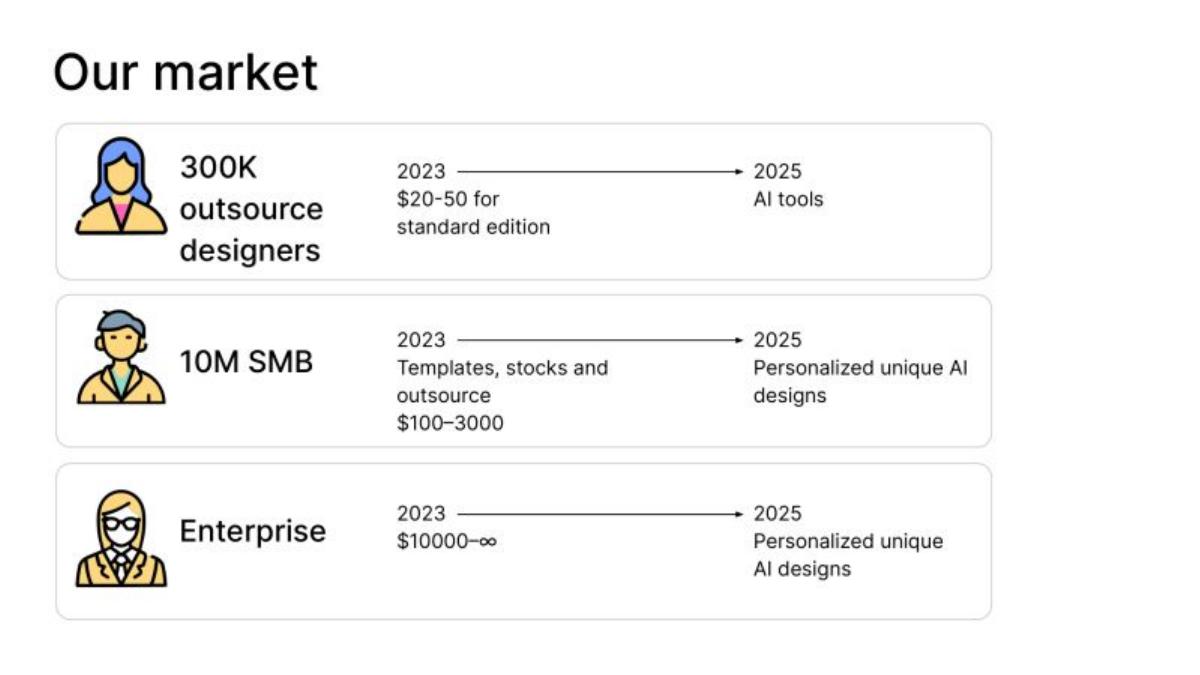
- The startup targets three distinct segments: 300k outsource designers, 10M SMBs, and Enterprise clients (Slide 6).
- Recraft utilizes a 'data advantage' loop where product analytics and designer-labeled pipelines inform the next foundation model (Slide 16).
- The deck lacks a traditional 'Team' slide featuring founder bios or previous experience, relying instead on a list of high-profile investors (Slide 22).
The Professional Pivot: Recraft's Series A Teardown
Recraft entered a crowded Generative AI market in 2023, but their Series A deck reveals a surgical focus on the professional design workflow. While Midjourney and DALL-E captured the consumer imagination, Recraft targeted the 'vector' gap—the specific technical requirement of professional graphic designers. This 23-slide deck is a masterclass in using product-led growth metrics and technical differentiation to justify a significant capital raise.
Slides 1-5: The Traction Hook
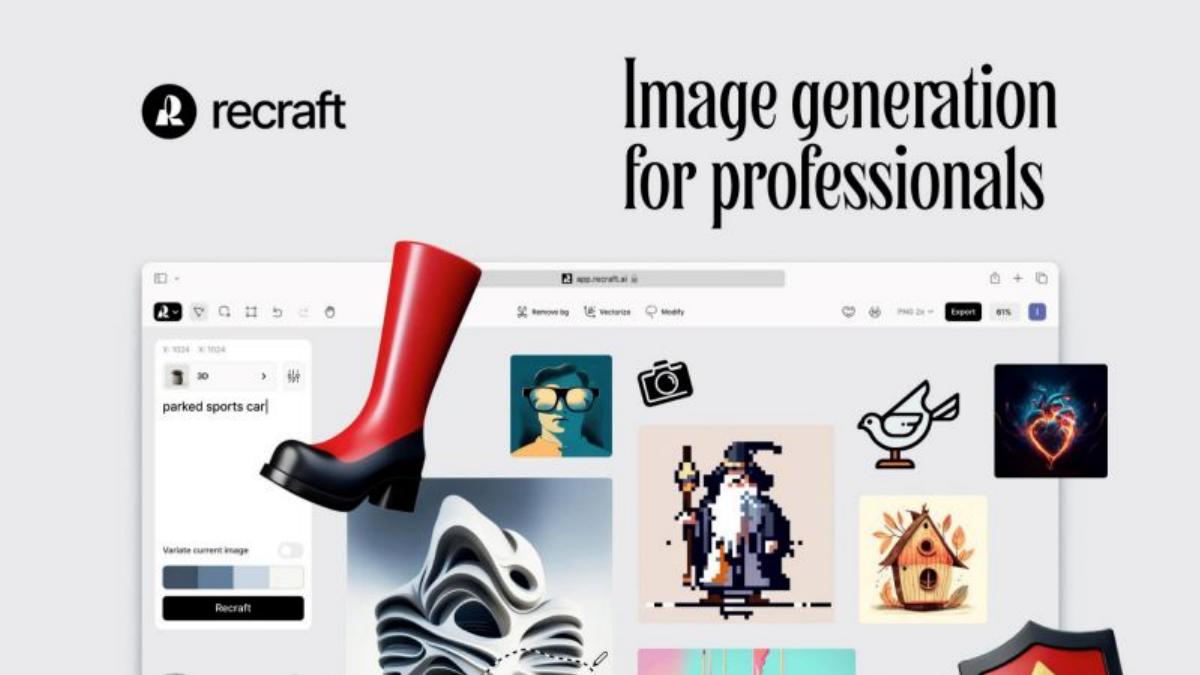
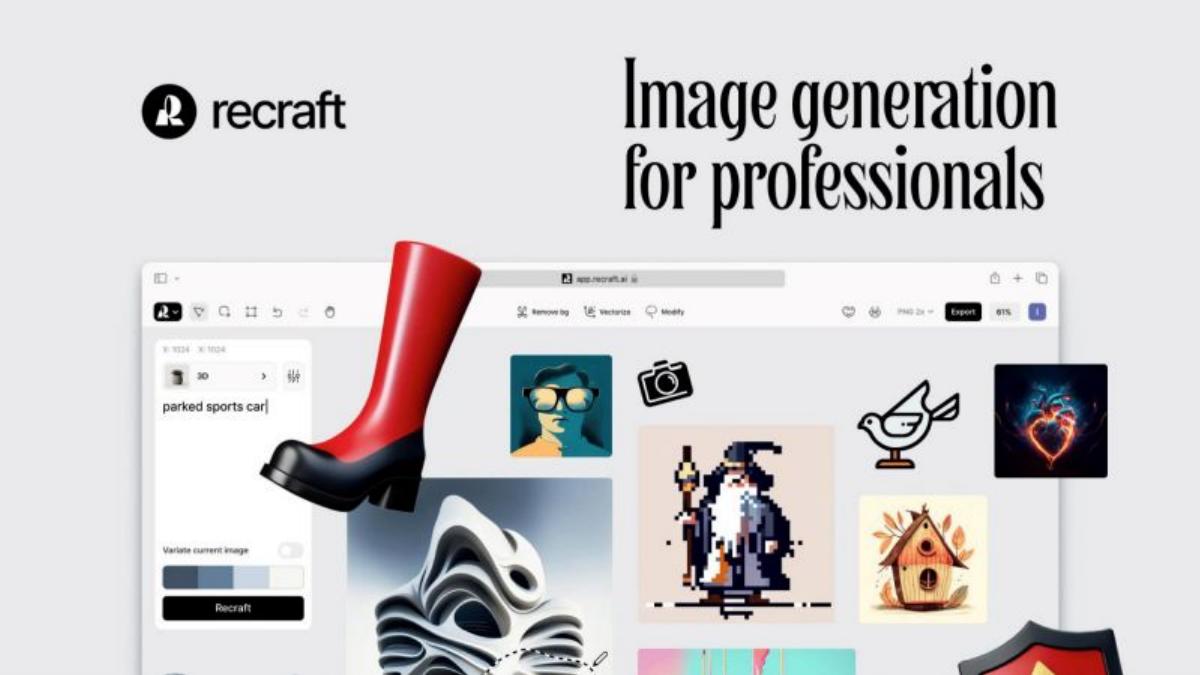
Slide 1 opens with a clear value proposition: "Image generation for professionals." The visual shows a sophisticated UI, signaling that this is a tool, not just a prompt box. Slide 2 highlights their Product Hunt launch, where they secured 2nd Product of the Day and 5th Product of the Week with 942 upvotes. This establishes immediate third-party validation.
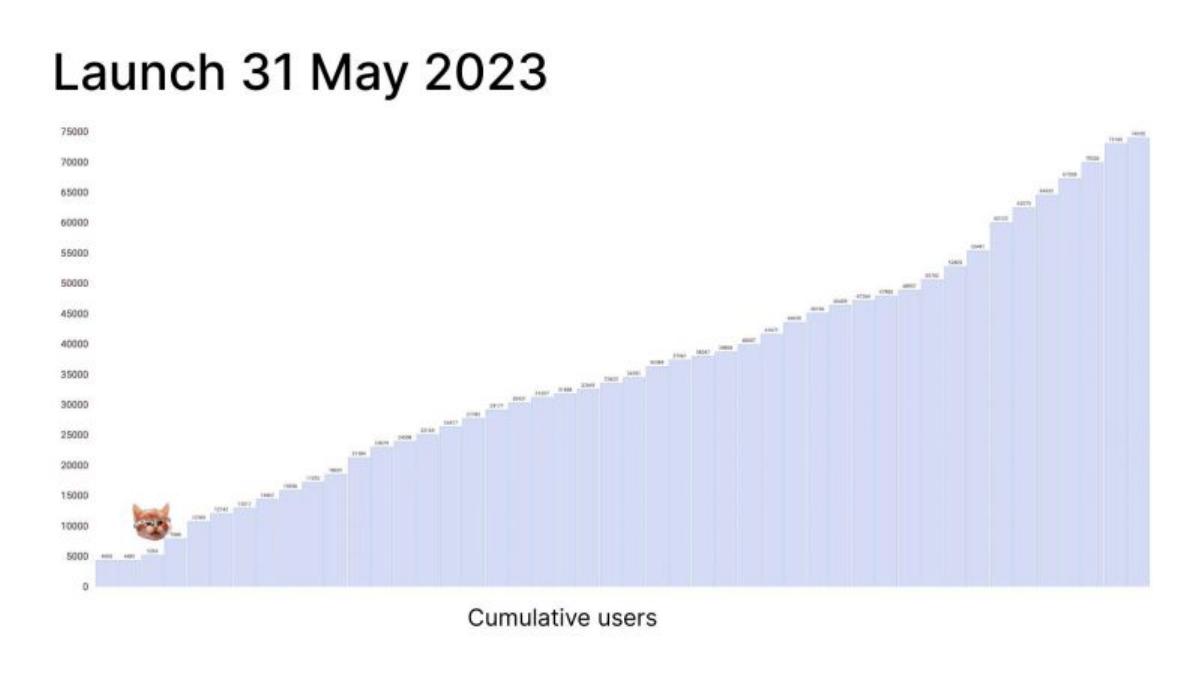
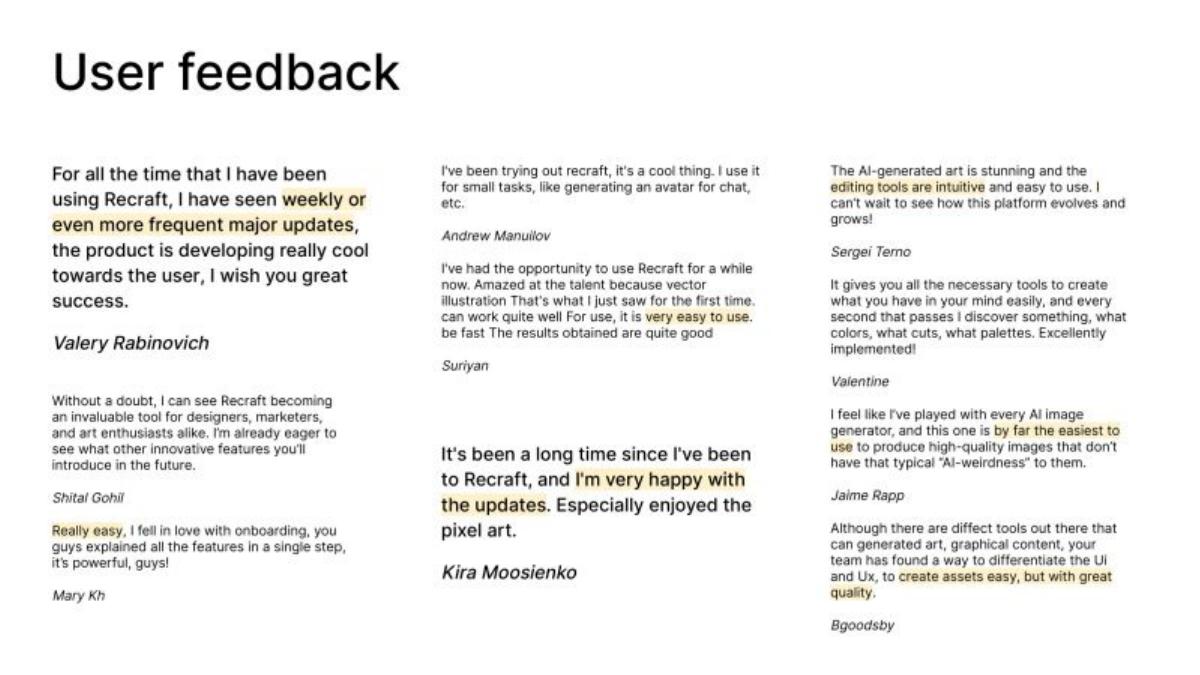
Slides 3 and 4 are the 'meat' of the opening. The company shows an aggressive growth curve since their May 31, 2023, launch. They reached 75,000 users and 2.5 million 'recrafts' (generations) in a matter of months. Notably, Slide 3 points out that it took only 20 days to reach 1 million generations. Slide 5 rounds out the intro with user feedback, emphasizing 'weekly updates' and 'ease of use,' which suggests a high velocity of development.
Slides 6-10: Market and Technical Moat
Slide 6 defines the market opportunity across three tiers: 300k outsource designers, 10M SMBs, and the Enterprise. It suggests a shift from manual outsourcing ($100-$3000) to personalized AI designs by 2025. This slide is a bit light on total addressable market (TAM) figures but focuses on the transition of spend.
Slides 7, 8, and 9 dive into the 'Technology and data advantage.' Slide 8 is perhaps the most important in the deck; it shows a vector bird with editable nodes. This is the 'aha' moment for investors: Recraft isn't just making pictures; it's making geometry. Slide 9 takes a direct shot at Adobe, showing 'smooth gradients' in Recraft versus 'broken gradients' in Adobe's AI output. This bold comparison positions them as a technical leader rather than a follower.
Slides 10-15: Product Depth and Presets
Slide 10 and 23 (which appears to be a duplicate or extension of Style Control) demonstrate the granularity of the tool. Users can control 'complexity level,' 'brand colors,' and 'visual references.' This moves the conversation from 'random generation' to 'brand consistency.'
Slides 11 through 15 showcase the breadth of the model's capabilities: Vector illustrations, Raster presets (Pixel Art, 80s, Psychedelic), 3D art (Plastic 3D), and Icon sets. By showing 'Icon presets' in Slide 14 , Recraft demonstrates a specific B2B use case—generating uniform icon sets in four different styles—which is a common, time-consuming task for professional designers.
Slides 16-19: The Data Loop and Competition
Slide 16 explains the 'Data advantage.' Recraft uses labeling pipelines with designers and feeds product analytics back into training. This 'flywheel' argument is standard in AI decks but is backed here by the quality shown in previous slides. Slide 17 and 18 introduce the competition: Midjourney, Adobe, Canva, and other GenAI companies.
Slide 19 is a 'blind test' style comparison. Using the prompt 'rabbit is driving a train,' Recraft places its output alongside Lexica, Adobe, OpenAI, and Stability.ai. Recraft’s output is arguably the most stylistically coherent and 'professional' looking, reinforcing the 'Image generation for professionals' tagline from Slide 1.
Slides 20-22: Monetization, The Ask, and Investors
Slide 20 outlines the monetization strategy. It moves from a 'Subscription' model (Early Recrafter, Creator, Professional) to an 'Enterprise' model focusing on 'Brand Setup' (Logo, Icon Set, Mockup). This shows a clear path to capturing high-contract-value customers.
Slide 21 is the 'Round' slide. It states a goal of reaching $1M in revenue and proving GTM motion. The 'Raising $10M' ask is broken down with surprising transparency: $350k per FM training run and $25k/month for inference. They also list 11 specific hires. Slide 22 concludes with an 'Investors include' list. While the deck lacks a traditional team slide with bios, the presence of Khosla Ventures, Nat Friedman, and Elad Gil serves as a proxy for team quality.
What Recraft Does Well
Visual Proof: The deck doesn't just say they are better; it shows side-by-side comparisons with Adobe and OpenAI. · Technical Specificity: Focusing on 'true vector' art (Slide 8) provides a clear reason why a designer would use this over Midjourney. · Capital Transparency: Breaking down the cost of a single training run ($350k) helps investors understand exactly how their capital will be deployed in an R&D-heavy sector.
What is Missing
Team Bios: There is no slide detailing the founders' backgrounds. While the investor list is impressive, knowing who is building the models is usually a requirement for a Series A. · Unit Economics: While they mention inference costs ($25k/mo), there is no mention of Customer Acquisition Cost (CAC) or Lifetime Value (LTV), though this is common for early-stage PLG (Product-Led Growth) companies. · TAM/SAM/SOM: The market slide (Slide 6) identifies segments but doesn't quantify the total dollar opportunity in a traditional way.
What a Founder Should Copy
The 'Traction Hook': If you have 75k users in 5 months, put it on Slide 3. Don't bury it. · The Side-by-Side: If your product is technically superior, use a standardized prompt/test to prove it against the market leader. · The Granular Ask: Instead of saying "$10M for scaling," say "$350k per training run." It shows you have a handle on your burn and your infrastructure.
Frequently asked questions
- How much did Recraft raise and who were the lead investors?
- According to the catalogue facts, Recraft raised €11M in their Series A round. The deck lists Khosla Ventures as a primary institutional investor, alongside high-profile angels such as Nat Friedman (former CEO of GitHub), Elad Gil, and Dharmesh Shah (founder of HubSpot).
- What is Recraft's primary technical differentiator in the AI space?
- Recraft focuses on 'Image generation for professionals,' specifically highlighting its ability to generate true vector art (Slide 8). Unlike most Generative AI tools that produce static pixels (raster), Recraft’s model is built to create paths and nodes that designers can edit in professional software.
- What does the traction look like for Recraft?
- The traction is significant for an early-stage company. Slide 3 shows they reached 1 million generations in 20 days and 2 million in 35 days. By the time of the deck's creation, they had 75,000 users and a consistent upward trend in repeat daily users.
- How does Recraft plan to spend the Series A capital?
- Slide 21 outlines a $10M raise (though the final round was €11M). The funds are earmarked for Foundation Model (FM) training at $350k per run, $150k/month for experiments, and a hiring plan for 11 specific roles including ML engineers and product designers.
- Does the deck include a competitive analysis?
- Yes, Slide 18 and 19 address competition. Recraft positions itself against Midjourney, Adobe, Canva, and other GenAI companies. Crucially, Slide 19 uses a side-by-side 'Generation quality' test with the prompt 'rabbit is driving a train' to visually demonstrate their model's superiority.