RealtyShares utilized a remarkably brief 6-slide deck to communicate a high-growth marketplace story. Despite the short length, the deck manages to cover the two-sided value proposition, impressive traction metrics, and a deeply experienced leadership team. By April 2016, the company had funded over $170 million in capital across 350+ deals, showing a clear 4x growth trend from the previous year. The deck skips traditional sections like 'Problem' or 'Market Size,' likely because the $800mm+ property value already proved the market's existence. It serves as a prime example of a 'traction-first…
Key takeaways
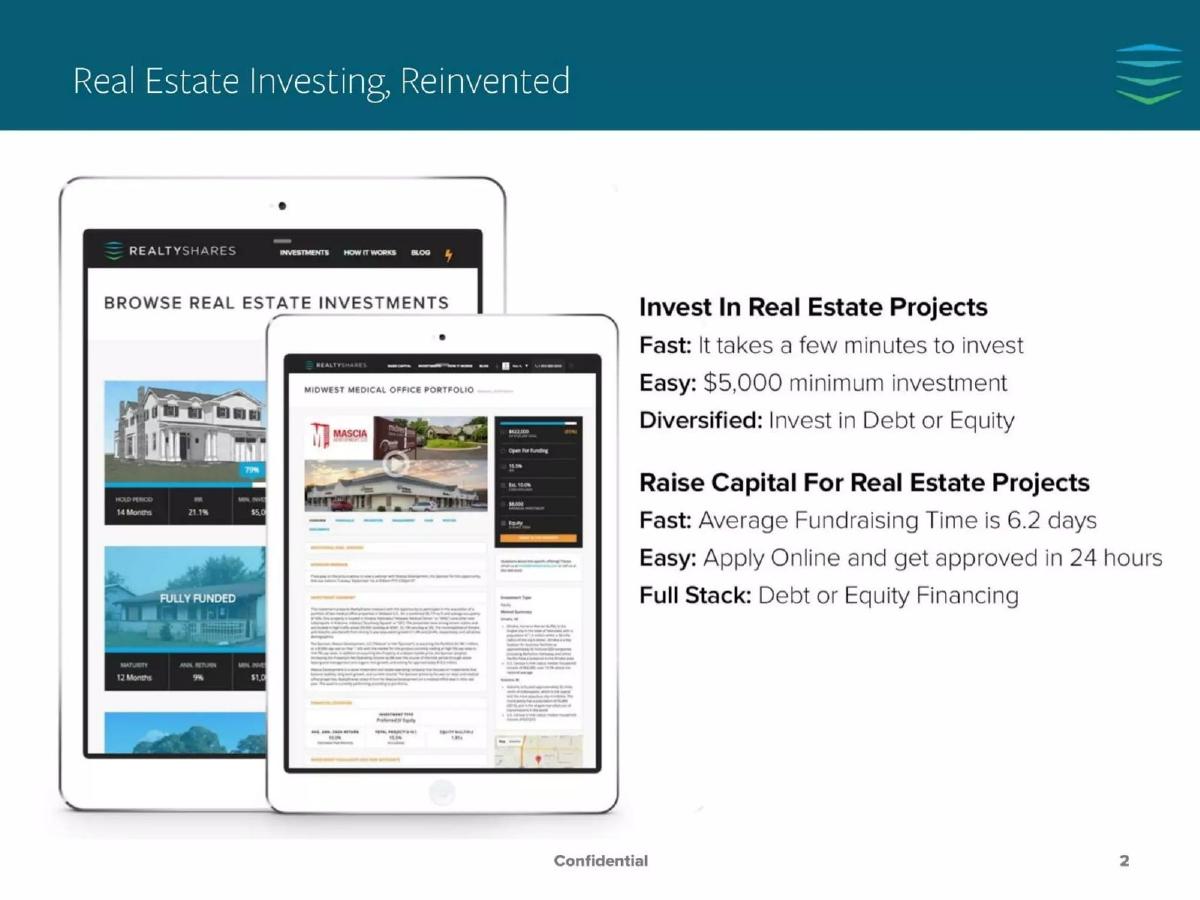
- The deck highlights a $5,000 minimum investment for individuals to access real estate projects on slide 2.
- Fundraising efficiency is a core value prop, with an average fundraising time of 6.2 days for operators on slide 2.
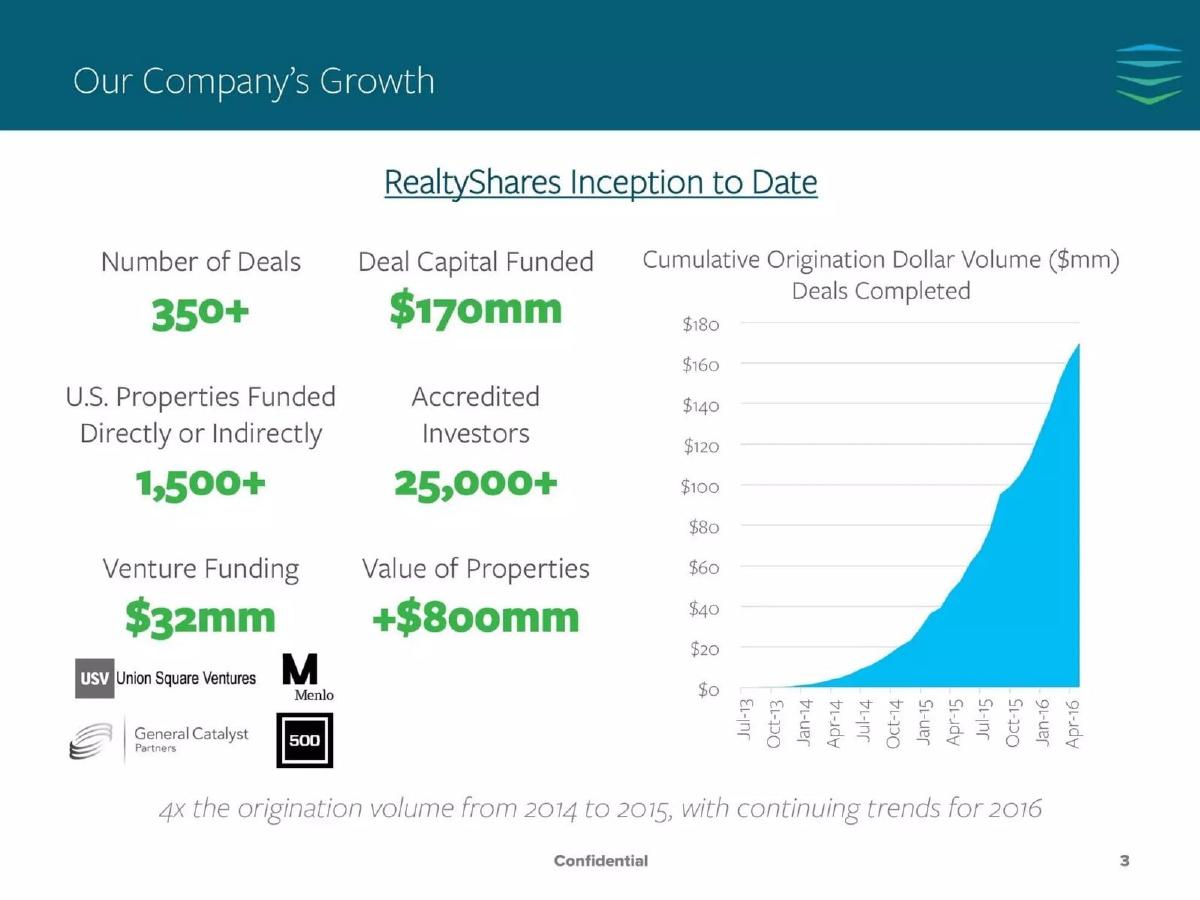
- Traction is the centerpiece, showing $170mm in deal capital funded and 25,000+ accredited investors on slide 3.
- The company achieved 4x origination volume growth between 2014 and 2015 as noted on slide 3.
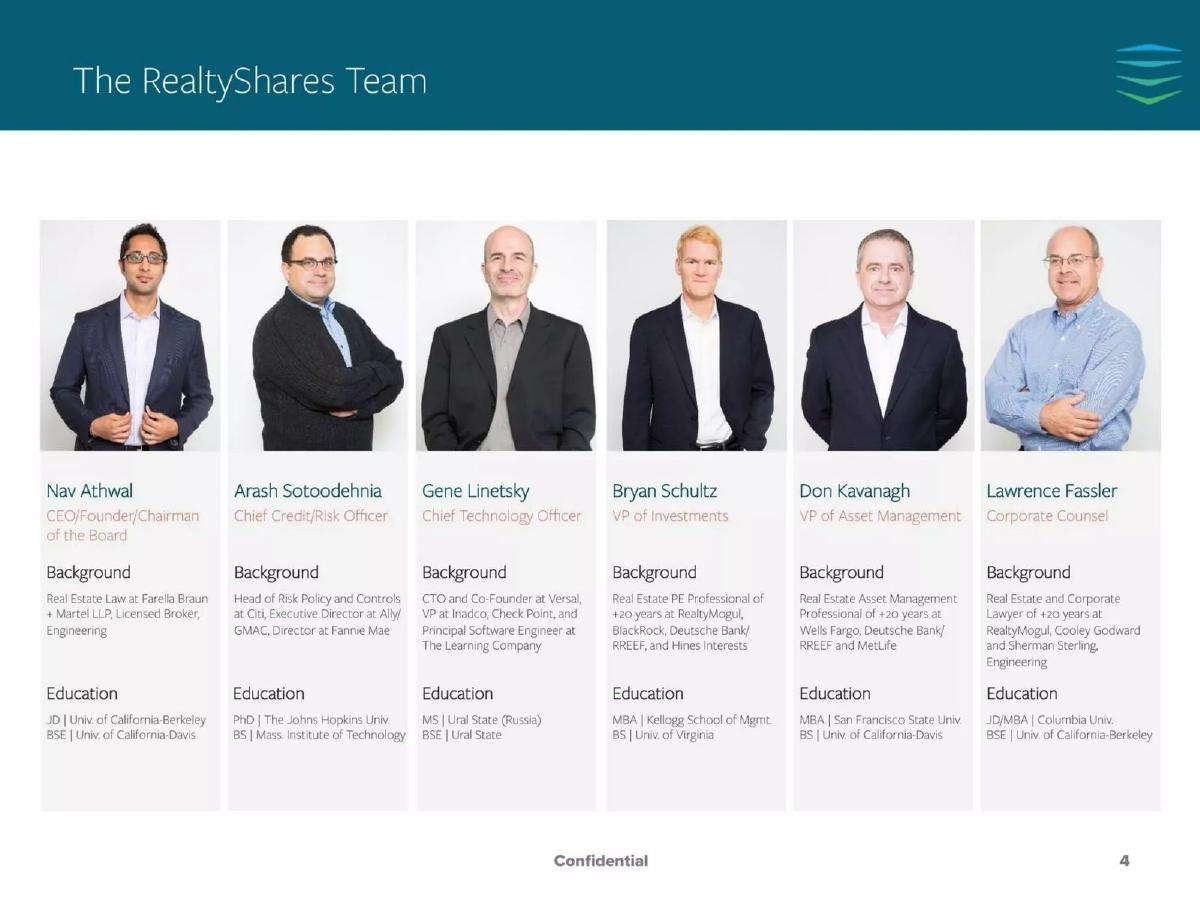
- The team slide (slide 4) emphasizes institutional pedigree, featuring leaders from Wells Fargo, Deutsche Bank, and Fannie Mae.
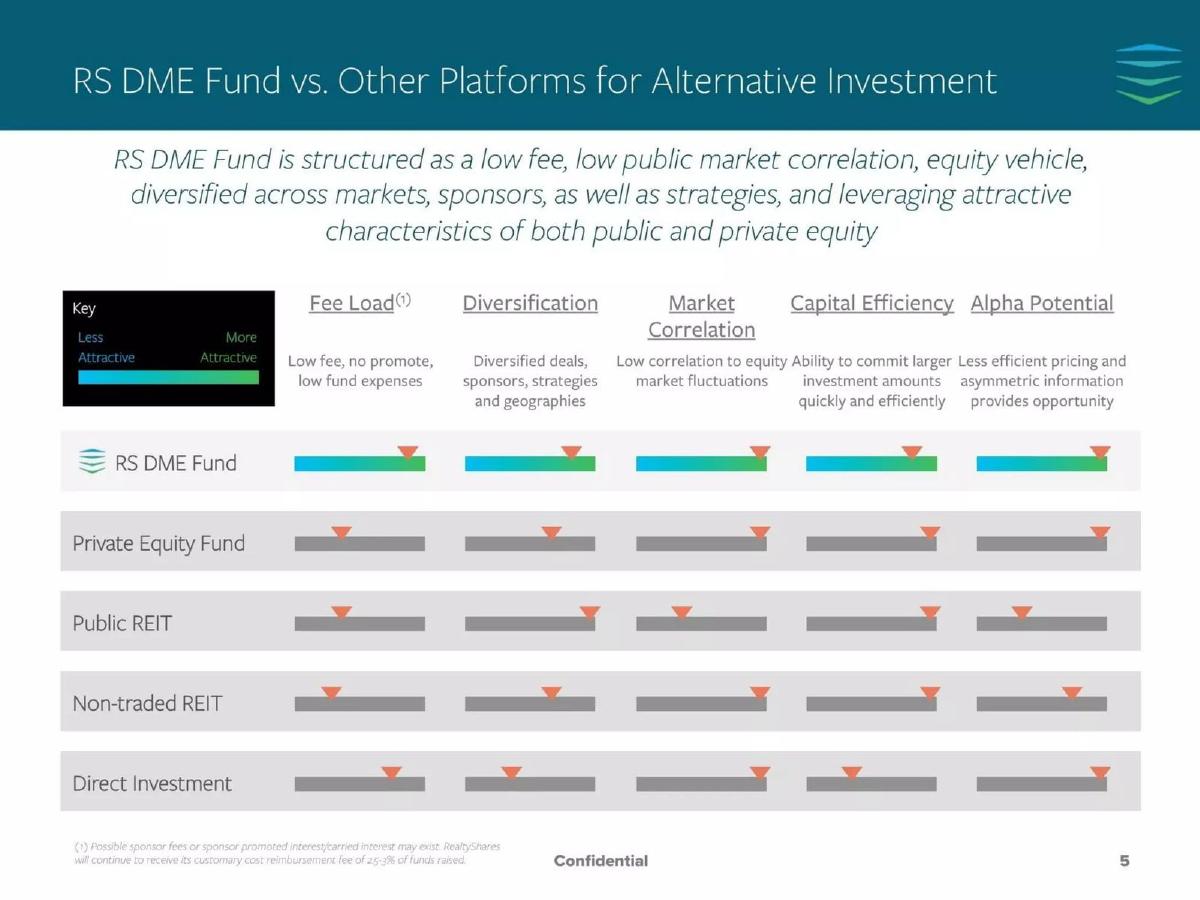
- Competitive positioning on slide 5 uses a 'RS DME Fund' comparison to show superiority in fee load and alpha potential.
- The deck completely omits a dedicated 'Problem' slide, 'Market Size' slide, and a specific 'Ask' or use of funds.
- Visual evidence of the product is limited to two tablet mockups on slide 2 showing the investment browsing interface.
Introduction: The Power of Brevity in Growth-Stage Fundraising
The RealtyShares pitch deck is a fascinating artifact in the world of venture capital. While many early-stage founders struggle to condense their vision into 15 slides, RealtyShares managed to tell a compelling story in just six. This deck, dating from approximately 2016 based on the charts, represents a company that has moved past the 'idea' phase and into the 'scaling' phase. According to the catalogue facts, the company eventually raised over $105 million, and this deck shows exactly why: the numbers were simply too good to ignore.
Slide 1: The Cover
The deck opens with a high-resolution, grayscale aerial shot of a dense urban environment, presumably Manhattan. The RealtyShares logo—a stylized stack of four planes in blue and green—sits prominently in the center. The tagline is simple: "Online Marketplace for Real Estate Investing." This slide establishes the industry and the business model immediately. There is no ambiguity; it is a marketplace, and it is for real estate.
Slide 2: The Value Proposition (Two-Sided Marketplace)
Slide 2, titled "Real Estate Investing, Reinvented," uses a split-screen approach to address both sides of their marketplace. On the left, two tablet mockups show the user interface, highlighting a "Midwest Medical Office Portfolio" and a residential property. This provides visual proof that the product is live and functional.
On the right, the slide breaks down the benefits for two distinct user groups:
Investors: The deck emphasizes that it takes a "few minutes to invest," features a "$5,000 minimum investment," and offers diversification across "Debt or Equity." · Capital Seekers: The value prop here is speed. The slide claims an "Average Fundraising Time is 6.2 days" and that users can get "approved in 24 hours."
By quantifying the speed (6.2 days) and the barrier to entry ($5,000), RealtyShares moves away from vague marketing speak and into concrete operational metrics.
Slide 3: Traction and Growth
This is the 'money slide' of the deck. Titled "Our Company's Growth," it presents six key metrics that demonstrate massive scale:
Number of Deals: 350+ · Deal Capital Funded: $170mm · U.S. Properties Funded: 1,500+ · Accredited Investors: 25,000+ · Venture Funding: $32mm (noting investors like USV, Menlo, General Catalyst, and 500 Startups) · Value of Properties: +$800mm
The right side of the slide features a cumulative origination dollar volume graph. The curve is a classic 'hockey stick,' starting at near zero in July 2013 and skyrocketing to $170mm by April 2016. A footer note adds further emphasis: "4x the origination volume from 2014 to 2015, with continuing trends for 2016." This slide effectively ends the argument about whether the business model works.
Slide 4: The Team
For a fintech company, credibility is everything. The "RealtyShares Team" slide features six executives, each with a professional headshot and a detailed pedigree. The backgrounds are impressive:
Nav Athwal (CEO): Real Estate Law and Engineering background. · Arash Sotoodehnia (Chief Credit/Risk Officer): Former Head of Risk Policy at Citi and Director at Fannie Mae. · Bryan Schultz (VP of Investments): 20+ years at RealtyMogul, BlackRock, and Deutsche Bank. · Don Kavanagh (VP of Asset Management): 20+ years at Wells Fargo and MetLife.
The inclusion of heavyweights from Fannie Mae, BlackRock, and Wells Fargo signals to investors that the platform is managed by institutional-grade professionals, not just 'tech bros' trying to disrupt a regulated industry they don't understand.
Slide 5: Competitive Landscape and Product Strategy
Slide 5 introduces the "RS DME Fund" and compares it to other alternative investment platforms. This slide is more technical, using a visual 'slider' scale to compare five attributes: Fee Load, Diversification, Market Correlation, Capital Efficiency, and Alpha Potential.
The RS DME Fund is positioned at the far right (the "More Attractive" end) for every category. It specifically highlights "Low fee, no promote, low fund expenses" and "Less efficient pricing and asymmetric information provides opportunity." By comparing themselves against Private Equity Funds, Public REITs, and Direct Investment, RealtyShares defines its niche as a high-alpha, low-fee alternative that combines the best of public and private markets.
Slide 6: Contact and Closing
The final slide is a standard contact page with the CEO's email and the company website, set against a backdrop of modern residential architecture. It is clean and professional, maintaining the aesthetic of the rest of the deck.
What Works in This Deck
1. Extreme Focus on Traction: Slide 3 is the strongest part of the deck. It uses large, green, bold numbers to highlight the most important marketplace KPIs. By the time an investor reaches this slide, the scale of the operation is undeniable.
2. Institutional Credibility: The team slide is a masterclass in 'pedigree signaling.' In fintech, investors are terrified of regulatory failure or poor credit underwriting. By showing a team with decades of experience at the world's largest financial institutions, RealtyShares de-risks the investment.
3. Quantified Value Propositions: Instead of saying "we fund deals fast," they say "6.2 days." Instead of saying "it's for everyone," they say "$5,000 minimum." These specific numbers make the business model feel tangible and tested.
What Is Missing from This Deck
1. The 'Problem' Slide: The deck assumes the investor already knows that real estate investing is broken, opaque, and illiquid. While this works for industry-specific VCs, a generalist might want to see the specific pain points being solved.
2. Unit Economics: There is no mention of how RealtyShares actually makes money. Do they take a percentage of the capital raised? A management fee? A spread on the interest? For a $100M+ raise, investors would eventually need to see the take-rate and margins.
3. The 'Ask': The deck does not state how much money they are looking to raise or what they plan to do with the capital. This is common in 'teaser' decks, but it leaves the narrative unfinished.
4. Market Size (TAM): While the $800mm property value is impressive, the deck doesn't explicitly state the total addressable market. Investors usually want to see the 'ceiling' of the opportunity.
What a Founder Should Copy
1. The 'Traction Grid': If you have strong numbers, put them all on one slide in a grid format like Slide 3. It creates an overwhelming sense of momentum that is hard to argue with.
2. The Comparison Matrix: Slide 5's use of sliders instead of the traditional 'check-mark' table is a refreshing way to show competitive advantage. It allows for nuance (showing that a REIT is 'okay' at diversification but 'bad' at alpha) rather than just binary 'yes/no' comparisons.
3. High-Density Team Bios: Don't just list titles. List the specific, recognizable institutions your team came from. RealtyShares successfully used the logos and names of Fannie Mae and BlackRock to borrow institutional trust.
Conclusion
The RealtyShares deck is proof that you don't need 20 slides to raise millions if your growth metrics are exceptional. It is a 'traction-first' presentation that relies on the sheer velocity of the marketplace to do the selling. For founders in the Series A or B stage, this deck serves as a reminder to cut the fluff and let the data—and the team's pedigree—speak for itself.
Note: While this deck was successful in fundraising, RealtyShares eventually ceased operations and underwent a wind-down in late 2018, highlighting that even the most impressive growth decks cannot always account for long-term operational sustainability or shifting capital markets.
Frequently asked questions
- Why is the RealtyShares deck so short at only 6 slides?
- At the stage this deck was used (likely Series B or C given the $32mm in prior funding mentioned), the company had already proven its model. When a startup has $170mm in funded capital and 25,000+ investors, the 'Problem' and 'Solution' are self-evident. The deck focuses exclusively on what investors at later stages care about: growth velocity, unit economics (implied by fundraising speed), and management quality.
- What is the 'RS DME Fund' mentioned on slide 5?
- The slide describes it as a low-fee, equity vehicle diversified across markets and sponsors. It is positioned as a superior alternative to Private Equity Funds and Public REITs. By including this, RealtyShares shows they aren't just a software platform, but a sophisticated financial product issuer capable of generating 'Alpha Potential' through asymmetric information.
- How does the deck handle the 'two-sided marketplace' challenge?
- Slide 2 addresses both sides of the market simultaneously. For investors, it promises speed (minutes to invest) and low barriers ($5,000 minimum). For capital seekers, it promises extreme efficiency (6.2-day average fundraising) and speed (24-hour approval). This demonstrates that the platform has solved the liquidity issue inherent in real estate.
- Is the lack of a 'Market Size' slide a mistake?
- In this specific case, no. By showing $800mm+ in property value already touched by the platform on slide 3, the founders demonstrate that the market is massive without needing a generic 'TAM/SAM/SOM' slide. Real estate is universally understood as one of the largest asset classes, so the traction serves as the market validation.
- What does the team slide tell us about the company's strategy?
- The team slide (slide 4) is heavily weighted toward risk, legal, and asset management rather than just 'tech.' With a Chief Credit/Risk Officer from Fannie Mae and a VP of Asset Management from Wells Fargo, the deck signals to investors that RealtyShares is a 'fintech' company that prioritizes the 'fin' (financial stability and compliance) as much as the 'tech.'