Realtime Robotics used this 13-slide deck to secure a $19.7M Series A in 2021, positioning themselves as the software layer that makes industrial robots flexible and safe. The deck excels by quantifying the massive inefficiency in current robotics—specifically noting that programming can account for 50% of a robot's $350,000 lifetime cost. By showcasing a 'who's who' of strategic partners (Fanuc, Siemens, Yaskawa) and investors (Hyundai, Toyota AI Ventures), the company bypassed the typical skepticism faced by hardware-adjacent startups. The narrative moves cleanly from the rigidity of curren…
Key takeaways
- The deck identifies a massive pain point: programming costs can account for 50% of a robot's $350,000 lifetime cost (Slide 4).
- Realtime Robotics positions itself as an 'asset light' business model with no internal manufacturing, focusing on high-margin software and IP (Slide 2).
- The company boasts significant IP protection, citing 17 unique invention disclosures and 3 awarded patents (Slide 2).
- Strategic validation is a core theme, listing major industry players like Fanuc, Siemens, and Yaskawa as partners (Slide 2).
- The technology aims to reduce deployment time from weeks to hours through robot-agnostic AI control (Slide 6).
- A specific case study with Valiant TMS and Siemens demonstrates an 82% reduction in engineering time for multi-robot welding (Slide 12).
- The deck targets a massive Total Addressable Market (TAM) of $173 Billion (Slide 2).
- The solution addresses the 'speed vs. safety' trade-off in collaborative robots, allowing industrial robots to plan around humans in real-time (Slide 8).
The Strategic Power of Industrial Validation
Realtime Robotics is a Boston-based startup that emerged from the challenge of making industrial robots smarter and safer. In 2021, they raised a $19.7M Series A round, a feat documented in this 13-slide pitch deck. The deck is a masterclass in using 'social proof' and strategic alignment to overcome the inherent risks of the hardware and industrial automation sector. By the second slide, the reader is already looking at logos for Siemens, Fanuc, and Toyota, effectively ending the 'can they actually build this?' conversation before it starts.
Slide 1: The Visual Hook
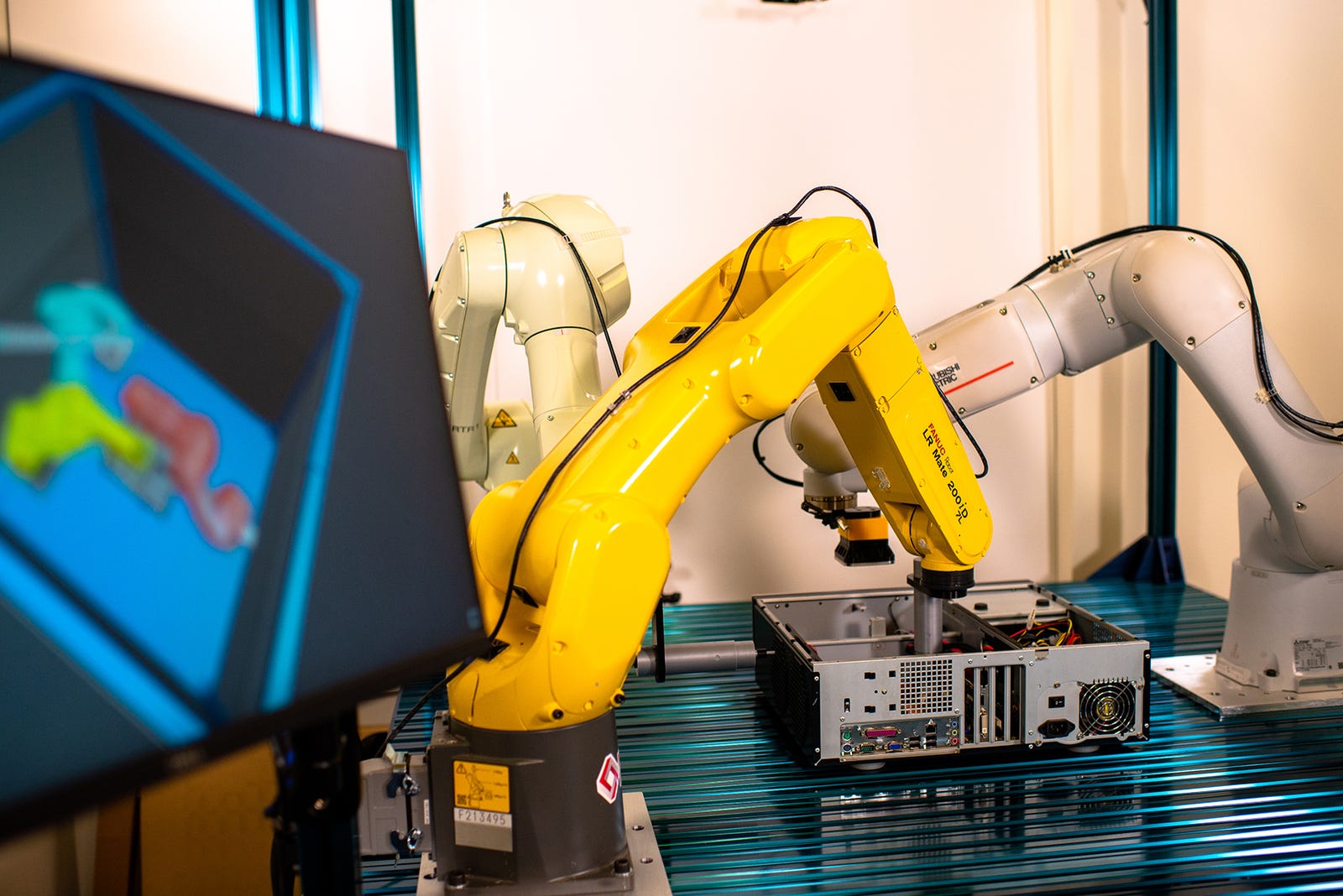
The deck opens with a high-resolution image of a 'Melco 3 Robot Screw Cell.' This isn't just a pretty picture; it shows multiple robotic arms (Fanuc and Mitsubishi brands are visible) working in close proximity. This visual sets the stage for the technical problem the company solves: multi-robot coordination and collision avoidance in tight spaces.
Slide 2: Realtime Robotics at a Glance
Slide 2 is an 'Executive Summary' style slide that packs an immense amount of data. It establishes the company's pedigree: founded in 2017, 60 employees (47 in engineering), and $31M raised to date. Crucially, it defines the business model as 'Asset light' with 'no own manufacturing.' For investors, this is a signal that the company scales like a software business, not a capital-intensive hardware manufacturer. The slide also lists a 'Huge global TAM of $173 Billion' and highlights an impressive IP portfolio including 17 invention disclosures and 3 awarded patents. The bottom half of the slide is dedicated to 'Strategic Partners' and 'Strategic Investors,' featuring industry titans like Hyundai, Mitsubishi Electric, and Yaskawa. This slide alone does 80% of the heavy lifting for the fundraise.
Slide 3-5: The Problem of Rigid Automation
Slide 4 articulates the 'Problem' with surgical precision. It argues that while automation should be the answer, it is currently 'Rigid, Inflexible, Complex, and Expensive.' The standout metric here is the 'Average Robot Lifetime Cost' of $350,000. The deck notes that programming costs can account for 50% of this total. By framing the problem in dollars and cents rather than just technical limitations, Realtime Robotics makes a compelling economic case for their solution.
Slide 6-7: The AI Breakthrough
Slide 6 introduces the 'AI Core.' It uses a hexagonal diagram to show how their technology integrates collision-free motion planning, machine vision, and robot-agnostic control. The value proposition is clear: 'Deploy in hours vs weeks.' This slide transitions from the 'what' to the 'how,' emphasizing that their software allows robots to react autonomously in real-time to unexpected interruptions. This is a significant departure from traditional robotics, which typically requires a complete stop if a human or object enters the workspace.
Slide 8-9: Redefining Collaborative Automation
Slide 8 compares 'Conventional Robots' (which require expensive fences), 'Today's Cobots' (which are slow and limited in payload), and 'Realtime Collaborative' robots. The company claims to offer the 'Speed and Separation' of industrial robots with the safety of collaborative ones. By using both 2D and 3D sensors, their system allows industrial robots to plan around humans instead of stopping. This addresses a major bottleneck in manufacturing throughput.
Slide 10-11: Target Markets and Focus Verticals
Slide 10 breaks down the business into four focus verticals: Logistics, Automotive, Digital Simulation, and Safe Collaboration. Each vertical is mapped to an 'Anchor Application' and an 'Anchor Partner.' For example, in Logistics, the focus is mixed-case palletizing with Yaskawa as the partner. In Automotive, it is multi-robot welding with Siemens. This level of specificity shows that the company isn't just 'searching' for a market; they have already embedded themselves into specific high-value workflows with the world's largest industrial companies.
Slide 12: The Proof Point (Case Study)
Slide 12 provides a concrete case study with Valiant TMS and Siemens. The application is multi-robot chassis welding. The results are stark: a 33-hour conventional planning time was reduced by 82% using Realtime's 'RapidPlan Simulate.' Demonstrating a near 5x improvement in engineering efficiency is the 'smoking gun' that justifies the Series A valuation.
Slide 13: Closing
The deck concludes with a standard contact slide. Notably, there is no 'Ask' slide in this version of the deck, which is common in decks shared for public consumption or after the round has closed. However, the preceding 12 slides provide a comprehensive narrative of technical superiority and market validation.
What Realtime Robotics Got Right
Quantified Pain Points: They didn't just say programming is hard; they said it costs $175,000 per robot (50% of $350k). · Strategic Logo Soup: The inclusion of Mitsubishi, Siemens, and Fanuc logos isn't just for show; these are the gatekeepers of the robotics industry. Their involvement validates the technology's compatibility. · Asset-Light Narrative: By explicitly stating they don't manufacture hardware, they distanced themselves from the 'hardware is hard' stigma that often depresses valuations. · Clear Vertical Mapping: They showed exactly where the product fits in a factory, from the welding line to the shipping dock.
What Was Missing
The Financial Ask: The deck does not state how much they are looking to raise in this specific round or how the funds will be allocated (e.g., sales expansion vs. R&D). · Unit Economics: While they mention a 'Flexible RaaS (Robot as a Service) model,' they don't provide details on pricing tiers, customer acquisition costs (CAC), or lifetime value (LTV). · Competitive Landscape: The deck assumes a vacuum. It doesn't address other AI-driven motion planning startups or the internal R&D efforts of the very partners (like Fanuc) they list. · Revenue Traction: While the case study is excellent, the deck lacks a slide showing aggregate revenue growth or a pipeline of signed contracts.
Founder's Playbook: Lessons to Copy
Lead with the Team and Partners: If you have world-class partners, put them on Slide 2. Don't make investors wait until the end to find out you're working with Siemens. · Use a 'Conventional vs. Ours' Comparison: Slide 8 is a perfect example of how to position a product against both old-school incumbents and newer, but flawed, competitors (cobots). · Focus on Engineering Efficiency: In B2B industrial tech, time is money. The '82% reduction in engineering time' metric is the most powerful sentence in the entire deck. · Define Your 'Core': The hexagonal 'AI Core' on Slide 6 helps non-technical investors understand how disparate features (vision, planning, safety) come together into a single platform.
Frequently asked questions
- How does Realtime Robotics justify its market value?
- The deck points to a $173 Billion TAM and a significant reduction in the 'Average Robot Lifetime Cost' of $350,000. By showing that programming currently consumes half of that cost, they position their software as a massive cost-saving engine for manufacturers.
- What is the core technology being pitched?
- The core is an 'AI-driven robot programming platform' that enables collision-free motion planning. It uses 2D and 3D sensors to allow robots to react autonomously to unexpected deviations in real-time, rather than following rigid, pre-programmed paths.
- Who are the key investors in Realtime Robotics?
- The deck lists high-profile strategic investors including Hyundai, Mitsubishi Electric, Omron, SAIC, and Toyota AI Ventures. This heavy concentration of industry giants suggests strong product-market fit within the automotive and electronics sectors.
- What are the primary target industries for this technology?
- Slide 10 identifies four focus verticals: Logistics (mixed-case palletizing), Automotive (multi-robot welding), Digital Simulation (digital twins), and Safe Collaboration (industrial robots working alongside people).
- Does the deck include a team slide?
- Yes, Slide 2 features a six-person leadership team including a CEO, CCO, CFO, VP of Engineering, VP of Systems, and Director of Product. It notes that 47 of their 60 employees are in engineering, emphasizing a product-heavy organization.