Realtime Robotics successfully raised $31M in 2021 using a deck that prioritizes technical credibility and strategic validation over flashy design. The company identifies a critical bottleneck in manufacturing: the rigidity and high cost of robot programming. By highlighting that 50% of a robot's $350,000 lifetime cost is attributed to application software, they position their 'AI Core' as a 40% cost-reduction engine. The deck is notable for its heavy reliance on blue-chip validation, featuring logos from Siemens, Ford, and Mitsubishi Electric. While it lacks a detailed financial forecast or…
Key takeaways
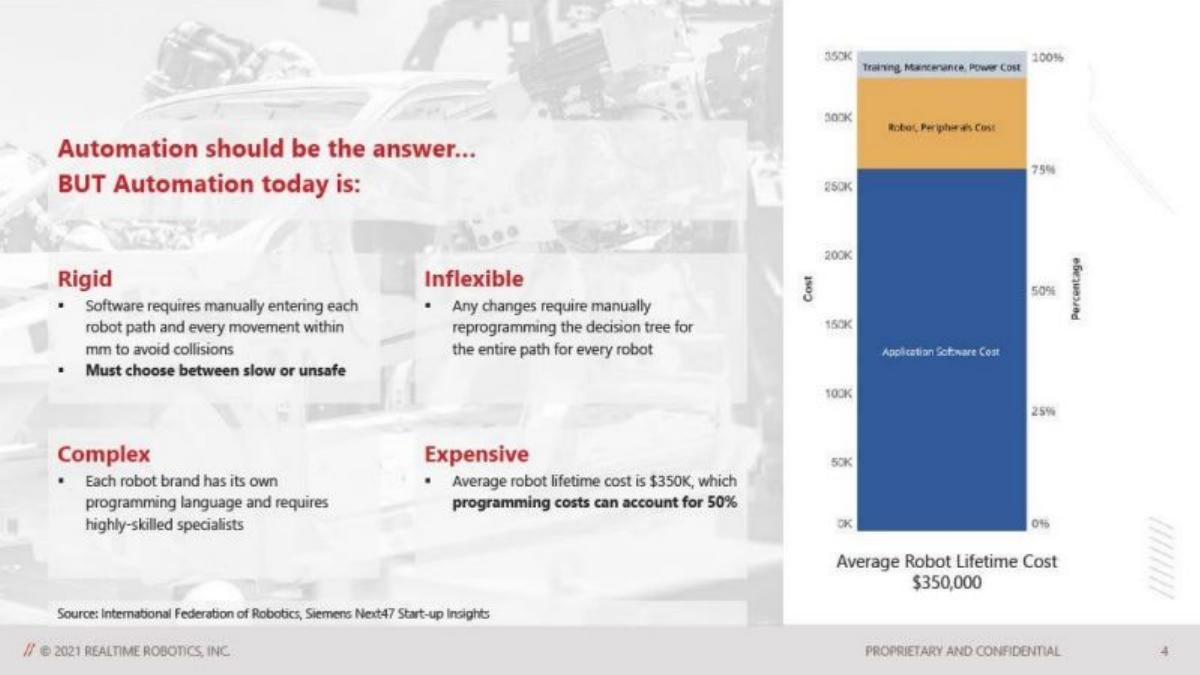
- The company identifies that application software costs account for 50% of the $350,000 average robot lifetime cost (Slide 4).
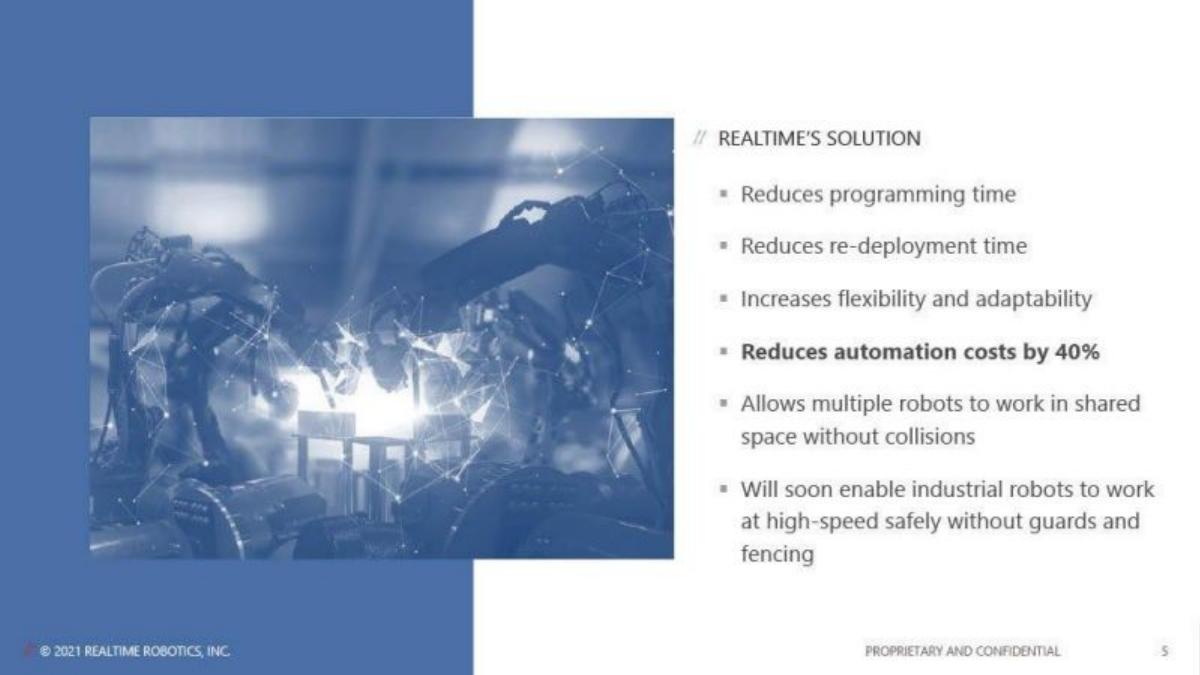
- Realtime Robotics claims its solution reduces overall automation costs by 40% (Slide 5).
- The technical team is substantial, with 47 of the 60 employees dedicated to engineering (Slide 2).
- The company maintains an asset-light business model with no in-house manufacturing (Slide 2).
- The IP portfolio is a core asset, citing 17 unique invention disclosures and 3 awarded patents (Slide 2).
- Market opportunity is segmented into a $173 Billion TAM by 2025, with 'Safe Collaboration' being the largest slice at $85B (Slide 9).
- A case study with Valiant TMS demonstrates an 82% reduction in engineering time, moving from 33 hours to a fraction of that (Slide 12).
- The deck lacks a specific funding request or 'Use of Funds' slide, focusing instead on technology and market validation (Slide 1-13).
The Series A Narrative: Efficiency Over Innovation
Realtime Robotics raised $31M in 2021 with a deck that is remarkably focused on the bottom line of the factory floor. While many robotics startups pitch the 'future of work,' Realtime Robotics pitches the 'reduction of cost.' The 13-slide deck is a masterclass in industrial B2B positioning, focusing on the massive hidden costs of traditional automation and presenting a software-first solution to a hardware-heavy problem.
Slide 1: The Hook
The cover slide uses the tagline "AUTOMATING AUTOMATION." This is a sophisticated positioning statement. It acknowledges that their customers (manufacturers) are already automated but suggests that the process of setting up that automation is itself a manual, inefficient bottleneck. The sub-headline reinforces this by promising to "reduce cost and increase productivity."
Slide 2: Company Overview and Validation
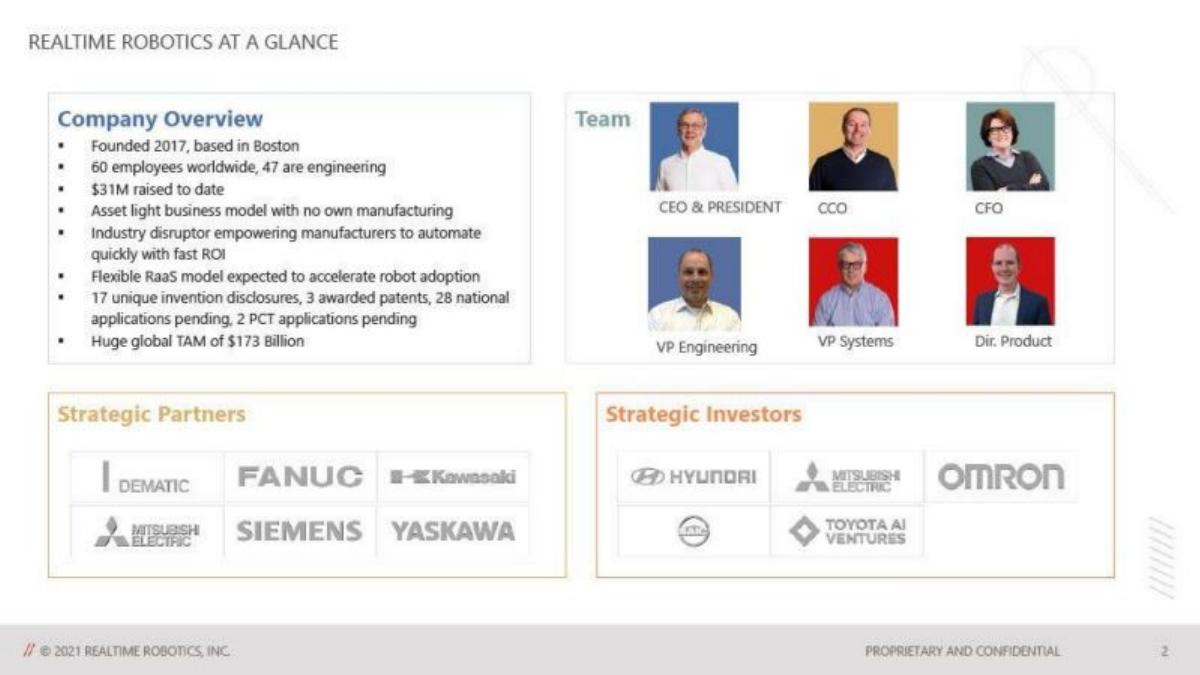
Slide 2, titled "REALTIME ROBOTICS AT A GLANCE," is a 'trust' slide. It immediately establishes the company's scale and credibility. Key facts listed include being founded in 2017 in Boston, having 60 employees (47 of whom are in engineering), and having raised $31M to date. The slide also highlights their "Asset light business model with no own manufacturing," which is a critical point for investors who are often wary of the capital intensity of hardware startups. The inclusion of 17 invention disclosures and 3 awarded patents signals a strong defensive moat. The bottom half of the slide is a 'logo soup' of strategic partners like Siemens and Fanuc, and investors like Hyundai and Toyota AI Ventures, which provides massive industry validation early in the deck.
Slide 3 & 4: The Problem and the Cost Bottleneck
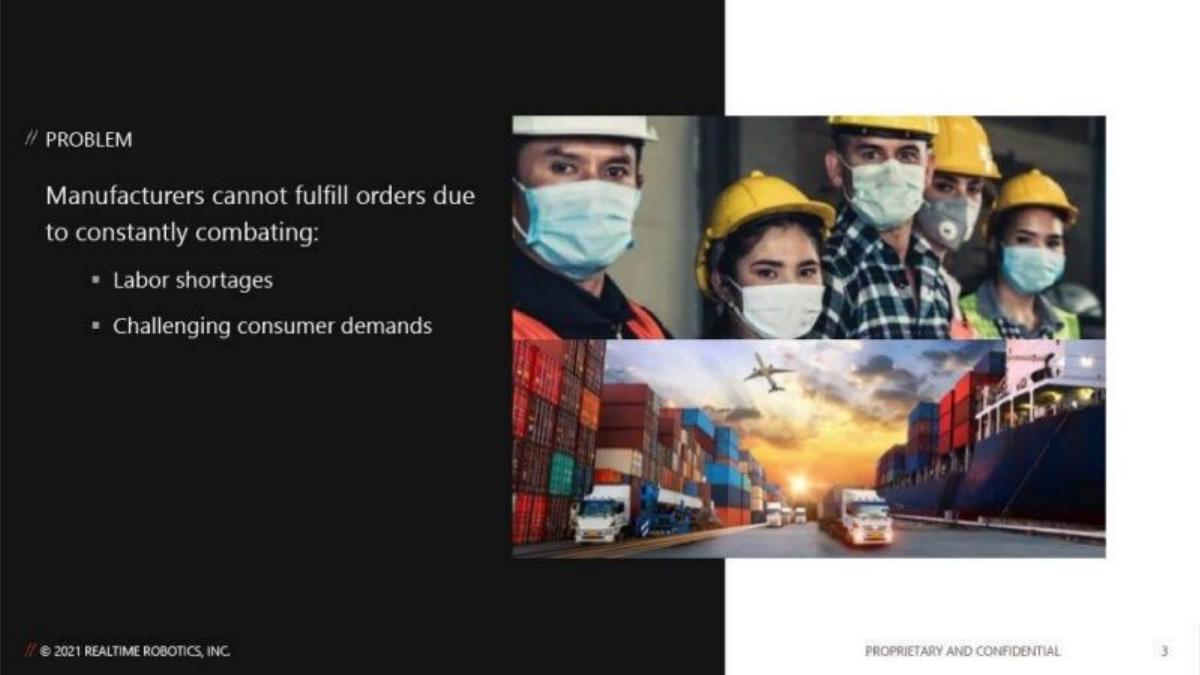
Slide 3 uses imagery of masked workers and shipping containers to highlight labor shortages and consumer demands. However, Slide 4 is where the real 'pain' is quantified. It describes current automation as "Rigid, Inflexible, Complex, and Expensive." The most impactful element of this slide is the bar chart showing the "Average Robot Lifetime Cost $350,000." It reveals that while the robot and peripherals cost money, "Application Software Cost" accounts for 50% of the total. This slide effectively identifies the specific budget line item Realtime Robotics intends to disrupt.
Slide 5 & 6: The Solution and AI Core
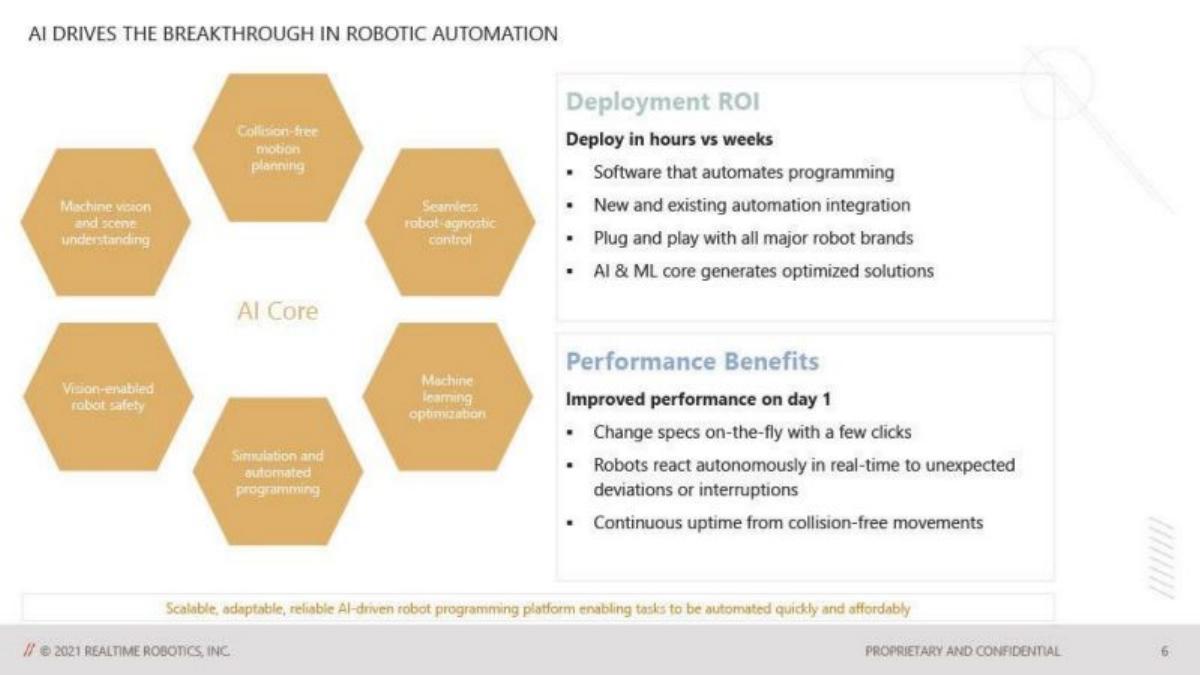
Slide 5 introduces the solution with a bold claim: "Reduces automation costs by 40%." It lists benefits such as reduced programming time and the ability for multiple robots to work in shared spaces without collisions. Slide 6 dives into the "AI Core," explaining how the software automates programming. It promises a shift from "weeks to hours" for deployment. This slide is crucial because it moves the conversation from 'what' the product does to 'how' it delivers ROI, specifically through continuous uptime and autonomous reaction to deviations.
Slide 7 & 8: Product Suite and Competitive Advantage
Slide 7 breaks down the technology into three components: Realtime Controller (specialized hardware for up to 16 robots), RapidPlan (AI choreography software), and RapidSense (spatial perception and 3D vision). Slide 8 compares "Realtime Collaborative" robots against conventional robots and current 'cobots.' It argues that while current cobots are limited by speed and payload, Realtime's technology allows industrial-strength robots to work safely around humans without stopping, using both 2D and 3D sensors.
Slide 9 & 10: Market Size and Vertical Focus
Slide 9 presents a "$173 BILLION TAM BY 2025," broken down into Logistics ($56B), Automotive ($20B), Digital Simulation ($12B), and Safe Collaboration ($85B). Slide 10 then maps these verticals to specific "Anchor Partners." For example, Yaskawa is linked to Logistics, while Siemens is linked to Automotive and Digital Simulation. This mapping shows that the company isn't just chasing a large number; they have specific, high-value targets and existing relationships in each segment.
Slide 11 & 12: Social Proof and Case Studies
Slide 11 features testimonials from executives at Valiant TMS, Ford, and Siemens. The quote from Ford's Robotics Research Engineer about driving the "future of manufacturing excellence" is a high-level endorsement. Slide 12 provides the hard data to back up these quotes. It details a "Multi-Robot Chassis Welding" application where conventional engineering took 33 hours. Realtime achieved an "82% reduction in engineering time." This specific metric is the 'closing argument' for the deck's value proposition.
What Realtime Robotics Does Well
Quantified Pain: By breaking down the $350k lifetime cost of a robot, they make the problem feel expensive and urgent. · Heavy Validation: The deck is saturated with blue-chip logos. For a Series A company, having Siemens, Ford, and Toyota in your corner is a massive signal of product-market fit. · Engineering Focus: Stating that 47 out of 60 employees are engineers (Slide 2) tells investors that the $31M will be spent on technical moats, not just sales and marketing. · Clear ROI: The 82% reduction in engineering time (Slide 12) is a clear, repeatable metric that any factory manager can understand.
What Is Missing from the Deck
The Ask: There is no slide detailing how much they are raising in this specific round or how they plan to use the funds. · Financial Projections: While the TAM is mentioned, there are no slides showing the company's historical revenue growth or projected burn rate. · Unit Economics: The deck mentions a "Flexible RaaS model" on Slide 2, but it never explains the pricing structure or the margins on their hardware controller. · Competition: There is no competitive landscape slide. While they compare themselves to 'conventional' robots, they don't name other startups in the spatial AI or motion planning space.
What Other Founders Should Copy
The 'At a Glance' Slide: Slide 2 is a perfect template for a Series A summary. It covers location, headcount, IP, business model, and strategic backing in one view. · The Vertical Mapping: Slide 10, which connects specific products to specific partners in specific industries, is an excellent way to show a structured go-to-market strategy. · Case Study Structure: Slide 12's 'Conventional vs. Realtime' comparison is the most effective way to demonstrate value. Founders should always aim to show a 'Before and After' with a clear percentage improvement.
Frequently asked questions
- What is the primary problem Realtime Robotics solves?
- The deck identifies that current automation is rigid, inflexible, complex, and expensive. Specifically, it points out that software requires manual entry for every robot path and movement to avoid collisions. This manual labor results in application software costs making up half of the $350,000 lifetime cost of an industrial robot.
- How does the technology actually work?
- The company uses an 'AI Core' to automate motion planning. This includes 'RapidPlan' for choreographing robot movements and 'RapidSense' for 3D machine vision and obstacle detection. This allows robots to react autonomously in real-time to unexpected deviations without needing manual reprogramming for every change.
- Who are the key strategic partners and investors?
- Realtime Robotics has high-tier industrial validation. Strategic partners include Siemens, Fanuc, Kawasaki, and Yaskawa. Their strategic investor list features major automotive and tech players like Hyundai, Mitsubishi Electric, Omron, SAIC, and Toyota AI Ventures.
- What is the company's business model?
- The company operates an 'asset-light' business model, meaning they do not manufacture the robots themselves. Instead, they provide the software and control hardware. They also mention a flexible 'Robotics as a Service' (RaaS) model intended to accelerate adoption among manufacturers.
- What metrics are used to prove the product works?
- The deck highlights an 82% reduction in engineering time for multi-robot chassis welding. It also claims the ability to reduce programming time from weeks to hours and overall automation costs by 40% through their specialized controller and software suite.