Reachdesk’s Series B deck is a masterclass in converting a 'physical' service into a scalable SaaS narrative. By framing direct mail and gifting as an 'integrated, automated, and measurable' channel, the company addresses the primary skepticism surrounding offline marketing: lack of attribution. The deck relies on heavy-hitting metrics, such as a 40% average response rate and a 46% decrease in CAC, to prove the efficacy of their platform. Furthermore, the inclusion of a 'Covid-19 Impacts' slide demonstrates tactical agility, showing how the company pivoted to remote employee engagement and di…
Key takeaways
- The deck positions direct mail as a high-ROI alternative to failing cold calls and emails (Slide 3).
- Reachdesk claims a 40% average response rate and a 9x higher response rate compared to digital channels (Slide 7).
- A detailed case study for 'test IO' highlights a 600% uplift in response rates and 2 full work days saved per SDR per month (Slide 10).
- The company leverages G2 crowd ratings to claim the #1 spot in every category against competitors like Alyce and Sendoso (Slide 11).
- The timeline slide uses placeholders ($XM, $XXM) for ARR, indicating rapid growth without disclosing exact figures in the public-facing version (Slide 12).
- The product is described as a three-pillar system: Enterprise Software, Marketplace, and Warehouse/Logistics (Slide 9).
- The 'Covid-19 Impacts' slide specifically addresses the shift toward remote employee engagement and e-gift cards (Slide 13).
- The deck emphasizes 2-way data integration with CRMs to solve the 'no tracking' problem of traditional gifting (Slide 4).
The Narrative: Making the Physical Measurable
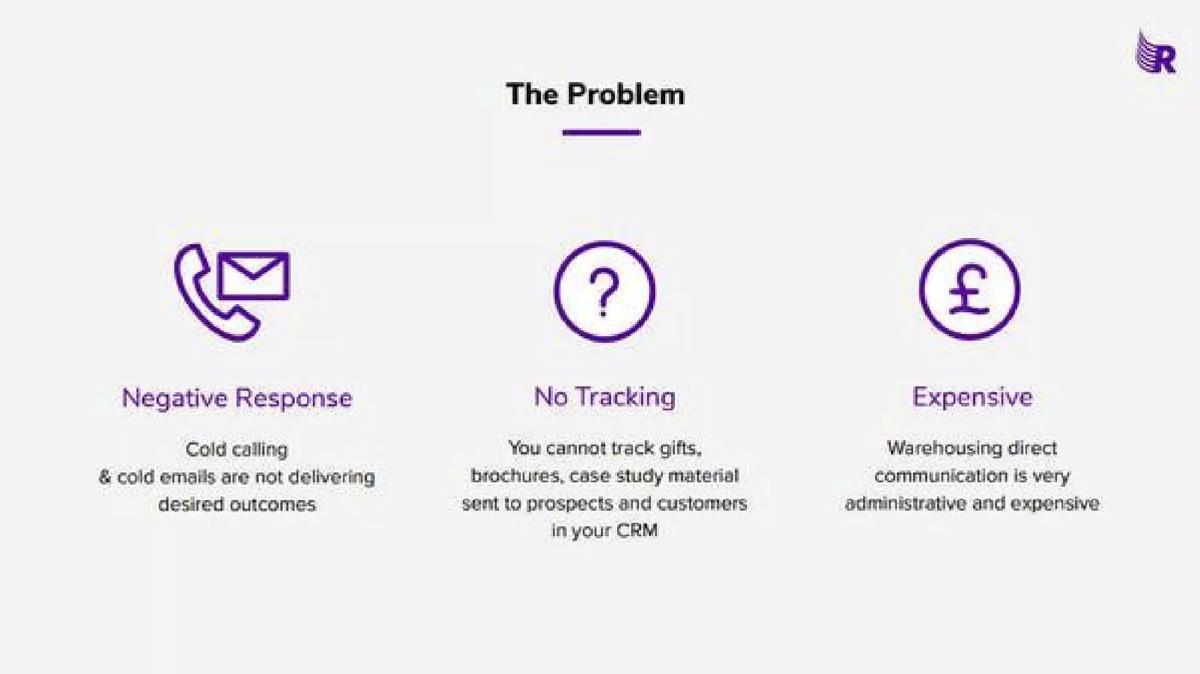
Reachdesk’s Series B deck is built on the premise that traditional B2B outreach—cold calling and email—is failing. By Slide 3, they have already established the 'Problem': negative responses, lack of tracking, and high administrative costs. The narrative shift happens immediately on Slide 4, where they redefine direct mail not as a 'marketing tactic,' but as a 'streamlined, integrated' software solution. This is a crucial distinction for a Series B company; they aren't selling gifts, they are selling a workflow that happens to result in a gift.
Slides 1-2: Mission and Identity
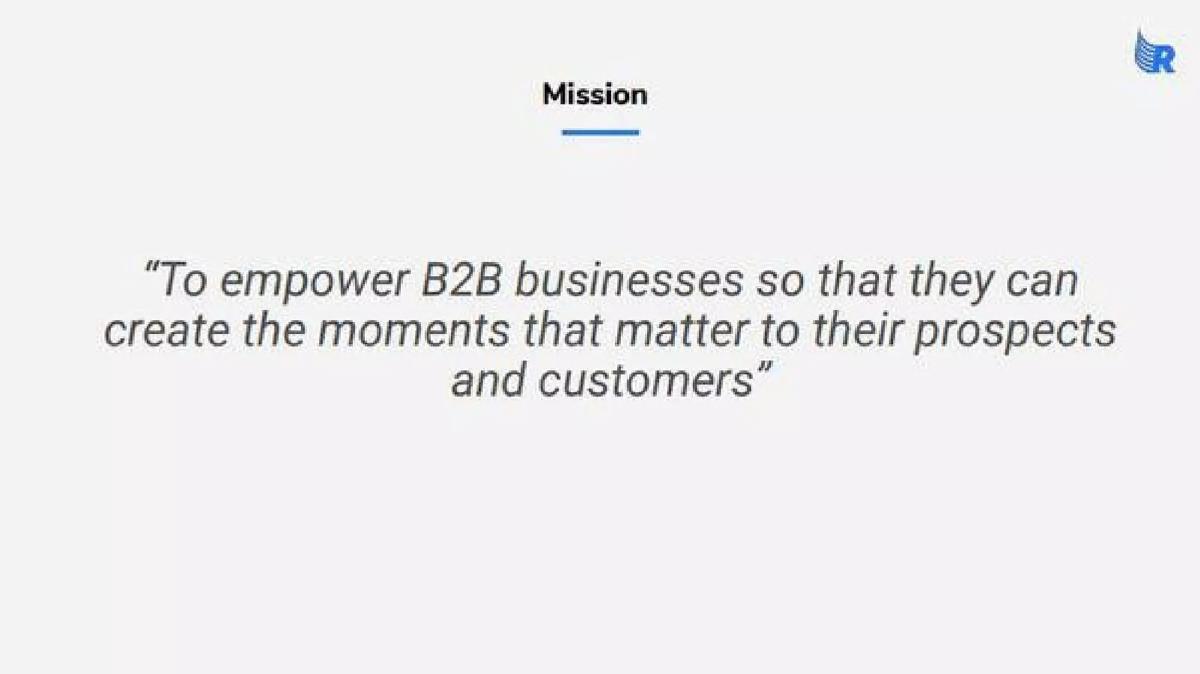
The deck opens with a clean, purple-branded title slide featuring the tagline: "Integrated, Automated, Measurable." This sets the stage for a data-driven pitch. Slide 2 defines the mission: "To empower B2B businesses so that they can create the moments that matter to their prospects and customers." It is a broad, emotional hook that transitions quickly into the cold reality of marketing friction.
Slides 3-4: The Problem and Solution
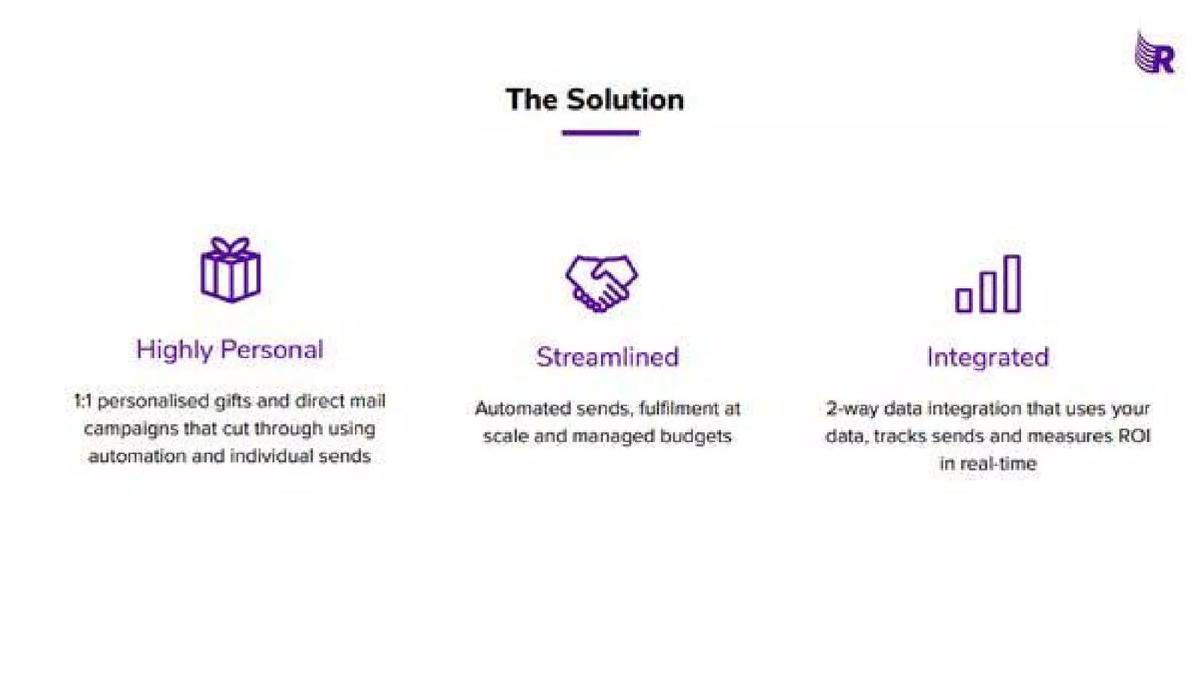
Slide 3 identifies three pain points: Negative Response (cold outreach isn't working), No Tracking (CRM blindness), and Expensive (warehousing logistics). Slide 4 presents the Reachdesk solution as the inverse: Highly Personal , Streamlined , and Integrated . The emphasis on "2-way data integration" is the most important point here, as it addresses the primary objection of CMOs: attribution.
Slides 5-6: Visualizing the Lifecycle
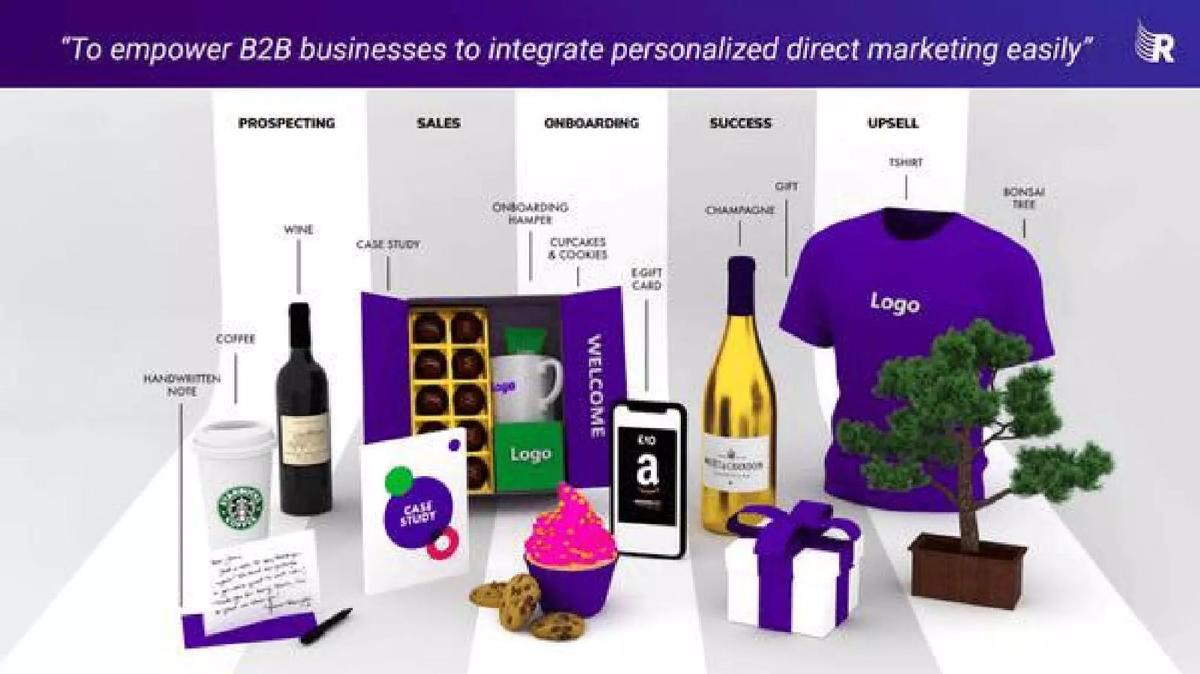
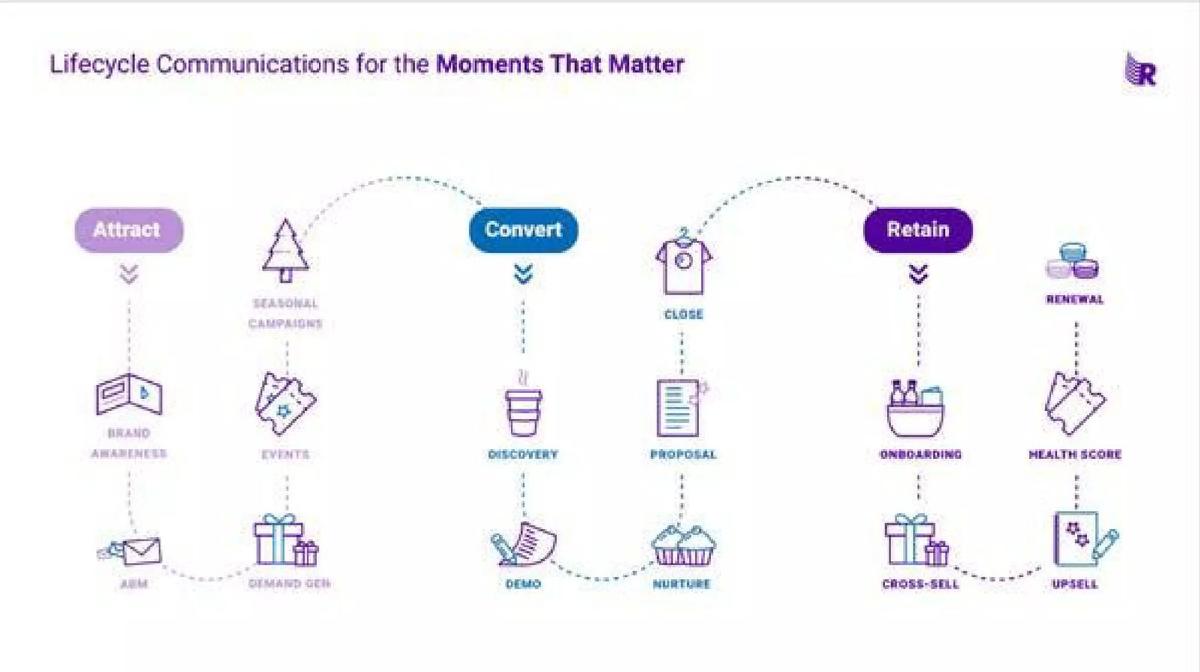
Slide 5 is a high-impact visual showing various physical goods—coffee, wine, cupcakes, and branded apparel—mapped across the customer journey: Prospecting, Sales, Onboarding, Success, and Upsell. Slide 6 reinforces this with a "Lifecycle Communications" map. It visualizes how Reachdesk touches every stage of the funnel, from 'Brand Awareness' in the Attract phase to 'Renewal' and 'Health Score' in the Retain phase. This suggests that Reachdesk is a platform for the entire company, not just the sales team.
Slides 7-8: The ROI and Goals
Slide 7 is the 'money slide.' It cites a 40% Average Response Rate and a 46% decrease in CAC . By quoting external sources like the DMA and Outreach.io, Reachdesk lends third-party credibility to these claims. Slide 8 lists their goals, which are tactical: Increase Demo Attendees , Building Customer Rapport , and Case Study Triggers . This slide helps investors understand exactly what the end-user is trying to achieve.
Slide 9: Product Architecture
The product is broken down into three distinct components on Slide 9: Enterprise Software (the UX and integrations), Marketplace (100+ providers), and Warehouse/Logistics (global presence in US, UK, and APAC). This slide proves that Reachdesk has solved the 'unsexy' part of the business—the physical logistics—while maintaining a software-first margin profile.
Slide 10: The 'test IO' Case Study
This slide provides a deep dive into a customer success story. It notes that before Reachdesk, campaigns took "over 4 weeks per campaign to execute." Post-implementation, the results were: 600% uplift in response rates , 2 full work days saved per SDR per month , and a 46% decrease in Customer Acquisition Cost . Using a specific customer name (test IO, now part of EPAM) adds significant weight to the pitch.
Slide 11: Competitive Social Proof
Slide 11 is a direct shot at the competition. Using G2 data, Reachdesk shows they are "#1 in Customer Reviews." They highlight specific ratings: 9.2 for Ease of Use and 10.0 for Quality of Support . By placing their logo alongside Alyce, PFL, and Sendoso, they define the market landscape and claim the leadership position within it.
Slides 12-13: Growth and Pivot
Slide 12 shows a timeline from Q4 2018 to Dec 2021. While the ARR figures are obscured with $XM, $XXM, and $XXXM , the trajectory is clear. The slide also lists impressive logos like Hootsuite, Cognism, and Segment . Slide 13, "Covid-19 Impacts," is a fascinating historical artifact. It shows how the company adapted to the pandemic by focusing on remote employee engagement and digital e-gift cards (Uber Eats, Charity donations), proving the platform's resilience in a changing world.
Slides 14-17: Visual Proof and Appendix
The final slides (14-17) are a gallery of the product in action. Slide 15 shows "Digital Engagement" via LinkedIn posts and emails. Slides 16 and 17 show "Perishables" (cupcakes, champagne) and "Gifting" (custom boxes, boxing gloves). These slides serve to make the abstract concept of 'direct mail' tangible for the investor.
What Works in This Deck
Quantifiable ROI: The deck doesn't just say they are better; it claims a 46% reduction in CAC and a 9x higher response rate than digital. · Integration Focus: By emphasizing CRM integration, they position themselves as a 'must-have' in the modern tech stack rather than a 'nice-to-have' gift shop. · G2 Social Proof: Using third-party review data to benchmark against competitors is a highly effective way to demonstrate market dominance without sounding biased. · Adaptability: The Covid-19 slide shows that the management team is capable of pivoting strategy in the face of macro-economic shifts.
What Is Missing
Team Slide: There is no mention of the founders or the executive team. In a Series B, investors are betting heavily on the leadership's ability to scale. · Financial Specifics: The use of $XXM placeholders on the timeline slide is common for public versions of decks, but the lack of burn rate, LTV/CAC ratios, or margin data is notable. · The Ask: The deck ends with a 'Thanks' slide but does not specify how much capital is being raised or how it will be deployed (e.g., hiring, international expansion, R&D). · Market Size (TAM): There is no slide defining the Total Addressable Market for B2B gifting, which is usually a staple of growth-stage decks.
What a Founder Should Copy
The Lifecycle Map: Slide 6 is a great way to show that your product isn't just a point solution, but a platform that adds value across the entire customer journey. · The Problem/Solution Mirror: Slide 3 and 4 perfectly mirror each other, making the solution feel like the inevitable answer to the stated problems. · Visual Case Studies: Don't just list logos; show the actual results (Slide 10) and the actual physical output (Slides 15-17). It makes the business feel 'real.' · Third-Party Benchmarking: If you are a leader in your category on G2 or Capterra, use that data. It is much more convincing than your own internal metrics.
Frequently asked questions
- What is Reachdesk's core value proposition?
- Reachdesk positions itself as an 'Integrated, Automated, Measurable' platform for B2B gifting. According to Slide 4, the value lies in moving away from manual, unTrackable gifting toward a system that offers 2-way data integration, automated sends, and real-time ROI measurement within a company's existing tech stack.
- How does Reachdesk compare itself to competitors?
- On Slide 11, Reachdesk uses G2 customer review data to compare itself against Alyce, PFL, and Sendoso. They claim to be #1 in every single category, specifically highlighting high scores in 'Ease of Use' (9.2), 'Quality of Support' (10.0), and 'Ease of Setup' (9.1).
- What specific ROI metrics does the deck provide?
- Slide 7 lists several key performance indicators: a 40% average response rate, a 260% increase in Sales Accepted Leads, a 46% decrease in CAC, and a response rate 9x higher than digital channels. These figures are attributed to sources like the DMA and Outreach.io.
- How did the company handle the challenges of the 2020 pandemic?
- Slide 13, titled 'Covid-19 Impacts,' outlines their strategic pivot. They identified new opportunities in replacing cancelled event pipelines, engaging remote employees for HR, and introducing new product trends like Uber Eats eGift cards and 'Donate to Charity' experiences.
- What is missing from this pitch deck?
- The deck notably omits a dedicated Team slide, detailed financial breakdowns (using $XXM placeholders instead), a specific 'Ask' slide detailing how the $49M would be spent, and a deep dive into unit economics like LTV or churn rates.