Raydiant’s 14-slide Series A deck is a masterclass in repositioning a commodity hardware/software play—digital signage—into a high-growth platform category: the 'Operating System for Real-World Experiences.' The deck effectively uses a 'Problem vs. Solution' framework, contrasting a legacy $6B McDonald’s build-out with Raydiant’s 18-day deployment timeline. Financially, the deck leans heavily on Net Dollar Retention (NDR) benchmarks, showing a 107% NDR for customers with 3+ screens, outperforming IPO-stage SaaS giants like HubSpot and Shopify. While the deck lacks a specific 'Ask' slide or de…
Key takeaways
- Raydiant positions itself as the 'OS for Real-World Experiences' rather than just a signage provider (Slide 1).
- The B2B market is identified as a $1.2T opportunity with over 250M screens sold annually, contrasted against the well-served B2C market (Slide 3).
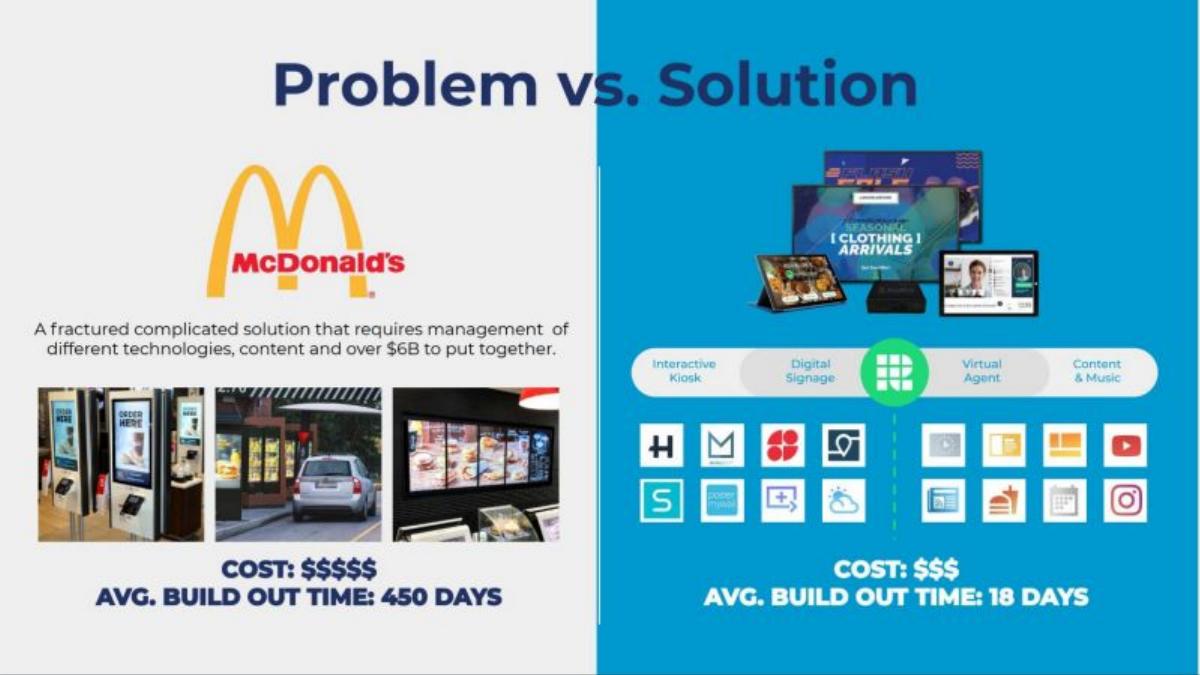
- Deployment speed is a core competitive advantage, claiming an 18-day build-out time compared to 450 days for legacy custom solutions (Slide 5).
- The company demonstrates market-leading Net Dollar Retention of 107% for its core customer segment (3+ screens), benchmarking against companies like Square and Shopify (Slide 11).
- The product roadmap follows a three-stage evolution: 'Own the Screen' ($32B), 'Own the Store' ($410B), and 'Own the Chain' ($1.2T) (Slide 7).
- Raydiant uses a cloud-first, dedicated hardware (x86) approach to achieve a 5-minute onboarding time (Slide 12).
- The leadership team features deep domain expertise from Revel Systems, Philo, and Verizon, alongside celebrity advisor Mark Wahlberg (Slide 13).
- The deck omits a formal 'Ask' slide, financial projections, or a specific breakdown of how the $13M Series A capital would be deployed.
Executive Summary: The Platformization of Physical Space
Raydiant’s Series A deck, used to raise $13M in 2021, is an example of how to frame a hardware-enabled software business for venture scale. By moving away from the term "digital signage" and toward "The OS for Real-World Experiences," the company successfully shifted the investor conversation from low-margin hardware to high-retention platform dynamics. The deck relies heavily on social proof—ranging from Ivy League universities to celebrity advisors—and rigorous cohort data to justify its $1.2T market claim.
Slide 1: Title Slide
The deck opens with a minimalist title slide featuring the Raydiant logo and the tagline: "THE OS FOR REAL-WORLD EXPERIENCES." This immediately establishes the company’s ambition to be a foundational layer of technology rather than a niche application.
Slide 2: Our Mission
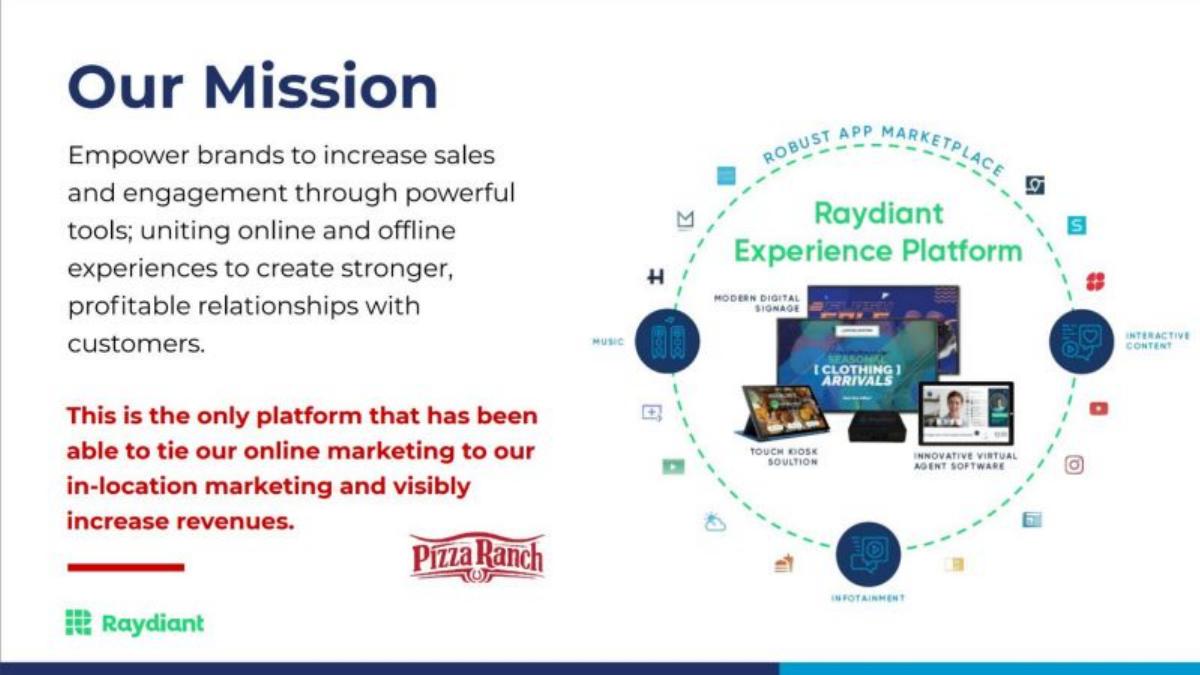
Raydiant defines its mission as empowering brands to increase sales by uniting online and offline experiences. The slide features a quote from Pizza Ranch stating that Raydiant is the "only platform" able to tie online marketing to in-location marketing. A circular graphic illustrates the "Raydiant Experience Platform" at the center of a robust app marketplace, including music, interactive content, infotainment, and virtual agent software.
Slide 3: Market Size and Opportunity
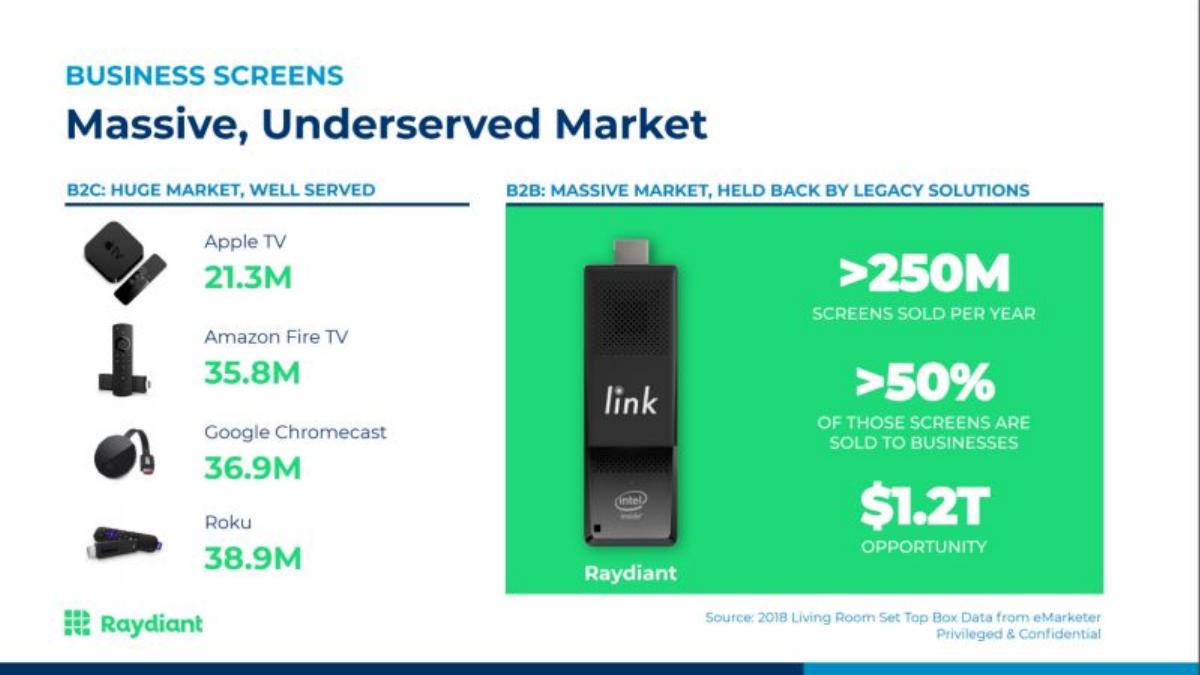
This slide contrasts the B2C market (Apple TV, Roku, etc.) with the B2B market. It notes that while B2C is well-served, the B2B market is "massive" and "underserved." Key figures cited include:
>250M screens sold per year. · >50% of those screens are sold to businesses. · A total opportunity of $1.2T.
The slide introduces the "Link" hardware, an Intel-powered stick that serves as the physical gateway for the software.
Slide 4: The Problem
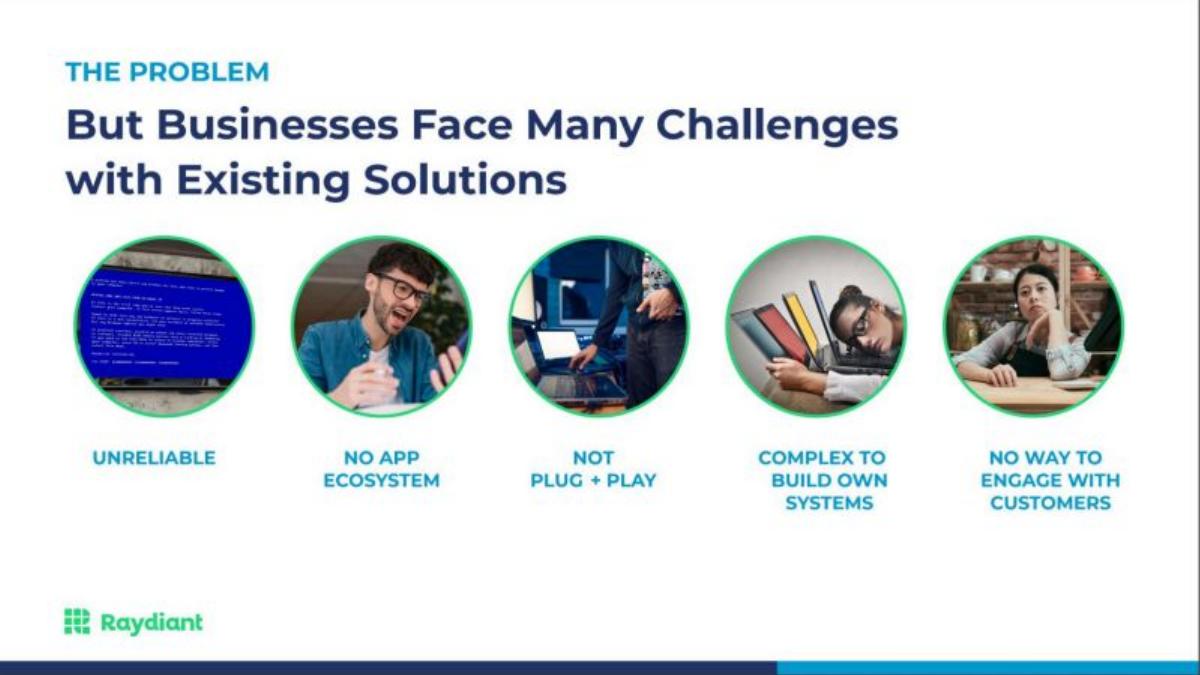
The problem is broken down into five distinct pain points illustrated with photography:
Unreliable (represented by a blue screen of death). · No App Ecosystem. · Not Plug + Play. · Complex to Build Own Systems. · No Way to Engage with Customers.
Slide 5: Problem vs. Solution (The McDonald’s Case)
This is a pivotal comparison slide. It shows the McDonald’s logo and describes their "fractured complicated solution" costing over $6B and taking 450 days to build. Raydiant contrasts this with their own solution, which they claim has a build-out time of just 18 days and a significantly lower cost profile. This slide effectively communicates the speed-to-value advantage of a cloud-first platform.
Slide 6: The Operating System for Real-World Experiences
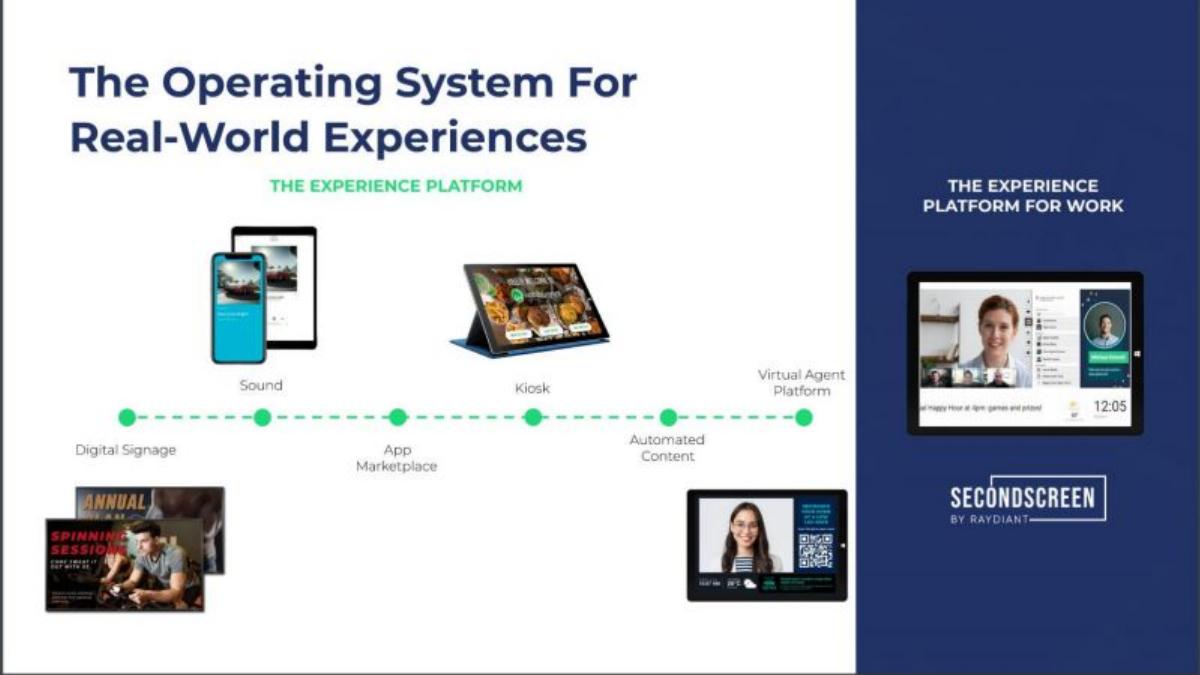
This slide visualizes the product breadth. It shows a timeline of capabilities: Digital Signage, Sound, Kiosk, App Marketplace, Automated Content, and Virtual Agent Platform. It also introduces "SecondScreen by Raydiant," a platform specifically for work environments, showing a video conferencing interface on a tablet.
Slide 7: The Path To Lead The Market
Own the Screen: $32B Opportunity. · Own the Store: $410B Opportunity (illustrated by a 3D retail floor plan with multiple touchpoints). · Own the Chain: $1.2T Opportunity (illustrated by a map of the United States with multiple locations).
Slide 8: Connecting the Real World
This slide uses analogies to position Raydiant alongside successful IoT and fintech companies. It asks "What others did for..." and lists:
WiFi... Meraki · Trucks... Samsara · POS... Square · Streaming TV... Roku
The right side of the slide explains that Raydiant provides an OS fully integrated with hardware, enterprise-grade fleet management, interactivity, and device-to-device (D2D) control channels.
Slide 9: Customer Logos
A high-density logo slide categorizes customers into six sectors: Retail/QSR (Wahlburgers, Pizza Ranch), Banking (Bank of America, Red Bull), Health (Planet Fitness), Hospitality (Treasure Island), DOOH (Advantage), and Education (Harvard, Princeton). The inclusion of Harvard and Princeton provides significant institutional credibility.
Slide 10: Customer Testimonials
Three detailed testimonials from Wahlburgers, First Bank, and Treasure Island emphasize revenue growth and the versatility of the platform. The Wahlburgers quote specifically mentions that Raydiant resulted in "more revenue but also into repeat visits."
Slide 11: Market-Leading Net Dollar Retention
This is the most data-heavy slide in the deck. It benchmarks Raydiant’s 1Y Net Dollar Retention (NDR) against other SMB-focused companies. Key data points:
Raydiant (All customers): 91% NDR. · Raydiant (3+ Screens): 107% NDR. · Comparison: HubSpot @ IPO (93%), Shopify @ IPO (101%), Square @ IPO (110%).
The slide also shows that 56% of newly acquired subscriptions in 2020 YTD came from customers with 3+ screens, indicating a shift toward higher-value enterprise clients.
Slide 12: Competition
A detailed competitive matrix compares Raydiant against "Cloud-First" rivals (Enplug, ScreenCloud) and "Legacy" players (Brightsign, Four Winds Interactive, Scala). Raydiant claims the fastest onboarding time (5 minutes) and is the only provider listed with a Kiosk Designer, Virtual Agent Platform, and LTE Support.
Slide 13: Our Team
Bobby Marhamat (CEO): Former COO of Revel, CRO of Highfive, SVP of Verizon. · Tuan Ho (CPO): Co-founder/CEO of Philo, Harvard '09. · Jack Abraham: Founder of Atomic, founder of TalkIQ and Milo. · Mark Wahlberg (Advisor): Actor and co-owner of Wahlburgers.
Slide 14: Closing Slide
The final slide is a promotional graphic for bestpitchdeck.com and does not contain Raydiant-specific information or a call to action.
What Works in This Deck
The "OS" Narrative: By framing the business as an Operating System, Raydiant justifies a platform valuation rather than a hardware multiple. This is supported by the "Path to Lead the Market" slide, which shows how they expand from a single screen to the entire chain.
Rigorous Benchmarking: Slide 11 is exceptionally strong. Comparing NDR to well-known public companies like Shopify and Square at their IPO stages provides a clear "North Star" for investors to understand the quality of Raydiant's revenue.
Speed as a Moat: The contrast between an 18-day deployment and a 450-day legacy build-out is a compelling reason for enterprise procurement departments to switch. It highlights a massive operational efficiency gain.
What Is Missing
The Ask: The deck does not explicitly state how much money is being raised or the terms of the round. While the catalogue facts state $13M was raised, the deck itself leaves the "Ask" and "Use of Funds" entirely to the verbal pitch.
Financial Projections: While retention data is excellent, there are no slides showing ARR growth, CAC/LTV ratios, or forward-looking revenue projections. This is unusual for a Series A deck, which typically includes a 3-year forecast.
Unit Economics: The deck mentions hardware (the Link stick) but doesn't detail the margins on hardware vs. software. Investors would typically want to see if the hardware is a loss-leader or a profit center.
What Other Founders Should Copy
The Analogous Positioning: Using the "Meraki for WiFi / Samsara for Trucks" framework (Slide 8) is a brilliant way to explain a complex IoT business. It allows investors to immediately categorize the company's business model and potential exit scale.
Segmented Retention Data: Raydiant didn't just show a blended retention number; they showed that their "ideal" customer (3+ screens) has significantly better economics (107% NDR). This proves they know who their best customers are and where to focus their sales efforts.
Vertical-Specific Social Proof: Grouping logos by industry (Slide 9) makes the product feel like a "must-have" for specific sectors. If a bank sees Bank of America on the slide, the perceived risk of the technology drops significantly.
Frequently asked questions
- What is Raydiant's core value proposition?
- Raydiant positions itself as a plug-and-play 'Experience Platform' that transforms any TV into an interactive business tool. Unlike legacy digital signage that is often unreliable and complex to manage, Raydiant offers an integrated hardware/software bundle with an app marketplace, automated content, and remote management capabilities. Their goal is to bridge the gap between online marketing and offline in-location experiences to drive measurable revenue increases for brick-and-mortar businesses.
- How does Raydiant compare its performance to other SaaS companies?
- On slide 11, Raydiant uses 1-year Net Dollar Retention (NDR) benchmarking to prove its enterprise value. It shows that for customers with 3 or more screens, Raydiant achieves 107% NDR. This is presented as superior to the IPO-stage metrics of HubSpot (93%), Xero (87%), and SurveyMonkey (80%), and nearly on par with Square's 110% at the time of its IPO.
- What is the 'McDonald’s' comparison used for in the deck?
- Raydiant uses McDonald’s as a proxy for the 'Legacy' problem. Slide 5 states that a fractured, complicated solution for a large chain can cost over $6B and take 450 days to build out. Raydiant contrasts this with their own platform, which they claim offers a lower cost (noted as '$$$' vs '$$$$$') and a significantly faster build-out time of just 18 days.
- Who are the key people behind Raydiant according to the deck?
- The leadership team includes CEO Bobby Marhamat (formerly of Revel and Verizon), CPO Tuan Ho (Co-founder of Philo), and VPs with experience at MindTickle, Amazon, and Oracle. Notably, the deck lists Jack Abraham (Founder of Atomic) and actor/entrepreneur Mark Wahlberg as advisors, the latter of whom is a co-owner of Wahlburgers, a Raydiant customer.
- What market segments does Raydiant target?
- The deck identifies six primary verticals on slide 9: Retail/Restaurant/QSR (e.g., Wahlburgers, Pizza Ranch), Banking & Corporate (e.g., Bank of America, Red Bull), Health & Wellness (e.g., Planet Fitness), Hospitality & Entertainment (e.g., Treasure Island), Digital Out of Home (DOOH) Advertising, and Education (e.g., Harvard, Princeton).