Read AI’s Series A deck is a clinical example of how to pitch a product-led growth (PLG) company in a competitive sector. By positioning itself as a 'System of Record for Meetings' on slide 4, the company moves beyond simple transcription into the realm of enterprise infrastructure. The deck relies heavily on product screenshots to demonstrate immediate utility, such as the 'Smart Scheduler' and 'Meeting Assistant.' However, the true anchor of the pitch is slide 22, which details the founders' track record of building and selling Placed to Snap for $200M and leading Foursquare to $125M in rev…
Key takeaways
- The deck positions the product as a 'System of Record for Meetings' (Slide 4), elevating it from a utility tool to essential enterprise software.
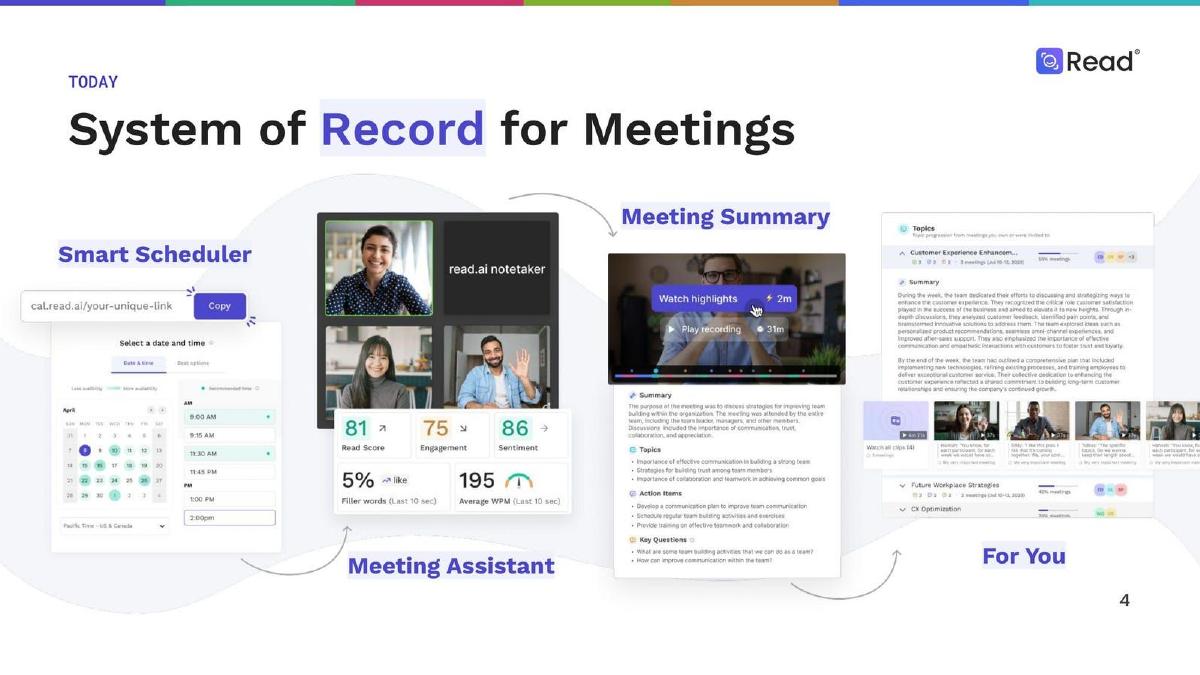
- Product functionality is demonstrated through four distinct pillars: Smart Scheduler, Meeting Assistant, Meeting Summary, and 'For You' (Slide 4).
- The company claims to be the 'fastest growing meeting notetaker in market' (Slide 19), though specific user numbers are not visible on the provided slide.
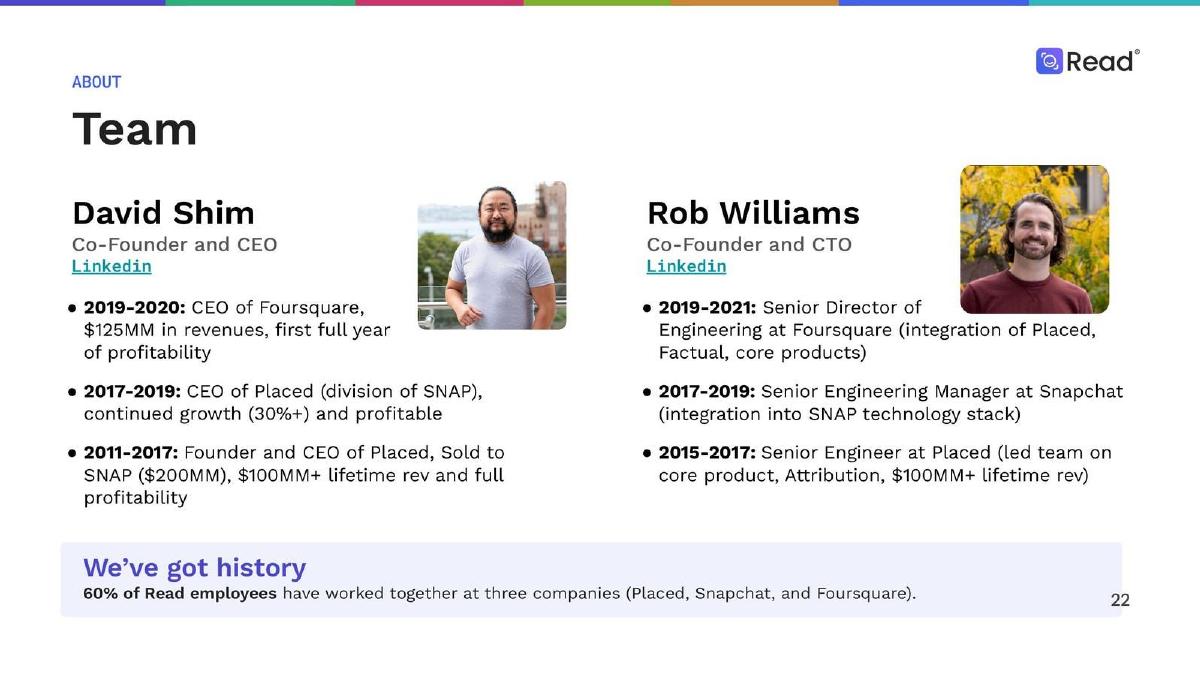
- Founder David Shim highlights a successful $200M exit of his previous company, Placed, to Snap (Slide 22).
- The team slide emphasizes institutional stability, noting that 60% of employees have worked together across three different companies (Slide 22).
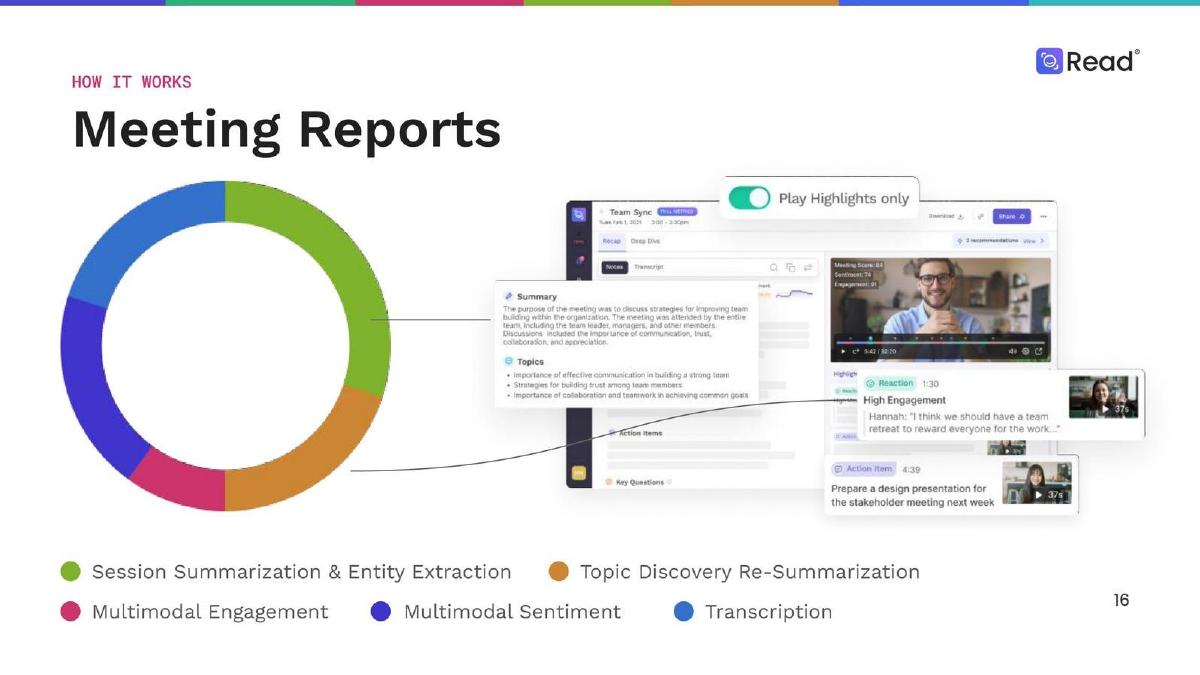
- Technical capabilities are summarized via a 'Meeting Reports' breakdown including multimodal engagement and sentiment analysis (Slide 16).
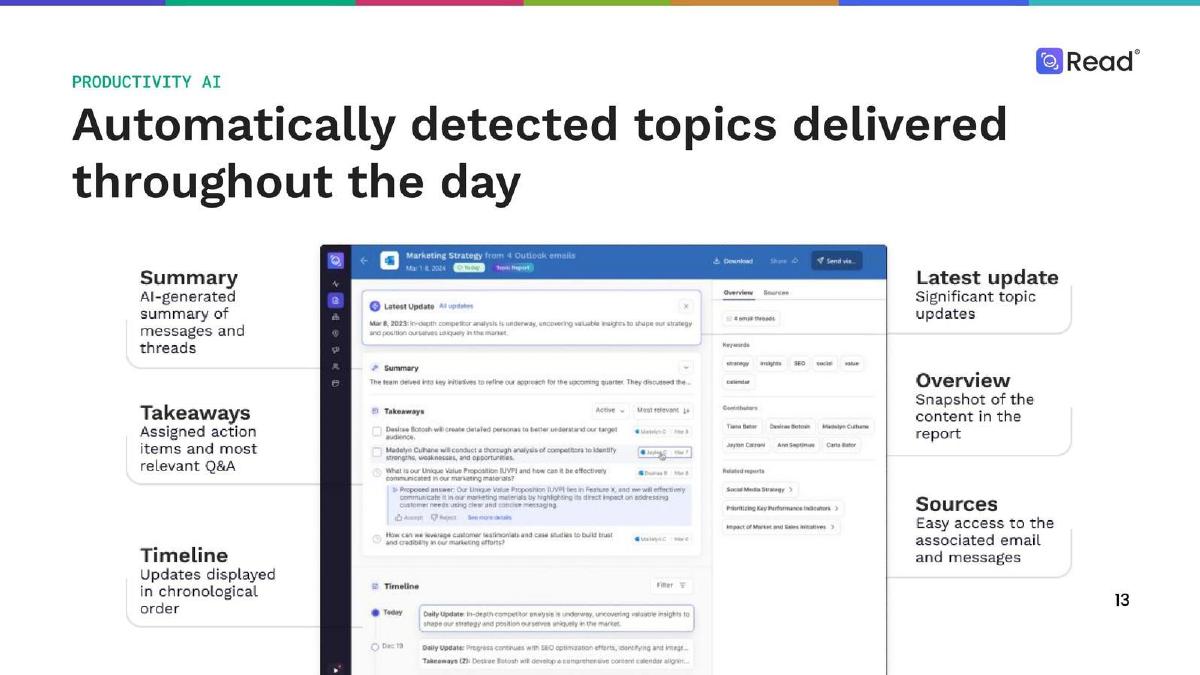
- The product vision extends beyond meetings to 'Automatically detected topics delivered throughout the day' from emails and messages (Slide 13).
- The deck uses a 'Today' vs. 'Tomorrow' structure to show the transition from a meeting tool to a broader productivity AI (Slides 4 and 10).
Read AI: Transforming Meetings into Connected Intelligence
Read AI entered a crowded market of AI notetakers and transcription services, yet they managed to secure a $21M Series A in 2024. The deck they used is a masterclass in establishing authority through founder pedigree and a clear product vision that extends beyond the 'transcription' commodity. By framing the product as a 'System of Record,' Read AI signals to investors that they are building a platform, not just a feature.
Slide 1-3: The Brand Identity
The opening slides are minimalist, focusing on the company name and the tagline: Connected Intelligence for the Future of Work . This phrasing is intentional. It avoids the word 'transcription' or 'notetaking,' which are often viewed as low-margin utilities. Instead, 'Connected Intelligence' suggests a sophisticated backend that links disparate data points across an organization.
Slide 4: The Current Product Ecosystem
Slide 4 is the most information-dense slide in the first half of the deck. Titled System of Record for Meetings , it breaks the product down into four core components:
Smart Scheduler: A calendar integration (cal.read.ai) that suggests the best times for meetings. · Meeting Assistant: A real-time interface showing 'Read Score,' 'Engagement,' and 'Sentiment' metrics (e.g., 81 Read Score, 75 Engagement). It even tracks 'Filler words' and 'Average WPM.' · Meeting Summary: An automated recap featuring topics, action items, and key questions. · For You: A personalized feed that aggregates topics across multiple meetings, such as 'Customer Experience Enhancement' or 'Future Workplace Strategies.'
This slide proves the product is already a multi-feature suite, moving the conversation from 'what could this be' to 'look at what we have built.'
Slide 7-10: The Macro Thesis
Slide 7 makes a bold claim: Productivity is AI’s first mainstream use case. This anchors the company in a massive, proven market. Slide 10 then transitions the narrative from 'Today' to Tomorrow , stating that Every interaction is improved with (Read) AI. This is the 'vision' portion of the deck, suggesting that the technology used for meetings will eventually be applied to every touchpoint in a business.
Slide 13: Beyond the Meeting Room
Slide 13, titled Automatically detected topics delivered throughout the day , shows the product expanding into email and messaging. The screenshot displays a 'Marketing Strategy' report generated from '4 Outlook emails.' It breaks down the content into a Summary, Takeaways (assigned action items), and a Timeline. This is a critical slide for a Series A; it demonstrates a path toward becoming a central hub for all workplace communication, significantly increasing the Total Addressable Market (TAM).
Slide 16: The Technical 'How It Works'
Instead of a complex architecture diagram, Read AI uses a circular chart to show the components of their Meeting Reports . The categories include:
Session Summarization & Entity Extraction · Multimodal Engagement · Multimodal Sentiment · Transcription · Topic Discovery Re-Summarization
By highlighting 'Multimodal Engagement' and 'Sentiment,' the company emphasizes that their AI isn't just listening to words—it's 'watching' the meeting to understand the emotional context. This is a key differentiator against basic LLM-based wrappers.
Slide 19: Market Traction
Slide 19 serves as the 'Traction' slide, stating Read is the fastest growing meeting notetaker in market. While the specific growth metrics (like MoM revenue or user count) are not detailed on this specific slide, the statement is designed to create FOMO (Fear Of Missing Out) among investors. In a Series A, proving momentum is often as important as proving the technology.
Slide 22: The 'Unfair Advantage' Team Slide
This is arguably the most important slide in the deck. The team pedigree is exceptional. David Shim (CEO) is listed as the former CEO of Foursquare ($125MM revenue) and the founder of Placed, which sold to Snap for $200M. Rob Williams (CTO) has a parallel history at Foursquare and Snapchat. The most compelling data point is at the bottom: 60% of Read employees have worked together at three companies. This effectively tells investors that the team is a 'pre-vetted' unit that knows how to scale and exit, drastically reducing the organizational risk.
What Works in This Deck
The 'System of Record' Framing: By using this terminology on slide 4, Read AI positions itself alongside companies like Salesforce (System of Record for Sales) or Workday (System of Record for HR). This is a high-valuation framing that suggests long-term defensibility and high switching costs.
Product-First Evidence: The deck is heavy on high-fidelity screenshots. Investors can see exactly what the user sees. This reduces the 'vaporware' concern that plagues many AI startups in the current cycle.
Team Cohesion: The fact that 60% of the team has worked together through an acquisition and at a major tech firm (Foursquare) is a rare and powerful signal. It suggests they can hire quickly and maintain culture under pressure.
What Is Missing
Unit Economics: There is no mention of Customer Acquisition Cost (CAC), Lifetime Value (LTV), or churn rates in the provided slides. For a Series A, investors usually want to see that the 'money-in to money-out' machine is starting to work.
Competitive Landscape: The deck does not explicitly address competitors like Otter.ai, Fireflies, or the native AI features being built into Zoom and Microsoft Teams. A 'Why We Win' slide against these incumbents would have been a standard addition.
The Ask: The specific dollar amount and the planned allocation of funds are not present in these slides. While often discussed in person, a clear 'Use of Funds' slide helps frame the milestones the company intends to hit before a Series B.
Founder Takeaways
Sell the Team's History: If you have worked with your co-founders or core team before, quantify it. Read AI’s '60% worked together at 3 companies' is a brilliant way to turn a team slide into a competitive advantage.
Show, Don't Just Tell: Use screenshots to explain complex AI features. Slide 13 does a better job of explaining 'cross-channel intelligence' than a paragraph of text ever could.
Bridge the Gap: Use a 'Today' and 'Tomorrow' structure. It allows you to prove you have a working product now while still selling the 'billion-dollar' future vision that VCs require.
Frequently asked questions
- What is Read AI's core value proposition?
- Read AI positions itself as 'Connected Intelligence for the Future of Work.' According to slide 4, it functions as a 'System of Record for Meetings,' providing automated summaries, transcripts, and highlights. It aims to improve workplace communication by turning unstructured meeting data into actionable insights and 'automatically detected topics' across various channels like email and chat (Slide 13).
- How does Read AI differentiate itself from other AI transcription tools?
- Read AI differentiates through 'multimodal' analysis. Slide 16 highlights that their reports include not just transcription, but also 'Multimodal Engagement' and 'Multimodal Sentiment.' This suggests the AI analyzes visual and tonal cues to score meetings. Furthermore, slide 13 shows they are expanding into email and message threads to provide a unified productivity dashboard.
- What is the background of the Read AI founding team?
- The team has significant pedigree. CEO David Shim previously founded Placed, which sold to Snap for $200M, and served as CEO of Foursquare, leading it to $125M in revenue (Slide 22). CTO Rob Williams was a Senior Director at Foursquare and a Senior Engineering Manager at Snapchat. 60% of the staff have worked together at Placed, Snapchat, and Foursquare.
- What stage of funding did this deck support?
- This deck was used for Read AI's Series A funding round in 2024. According to publisher reports from Business Insider, the company successfully raised $21M during this round to further develop its generative AI workplace tools.
- Does the deck include financial projections or a specific 'Ask'?
- Based on the provided slides, the deck focuses heavily on product vision, technical capabilities, and team history. While slide 19 claims they are the 'fastest growing' in the market, specific revenue figures, burn rates, or the exact dollar amount of the 'Ask' are not present in the analyzed slides.