Reality Loops presents itself as a three-pillar solution: a marketplace for XR assets, a collaboration hub for creators and agencies, and an end-to-end service provider for enterprise XR projects. The deck leans heavily on the projected growth of the XR industry, citing a $250B+ market by 2030. While the product vision includes sophisticated tools like an analytics dashboard and branded AR apps, the current traction shown is primarily event-based presence at Indian tech conferences. The most striking element of the deck is the funding ask, which totals just 4.0 Lakhs (approximately $4,800 USD…
Key takeaways
- The platform aims to serve as a marketplace for 3D models, filters, environments, and templates (Slide 2).
- The business model relies on a 10-15% transaction commission and subscription plans for creators (Slide 5).
- Market projections cite over 1 million XR developers and 3D artists globally (Slide 4).
- Service offerings extend beyond a simple marketplace to include custom branded AR apps and analytics (Slide 6).
- The company demonstrated physical presence at Startup Mahakumbh '25 and Indian Mobile Congress '25 (Slide 7).
- The total funding ask is extremely low at 4.0 Lakhs, with 30% allocated to marketing and creator onboarding (Slide 8).
- The deck lacks a dedicated team slide, leaving the founders' backgrounds and technical expertise unknown (Omission).
- No specific unit economics or current revenue figures are provided beyond the commission structure (Slide 5).
Reality Loops: The Unified XR Marketplace Teardown
Reality Loops enters the burgeoning Extended Reality (XR) space with a pitch focused on centralization. As digital marketing shifts toward immersive experiences, the demand for 3D assets and specialized talent has increased. Reality Loops positions itself as the connective tissue between the creators who build these assets and the brands that need them. This teardown examines their 16-slide deck (8 slides provided) to understand their strategy and market position.
Slide 1: Title and Vision
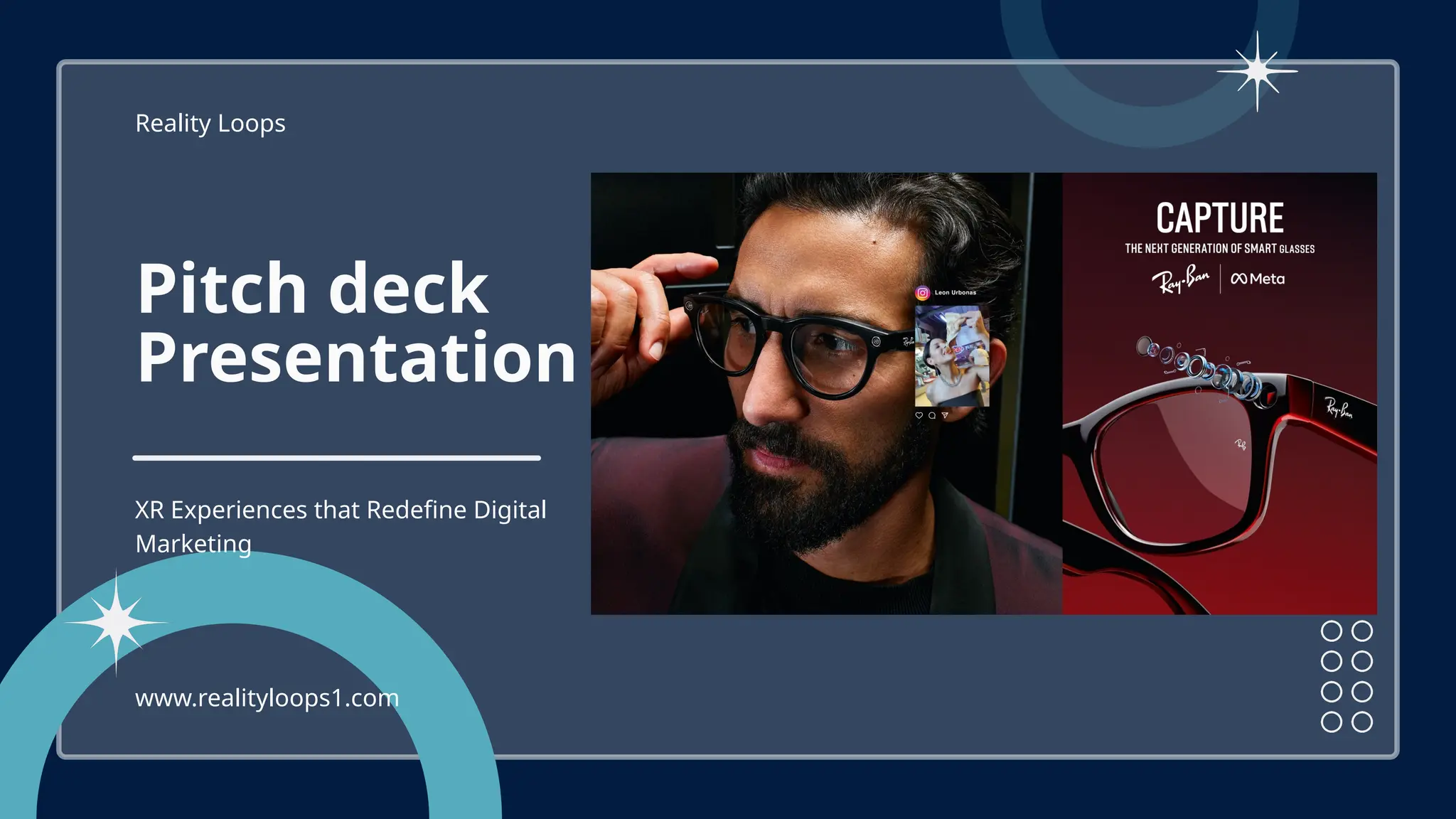
The cover slide establishes the company name and its core value proposition: "XR Experiences that Redefine Digital Marketing." It includes a URL (www.realityloops1.com) and imagery featuring smart glasses (Ray-Ban | Meta collaboration), which immediately signals that the company is targeting the hardware-agnostic software and asset layer of the XR industry. The design is clean, using a dark blue professional palette, though the use of third-party hardware imagery (Meta/Ray-Ban) is a common tactic for early-stage startups to borrow industry credibility.
Slide 2: The Three-Pillar Solution
Reality Loops breaks its solution into three distinct functional areas. First is a Marketplace for XR assets , covering 3D models, filters, and templates. Second is a Collaboration Hub , which acts as a freelance marketplace where creators and agencies can connect. Third is an End-to-End Service layer, providing the infrastructure for licensing, payments, and project tracking. By combining these, Reality Loops is attempting to be both the "Unity Asset Store" and the "Upwork" of the XR marketing world.
Slide 3: Product Interface Mockup
This slide provides a glimpse into the platform's UI. Notably, the browser address bar shows "localhost:3000," a clear indicator that the platform is in the development phase and not yet a fully deployed public product. The interface is categorized by asset type: AR Filters, AR Objects, VR Environments, Avatars, and XR Templates. The "Become a Seller" button is prominent, suggesting a focus on supply-side acquisition (creators) as a primary initial goal.
Slide 4: Market Opportunity
The deck cites a massive TAM (Total Addressable Market), projecting the XR industry to reach $250B+ by 2030 . They identify a global talent pool of over 1 million XR developers and 3D artists. The slide lists specific growth drivers: AR try-ons, 3D ads, metaverse spaces, and virtual showrooms. While these figures are standard for the industry, the slide lacks a specific SAM (Serviceable Addressable Market) or SOM (Serviceable Obtainable Market) that would show how much of this $250B Reality Loops actually expects to capture.
Slide 5: Business Model and Monetization
Reality Loops proposes a diversified revenue model. The core is a 10-15% commission per transaction , which is competitive compared to the 30% often taken by major app stores but higher than some lean marketplaces. They also plan to offer subscription plans for power users (creators/agencies), promoted listings for visibility, and enterprise onboarding fees. This multi-pronged approach is standard for marketplace businesses, though the success of the subscription model usually depends on high platform volume.
Slide 6: Service Offerings
This slide expands on how the platform will be used for enterprise clients. It lists four key areas: AR Digital Ads , VR Activations (for events and retail), Branded AR Apps , and an Analytics Dashboard . The inclusion of an analytics dashboard is a critical value add; brands are often hesitant to invest in XR because of the difficulty in measuring ROI. If Reality Loops can provide real-time insights into how users interact with 3D assets, they solve a major pain point for digital marketers.
Slide 7: Traction and Event Presence
Traction is demonstrated through photos of the team (or representatives) at two major Indian tech events: Startup Mahakumbh '25 and Indian Mobile Congress '25 . The photos show users engaging with VR headsets and AR displays. This indicates that the founders are active in the Indian startup ecosystem and have been validating the concept through public demonstrations. However, there is no mention of user numbers, signed LOIs (Letters of Intent), or revenue generated to date.
Slide 8: The Funding Ask
The final slide in this selection is the most revealing. The company is asking for a total of 4.0 Lakhs (approximately $4,800 USD). The allocation is broken down as follows:
Cloud Hosting & Maintenance: 1.0 Lakh (25%) · Marketing & Creator Onboarding: 1.2 Lakhs (30%) · Operations & Team Support: 1.0 Lakh (25%) · Legal & Compliance: 0.4 Lakh (10%) · Contingency & Tools: 0.4 Lakh (10%)
This is a micro-funding request. In the context of venture capital, this amount is negligible, suggesting the deck is intended for a government grant, a university incubator, or a very early angel investor in the Indian market. It covers the bare essentials to move from a "localhost" prototype to a live, incorporated entity.
What Works in This Deck
Clear Categorization: The deck does a good job of explaining exactly what will be sold on the platform. By listing 3D models, filters, and templates, they move away from vague "metaverse" buzzwords and into tangible digital goods.
Revenue Diversity: The business model slide shows a sophisticated understanding of how marketplaces scale. They aren't just relying on transaction fees; they are looking at advertising (promoted listings) and SaaS (subscriptions) as well.
Visual Consistency: The deck follows a consistent design language. While it uses stock imagery and standard templates, it looks professional and is easy to read, which is essential for early-stage credibility.
What is Missing
The Team Slide: One of the most critical omissions in this selection is the team slide. In a technical field like XR, investors need to know if the founders have the engineering chops to build a marketplace and the marketing background to attract brands. Without this, the deck is just a set of ideas.
Competitive Landscape: Reality Loops is not the first XR marketplace. Sketchfab, Unity Asset Store, and various AR-specific platforms already exist. The deck fails to mention these competitors or explain why Reality Loops is a better choice for digital marketers specifically.
Unit Economics: While they mention a 10-15% commission, they don't provide any data on Customer Acquisition Cost (CAC) or Lifetime Value (LTV). Even at a pre-seed stage, some projections on what it costs to acquire a creator versus a brand would be beneficial.
Founder's Takeaway
Target the Right Audience for the Ask: If you are asking for less than $5,000, you are not pitching to a VC. This deck is perfectly suited for a pitch competition or a small local grant. If the founders eventually want to raise a Seed round (e.g., $500k+), they will need to significantly expand their vision and traction metrics.
Move Beyond 'Localhost': Showing a screenshot of a site running on a local server is a double-edged sword. It shows you can code, but it also highlights that you haven't yet faced the challenges of a live environment (security, hosting, user traffic). Getting the site live on a staging domain would be a quick win for credibility.
Focus on the 'Unified' Aspect: The strongest part of the pitch is the combination of a marketplace and a collaboration hub. Founders should lean into this: explain how a brand can buy an asset and then immediately hire a creator on the same platform to customize it. That workflow is a unique selling point that separates them from simple asset repositories.
Frequently asked questions
- What is the primary problem Reality Loops is trying to solve?
- While a dedicated 'Problem' slide is missing from this selection, Slide 2 implies the problem is fragmentation in the XR space. They propose a 'Unified' platform that combines an asset marketplace with a collaboration hub, suggesting that currently, creators, agencies, and clients lack a single place to connect, trade assets, and track projects.
- How does Reality Loops plan to generate revenue?
- According to Slide 5, the company has four revenue streams: a 10-15% commission on every transaction, subscription plans for creators and agencies, fees for promoted listings or 'featured gigs,' and enterprise onboarding fees for B2B clients who require more hands-on service.
- What is the significance of the funding ask amount?
- The ask on Slide 8 is 4.0 Lakhs (INR), which is roughly $4,800 USD. This is an unusually small amount for a tech startup pitch deck. It suggests the company is at the earliest possible stage, perhaps seeking a micro-grant or initial 'friends and family' level capital to cover basic hosting and incorporation costs.
- What kind of XR assets will be available on the marketplace?
- Slide 2 and Slide 3 specify that the marketplace will host 3D models, AR filters, VR environments, avatars, characters, and XR templates. The UI mockup on Slide 3 shows categories specifically for 'AR Objects & Experiences' and 'XR Templates & Tools,' indicating a broad scope across augmented and virtual reality.
- Does the deck show a working product?
- Slide 3 shows a browser-based mockup of the platform running on 'localhost:3000'. This indicates that a prototype or MVP (Minimum Viable Product) exists in a local development environment, but it does not confirm if the platform is live or has processed actual transactions.