Rebel Girls secured an $8M Series A in 2023, led by publishing giant Penguin Random House. The 17-slide deck is a masterclass in brand storytelling, shifting the narrative from a successful book series to a diversified 'omni-channel universe.' By highlighting 8.5 million books sold and 22 million podcast downloads, the company demonstrates massive existing traction while outlining a future involving the metaverse, television, and consumer products. The deck lacks traditional financial slides—there are no revenue charts, burn rates, or unit economics—suggesting a round driven by strategic alig…
Key takeaways
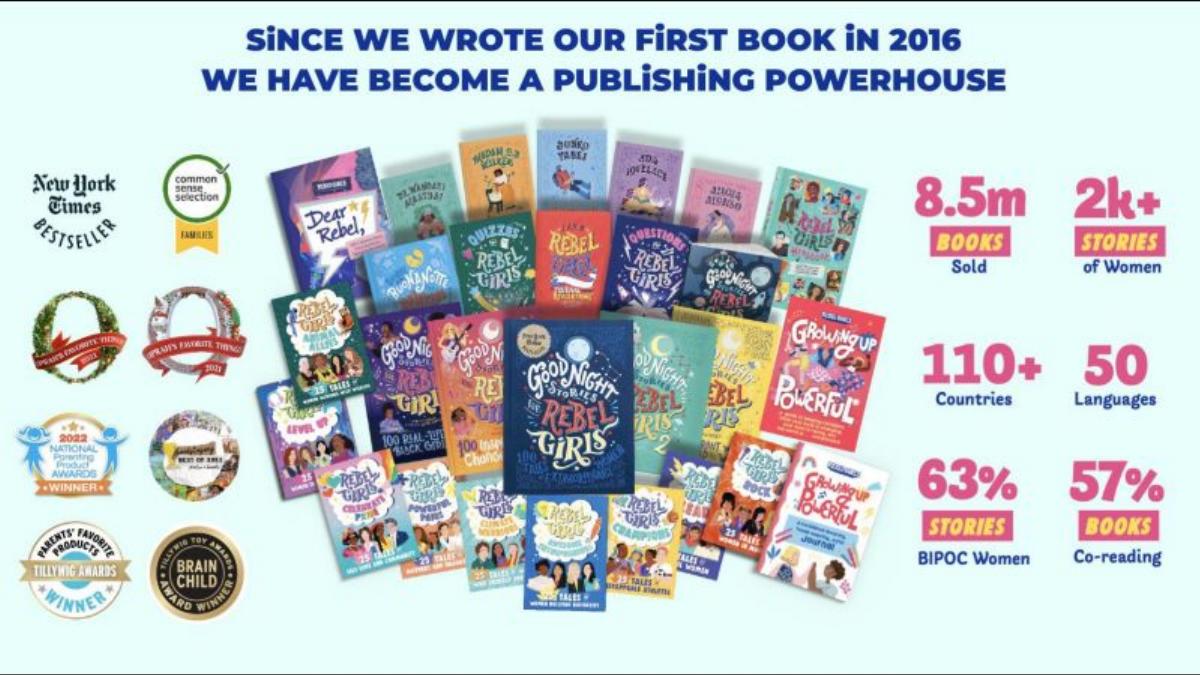
- The company positions itself as a 'publishing powerhouse' with 8.5 million books sold across 110+ countries (Slide 6).
- Rebel Girls utilizes a multi-platform strategy, reporting 22 million podcast downloads and 135k+ app downloads (Slide 7).
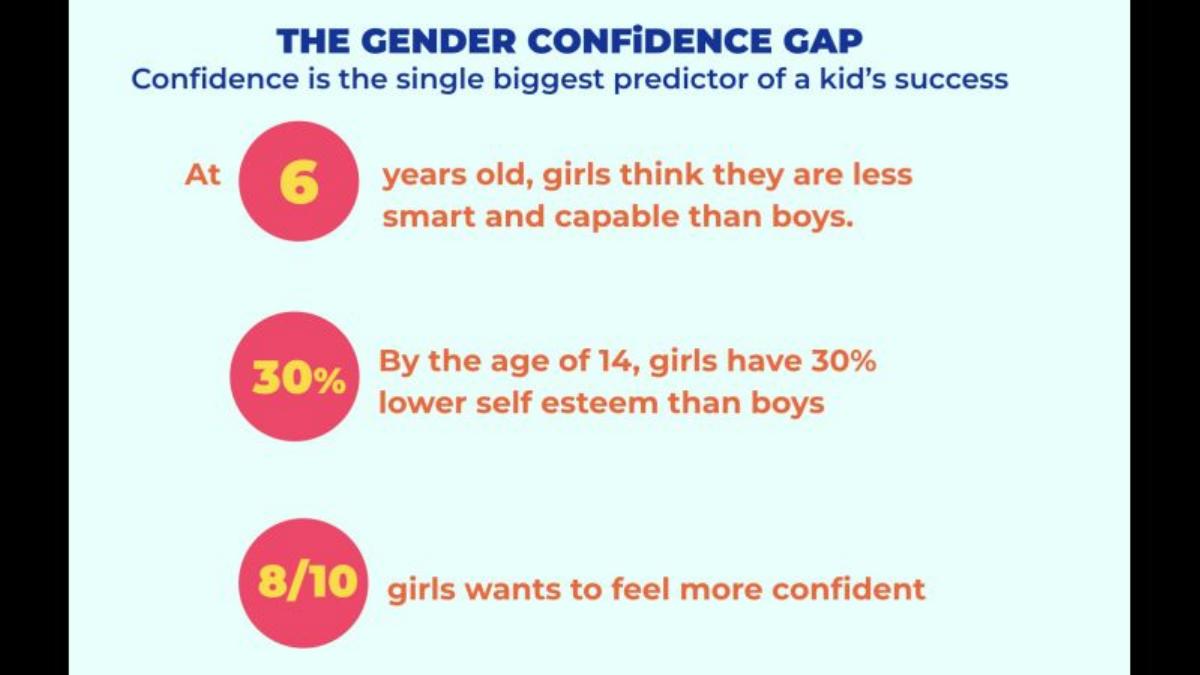
- The deck identifies a specific psychological 'Gender Confidence Gap' as the core problem, noting girls' self-esteem drops 30% by age 14 (Slide 2).
- Strategic partnerships are a central pillar of their growth, featuring collaborations with Nike, Alaska Airlines, and Google Kids Space (Slide 8).
- The brand claims high user satisfaction with a Net Promoter Score (NPS) of 81 (Slide 13).
- Future growth targets include reaching 50 million girls globally by 2025 through expansion into TV, Broadway, and Web3 (Slide 14).
- The deck omits all financial data, including revenue, margins, and the specific use of funds for the $8M raise.
- Community is highlighted as a 'superpower,' citing a network of 400+ artists and 60+ writers from over 50 countries (Slide 12).
The Narrative of Brand as a Moat
The Rebel Girls Series A deck is a departure from the data-heavy, chart-filled presentations typical of Silicon Valley tech startups. Instead, it functions as a brand manifesto. For a company that started as a record-breaking Kickstarter project for a single book, this deck is designed to prove that Rebel Girls is no longer just a publishing house, but a global media franchise. The $8M raise, led by Penguin Random House, suggests that the strategy of leveraging content into a multi-platform ecosystem was successful.
Slide 1-3: The Mission and the Problem
The deck opens with a clean title slide featuring the Certified B Corporation and Women Owned badges, immediately establishing the company's values. Slide 2, titled The Gender Confidence Gap , provides the 'Why.' It uses three stark statistics: girls feeling less capable at age 6, a 30% drop in self-esteem by age 14, and the fact that 8/10 girls want to feel more confident. This slide is critical because it frames the product not as entertainment, but as a necessary intervention.
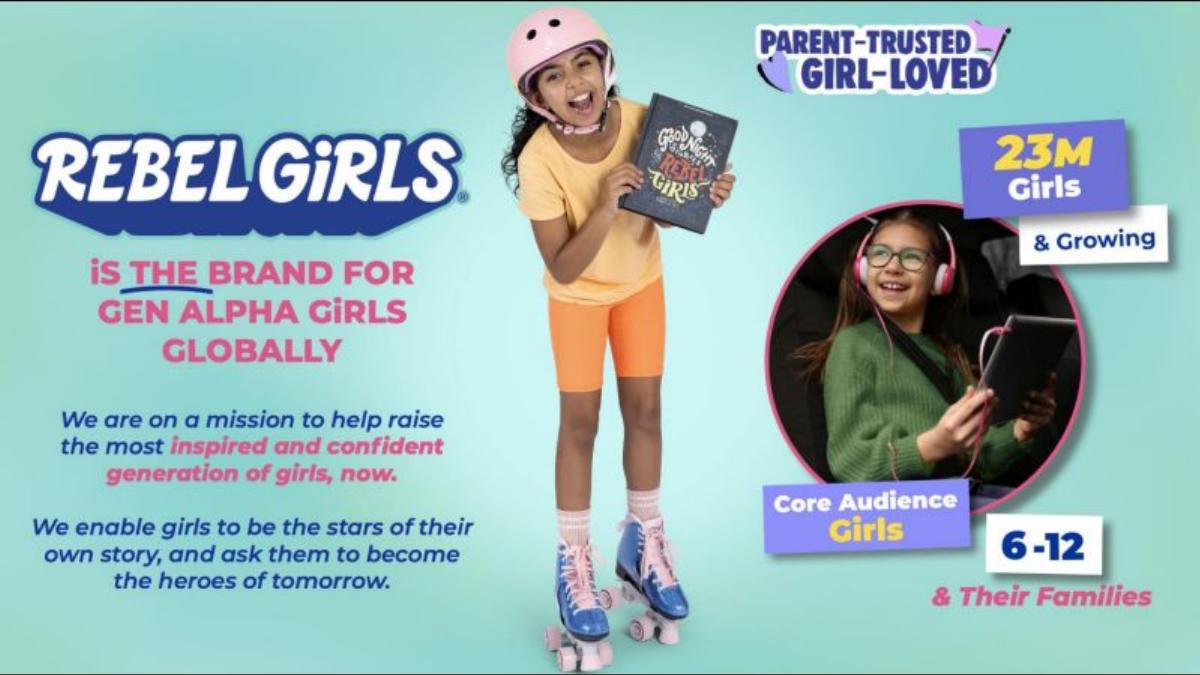
Slide 3 introduces the brand as the solution for Gen Alpha Girls Globally . It claims a reach of 23M Girls & Growing and defines the core audience as girls aged 6-12 and their families. This slide serves as the 'hook,' combining a massive addressable market with a clear social mission.
Slide 4-5: The Omni-Channel Strategy
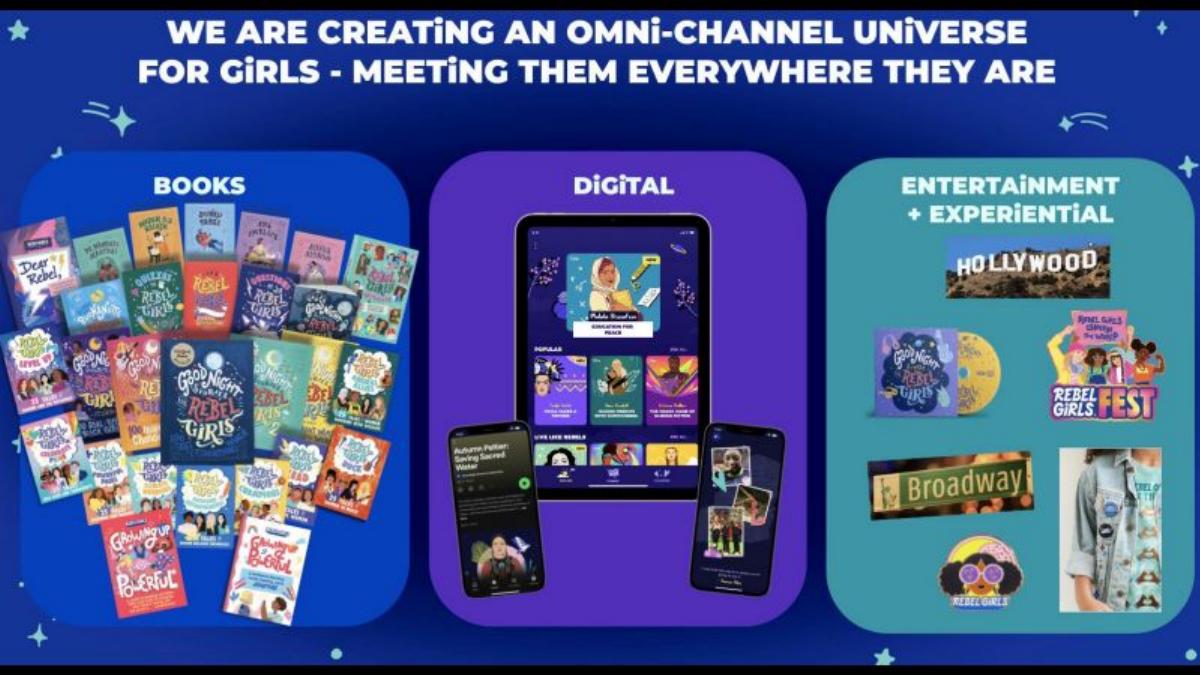
Slide 4 is the structural heart of the deck. It defines the Omni-Channel Universe across three silos: Books , Digital , and Entertainment + Experiential . By showing book covers, app interfaces, and logos for Hollywood and Broadway, the company signals that it is following the 'Disney model' of content monetization—create IP in one medium and extract value across all others.
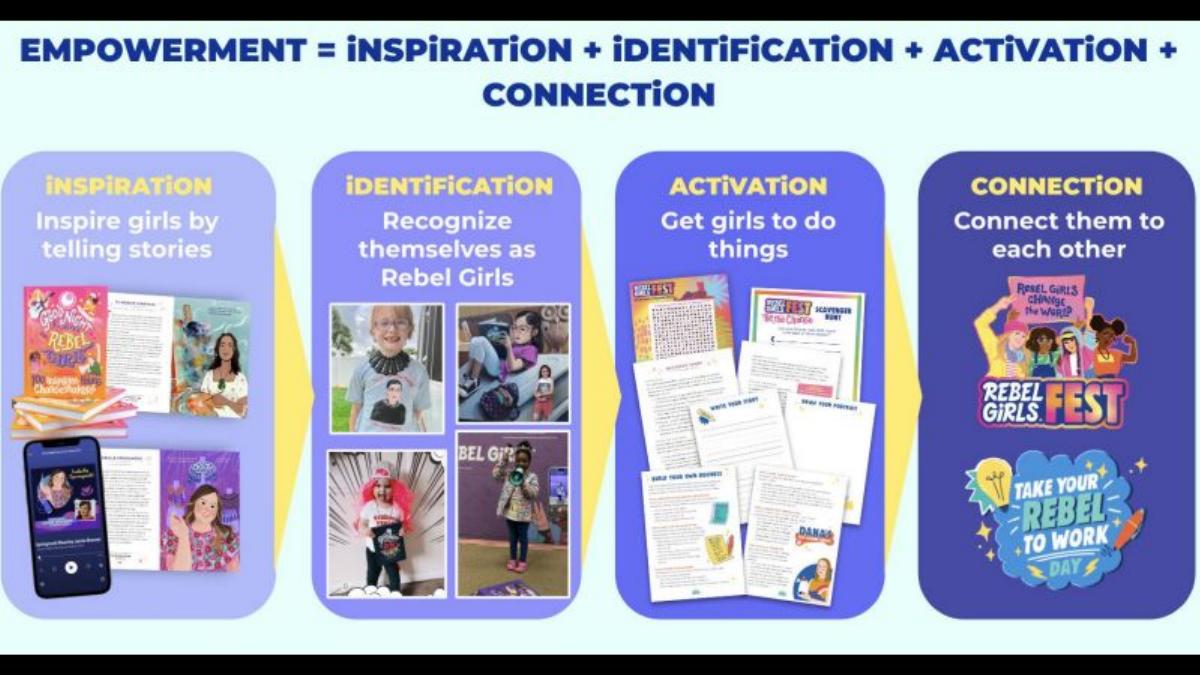
Slide 5 breaks down their internal formula for Empowerment : Inspiration + Identification + Activation + Connection. This is a rare look at the company's 'secret sauce,' explaining how they move a user from reading a story (Inspiration) to attending a 'Rebel Girls Fest' (Connection). It’s a roadmap for user retention and community building.
Slide 6-7: Traction and Proof of Concept
Slide 6 focuses on their origins. Since 2016, they have sold 8.5m Books , featured 2k+ Stories of Women , and expanded into 110+ Countries and 50 Languages . Notably, they mention that 63% of stories are of BIPOC Women and 57% of books involve co-reading , which appeals to ESG-conscious investors and highlights the 'family' aspect of the brand.
Slide 7 shifts to digital traction. The metrics are impressive: 22m Podcast Downloads , 1.8m Kahoot Players , and 135k+ App Downloads . They also highlight an Apple Design Award (2022) and a 4.6-star rating from 8,678 ratings . These figures are intended to prove that the brand successfully translates from physical paper to digital screens.
Slide 8-11: Partnerships and Physical Expansion
Slide 8 showcases high-tier corporate partnerships with Nike , Athleta Girl , Alaska Airlines , and Google Kids Space . This isn't just vanity; it demonstrates B2B revenue potential and brand validation from global leaders. Slide 9 continues this theme with consumer products, showing Build-A-Bear Workshop , Mad Engine , and King Features . The slide displays apparel, stationery, and toys, illustrating the licensing potential of the IP.
Slide 10 and 11 focus on the 'Experiential' arm. Slide 10 uses a collage of photos to show Retail/In-Store events, Corporate activations, and the Rebel Girls Fest . Slide 11 looks forward, mentioning expansion into TV, Theater, the Metaverse, and Animated Shorts , specifically calling out Roblox and Minecraft . This is a clear play for the 'Gen Alpha' demographic that lives in digital sandboxes.
Slide 12-13: The Community and Sentiment
Slide 12 highlights the Plurality of Global Voices , citing 400+ artists and 60+ writers . By featuring photos of creators like Jameela Jamil and Andra Day , the company emphasizes that its content is produced by a diverse, high-profile community, which acts as a barrier to entry for competitors. Slide 13 provides the ultimate social proof: an NPS Score of 81 . For context, an NPS over 70 is considered world-class. The slide is filled with glowing testimonials from children and parents, reinforcing the emotional connection the brand has with its users.
Slide 14-15: The Future and the Team
Slide 14, By 2025 Rebel Girls Will Have... , sets the North Star: Reached 50M Girls Globally . It lists specific targets like 50M+ podcast downloads, 30+ licenses, and a Broadway show. This slide gives investors a clear picture of what 'success' looks like for this round of funding.
Slide 15 introduces the World Class Leadership Team . Led by CEO Jes Wolfe and Co-Founder Elena Favilli , the team boasts experience from WarnerMedia, NBCU, Audible, Morgan Stanley, and Boston Consulting Group . This is a heavy-hitting roster for a media company, suggesting they have the operational expertise to manage a complex, multi-platform rollout.
What Rebel Girls Does Well
1. Mastery of Social Proof: The deck is relentless in its use of awards, ratings, and high-profile partnerships. By the time an investor reaches the end, the brand's legitimacy is unquestionable. Using an NPS score of 81 is a brilliant way to quantify 'love,' which is usually a qualitative metric.
2. Clear Audience Definition: They don't just say 'kids.' They specify 'Gen Alpha Girls' and '6-12.' This specificity allows them to talk about platforms like Roblox and Minecraft with authority, showing they understand where their audience actually spends time.
3. IP-First Strategy: The deck successfully argues that Rebel Girls is an IP engine. They aren't just selling books; they are selling a 'universe.' This is a much more scalable and defensible pitch than a traditional publishing business.
What is Missing from the Deck
1. Financial Data: There is a total absence of revenue figures, EBITDA, or growth rates in dollar terms. While the 8.5M books sold is a great proxy for revenue, investors usually want to see the actual P&L, especially at Series A. The lack of a 'The Ask' slide or a 'Use of Funds' breakdown is also a significant omission in this version of the deck.
2. Unit Economics: For a company with a digital app and physical products, understanding the Customer Acquisition Cost (CAC) and Lifetime Value (LTV) is vital. The deck doesn't explain how much it costs to acquire a podcast listener versus a book buyer, or how they cross-sell between the two.
3. Competitive Landscape: The deck operates as if Rebel Girls exists in a vacuum. There is no mention of other empowerment brands, traditional publishers (like Scholastic), or digital competitors. A 'Competitive Matrix' slide would have helped define their unique positioning.
What Other Founders Should Copy
1. The 'Problem' Slide: Slide 2 is a perfect example of how to use data to create an emotional and logical 'need' for a product. It identifies a specific psychological pain point (the confidence gap) and backs it up with stats.
2. Visual Consistency: The deck is beautiful. It uses the brand's actual aesthetic—vibrant colors, diverse illustrations, and playful fonts—to tell the story. This makes the deck feel like an extension of the product itself.
3. Multi-Platform Mapping: Slide 4 is a great template for any content-based startup. It shows how a single piece of IP can be leveraged across different revenue streams, helping investors see the 'big picture' beyond the initial product.
Frequently asked questions
- How much did Rebel Girls raise and who were the investors?
- According to the catalogue facts, Rebel Girls raised $8 million in a Series A round in 2023. The round was led by Penguin Random House. Other investors included Asma Ishaq, Jenny Zhu, Jocelyn Mangan, Melissa Kushner, Joan Jett, and Stephanie Sperbe.
- What is the core problem Rebel Girls aims to solve?
- As shown on Slide 2, the company addresses the 'Gender Confidence Gap.' They cite data stating that at 6 years old, girls begin to think they are less smart than boys, and by age 14, their self-esteem is 30% lower than their male peers.
- What are the primary business segments for Rebel Girls?
- Slide 4 outlines an 'omni-channel universe' consisting of three main pillars: Books (publishing), Digital (apps and podcasts), and Entertainment + Experiential (events, Broadway, and Hollywood projects).
- Does the deck include financial projections or revenue figures?
- No. The 17-slide deck is entirely focused on brand reach, audience metrics (like downloads and books sold), and partnership logos. It does not disclose annual recurring revenue (ARR), profit margins, or specific financial forecasts.
- What are the company's goals for 2025?
- Slide 14 details several '2025' milestones, including reaching 50 million girls globally, expanding to 85+ book titles, achieving 50M+ podcast downloads, and launching a live-action series and a Broadway show.