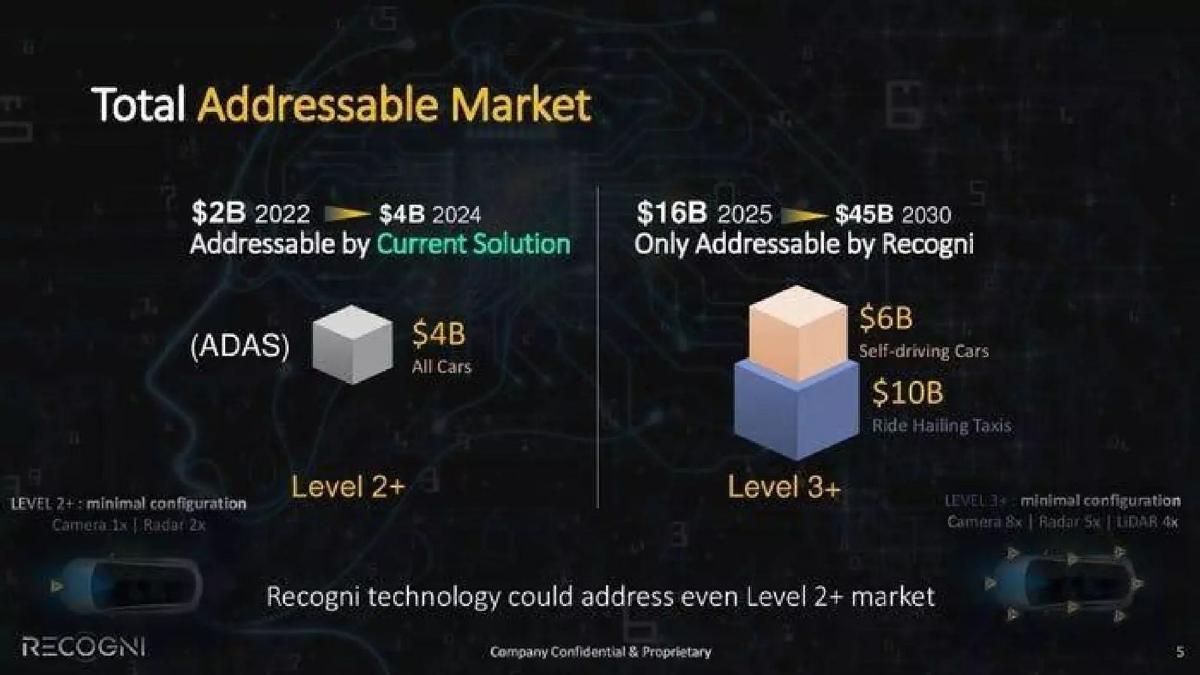
Recogni’s 9-slide deck from 2019 targets a specific technical failure in the autonomous vehicle (AV) market: the inability of current hardware to handle Level 3+ autonomy within a reasonable power budget. The presentation identifies that while Level 2 autonomy is 'solved,' moving to Level 3+ requires a jump to 7000+ TOPS, which current state-of-the-art systems can only achieve by consuming 26kW. Recogni positions its ASIC as the only solution optimized for both performance and power, claiming a 1000 TOPS output at just 5 Watts. The deck is light on financial projections and specific go-to-mar…
Key takeaways
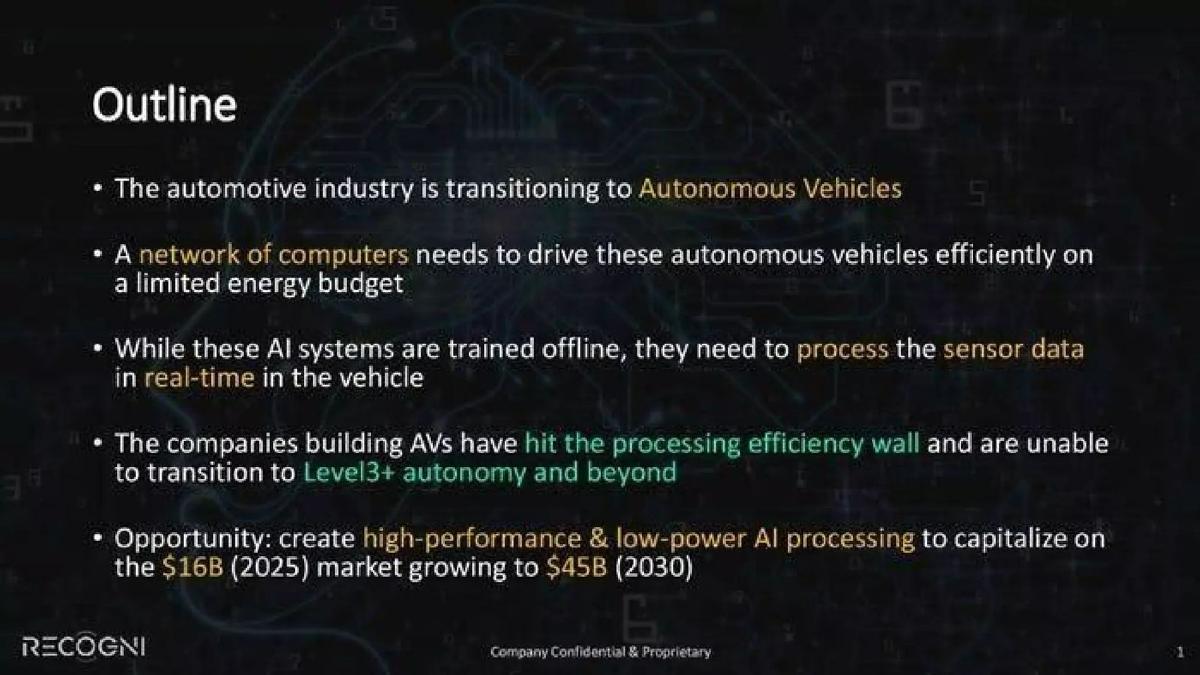
- The deck identifies a specific 'processing efficiency wall' preventing the transition to Level 3+ autonomy on slide 1.
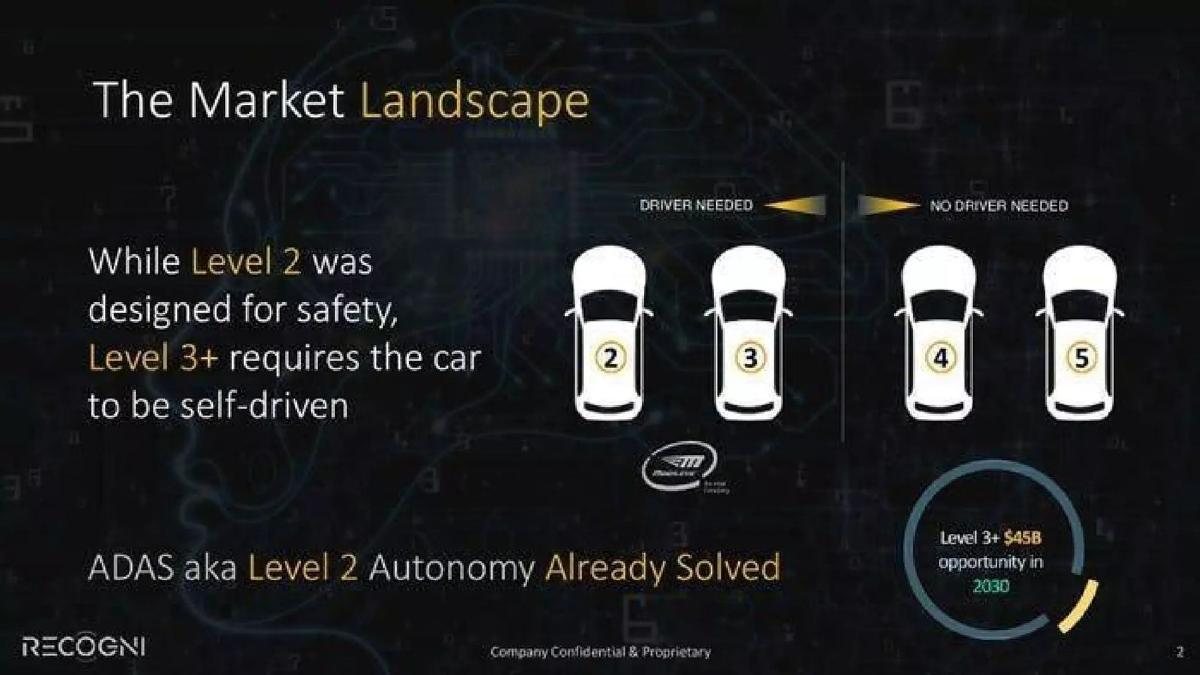
- Market sizing distinguishes between the $4B Level 2 market and the $45B Level 3+ opportunity by 2030 on slide 2.
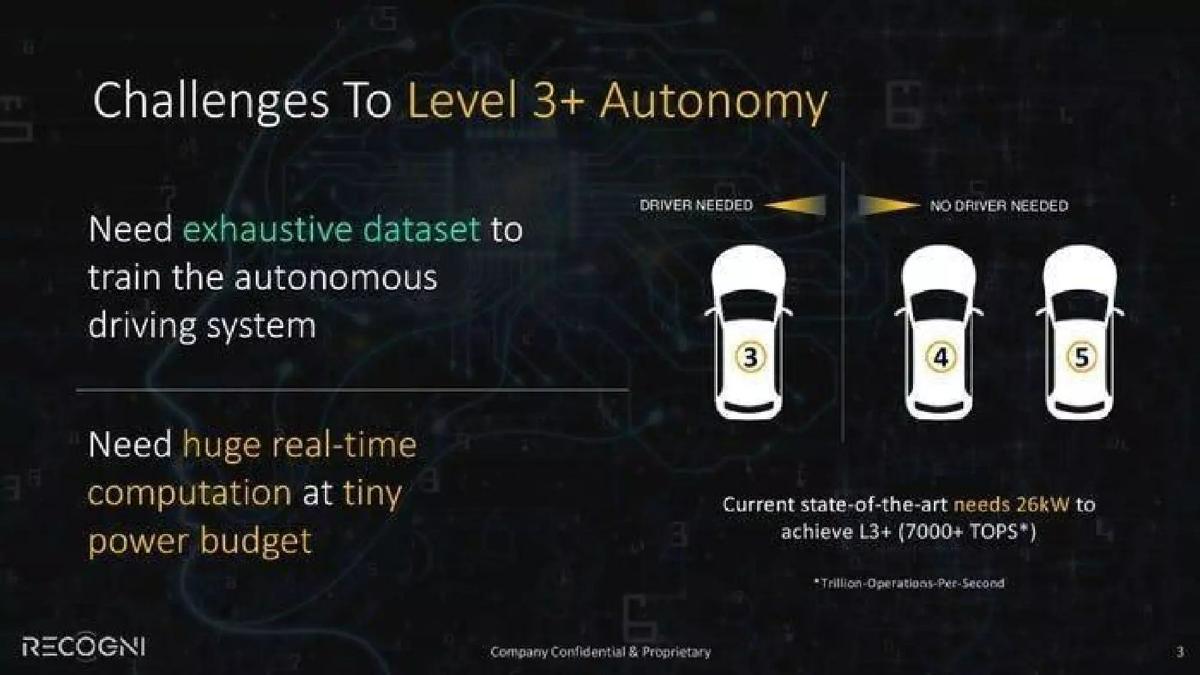
- Technical requirements for Level 3+ are quantified at 7000+ Trillion-Operations-Per-Second (TOPS) on slide 3.
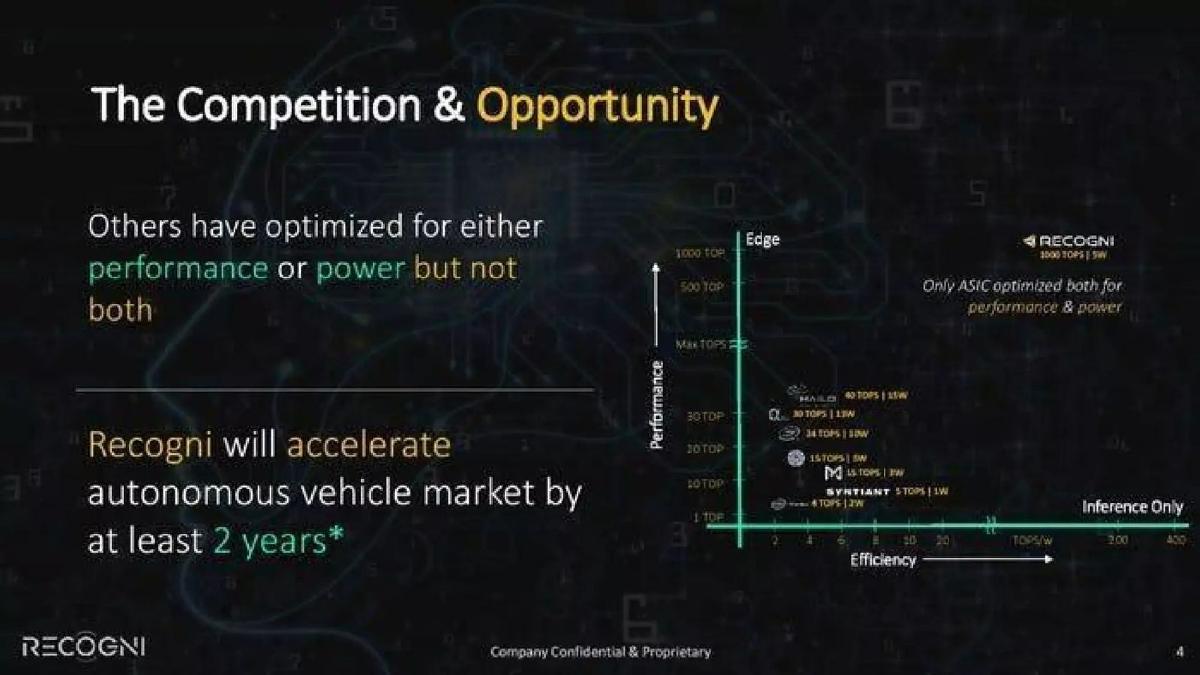
- Competitor benchmarking on slide 4 shows Recogni at 1000 TOPS / 5W, significantly higher in efficiency than Intel, NVIDIA, or Hailo.
- The Total Addressable Market is segmented into $6B for self-driving cars and $10B for ride-hailing taxis by 2025 on slide 5.
- Product claims include processing 95% of all AI workload for an entire vehicle using less than 100W on slide 6.
- The founding team features five members with previous experience at companies like Juniper, Sun, and Intel on slide 7.
- Intellectual property is highlighted on slide 8 with 7+ provisional patents filed.
The Recogni Pitch Deck: A Technical Deep Dive into Edge AI
Recogni’s 2019 investor presentation is a concise, 9-slide document that focuses heavily on the technical bottleneck of autonomous driving. At the time of this deck, the industry was grappling with the massive power requirements of AI inference chips. Recogni’s strategy was to position themselves not just as another chip company, but as the essential enabler for Level 3+ autonomy. The deck is characterized by a dark, high-tech aesthetic and a narrative built on the 'efficiency wall' that traditional processors like GPUs were hitting.
Introduction and The Problem Statement
Slide 1: Title Slide The deck opens with a minimalist title slide featuring the Recogni logo and the tagline 'Realtime Object Recognition.' The date is marked as March 2019. The background imagery suggests a complex, interconnected network, setting a high-tech tone immediately.
Slide 2: Outline The outline slide functions as an executive summary. It establishes four critical points: the transition to Autonomous Vehicles (AVs), the need for efficient computing on a limited energy budget, the requirement for real-time sensor processing, and the 'processing efficiency wall.' Crucially, it introduces the market opportunity: a $16B market in 2025 growing to $45B by 2030. This slide sets the stakes high, framing the problem as a binary blocker for the entire AV industry.
Market Landscape and Technical Challenges
Slide 3: The Market Landscape Recogni uses this slide to bifurcate the market. They claim that 'ADAS aka Level 2 Autonomy [is] Already Solved.' This is a bold strategic move; by dismissing Level 2 as a solved problem, they force the investor to look at the Level 3+ opportunity where Recogni claims their technology is uniquely required. The slide uses a simple visual of cars labeled 2 through 5 to represent the levels of autonomy, highlighting a $45B opportunity in 2030 for Level 3+.
Slide 4: Challenges to Level 3+ Autonomy This slide quantifies the 'efficiency wall.' It states that Level 3+ requires 7000+ TOPS (Trillion Operations Per Second). The most damning metric provided is that 'current state-of-the-art needs 26kW to achieve L3+.' In the context of an electric vehicle, a 26kW draw just for computation is catastrophic for range and thermal management. This slide creates the 'villain' in the story: the power-hungry incumbent hardware.
Competitive Positioning and TAM
Slide 5: The Competition & Opportunity This is the core 'moat' slide. It features a quadrant graph plotting Performance (TOPS) against Efficiency (TOPS/W). Recogni places itself alone in the top-right corner, claiming 1000 TOPS at 5W. Competitors, represented by logos including Intel and NVIDIA, are clustered in the lower-left quadrants. The slide makes the definitive claim: 'Only ASIC optimized both for performance & power.' It also includes a bold promise that Recogni will 'accelerate autonomous vehicle market by at least 2 years.'
Slide 6: Total Addressable Market Slide 6 provides a more granular look at the TAM. It compares the 'Current Solution' addressable market ($2B in 2022) against the 'Only Addressable by Recogni' market ($16B in 2025). It breaks down the 2025 market into $6B for self-driving cars and $10B for ride-hailing taxis. This slide also notes the sensor configuration differences, moving from 1 camera/2 radars in Level 2+ to 8 cameras/5 radars/4 LIDARs in Level 3+, justifying the need for massive increases in compute power.
Technology and Team
Slide 7: The Recogni Technology This slide moves into the 'how.' It shows a high-level architecture of the Recogni VCM (Vision Control Module). Key specs listed include 1000 TOPS, 5 Watt power consumption, passive cooling, and 120 dB dynamic range. The most significant business claim here is 'Ongoing technical engagements and commitment to invest from several automotive OEMs and Tier-1 parts supplier.' This provides the necessary validation that their theoretical specs are being tested by the industry's gatekeepers.
Slide 8: The Founding Team The team slide is strong on pedigree. It features five leaders: RK Anand (CEO), Eugene Feinberg (Technology), Ashwini Choudhary (Products/Marketing), Gilles Backhus (AI), and Valerie Chan (Operations). The logos at the bottom—including Juniper, Sun, Intel, and Kumu—suggest a team that has successfully built and scaled complex hardware and networking companies before. This is a critical slide for a Series B deck, as it reassures investors that the technical claims are backed by seasoned professionals.
Summary and IP
Slide 9: Summary The final slide summarizes the three pillars of the company: Competition (no one else has this level of power/performance), Innovations (7+ provisional patents filed), and Market (Multi-billion dollar AV market). It reiterates the technical edge: 'Fastest perception engine' and 'Lowest Photon-to-Intelligence latency.' The closing statement, 'Recogni will change the trajectory of Level 2+ Autonomy market,' serves as a final call to action, though it curiously pivots back to Level 2+ after the previous slides focused so heavily on Level 3+.
What Works in This Deck
The Power Metric: By highlighting the 26kW requirement of competitors, Recogni makes the problem feel urgent and the current solutions feel absurd. It is a very effective way to frame a technical advantage. · Clear Market Bifurcation: Separating 'solved' Level 2 from 'unsolved' Level 3+ allows the company to own a specific niche rather than trying to compete in the crowded ADAS space. · Visual Simplicity: Despite being a deep-tech hardware company, the slides are not cluttered with circuit diagrams. They focus on high-level metrics (TOPS, Watts, Dollars) that an investor can easily digest. · Team Pedigree: The team slide effectively uses recognizable logos to establish credibility in a field (silicon design) where experience is everything.
What Is Missing
The Ask: There is no slide indicating how much money is being raised or what the valuation expectations are. While this is common in 'leaked' decks, its absence in a fundraising teardown is always a major omission. · Financial Projections: There are no details on the cost to manufacture the ASICs, expected margins, or revenue targets. For a Series B, investors usually expect to see a path to commercial sustainability. · Roadmap: The deck lacks a timeline. When will the first chips tape out? When will the first OEM vehicles with Recogni tech hit the road? The '2-year acceleration' claim is vague without a concrete schedule. · Unit Economics: There is no mention of the price point for the VCM. In the automotive industry, where Tier-1 suppliers squeeze every penny, the lack of pricing strategy is a notable gap.
What a Founder Should Copy
The 'Efficiency Wall' Narrative: If your startup is entering a market with established giants, find the one metric where the giants are failing (in this case, power consumption) and make it the centerpiece of your deck. · Quadrant Positioning: Slide 5 is a perfect example of how to use a graph to show you are in a 'category of one.' By choosing axes that favor your specific innovation, you make competitors look obsolete. · TAM Segmentation: Instead of just giving one large number, breaking the market down by year and by use case (Ride-hailing vs. Personal cars) shows a deeper understanding of the industry's evolution. · IP Highlighting: Mentioning the number of provisional patents filed (Slide 8) is a quick way to signal that the technology is defensible without needing to explain the underlying math in the pitch.
Frequently asked questions
- What is the primary technical problem Recogni is solving?
- Recogni addresses the 'processing efficiency wall' in autonomous vehicles. According to slide 3, current state-of-the-art systems require 26kW of power to achieve the 7000+ TOPS (Trillion Operations Per Second) necessary for Level 3+ autonomy. Recogni's technology aims to provide high-performance inference at a fraction of that power budget, specifically claiming 1000 TOPS at just 5 Watts on slide 6.
- How does Recogni segment the autonomous vehicle market?
- The deck differentiates between Level 2 (ADAS) and Level 3+ autonomy. Slide 2 states that Level 2 is 'already solved' and was designed for safety. Level 3+ requires the car to be truly self-driven. Slide 5 projects the Level 3+ market to grow from $16B in 2025 to $45B by 2030, specifically highlighting ride-hailing taxis as a $10B sub-segment.
- Who are the key competitors mentioned in the deck?
- While not explicitly named in a list, slide 4 features a performance vs. efficiency graph that includes logos for Intel, NVIDIA, Hailo, and Syntiant. Recogni positions itself in the top-right quadrant (high performance, high efficiency), while placing these competitors significantly lower on the TOPS scale or further left on the efficiency (TOPS/W) axis.
- What evidence of traction does the deck provide?
- Traction is primarily presented through technical validation and industry interest rather than revenue. Slide 6 mentions 'ongoing technical engagements and commitment to invest from several automotive OEMs and Tier-1 parts suppliers.' Additionally, slide 8 notes that the company has filed 7+ provisional patents to protect its innovations.
- What critical fundraising information is missing from this deck?
- This deck is notably missing a 'Use of Funds' or 'The Ask' slide, which is unusual for a Series B presentation. It also lacks any financial projections (revenue, burn rate, or margins), a detailed product roadmap, or specific case studies from their 'ongoing technical engagements.' The focus is almost entirely on the technical 'why now' and the team's pedigree.