Mobility Competition Slides: 10 Real Pitch Deck Examples
How transport and mobility startups show competition in a pitch deck: a performance-vs-power chart of named chips, two named rivals with acquisition history.
Mobility Competition Slide: Name the Rivals, Including Taxis and Your Own Weak Spots
Transport startups compete with more than other startups: taxis, public transport, personal cars and traditional brokers are all alternatives a rider or buyer already uses. Investors also know that many mobility models are easy to copy. This guide compares ten real competition slides from decks tagged mobility in our library, from a chart that plots named rival chips on two measured axes to a slide that says there is no competition.
TL;DR
Name the rivals and the everyday alternatives, compare on something measurable, and say how you stay ahead when switching costs are low. Recogni plots rival chips by performance and power with figures on each. Hermes names two rivals, who acquired them and their estimated prices. Ober lists taxis, public transport and personal cars as substitutes and admits an "undifferentiated business model". Careem's early deck spells out what Uber's capital and brand let it do. Vruum gives the driver commission charged by Ola, Uber and Rapido next to its own. One Mobility maps kids' bike rivals on price and convenience, and GetPark names informal street parking attendants as local rivals. UberCab's early deck lists differentiators without naming the taxi it replaces. Jetway compares itself with "traditional brokerage" without figures, and Scoutr says there is "no competition" in its market.
Mobility competition slides from real pitch decks
Each example shows the exact stored slide above its analysis and links to the full teardown. The most complete comparisons come first; weaker ones follow for contrast. Claims are as shown on the slides; comments are ours.
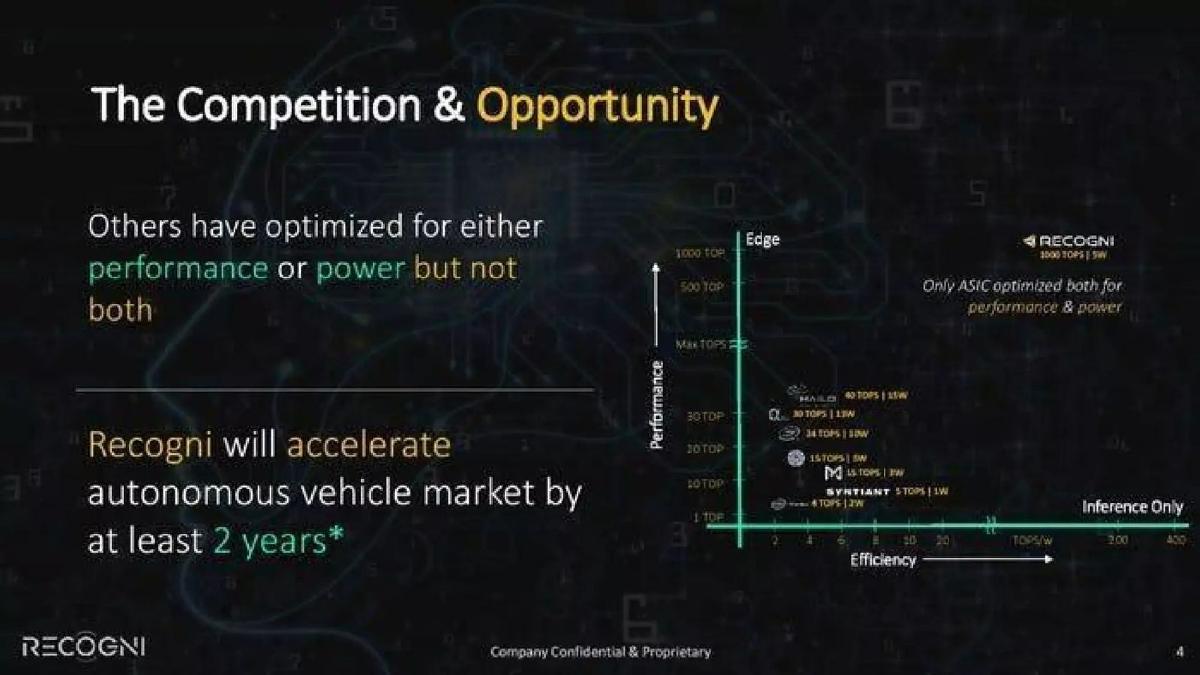
Recogni competition slide — slide 5
Chip maker for autonomous vehicle perception. Slide titled "The Competition & Opportunity".
Recogni deck, slide 5. Exact stored slide matched to this analysis.
Our analysis: It compares every rival on the same two measured axes, so an investor can see the claimed gap at a glance.
Evidence and limitation: The asterisk has no footnote on the slide, and several rival logos are hard to read. The figures are the company's claims; the slide does not say whether Recogni's figure is measured or a design target.
What a founder can adapt: Keep the two-axis chart, write each rival's name in text, and say whether your figure is measured silicon or a target.
Supporting analysis
What the deck claims: "Others have optimized for either performance or power but not both." A chart plots performance against efficiency (TOPS/W). Rival chips sit low on both axes with labels such as "40 TOPS | 15W", "15 TOPS | 3W" and Syntiant "5 TOPS | 1W". Recogni sits top right: "1000 TOPS | 5W", "Only ASIC optimized both for performance & power". "Recogni will accelerate autonomous vehicle market by at least 2 years*."
Presentation choice: For vehicle hardware, buyers compare specifications; a chart of named figures answers that directly.
When it does not fit: A claim with an asterisk and no footnote.
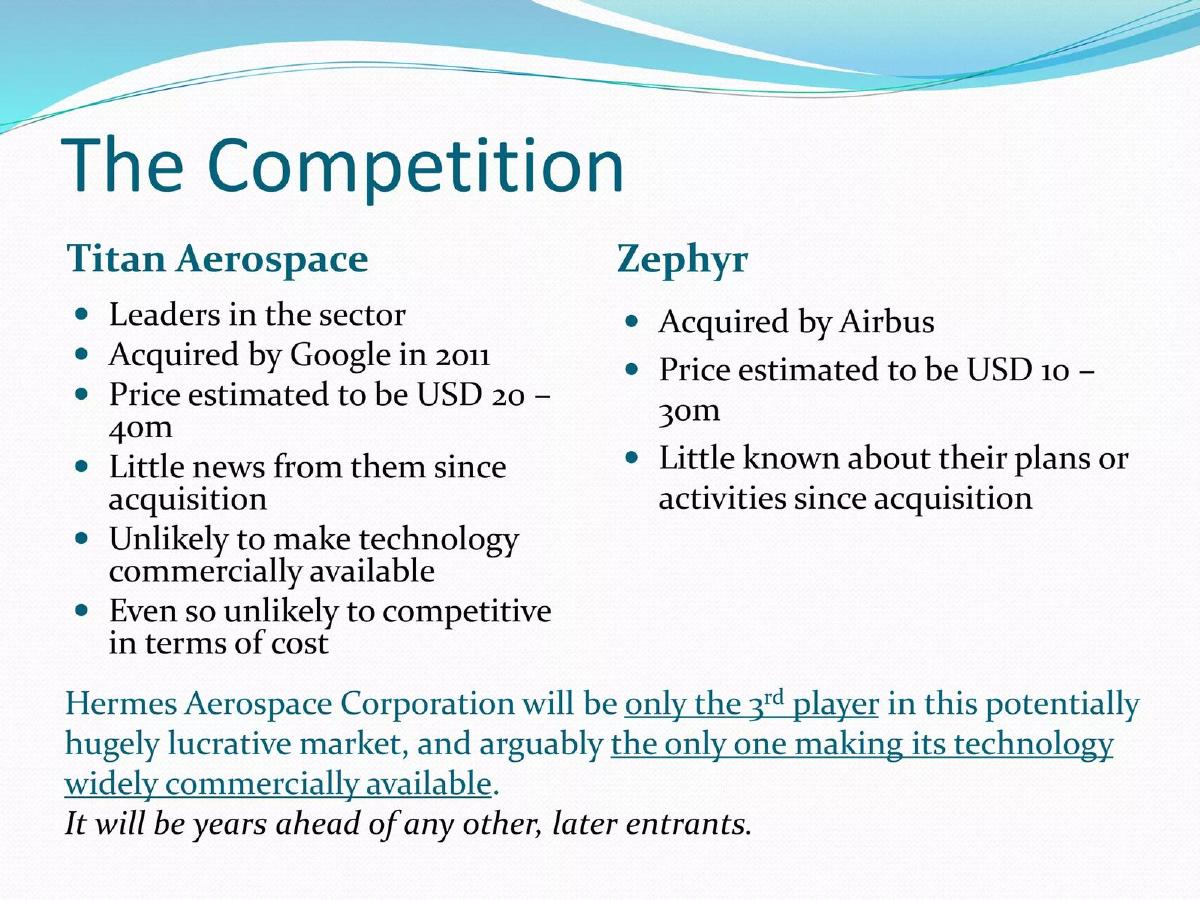
High-altitude unmanned aircraft (atmospheric satellite) project. Slide titled "The Competition".
Hermes Aerospace deck, slide 5. Exact stored slide matched to this analysis.
Our analysis: It names both rivals, who owns them and what they may cost, then states its own position: available to buy when the others may not be.
Evidence and limitation: No source for the price estimates, and Hermes' own price is not given. The acquisition year for Titan Aerospace is as stated on the slide; we have not checked it.
What a founder can adapt: Add your own expected price beside the rivals' estimates and cite where each estimate comes from.
Supporting analysis
What the deck claims: Titan Aerospace: "Leaders in the sector", "Acquired by Google in 2011", "Price estimated to be USD 20 – 40m", "Little news from them since acquisition", "Unlikely to make technology commercially available", "Even so unlikely to competitive in terms of cost". Zephyr: "Acquired by Airbus", "Price estimated to be USD 10 – 30m", "Little known about their plans or activities since acquisition". "Hermes Aerospace Corporation will be only the 3rd player in this potentially hugely lucrative market, and arguably the only one making its technology widely commercially available."
Presentation choice: When rivals belong to large companies, investors want to know whether they will sell to customers; the slide addresses that directly.
When it does not fit: "Years ahead of any other, later entrants" without saying what would stop them.
Early deck for the on-demand car service that became Uber. Slide titled "Key Differentiators". (weaker)
UberCab deck, slide 6. Exact stored slide matched to this analysis.
Our analysis: The differentiators are concrete features a rider would notice, but the reader has to guess what they are being compared with.
Evidence and limitation: No rival is named; "easier than calling" implies a phone-booked car or taxi. No response times or prices are compared.
What a founder can adapt: Put the alternative in a second column: taxi or black car, with typical wait and booking steps against yours.
Supporting analysis
What the deck claims: "Members Only – Respectable clientele", "1-click hailing – 'Pickup here in 5 mins'", "Fast Response time – easier than calling", "Luxury automobiles – Mercedes Sedans", "Great drivers – 'Rate your trip' feature", "High-tech solution: Geo-aware auto-dispatch", "Optimized fleet – Logistical LBS software".
Presentation choice: A famous outcome does not make this a complete competition slide; it shows that features alone leave the comparison to the reader.
When it does not fit: Differentiators with no named alternative.
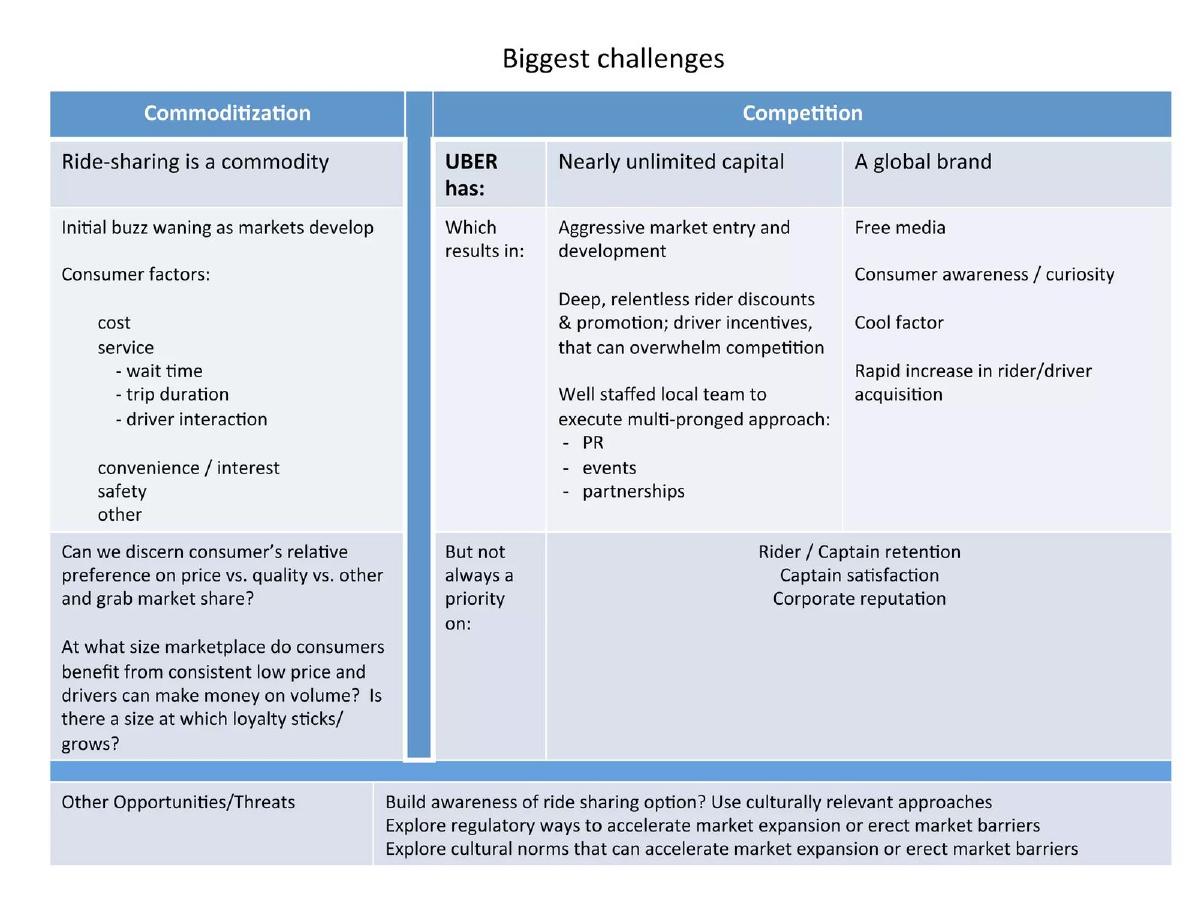
Ride-hailing company in the Middle East (early deck, before Uber acquired it). Slide titled "Biggest challenges".
Careem deck, slide 3. Exact stored slide matched to this analysis.
Our analysis: It treats the biggest rival honestly: it lists what Uber's money buys, then names three areas where Careem thinks Uber is weaker.
Evidence and limitation: Claimed; no figures. One rival named.
What a founder can adapt: Add one figure for each gap, such as monthly driver retention compared with a published Uber figure, with the date.
Supporting analysis
What the deck claims: Two columns. Commoditization: "Ride-sharing is a commodity", with consumer factors cost, service (wait time, trip duration, driver interaction), convenience and safety, and open questions such as "At what size marketplace do consumers benefit from consistent low price and drivers can make money on volume?" Competition: "UBER has: Nearly unlimited capital" and "A global brand", which result in "Deep, relentless rider discounts & promotion; driver incentives, that can overwhelm competition" and "Free media". "But not always a priority on: Rider / Captain retention, Captain satisfaction, Corporate reputation."
Presentation choice: Admitting that ride-sharing is a commodity and that Uber can outspend it makes the claimed gaps (driver retention and satisfaction) more believable, and it poses the questions investors would ask anyway.
When it does not fit: Leaving the open questions unanswered; say which one the round will answer.
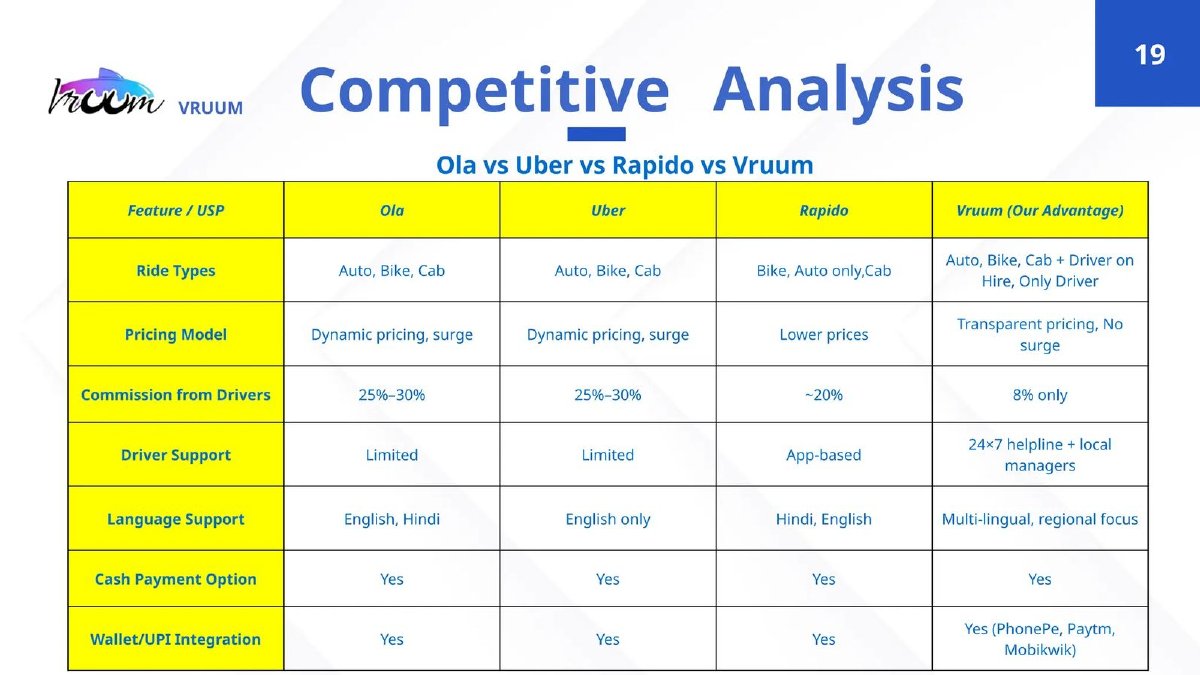
Planned ride-hailing app in India. Slide titled "Competitive Analysis: Ola vs Uber vs Rapido vs Vruum".
Vruum deck, slide 19. Exact stored slide matched to this analysis.
Our analysis: It compares on the number drivers care about most, and it keeps rows where everyone is equal, such as cash payment.
Evidence and limitation: Claimed. Rivals' commission rates are given without a source; Vruum's 8% is a plan.
What a founder can adapt: Cite where each rival's commission comes from and add a row showing how Vruum makes money at 8%.
Supporting analysis
What the deck claims: Rows: Ride Types, Pricing Model, Commission from Drivers, Driver Support, Language Support, Cash Payment Option, Wallet/UPI Integration. Commission: Ola "25%–30%", Uber "25%–30%", Rapido "~20%", Vruum "8% only". Pricing: Ola and Uber "Dynamic pricing, surge", Rapido "Lower prices", Vruum "Transparent pricing, No surge". Cash payment is "Yes" for all four.
Presentation choice: A commission rate is easy for investors to check against rivals, and showing tied rows makes the table look fair rather than selected.
When it does not fit: A low commission with no unit economics; investors will ask how the company pays for driver support and no-surge pricing.
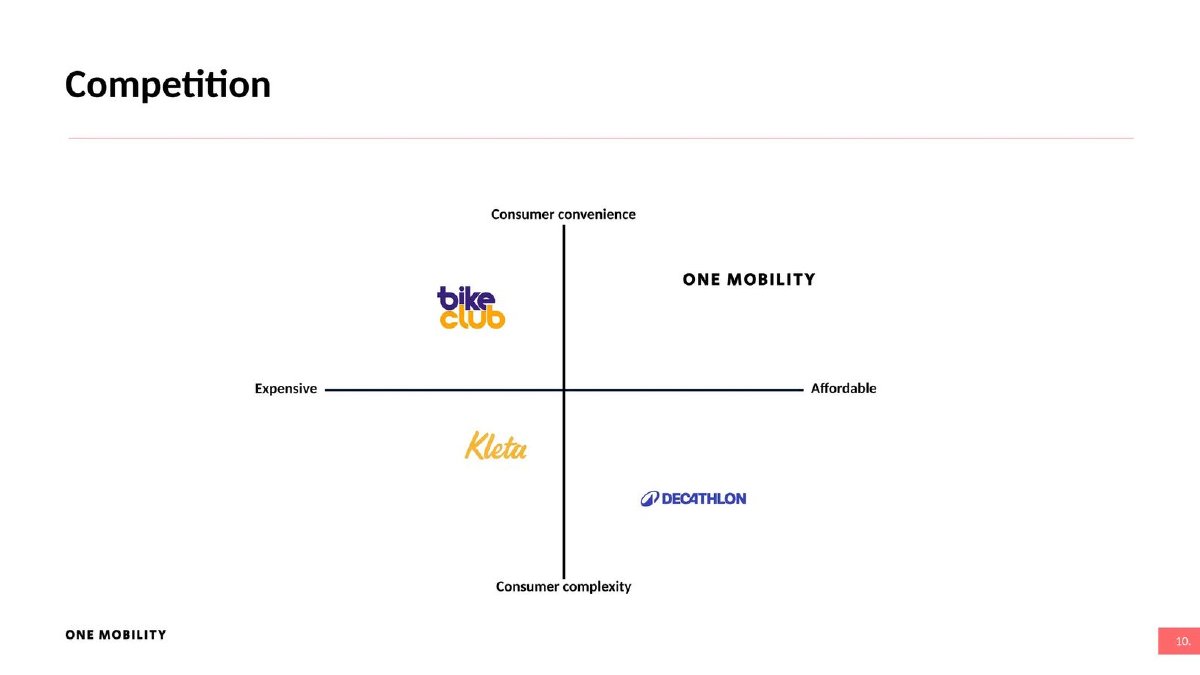
Kids' bike subscription platform. Slide titled "Competition" (numbered 10 on the slide; page 11 of the deck), shown as a two-axis map.
One Mobility deck, slide 11. Exact stored slide matched to this analysis.
Our analysis: It includes a big retailer (Decathlon), where most parents buy kids' bikes today, not only other subscription startups.
Evidence and limitation: Claimed; positions are the company's judgement, with no prices.
What a founder can adapt: Add a monthly cost per child for each option, including buying from Decathlon and reselling, so "affordable" has a number.
Supporting analysis
What the deck claims: Axes: Expensive to Affordable, and Consumer complexity to Consumer convenience. One Mobility sits alone in the affordable and convenient corner; Bike Club is convenient but expensive; Kleta is expensive and complex; Decathlon is affordable but complex.
Presentation choice: Including the obvious retail option shows the founders know the real alternative, but the empty corner is easy to draw and hard to check.
When it does not fit: A map with you alone in the best corner and no figures behind either axis.
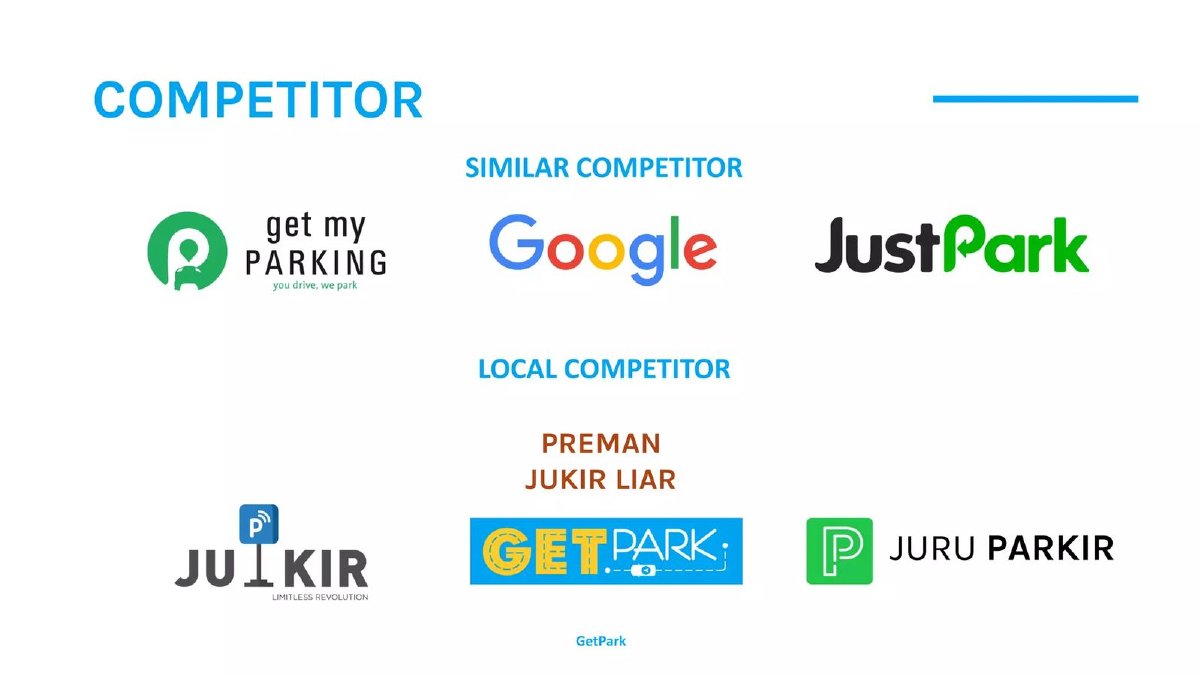
Parking app in Indonesia. Slide titled "Competitor".
GetPark deck, slide 18. Exact stored slide matched to this analysis.
Our analysis: It splits global and local rivals and counts informal street attendants as competition, which is what many drivers use.
Evidence and limitation: Names only; no comparison, prices or figures.
What a founder can adapt: Keep both rows and add one line per rival: what a driver pays, how they find a space, and what GetPark changes.
Supporting analysis
What the deck claims: "Similar Competitor": Get My Parking, Google, JustPark. "Local Competitor": Jukir, "Preman Jukir Liar" (informal street parking attendants) and Juru Parkir.
Presentation choice: Shown for contrast. Naming the informal option is a good instinct, but with logos only the reader cannot tell how GetPark is different from any of them.
When it does not fit: A logo wall; it shows who exists, not why a driver would switch.
Online private-aircraft charter booking. Slide titled "Advantage". (weaker)
Jetway deck, slide 5. Exact stored slide matched to this analysis.
Our analysis: It names the real alternative, the traditional broker, and the reason to switch, but gives no figure.
Evidence and limitation: "Significantly" is not quantified and no broker or booking platform is named.
What a founder can adapt: Show one route priced through a broker and through you, with the date and how you got the quote.
Supporting analysis
What the deck claims: "We employ leading-edge IT technologies to help our clients to find the aircraft which they need, not the one their broker wants." "Full automation allows us to cut costs significantly compared to traditional brokerage." "Maximizes airline efficiency with empty leg management and cargo services."
Presentation choice: Charter buyers compare price per flight; a cost claim without a number is hard to believe.
When it does not fit: "Leading-edge IT" as a differentiator; every rival says the same.
Scooter rental service in Morocco. Slide titled "Timing". (weakest)
Scoutr deck, slide 6. Exact stored slide matched to this analysis.
Our analysis: It turns competition into a timing argument, which raises the question of what happens when Lime or Bird arrive.
Evidence and limitation: Names Lime and Bird but only as absent; no local alternatives such as taxis or buses are mentioned.
What a founder can adapt: Name the local alternatives riders use today and say what you will have in place (permits, city deals, fleet) before large operators arrive.
Supporting analysis
What the deck claims: "NO COMPETITION. Morocco is a market free of competition by big corporations such as Lime and Bird, this is the best timing for our launch." "COVID 19 AND LOCKDOWN – People do not want to stay in crowded places anymore."
Presentation choice: Investors read "no competition" as "no one has checked yet" or "large rivals will come".
When it does not fit: "No competition" as a headline.
List the everyday alternatives: taxi, public transport, own car, broker.
Compare on measured axes, with the figure next to each rival.
Say who owns each rival; acquisitions change how they compete.
If switching costs are low, say so and explain what keeps customers.
"No competition" usually means a rival has not arrived yet.
Build your mobility competition slide
Start from how your rider or buyer gets there today.
Today's option. How does the customer travel or book today: taxi, bus, own car, broker?
Named rivals. Which operators or makers compete in your city or segment, and who owns them?
Measured gap. Which figure shows the difference: wait time, price per trip, range, power, cost per flight?
Switching. If switching is easy, what keeps customers with you?
Where you lose. Where does a rival beat you today (coverage, price, funding)?
Copyable framework: Riders today use [alternative] ([measured limit]); [named rival] offers [what]. We offer [measured difference], measured [how], [date]. We keep customers by [reason].
Illustrative example 1 — written by us
Before: Full automation allows us to cut costs significantly compared to traditional brokerage.
After: A London–Nice light-jet charter quoted by two brokers averaged €14,000 in May; our automated quote for the same flight was €11,500.
What improved: Our illustrative rewrite; the route and prices are invented for the example. It names the alternative, gives one comparable figure and says when it was measured.
What this guide adds
The general competition slide guide covers any business. Mobility adds two pressures: riders and fleet buyers can switch in seconds, and large, well-funded operators can enter a new city quickly. The strongest slides here either measure a difference that is hard to copy or admit the weakness and say how they will handle it.
Our library's mobility tag covers ride-hailing, micromobility, aviation and vehicle technology. We note each company's business in the examples. The mobility product, solution and market guides cover other slides from similar decks.
How we read each slide
We quote the text on the stored slide images. We have not checked any performance figure, price estimate, commission rate or market claim. Figures are labelled "claimed" when the slide gives no source.
Competing with a giant: what to put on the slide
Most mobility markets have one or two operators with far more money. Careem's early slide shows a useful pattern: name the giant, list exactly what its money buys (rider discounts, driver incentives, fast city launches, free press), then name what the giant does not prioritise, in Careem's words driver retention, driver satisfaction and corporate reputation.
Vruum takes a narrower route: one number investors can check, the commission taken from drivers, set against three named rivals. A single comparable figure like this does more than a page of feature ticks, as long as the founder can show it holds up as the company grows.
Maps are the third common format, used by One Mobility. They show a gap at a glance, but the founder chooses both axes, so investors usually ask for the figures behind each position: a monthly price, an average wait time or the number of steps to book. Without those, the empty corner is a claim rather than evidence, and a reader cannot tell whether a rival would land in the same place.
Questions investors ask about a mobility competition slide
What happens when the big operator cuts prices? A slide should say how the startup survives a discount war, not only that it is cheaper today.
Is the advantage lasting? A lower commission or price can be matched; investors look for something harder to copy, such as local permits, a network or lower costs.
Who decides where everyone sits on the map? Price and convenience positions need a source, such as rival price lists with a date.
Are informal options included? Street attendants, taxis and walking often take more customers than any app.
Common mistakes
Leaving out everyday alternatives. Taxis, buses and personal cars are the rivals most riders use.
Features with no comparison. Say what each feature is better than.
Unquantified cost claims. "Significantly cheaper" needs a price.
Weaknesses with no plan. Admitting low switching costs helps only if you say how you will keep customers.
Logo walls. GetPark names six rivals but gives no reason to switch.
"No competition". Name who will arrive and what you will have first.
Diagnostic checklist
Lists the everyday alternatives as well as named rivals.
Compares on at least one measured axis, with figures per rival.
Says who owns or funds the main rivals.
Explains what keeps customers if switching is easy.
Admits where a rival is ahead.
Says how you would survive a price war with the biggest operator.
Frequently asked questions
Should a ride-hailing or scooter startup list taxis and buses as competitors?
Yes; they are what most riders use today. Ober lists taxi, public transportation and personal cars as substitutes on its industry slide.
How should vehicle hardware startups compare with rivals?
On the specifications buyers compare, with a figure per rival. Recogni plots rival chips by performance and power, each labelled with TOPS and watts.
How should a ride-hailing startup compete with Uber on a slide?
Name what the big operator's money buys and where it is weaker. Careem lists Uber's capital and brand, then names driver retention and satisfaction as gaps; Vruum compares driver commission against Ola, Uber and Rapido.
Is it wise to admit an undifferentiated business model?
It builds trust, but only if you add how you will win. Ober admits low barriers and no switching cost but does not say how it will keep riders.
How we chose these examples
Update (2026-10-01): added Careem p3, Vruum p19, One Mobility p11 and GetPark p18 after searching the full slide corpus for competition wording near scooter, ride-hailing, parking, charging and mobility terms. Not used: Grivo p14–15 and Get A Drive p9 (used in other guides), Freewheel p6 (no rivals named), Blink Charging p20 (listed company), Rowan Companies (listed, offshore drilling), Anybotics p15 (robot mobility, not transport), and market or problem slides that mention competition in passing. Careem was privately held when this deck was made; Uber completed its $3.1 billion acquisition on 2 January 2020 (Uber press release, investor.uber.com).
Corpus: published pitch deck teardowns on StartupFundraising.com. Founder-uploaded private decks are excluded.
Selection (2026-09-27): we searched extracted slide text in decks tagged mobility for competition, competitors, comparison, compared, unlike, incumbent, differentiation and landscape. Most matches were market, problem or disclaimer slides, or listed-company decks.
Kept six with stored images. Excluded: slides already used in other guides (Acerta p5–6, Arrival p6, Get A Drive p6, Recogni p6), Acerta p9, Get A Drive p10, Recogni p9, Arrival p9, Drive-Ver p7 and DARTRAYS p7–8 (no stored image; no uploads requested), Ecomiles p3 (press headlines, not a comparison), and airline and listed-company investor decks.
The Recogni slide is marked "Company Confidential & Proprietary" but is part of a teardown already published on this site.
Review: stored slide text and images were checked on 2026-09-27 (first six) and 2026-10-01 (four added) and matched to company, deck and slide number (editorial model review). No person has yet completed an editorial review of this page. We make no claim that any slide caused a fundraising outcome.