The Ober pitch deck is a concise 8-slide presentation that positions the company as a global competitor in the transportation networking space. The deck relies heavily on macro market data from 2017, citing a total market value of $9.8 billion and a potential non-smartphone market of $9.2 billion. While it outlines a clear product hierarchy including OberX, Black, and Freight, the deck suffers from significant omissions typical of early-stage templates, such as a specific financial ask, detailed unit economics, or a roadmap for future expansion. The management team is presented with generic n…
Key takeaways
- The company claims to operate in major cities across over 23 countries as of the overview slide (Slide 2).
- The deck notes a historical name change from 'OberCab' and a founding date of 2016 (Slide 3).
- A previous funding round of $375 million is mentioned, alongside a post-investment valuation of over $4.1 billion (Slide 3).
- Macro market data from 2017 values the total market at $9.8 billion, with consumers making up 54.6% of the segment (Slide 4).
- The deck identifies a potential market without smartphones valued at $9.2 billion (Slide 5).
- Marketing strategy focuses on age ranges 18-25 and 25-35+ using social media, campus reps, Yelp, and Twitter (Slide 5).
- The industry analysis acknowledges 'no proprietary elements' and 'low initial capital' as threats of new entrants (Slide 6).
- The business model slide lists five service tiers: OberX, Taxi, Black, SUV, and LUX (Slide 8).
Executive Summary: The Template of a Disruptor
The Ober pitch deck is a brief, 8-slide presentation that serves as a high-level overview of a ridesharing platform. The deck is dated by its 2017 macro market data and uses names like 'Johny Doe' and 'James Wong,' which strongly suggests this is a template or a conceptual deck rather than a live pitch for an active startup. However, as a structural exercise, it follows a standard narrative arc: identifying a declining incumbent (taxis), showcasing a massive market opportunity, and detailing a tiered product offering.
Slide 1: Title Slide
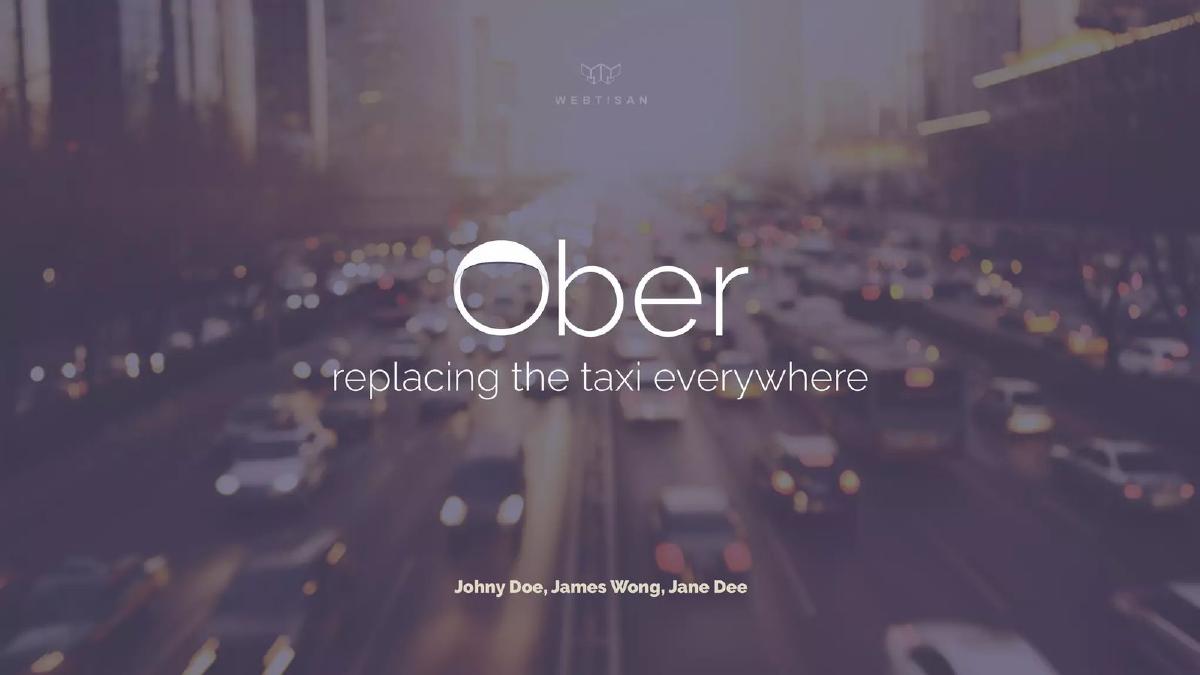
The deck opens with a clear, minimalist title slide. The company name 'Ober' is centered over a blurred city traffic background. The tagline 'replacing the taxi everywhere' immediately establishes the company's mission and target industry. The names Johny Doe, James Wong, and Jane Dee are listed at the bottom, though no titles are provided on this initial page. A small logo for 'WEBTISAN' appears at the top, likely the creator of the deck template.
Slide 2: Company Overview
Slide 2 defines the product as a 'Transportation Networking Mobile App' that 'connects users with drivers for hire.' It uses the slogan 'Everyone's Private Driver.' The slide claims the company operates in major cities in over 23 countries. A graphic of a smartphone on the right side shows a user profile for 'Jack Crane' and a line graph spanning 2010 to 2016, though the axes of the graph are not labeled with specific metrics, making the data visualization purely decorative.
Slide 3: Company History and Progress
This slide provides a timeline of the company's evolution. It states the company was founded as 'OberCab' by G. Wong and T. Doe in 2016. It notes a strategic shift from offering only luxury vehicles to launching 'OberX' to target the 'lower-market.' Financial milestones are highlighted: a $375M raise in August and a current valuation of over $4.1B. The slide also lists 'Oogle' and 'J.X.S.' as post-investors. A wireframe outline of a car occupies the bottom half of the slide.
Slide 4: Macro Market (2017) - Part 1
Slide 4 focuses on the decline of the traditional taxi industry to justify the need for Ober. It cites that taxi ridership fell 9-25% and that there were 15% fewer calls for taxis. The market is described as fragmented, with the top 5 taxi companies accounting for only 4% of the market. A donut chart segments the $9.8 billion total market into consumers (54.6%), corporations (29.6%), tourists (13.3%), and other (2.8%).
Slide 5: Macro Market (2017) - Part 2
The market analysis continues on Slide 5, focusing on smartphone penetration and geography. It claims the 'potential market without smartphones is $9.2 billion,' which is a confusing metric that likely refers to the total addressable market currently served by non-digital means. The slide lists the product line: Ober, OberX, Ober Black, and Ober Freight. A map of the United States shows 'business locations' with a color-coded legend for 'establishments,' ranging from 'less than 3%' to '20% or more,' though it does not specify what these percentages represent (e.g., market share or driver density).
Slide 6: Industry Analysis
This slide uses a structured list to perform a macro industry analysis. It breaks down the business environment into five categories: threat of new entrants, supplier power, buyer power, threat of substitutes, and competitive rivalry. Notable admissions include that there are 'no proprietary elements' and 'no switching cost' for users. It also states the company is 'currently filing for software patents' and acknowledges an 'undifferentiated business model,' suggesting that competitive advantage relies on 'more funding' and 'access to resources.'
Slide 7: Management Team
The management team slide features three individuals: Johny Doe (co-founder), James Wong (co-founder and C.E.O.), and Jane Dee (VP of Operations). Each is accompanied by a headshot. The slide lacks any biographical information, past professional successes, or educational background, which are standard requirements for a professional pitch deck to establish founder-market fit.
Slide 8: Business Model
The final slide outlines the revenue and service structure. It lists the service tiers: OberX, Taxi, Black, SUV, and LUX. It mentions a 'pricing model and surge pricing' as a core component of the business. The slide also hints at future growth through a 'possible on-demand service' and 'continuous improvements.' Three icons at the bottom represent a driver, a mobile app interface, and a passenger, reinforcing the three-sided nature of the marketplace.
What Ober Does Well
The deck is visually consistent and uses a clean, professional color palette. It successfully identifies a clear 'enemy'—the declining taxi industry—which is a classic storytelling technique in fundraising. By citing specific percentage drops in taxi ridership (Slide 4), the founders create a sense of urgency and an obvious market gap. The tiered product strategy (Slide 8) also shows an understanding of market segmentation, moving from high-end luxury to mass-market affordability.
What is Missing from the Deck
The most glaring omission is 'The Ask.' There is no mention of how much money is being raised in the current round, the valuation being sought, or the specific milestones the company intends to reach with the new capital. Furthermore, the deck lacks unit economics. In a low-margin, high-volume business like ridesharing, investors need to see the take-rate, customer acquisition cost (CAC), and lifetime value (LTV). The 'Management Team' slide is also insufficient, as it provides no evidence that these individuals have the expertise to manage a $4.1 billion entity. Finally, there is no mention of the regulatory or legal hurdles that are synonymous with this specific industry.
Founder Takeaways
Founders should look at Slide 6 (Industry Analysis) as a good example of intellectual honesty. Acknowledging that your business has 'no switching costs' or 'no proprietary elements' shows a level of realism that can build trust with investors, provided you follow it up with a strong plan for how to build a moat (such as network effects or scale). However, founders should avoid the vagueness found on Slide 5; maps and charts must have clearly defined legends and units of measurement to be useful. Always include a clear 'Ask' slide to ensure the meeting ends with a concrete call to action.
Frequently asked questions
- What is the primary value proposition of Ober?
- According to Slide 1 and Slide 2, Ober positions itself as 'everyone's private driver' with the goal of 'replacing the taxi everywhere.' It functions as a transportation networking mobile app that connects users directly with drivers for hire, aiming to disrupt the traditional taxi industry which the deck claims saw a ridership fall of 9-25% in 2017.
- Who are the investors mentioned in the deck?
- Slide 3 lists two specific investors: 'Oogle' and 'J.X.S.' These names appear to be pseudonyms or slight variations of well-known venture entities, which is common in template-based decks. The slide claims these investors participated in a round that brought the company to a valuation of over $4.1 billion.
- How does Ober plan to acquire customers?
- Slide 5 outlines a multi-channel marketing approach targeting two primary age demographics: 18-25 and 25-35+. The strategy includes the use of social media, campus representatives, Yelp, and Twitter. This suggests a heavy reliance on digital presence and grassroots collegiate marketing to drive app adoption.
- What are the identified risks in the industry analysis?
- Slide 6 provides a Porter’s Five Forces style analysis. It identifies high 'buyer power' due to price sensitivity and no switching costs. It also notes a high 'threat of new entrants' because the business model has no proprietary elements and requires low initial capital. Interestingly, it admits the business model is currently 'undifferentiated.'
- Is there a clear financial request for investors?
- No. The deck completely omits a 'The Ask' slide. While it mentions a past raise of $375 million on Slide 3, it does not state how much capital the company is currently seeking, the terms of a new round, or how the management team intends to allocate new capital.