Nyra Health’s pitch deck is a masterclass in medical minimalism. Raising $4.9M in a 2024 Seed round, the European healthcare startup focused on the 'digital neuro-clinic' value proposition. The deck relies heavily on product visuals and regulatory milestones rather than dense text. By highlighting its CE Class I certification and ongoing clinical trials in two hospitals, the company de-risked the investment for healthcare VCs. However, the deck is notably silent on traditional business metrics; there is no mention of revenue, customer acquisition costs, or a specific financial 'ask.' It funct…
Key takeaways
- The company positions itself as 'The digital neuro-clinic,' a broad category play for neurological disorders (Slide 1).
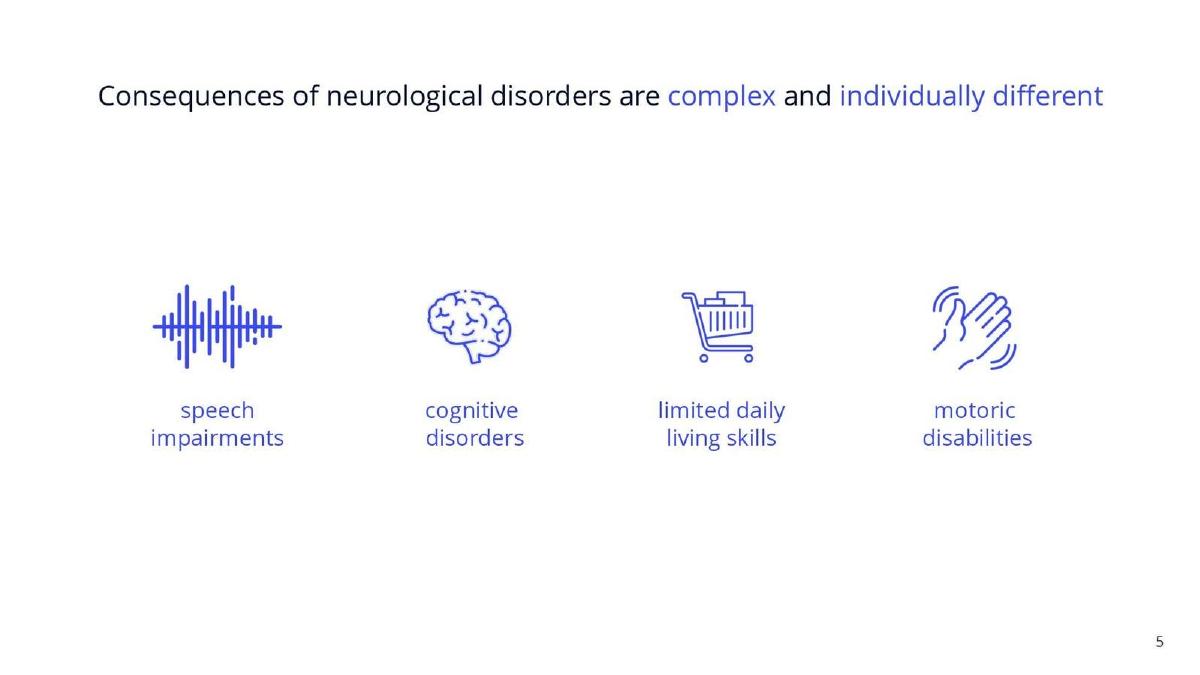
- The deck identifies four specific clinical focus areas: speech impairments, cognitive disorders, limited daily living skills, and motoric disabilities (Slide 5).
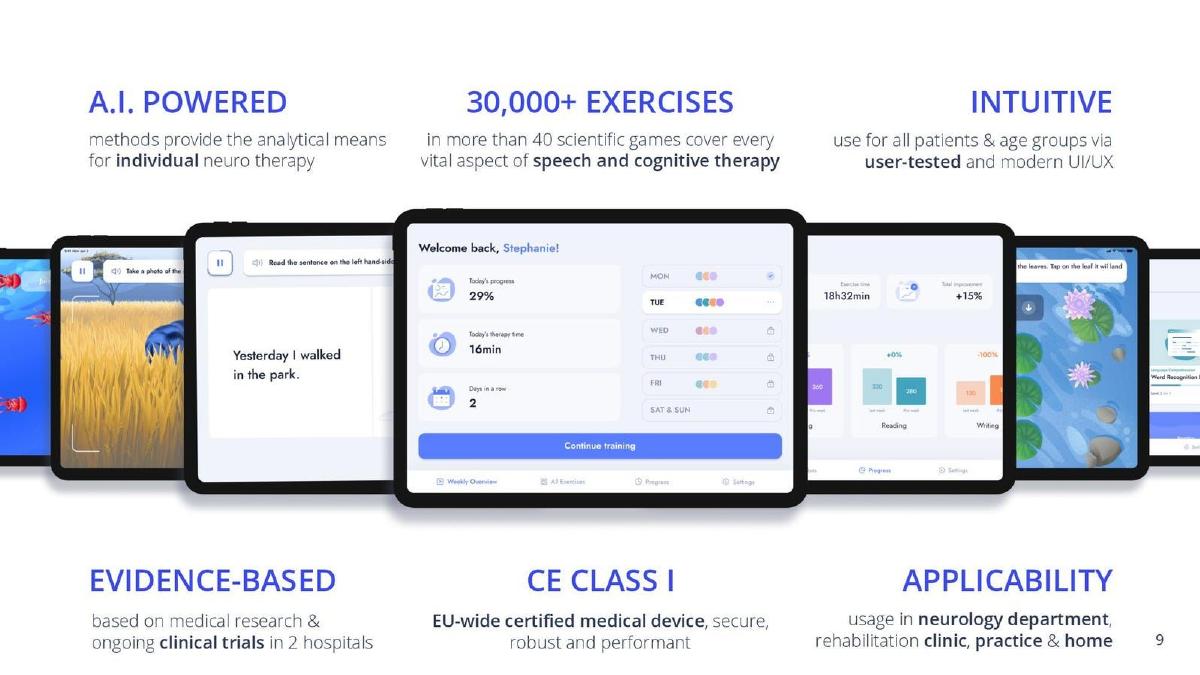
- Product depth is quantified at 30,000+ exercises across more than 40 scientific games (Slide 9).
- Regulatory compliance is a core pillar, prominently featuring CE Class I certification and ISO 27001/13485 standards (Slides 1 and 9).
- Clinical validation is established through ongoing trials at two separate hospitals (Slide 9).
- The platform is designed for cross-setting applicability, spanning neurology departments, rehab clinics, and home use (Slide 9).
- The deck completely omits a team slide, providing no information on the founders' backgrounds or medical expertise.
- There is no financial data, business model explanation, or specific funding request included in these slides.
Introduction
Nyra Health, a European healthcare startup, successfully raised $4.9M in a 2024 Seed round. Their pitch deck, consisting of 11 slides, is a study in clinical minimalism. In an industry often bogged down by dense white papers and complex biological explanations, Nyra Health opts for a highly visual approach that emphasizes product readiness and regulatory compliance. The following teardown examines how they structured their narrative to secure significant seed-stage funding.
Slide 1: Title and Compliance
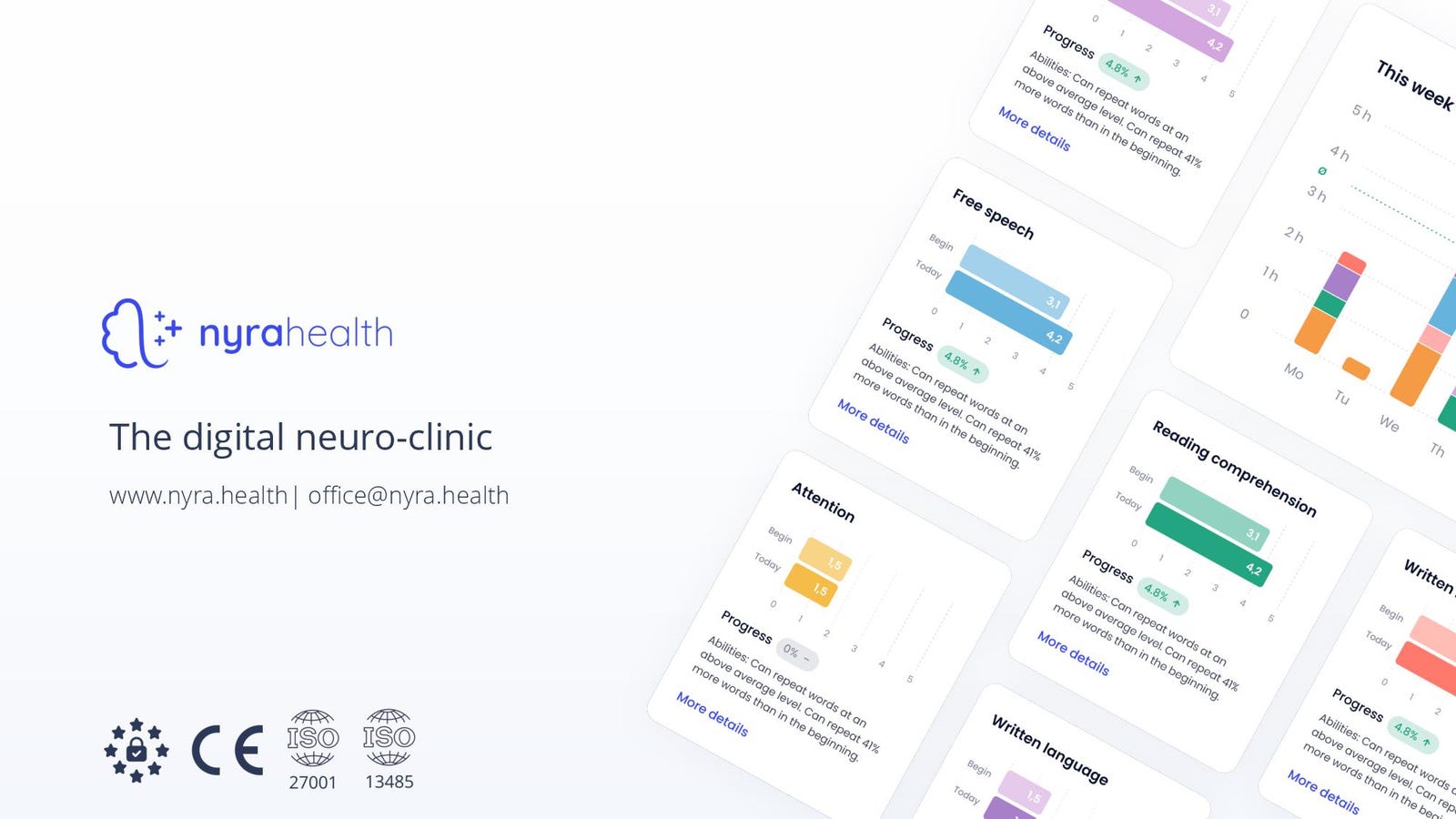
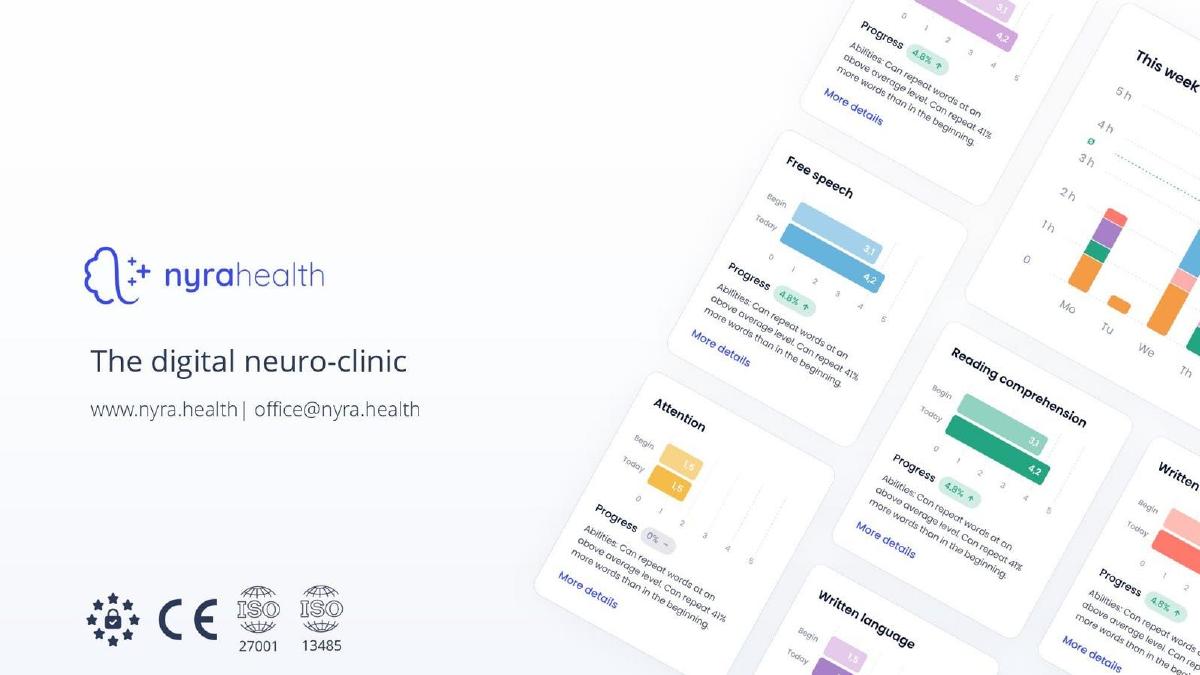
The opening slide introduces the brand and its core value proposition: "The digital neuro-clinic." This phrasing is strategic; it suggests a comprehensive solution rather than a single-feature app. Below the title, the company lists its website and a general office email address. Crucially, the bottom of the slide features four logos: the CE mark, the EU flag with a lock icon, ISO 27001, and ISO 13485. For a healthcare investor, these are the most important elements on the page. They signal that the company has already cleared the significant hurdles of data security and medical device quality management systems. The right side of the slide features a collage of mobile app screens showing progress charts for "Free speech," "Attention," and "Reading comprehension," all citing a "4.8%" progress metric and repeating the phrase "Can repeat 41% more words than in the beginning."
Slides 2-4: The Problem Framework
Slides 2, 3, and 4 serve as a minimalist transition into the problem statement. Slide 2 simply reads "The problem" in blue text against a white background. Slide 3 is blank in the provided sequence, acting as a visual breather. Slide 4 is not explicitly detailed in the text but follows the same minimalist pattern. This pacing suggests a presentation intended to be delivered live, where the speaker provides the context while the slides remain uncluttered.
Slide 5: Defining the Clinical Scope
Slide 5 breaks down the "Consequences of neurological disorders" into four distinct categories, each accompanied by a simple blue icon: speech impairments , cognitive disorders , limited daily living skills , and motoric disabilities . The headline notes that these consequences are "complex and individually different." This slide establishes the breadth of the market Nyra is addressing. By including motoric disabilities alongside speech and cognition, they position themselves as a holistic rehabilitation tool rather than a niche speech-therapy app.
Slides 6-8: The Solution Transition
Similar to the problem section, Slides 6, 7, and 8 manage the transition to the solution. Slide 6 contains only the words "The solution." Slides 7 and 8 are minimalist placeholders. This structure forces the audience to focus on the "What" (the problem) before moving to the "How" (the product). In a digital-first pitch, this can be risky if the deck is sent as a standalone PDF, as it requires the reader to click through multiple pages to find substantive information.
Slide 9: The Product Deep-Dive
Slide 9 is the most information-dense slide in the deck and serves as the core of the pitch. It features a central tablet showing a "Welcome back, Stephanie!" dashboard, surrounded by six key value pillars:
A.I. POWERED: Claims to provide analytical means for individual neuro therapy. · 30,000+ EXERCISES: Quantifies the depth of the content library, mentioning 40+ scientific games. · INTUITIVE: Highlights user-tested UI/UX for all age groups. · EVIDENCE-BASED: Mentions medical research and ongoing clinical trials in 2 hospitals. · CE CLASS I: Reiterates the EU-wide certified medical device status. · APPLICABILITY: Lists the settings where the tool is used, from neurology departments to the home.
This slide effectively addresses the three main risks of a health-tech startup: Product Risk (it is built and has 30,000 exercises), Clinical Risk (it is evidence-based and in trials), and Regulatory Risk (it is CE Class I certified).
Slides 10-11: Closing and Contact
Slide 10 is a blank transition, and Slide 11 is a duplicate of the branding on the title slide, providing the website and email address once more. There is no "Ask" slide, no roadmap, and no team slide included in this sequence.
What Works in This Deck
Regulatory Front-Loading: By placing ISO and CE certifications on the very first slide, Nyra Health immediately qualifies itself as a serious healthcare contender. In the European market, the transition from a wellness app to a regulated medical device (DiGA/DiPA pathways) is the primary value inflection point. Nyra makes it clear they have already crossed that line.
Quantified Product Depth: The mention of "30,000+ exercises" on Slide 9 is a powerful metric. It suggests a level of content moat that would be difficult for a new competitor to replicate quickly. It also implies that the AI has a vast dataset to work with when personalizing therapy for individual users.
Visual Clarity: The deck is exceptionally clean. It avoids the "wall of text" trap that many scientific founders fall into. The use of actual product mockups (Slide 1 and Slide 9) gives investors a clear sense of the user experience, which is vital for a tool intended for patients who may have cognitive or motor impairments.
What Is Missing from the Deck
The Team: This is a glaring omission. In a Seed round, investors are primarily betting on the founders. There is no information regarding the medical expertise, technical background, or previous successes of the leadership team. Without this, an investor cannot judge if the team has the clinical authority to run trials or the technical skill to build the AI mentioned on Slide 9.
Business Model and Traction: The deck explains what the product is, but not how it makes money. Is it a SaaS model for clinics? A prescription-based model reimbursed by insurance? A direct-to-consumer subscription? Furthermore, there are no growth metrics. While they mention trials in two hospitals, they do not disclose how many active patients they have or what their retention rates look like.
Market Size and Competition: There is no mention of the Total Addressable Market (TAM). Neurological rehabilitation is a massive field, but the deck fails to quantify the financial opportunity. It also fails to acknowledge competitors in the digital therapeutics (DTx) space, which is increasingly crowded.
The Ask: A pitch deck is a fundraising tool, yet this deck does not state how much money is being raised or what the milestones for the next 18-24 months will be. While this information might be reserved for a separate document or a verbal pitch, its absence makes the deck feel incomplete as a standalone fundraising asset.
Founder Takeaways
Use regulatory milestones as trust signals. If you have ISO certifications or medical device clearances, do not hide them in the appendix. Nyra Health’s decision to put them on Slide 1 is a strong move for any regulated industry.
Balance minimalism with information. While the clean design is admirable, the high number of transition slides (Slides 2, 4, 6, 7, 8, 10) may be excessive for a deck sent via email. Founders should ensure that every slide provides new value to a reader who might be skimming the deck in under two minutes.
Show, don't just tell, the product. The dashboard view on Slide 9, showing "Today's progress 29%" and "Today's therapy time 16min," makes the abstract concept of a "digital neuro-clinic" feel like a tangible, ready-to-use product. High-fidelity mockups are essential for software-based medical solutions.
Don't forget the 'Who' and the 'How much.' Even if a deck is intended to be a visual aid for a speech, it should always include a team slide and a clear statement of intent regarding the funding round. Investors need to know who is driving the bus and where the gas money is going.
Frequently asked questions
- What is the primary product offered by Nyra Health?
- Nyra Health offers a digital neuro-therapy platform that provides personalized exercises for patients with neurological conditions. According to Slide 9, the platform includes over 30,000 exercises and 40 scientific games covering speech and cognitive therapy. It is designed to be used in professional clinical settings as well as for at-home telerehabilitation.
- How does Nyra Health validate its medical claims?
- The company relies on three pillars of validation shown on Slide 9: it is an EU-wide certified medical device (CE Class I), it is built on medical research, and it is currently undergoing clinical trials in two hospitals. They also display ISO 27001 and ISO 13485 certifications on the title slide to signal data security and quality management compliance.
- Who is the target user for this platform?
- The deck specifies that the platform is 'intuitive' for all patients and age groups. Slide 9 notes its 'applicability' across neurology departments, rehabilitation clinics, private practices, and the patient's home. This suggests a B2B2C model where clinicians prescribe or oversee the use of the app by patients.
- What business metrics are included in the pitch?
- The deck is almost entirely devoid of traditional business metrics. There is no mention of user growth, revenue, churn, or market size (TAM/SAM/SOM). The only quantitative metrics provided relate to the product itself (30,000+ exercises) and the progress tracking within the app UI (e.g., '4.8% progress' or '18h32min exercise time').
- Is there a clear 'Ask' or use of funds slide?
- No. The 11-slide deck concludes with a contact slide (Slide 11) without specifying how much capital is being raised or how it will be allocated. While publisher reports indicate a $4.9M Seed round was raised, the deck itself functions as a teaser or vision document rather than a full financial proposal.