Next Group Holdings (NXGH) utilized this January 2017 deck to pitch its position as a diversified holding company focused on the unbanked and underserved markets. At the time of the deck, the company was traded on the OTCQB with a market cap of $4.5M. The strategy relied heavily on a 'roll-up' model, highlighted by the acquisition of Tel3, which added $3.1M in annual revenue. The deck outlines three distinct product lines: Next Mobile 360 (an MVNO leveraging Sprint), Next CALA (a mobile banking and rewards solution), and NXT GN (a telepresence platform). While the deck provides granular finan…
Key takeaways
- The company reported a market capitalization of $4.5M as of December 16, 2016, with 246.9M shares outstanding (Slide 4).
- A recent acquisition of Tel3 added $3.1M in annual revenue, contributing to a total monthly revenue of $250,000 for the group (Slide 4).
- The business model is built on three pillars: a prepaid MVNO (Next Mobile 360), a mobile banking solution (Next CALA), and a telepresence platform (NXT GN) (Slide 7).
- Strategic partnerships are central to the operations, including branding by CP+B and licensing/distribution through InComm's 210,000 locations (Slide 10).
- Financial projections for the Next CALA product assume a starting point of 50,000 accounts opened in month one of 2017 (Slide 13).
- The company maintains a high level of inside ownership at 67.7%, with Arik Maimon holding 29.46% of shares (Slides 4 and 16).
- The management team and board include individuals with significant retail and tech backgrounds, such as Les Paul, a former CEO of Montgomery Ward (Slide 22).
- The deck identifies $1.2M in debt via convertible debentures, with plans to retire $0.7M of those notes (Slide 4).
Executive Summary: The Diversified Holding Company Model
The NXGH investor deck from January 2017 presents Next Group Holdings as a multifaceted entity operating at the intersection of telecommunications and financial technology. The deck is structured for a public market audience, specifically those trading on the OTCQB. It emphasizes revenue growth through acquisition and the deployment of a 'ecosystem' of products targeting the unbanked and international caller demographics. While the deck is data-heavy regarding share structure and partnerships, it lacks a traditional 'problem/solution' narrative found in early-stage venture decks, focusing instead on the mechanics of its existing and projected revenue streams.
Slide 1: Title and Market Identity
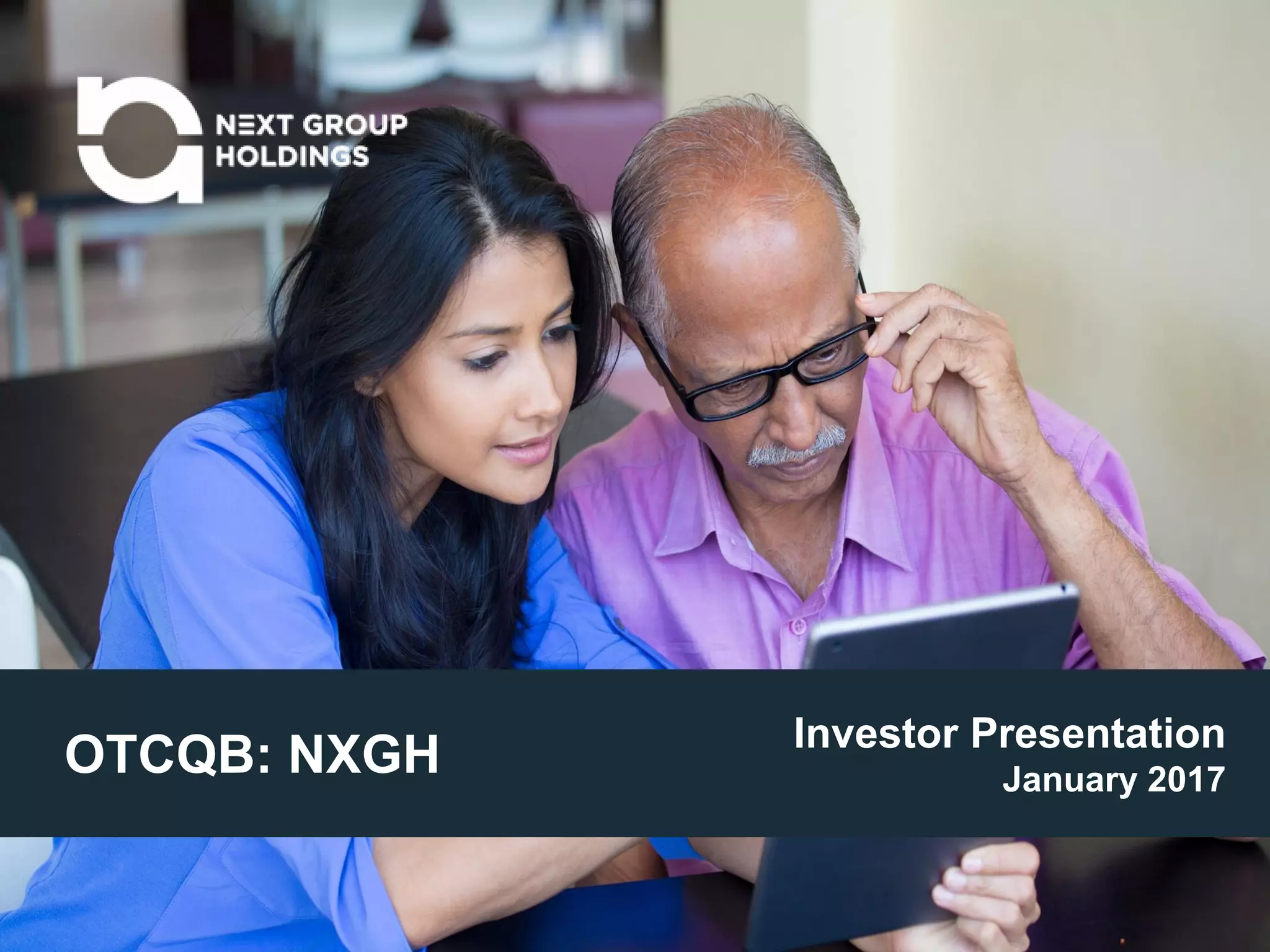
The cover slide establishes the company's identity as a publicly traded entity under the ticker OTCQB: NXGH . The imagery—a younger woman assisting an older man with a tablet—suggests a focus on accessibility and perhaps a multi-generational or immigrant demographic, which aligns with their international calling and prepaid banking products. The date, January 2017, sets the context for the financial projections that follow.
Slide 4: Key Facts and Capital Structure
This is one of the most critical slides for an OTC investor. It provides a snapshot of the company's health and scale. Key metrics include:
Acquisition Impact: The Tel3 acquisition is the headline, adding $3.1M in annual revenue. · Current Revenue: Stated at $250,000 monthly between Tel3 and M&M. · Operations: Based in Miami with 7 contractors, indicating a lean corporate overhead. · Debt: $1,200,000 in convertible debentures, with a note that they are retiring $0.7M. This is a vital disclosure for penny stock investors wary of dilution. · Market Cap: $4.5M as of December 16, 2016. · Ownership: 67.7% inside ownership, which suggests management's interests are aligned with shareholders.
Slide 7: Product & Service Offering
NXGH outlines three distinct business lines: Next | Mobile 360: A prepaid MVNO (Mobile Virtual Network Operator) using Sprint’s network. It focuses on international calling and claims 'above-average profits.' Next | CALA: Described as the 'Flagship product,' this is a mobile banking and Visa debit card solution. It is positioned as a cash alternative and includes a rewards program. NXT | GN: A telepresence platform developed in 2012. This product feels somewhat disconnected from the telecom/fintech focus of the other two, representing a legacy software play.
Slide 10: Strategic Partnerships
To establish credibility, NXGH lists several 'blue-chip' partners. The inclusion of Crispin Porter + Bogusky (CP+B) is notable; the deck claims CP+B is a 4% stakeholder and responsible for branding. The partnership with InComm is arguably the most important for their business model, as it provides the necessary Money Transmitter Licenses (MTL) and a massive distribution network of 210,000 locations. The slide also mentions The Bancorp Bank as the card issuer, which is a standard but necessary component for any prepaid card program.
Slide 13: Revenue and Growth Model
This slide presents a detailed spreadsheet of projections from 2017 through 2021. For the Next CALA product, they project starting with 50,000 accounts in month one. The model breaks down unit economics:
New account fee: $3.95 · Monthly maintenance fee: $3.95 · Card reload fee: $1.00 · Cost to manufacture card: $1.45 · Support cost per account: $0.75
The 'Revenue - Others' section shows Tel3 starting at $200,000 monthly with a 75% carrier cost, indicating a 25% gross margin on their telecom services.
Slide 16: Stock Ownership
Transparency regarding the cap table is provided here. Arik Maimon (29.46%) and Huseyin Kizanliki (20.39%) are the primary holders. The presence of 'CEDE&CO' at 17.90% represents the aggregate of shares held in 'street name' by brokers for retail and institutional clients. The asterisk indicates that management shares are restricted, a common tactic to reassure investors that the founders won't immediately dump shares on the open market.
Slides 19 & 22: Management and Board
The deck highlights two specific board members to build trust: Adiv Baruch (Slide 19): His bio emphasizes his role with Jerusalem Technology Investments and his experience with NASDAQ-traded companies like BOS. Les Paul (Slide 22): His bio is extensive, focusing on his 22-year tenure at Macy's (eventually becoming CEO of Macy's Midwest) and his role as CEO of Montgomery Ward. This retail pedigree is intended to validate the company's strategy in the consumer prepaid space.
Slide 25: Contact Information
The final slide provides the corporate address in Miami and directs investor inquiries to RedChip Companies, an investor relations firm specializing in micro-cap and small-cap stocks. This reinforces the deck's purpose as a tool for public market engagement rather than a private VC pitch.
What NXGH Does Well
The deck is exceptionally transparent regarding its capital structure and unit economics. For a micro-cap company, providing a clear breakdown of shares outstanding, float, and inside ownership is essential for building investor confidence. The inclusion of specific fees and costs for their flagship product (Slide 13) allows potential investors to model the business themselves. Furthermore, the emphasis on established partners like InComm and The Bancorp Bank mitigates the 'startup risk' by showing that the underlying infrastructure is handled by multi-billion dollar entities.
What is Missing from the Deck
The most glaring omission is a cohesive 'Problem' slide. While the products target the unbanked and international callers, the deck never explicitly defines the pain points these users face or why NXGH’s solution is superior to incumbents like Western Union or Netspend. Additionally, there is no competitive analysis. The prepaid card and MVNO markets were highly saturated in 2017, yet the deck acts as if NXGH is operating in a vacuum. Finally, the 'NXT GN' telepresence product is never explained in the context of the broader business; it feels like a legacy asset that distracts from the fintech narrative.
Founder Takeaways: Lessons from the NXGH Deck
1. Detail your unit economics: If you are in a high-volume, low-margin business like prepaid cards, follow NXGH's lead on Slide 13. Showing exactly how much you make per transaction versus your costs (manufacturing, support, rewards) is the best way to prove the viability of your model. 2. Leverage 'Borrowed Credibility': If your startup relies on larger platforms, highlight them. NXGH effectively uses the logos of Sprint, InComm, and Visa to show that they have the 'plumbing' required to scale. 3. Be clear about debt: For companies with existing liabilities, being upfront about convertible notes and the plan to retire them (as seen on Slide 4) is better than letting an investor find them in the fine print later. It shows proactive financial management.
Frequently asked questions
- What is the primary revenue driver for NXGH according to the deck?
- The primary revenue driver at the time of the presentation was the acquisition of Tel3, a prepaid international calling card service, which added $3.1M in annual revenue. Additionally, the deck highlights the Next CALA mobile banking product as a 'flagship' offering, projecting significant growth in account fees, maintenance fees, and reload fees starting in 2017.
- How does NXGH handle its banking and payment infrastructure?
- NXGH does not operate as a bank itself. Instead, it leverages strategic partnerships. Slide 10 notes that InComm provides the Money Transmitter Licenses (MTL) in all 50 states and facilitates 'Cash-To-Plastic' transactions at 210,000 locations. The Bancorp Bank is specifically named as the issuer for the Visa Prepaid Cards used in the Next CALA program.
- What is the 'NXT GN' product mentioned in the deck?
- NXT GN is described on Slide 7 as a high-definition telepresence platform for mobile phones. It was developed in 2012 and offers point-to-multipoint connectivity. It is available on both Android and iOS. Unlike the other fintech and telecom products, this appears to be a legacy software asset rather than a primary retail service.
- What is the ownership structure of the company?
- The company has a high concentration of inside ownership at 67.7%. The largest individual shareholder is Arik Maimon with 29.46%, followed by Huseyin Kizanliki at 20.39%. A significant portion of the shares (17.90%) is held by CEDE & CO, which typically represents shares held in brokerage accounts for various investors (Slide 16).
- What are the projected unit economics for the Next CALA card?
- According to Slide 13, the company charges a $3.95 new account fee and a $3.95 monthly maintenance fee. The cost to manufacture the card is $1.45, and customer support is estimated at $0.75 per account. They also earn a $1.00 fee per reload, though they offset some costs with rewards program expenses ($1.00 for opening, $0.50 for reloads).
What the Next Group Holdings, Inc. (NXGH) pitch deck was used for
This is a January 2017 investor presentation for Next Group Holdings, Inc. (OTCQB: NXGH), a Miami‑based fintech and telecom holding company focused on mobile banking and prepaid telecom services for underserved, primarily Latino, consumers in the U.S.. The deck was used while NXGH was already publicly traded on the OTCQB and sought to raise $3 million in new investment capital, primarily via a bridge/convertible structure, to support its prepaid card and mobile banking initiatives. At the time, the company derived revenue from prepaid and wholesale calling minutes and had begun partnering with InComm and other parties to distribute general purpose reloadable cards and related financial products to unbanked markets. Subsequent press releases and filings in 2017 highlight parallel efforts to restructure assets (such as selling back AIM) and pursue telecom acquisitions like Limecom, indicating the deck sat within a broader acquisition‑driven growth strategy.
Business model: Holding company investing in financial technology, providing prepaid and wholesale calling minutes and, via partners, general purpose reloadable debit cards targeted at underserved and unbanked markets, particularly Latino consumers in the U.S.
- Round
- Public OTCQB raise / bridge financing
- Year
- 2017
- Headquarters
- Miami, Florida, USA
Raising: The January 2017 investor presentation states that NXGH was seeking $3,000,000 in investment capital, with a specified use of proceeds including repayment of $1,100,000 to convertible note holders, $500,000 for initial card inventory, $500,000 for advertising/launch costs, and $900,000 for working capital. Subsequent disclosures reference additional financing efforts such as bridge loans and capit
Industry: Fintech and telecommunications, focusing on mobile banking, prepaid debit/credit, and telecommunications services to underbanked and underserved communities
Use of funds as presented: Repay convertible note holders ($1.1 million), fund initial prepaid card inventory ($0.5 million), cover advertising and product launch costs ($0.5 million), and provide working capital ($0.9 million) as outlined in the January 2017 investor presentation.
Next Group Holdings, Inc. (NXGH) pitch deck: common questions
What does Next Group Holdings (NXGH) do?
Next Group Holdings (NXGH) is a Miami‑based holding company that invests in financial technology and telecom businesses providing prepaid calling, mobile banking, and general purpose reloadable debit card solutions to unbanked and underserved markets, with a particular focus on Latino consumers in the U.S..
What was the purpose of Next Group Holdings’ January 2017 investor deck?
NXGH’s January 2017 investor deck was used while the company was listed on the OTCQB market under the ticker NXGH and raising $3 million in investment capital to fund card inventory, advertising/launch costs, working capital, and repayment of existing convertible notes.
How much capital was NXGH seeking in this deck and how did they plan to use it?
According to the January 2017 investor presentation, NXGH was seeking $3,000,000 in investment capital, with stated uses of proceeds including approximately $1.1 million to repay convertible note holders, $0.5 million for initial prepaid card inventory, $0.5 million for advertising and launch costs, and $0.9 million for working capital.
What were NXGH’s main revenue streams and partnerships around 2017?
NXGH reported that its revenues at the time came primarily from sales of prepaid and wholesale calling minutes, and it had an agreement with InComm, a major prepaid processor, to market and distribute general purpose reloadable debit cards targeting the Latin American and broader underserved market. Additionally, it pursued telecom acquisitions such as Limecom and distribution entities like SDI Next to expand its telecom and prepaid footprint.
What happened with NXGH after this 2017 deck—did it become profitable or complete major deals?
In 2017 NXGH remained unprofitable and relied on external financing; its 2017 annual report states that as of December 31, 2017 the company had a working capital deficit exceeding $7 million and an accumulated deficit over $14 million. The company later entered into a 2018 letter of intent with Cima Group to acquire fintech platforms valued at $21 million in exchange for a 25% equity stake, based on a $50 million valuation of NXGH, illustrating its strategy of using equity and partnerships rather than large cash rounds to access technology.
What each slide of the Next Group Holdings (NXGH) pitch deck says
Slide 1
a L/ ’ | \ AN A p= OTCQB: NXGH Investor Presentation - January 2017
Slide 2
Forward-Looking Statements This presentation contains forward-looking statements within the meaning of the Private Securities Litigation Reform Act of 1995. All statements pertaining to future financial and/or operating results, future events, or future developments involving Next Group Holdings may constitute forward-looking statements. The statements may be identified by words such as “expect,” “look forward to,” “anticipate,” “intend,” “plan,” “believe,” “seek,” “estimate,” “will,” “project,” or words of similar meaning. Such statements are based on the current expectations and certain assumptions of Next Group Holdings’ management, of which many are beyond control. These are subject to…
Slide 3
Next Group Holdings is a provider of a comprehensive total solution banking and telecom platform for unbanked Latinos in the U.S. Its first mile solution, available online and via mobile app, will be available in 210,000 locations in the U.S., including Wal-Mart, Walgreens, CVS, Rite Aid, Speedway, and 7-Eleven. NXGH'’s First Mile Solution: * Cash-to Plastic, quickly loadable cash to NEXTCALA (NXGH) card at thousands of Vanilla Reload retail locations » Direct Deposit to automatically load payroll, government benefits, or tax refunds * Purchase gift cards, general purpose cards, and credit cards * Purchase cell phone minutes, wholesale long distance provider, and prepaid Cellular plans * Ac…
Slide 4
* Recent acquisition of Tel3(Cheap Prepaid International Calling Cards) adds $3.1M annual revenue = $250,000 monthly Revenue (Tel3 / M&M) * Based in Miami, Florida * 7 contractors * Legal Counsel: Ellenoff Grossman & Schole LLP * Auditor: D’Arelli Pruzansky * Debt: $1,200,000 (convertible debentures, in process of retiring up to $0.7M of convertible notes) * Market Cap: $4.5M (as of December 16, 2016) * Shares Outstanding: 246.9M * Equity Float: 79.1M * 67.7% Inside Ownership SE EERReEEEEEE
Slide 5
Value Proposition Next Group Holdings is uniquely positioned to capitalize on the need for alternative banking solutions for the Unbanked and Underbanked in the U.S. Its global, comprehensive banking and telecom solution meets the needs of 56 million Latinos in the U.S.(Based on the 2015 census data) Partnered with a global advertising and branding agency and a $14 billion financial infrastructure company, its products and services will be available in 210,000 locations in the U.S., including major chains such as Wal-Mart, Walgreens, CVS, Rite-Aid, Speedway and many more. Its low market cap relative to its robust revenue growth and long-term growth strategy provides a compelling investment…
Slide 6
Products & Service Offering Available Mobile App, Online & Kiosk ¢ Cash-to-Plastic: (GPR) General Purpose Reloadable Cards * Prepaid cellular Plans: $7-$65 per month ¢ Wholesale Long Distance Service FH « Digital Currency Exchange * Global Remittance Service L y * Bill Payments ¢ Instant Issue Prepaid Gift Cards and Debit Cards -) ew 2016 Next Group Holdings | www nextgroupholdings.com 6 BE
Slide 7
Products & Service Offering NEXT | MOBILE 360 Prepaid MVNO, leveraging Sprint’s network Offers voice, text, and data services as well as international calling at affordable rates Above-average profits even at competitive rates Partnerships with NEXTCALA and NEXTCALA Rewards NEXT | CALA Flagship product Powers mobile banking solution and reward program(s) Safe and cost-effective alternative to carrying cash Accepted wherever Visa debit cards are accepted and can be used for all transactions NXT|GN HD telepresence platform for mobile phones Connects point-to-multipoint Developed in 2012 Available on both Android and iOS operating systems 2016 Next Group Holdings| www.nextgroupholdings.com
Slide 10
Next Group Holdings Benefits From These Major Strategic Partnerships * Crispin Porter + Bogusky, also known as CP+B, (a member of publicly traded MDC Partners, is an advertising agency that currently employs around 5,400 people) Crispin Porter, a 4% stakeholder in NXGH, is a global advertising agency with blue- chip clients, responsible for branding and marketing the NXGH service offering across the U.S. CP"’B”J * InComm, a $14 billion private company, a leader in prepaid and payment solutions provides NXGH MTL Money Transmitter Lic in all 50 States (Gift Cards & GPR General Purpose Reloadable Cards-Cash-To-Plastic in 210,000 locations) ¢ InComm Strategic Partners * My Vanilla & Vanilla Rel…
Slide 13
Compelling Long-Term Revenue and Growth Model [Revenue - Next Cala 2017 2018 2019 2020 2021 [Cuentas month 1 accounts opened 50000 [Cuentas account growth (monthly) 12.00% 5.00% 2.00% 1.00% 1.00% |Cuentas account closure (monthly) 3.00% 1.00% 0.50% 0.25% 025% [cuentas monthly reloads / account 2 2 2 2 2 [Cuentas new account fee 3 3.5 s 395 [s 3.95 |5 355 |5 395 [Cuentss account maintenance fes S 3.5 |$ 395 |5 395 |$ 3.95 |5 3.95 [Cuentas card relaod fee B 100 s 100 |3 1.00 |$ 1.00 [ 1.00 [Cuentas cost to manufacture card[1] S 145 |s 145 [$ 145 [ 145 [$ 145 [Cuentas rewards program cost per account opening 3 100 [$ 100 [ 1.00 [$ 1.00 [$ 1.00 |Cuentas rewards program cost per reload S 050 |$…
Slide 16
Stock Ownership Number of S| S ARIK MAIMOM* 72,704,809 HUSEYIN KIZANLIKI* 50,319,929 CEDE&CO 44,176,221 ALl GUVEN KIVILCIM* 14,606,148 MICHAEL DE PRADO* 14,606,148 5% Stockholders *Indicates Restricted 2016 Next Group Holdings| www.nextgroupholdings.com 29.46% 20.39% 17.90% 6.80% 592
Slide 19
Experienced, Successful Management Team Cont. ADIV BARUCH, Board Member Avid Baruch serves as Chairman of Jerusalem Technology Investments Ltd. ("JTI"), which is engaged in the business of identifying, investing in, and mentoring emerging software and medical devices technology companies. JTl is a publicly-traded company whose shares are listed on the Tel-Aviv Stock Exchange. He also currently serves as Chairman of Maayan Ventures, a platform for investments in innovative technology companies, as President of Nyotron, a global cyber technology company, and as Chairman of Covertix, whose patented technology delivers real-time, non-invasive control, protection, and tracking of confidential fi…
Slide 25
h N=XT GROUP u HOLDINGS Investor Contact: Bruce Haase RedChip Companies, Inc. 1-407-644-4256, ext. 131 bruce@redchip.com 1111 Brickell Ave, Suite 2200 Miami, FL. 33131. USA Tel: 1-800-611-3622 www.nextgroupholdings.com OTCQB: NXGH
Slide text above is read directly from the Next Group Holdings (NXGH) deck PDF embedded on this page.