Knowledgeo is an EdTech and recruitment hybrid platform designed to bridge the gap between college and professional careers. The 9-slide deck focuses heavily on the 'eco-system' of knowledge donation, where experts provide free training to job seekers, who are then recruited by corporations. The business model relies on a dual-revenue stream: subscription and placement fees from employers, and certification or tutorial fees from job seekers. While the deck features a strong academic pedigree from the University of Chicago Booth School of Business, it lacks critical investor data, including ma…
Key takeaways
- The platform aims to solve the 'skills gap' by providing free education that specifically targets the requirements of dream jobs (Slide 2).
- Knowledgeo targets two primary stakeholders: job seekers looking for differentiation and employers seeking to reduce recruiting and training costs (Slide 3).
- The product is divided into three distinct modules: Learn, Network, and Career (Slide 4).
- A 'knowledge donation' model is proposed where professionals provide content for 'Good PR' and companies eventually hire from the resulting database (Slide 5).
- Networking is facilitated through 'Knowledge Unions' intended to engage and motivate learners (Slide 6).
- The 'Career' module features a matching system that provides a 'Match Ratio' (e.g., 78%) between job seekers and corporate postings (Slide 7).
- Revenue is primarily generated from the career service portion via employer subscription fees and one-time prorated hiring fees (Slide 8).
- Secondary revenue comes from job seekers through certification fees, mentorship, and textbook sales (Slide 8).
Knowledgeo Pitch Deck Analysis
The Knowledgeo pitch deck, titled "Nvc investment pitch deck v1.0ed," is a 9-slide presentation that focuses on the conceptual framework of a professional knowledge-sharing society. The deck is structured to introduce a solution for the transition from academia to the workforce, leveraging a team with strong ties to the University of Chicago Booth School of Business.
Slide 1: Title Slide
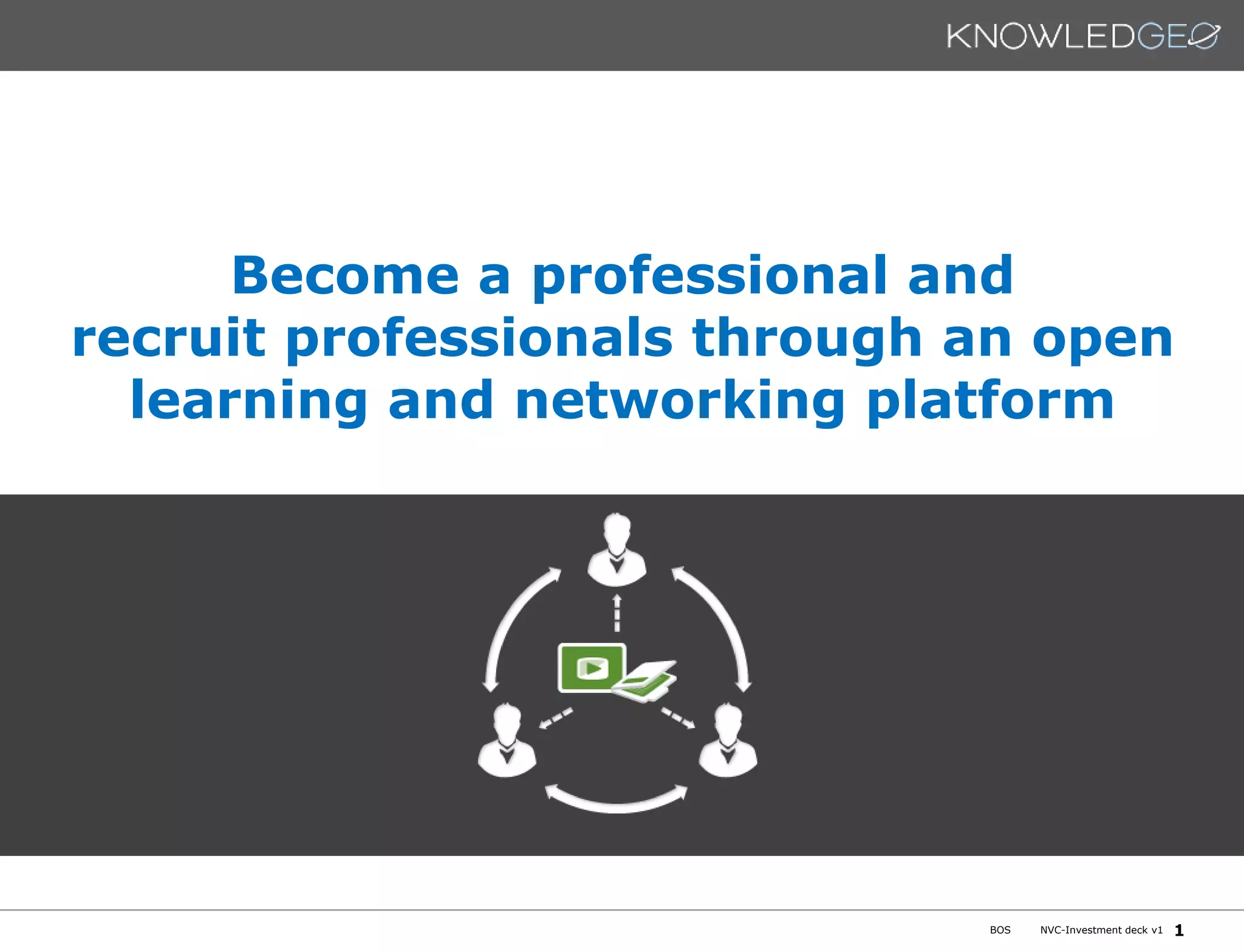
The deck opens with a clear value proposition: "Become a professional and recruit professionals through an open learning and networking platform." The visual includes a central icon of a video player and books, surrounded by three silhouettes representing a circular flow of interaction. The branding for "KNOWLEDGEØ" is visible in the top right corner, and the footer indicates this is version 1.0ed of the NVC-Investment deck.
Slide 2: The Gap
Slide 2 defines the problem space. It uses a linear timeline from High School to College to Professional. It places Khan Academy under High School, Coursera under College, and LinkedIn under Professional. A double-slash indicates a break between College and Professional. The slide asks two rhetorical questions: one regarding the lack of specific job skills in free education, and another regarding the lack of professional skills in trusted personal networks. This slide effectively positions Knowledgeo as the bridge over this gap.
Slide 3: Stakeholder Value
This slide breaks down the benefits for the two sides of the marketplace. For Job Seekers , the demand is for "Direction & differentiation," with the solution being the ability to learn exact skills and build a network. For Employers , the goal is to be "Free from recruiting hassle," with the solution being direct access to a verified talent pool. This slide establishes the dual-sided nature of the platform.
Slide 4: The Three Pillars
Knowledgeo categorizes its functionality into three areas: Learn , Network , and Career . The slide notes that experts donate knowledge, job seekers learn for free, and recruiters access verified skillsets to hire talent. This is a high-level overview of the product's operational flow.
Slide 5: The Learning Eco-System
Slide 5 uses a hand-drawn diagram to explain the "Eco-System." It shows professionals donating knowledge for "Good PR," leading to free online classes where job seekers earn certificates. This data is aggregated into a database that companies access to hire talent. The cycle completes when these new hires become experts and begin donating their own knowledge. This slide relies on a conceptual drawing rather than a technical architecture or product screenshot.
Slide 6: Networking and Knowledge Unions
Continuing the hand-drawn aesthetic, Slide 6 introduces "Knowledge Unions." These are depicted as overlapping circles of users meant to "Engage! Motivate! Share!" The slide suggests that these unions enhance the learning process through social interaction, though it does not detail the specific features of these unions.
Slide 7: Career and Matching
Slide 7 illustrates the recruitment interface. A hand-drawn "My Career Path" profile is shown being matched against a "Job Posting A." A "Match Ratio" of 78% is highlighted, indicating an algorithmic approach to recruitment. The diagram shows the database ("DB PROVIDED") acting as the conduit between the job seeker's profile and the corporation.
Slide 8: Revenue Model
The business model is split between the Career side and the Learn & Network side. The Career side (Employers) generates revenue through subscription fees and one-time prorated hire fees. The Learn & Network side (Job Seekers) generates revenue through certification fees, mentorship fees, textbook sales, and sponsored links. The slide explicitly states that revenue is generated "mainly from the career service portion."
Slide 9: Team
The final slide introduces the leadership team, all of whom are affiliated with the University of Chicago Booth School of Business:
Jay W Lee, CEO: Background in FMP at GE, VP at Pine Tree PE, and author of a finance career book. · Samir Patel, VP of Operation: Founder of Spare to Share, with operations experience at Continental Auto and Navistar. · Chris Brimmage, VP of Product: Background in education as a Team Lead at Elsik HS and founder of Karaoke Octopus Comics. · Jisoo Ahn, VP of Business Development: Former Senior Associate Consultant at Bain & Company.
The team slide emphasizes a "strong and balanced track-record," focusing on high-tier corporate and consulting backgrounds.
What Knowledgeo Does Well
The deck is highly effective at identifying a specific, relatable problem: the "last mile" of professional readiness. By positioning itself as the bridge between Coursera (learning) and LinkedIn (networking), Knowledgeo creates a clear mental model for where it fits in the existing tech stack. The team slide is a significant strength, showcasing a group with elite academic credentials and diverse professional experience ranging from GE and Bain to entrepreneurship and education. This lends immediate credibility to a conceptual-stage project.
What is Missing from the Deck
The most glaring omission is the lack of a Market Size (TAM) slide. Investors need to know if the recruitment and EdTech intersection is a billion-dollar opportunity or a niche play. Furthermore, there is no Traction slide; it is unclear if Knowledgeo is a functional product with users or merely a concept. The deck also lacks Financial Projections and a Roadmap , leaving the viewer in the dark about the company's growth trajectory. Finally, there is no Ask slide. A pitch deck is a fundraising tool, and failing to state how much money is being raised and how it will be used is a significant oversight.
Founder Takeaways: What to Copy and What to Avoid
Copy the clear stakeholder breakdown: Slide 3 is an excellent example of how to clearly articulate value for both sides of a marketplace. It uses simple language to define demand and solution for each party. Avoid the reliance on hand-drawn diagrams: While the sketches on Slides 5, 6, and 7 are charming, they lack the professional polish expected in a high-stakes investment deck. Founders should replace conceptual drawings with high-fidelity wireframes or screenshots of a working MVP to prove the product actually exists. Never omit the 'Ask': Every deck must conclude with a clear call to action, specifying the funding round size and the milestones that capital will help achieve.
Frequently asked questions
- What is the core problem Knowledgeo is trying to solve?
- According to Slide 2, Knowledgeo addresses the gap between college and the professional world. It argues that while free education exists (citing Khan Academy and Coursera), it often fails to teach the specific skills required for a 'dream job.' Simultaneously, it addresses the lack of professional skill verification in social networks like LinkedIn.
- How does Knowledgeo plan to make money?
- Slide 8 outlines a multi-pronged revenue model. Employers pay subscription fees to access the talent database and tools, plus a prorated fee per hire. Job seekers contribute through fees for certifications, tutorials, mentorship, and sponsored links for books or materials. The deck notes that revenue is 'generated mainly from the career service portion.'
- What is the 'Knowledge Donation' model mentioned in the deck?
- As illustrated on Slide 5, the model relies on professionals donating their knowledge to create free online classes. The incentive for these experts is described as 'Good PR.' Job seekers take these classes to earn certificates, and their data is aggregated into a database that companies pay to access for recruitment.
- Who are the competitors identified by Knowledgeo?
- Slide 2 explicitly positions Knowledgeo against Khan Academy and Coursera in the education space, and LinkedIn in the professional networking space. The deck suggests Knowledgeo 'bridges the gap' that these platforms leave open between academic learning and professional skill verification.
- What is missing from this pitch deck for a professional investor?
- The deck is missing several standard venture components. There is no 'Ask' slide detailing how much capital is being raised. It lacks a 'Market Size' slide (TAM/SAM/SOM), a 'Traction' slide showing current user numbers or revenue, and any financial projections or a roadmap for future development.