Curvanade’s 11-slide deck presents a classic early-2010s Backend-as-a-Service (BaaS) play, aiming to simplify mobile development across iOS, Android, and Windows. The company differentiates itself by adding indexing, search, and compute capabilities to standard BaaS features like push notifications and location services. While the deck identifies a clear market need backed by 2012 IDC data—showing 35% of developers planned to use cloud-based location services—it suffers from significant structural weaknesses. There is no mention of current traction, specific revenue figures, or a formal inves…
Key takeaways
- The product, CurvanadeMobile, is defined as a Backend-as-a-Service (BaaS) platform for cross-platform data management (Slide 2).
- Technical differentiation is centered on providing Indexing, Search, and Compute on top of standard BaaS features (Slide 3).
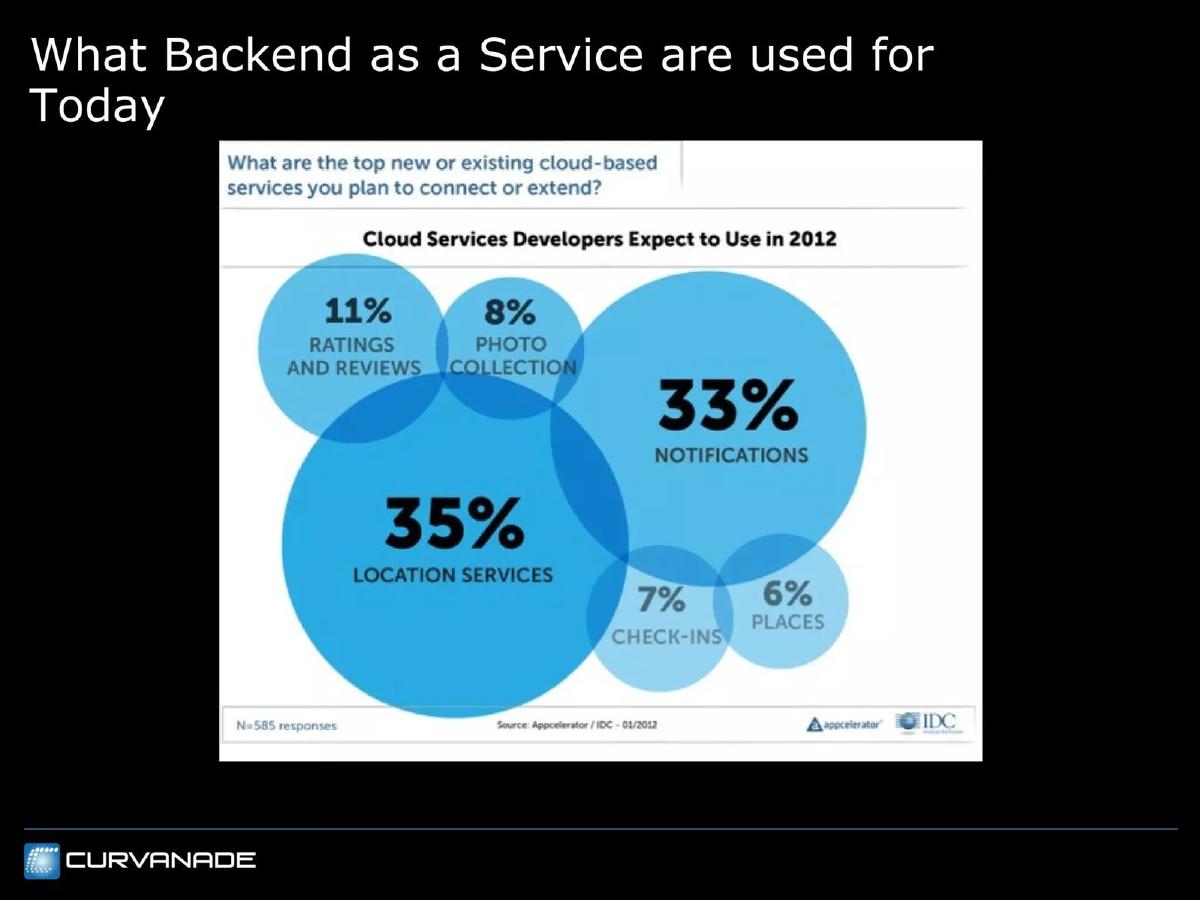
- Market demand is supported by a 2012 Appcelerator/IDC study showing high developer interest in location services (35%) and notifications (33%) (Slide 4).
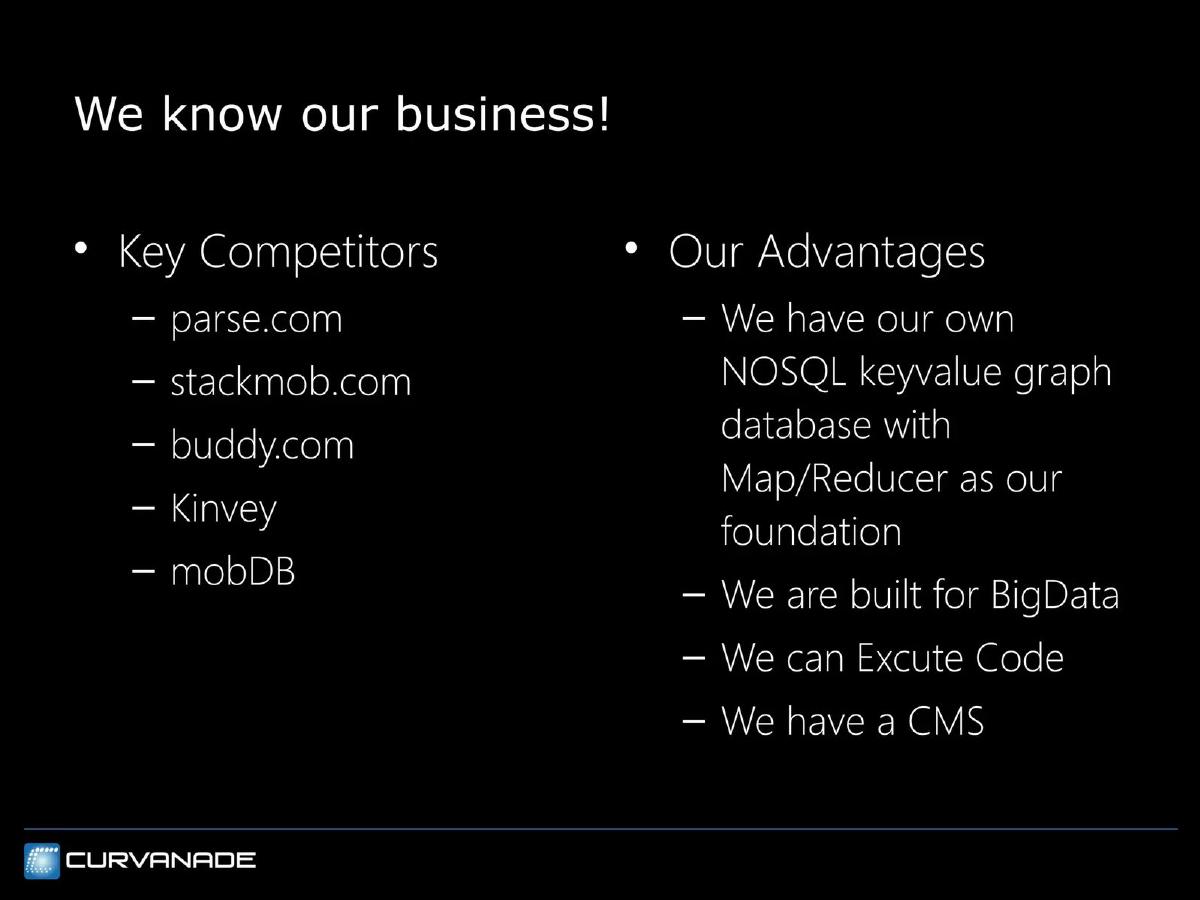
- The company claims a proprietary NoSQL key-value graph database with a Map/Reduce foundation as a core advantage (Slide 5).
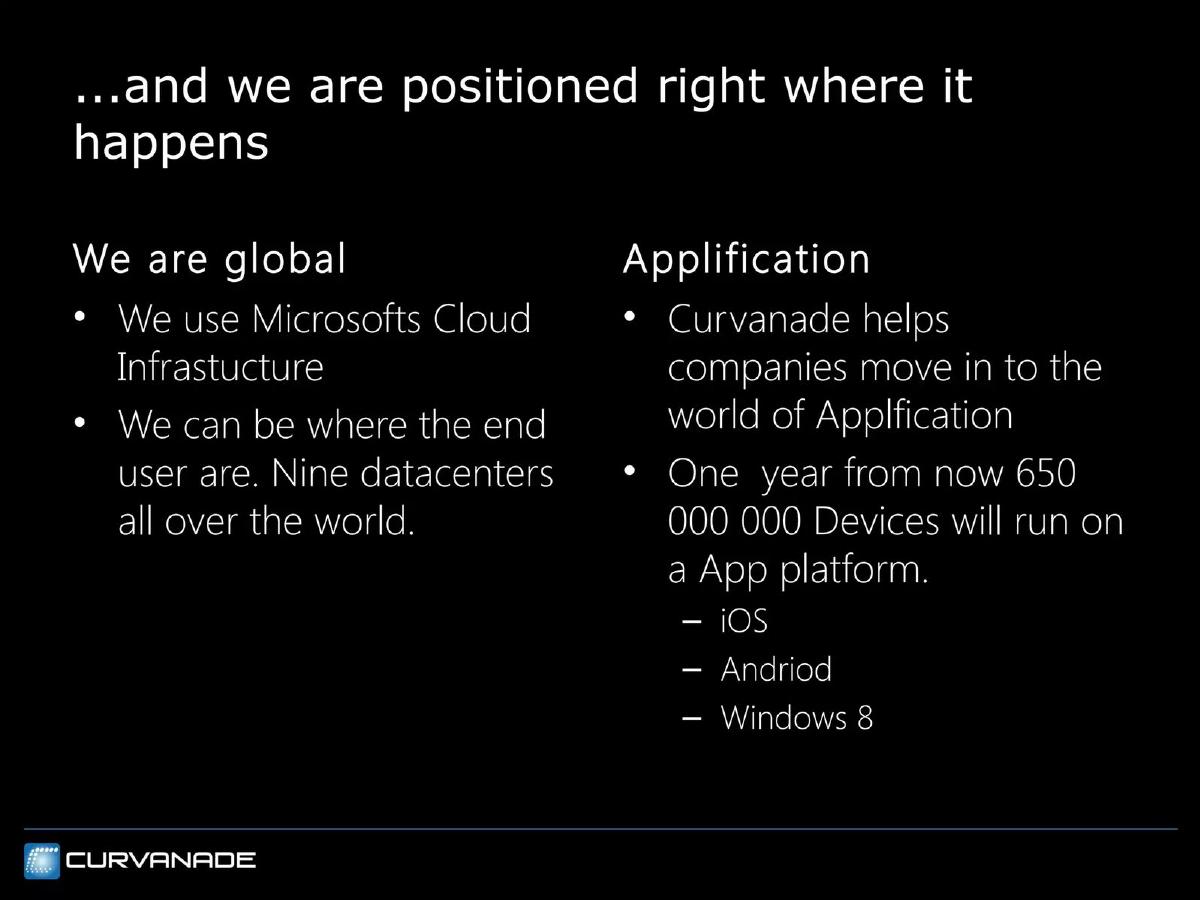
- Global infrastructure is built on Microsoft's Cloud, utilizing nine datacenters (Slide 6).
- The business model is strictly usage-based, charging for API calls, push notifications, and compute (Slide 8).
- The deck identifies five key competitors: parse.com, stackmob.com, buddy.com, Kinvey, and mobDB (Slide 5).
- Strategic objectives are high-level, aiming to 'be the number one BaaS company' without specific milestones or dates (Slide 10).
Curvanade Pitch Deck Analysis
Curvanade presents a technical solution to a problem that defined the early mobile era: the complexity of building and maintaining backends for fragmented mobile operating systems. By positioning themselves as the 'BackBone for Apps,' they targeted a developer audience looking to offload infrastructure management. However, as a fundraising document, the deck leans heavily on technical features while neglecting the commercial and operational metrics investors require.
Slide 1: Title Slide
The cover slide introduces the company name, Curvanade, with the tagline 'One Backend To Rule them All.' It prominently displays logos for Apple, Android, Windows, and HTML5, immediately signaling a cross-platform value proposition. The branding is minimalist, using a black background with white text, which is consistent throughout the deck.
Slide 2: What is Curvanade?
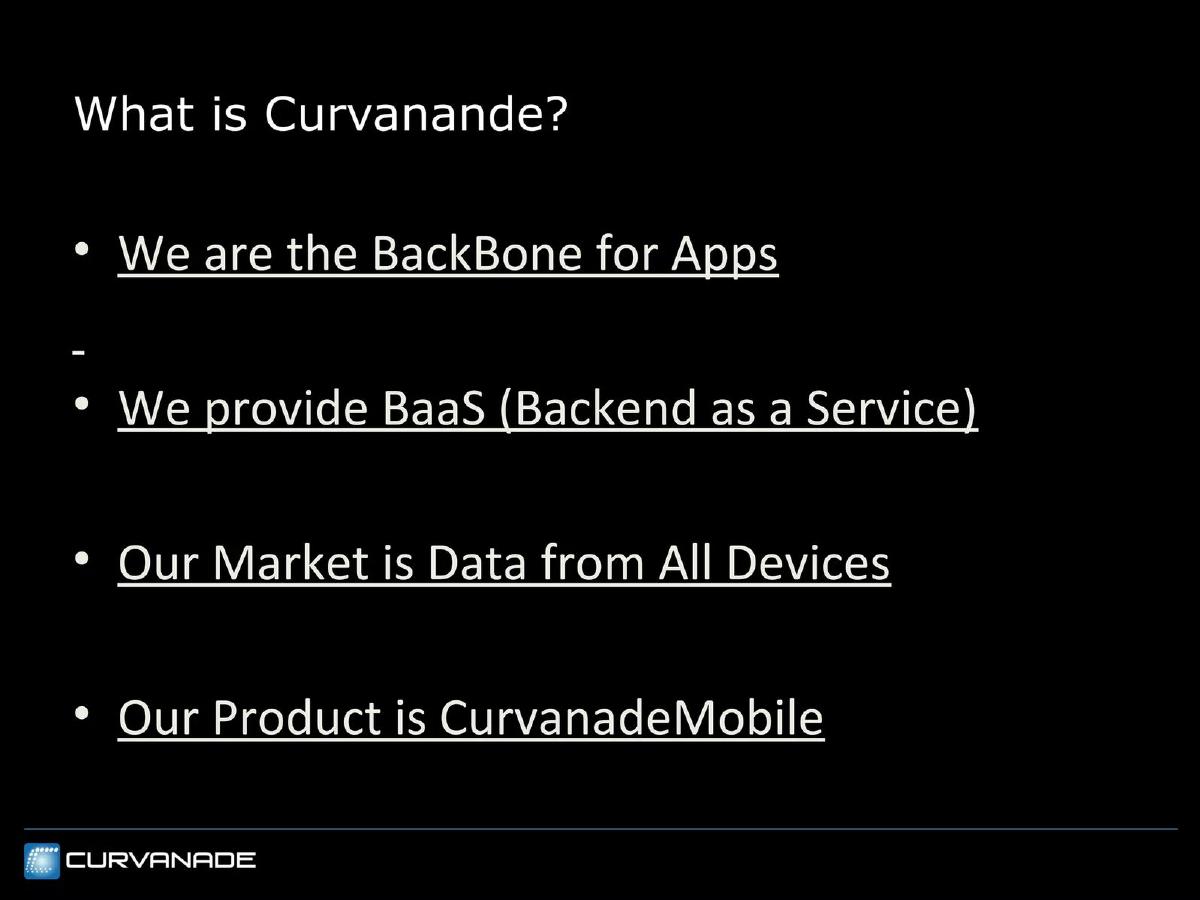
This slide defines the company's identity. It uses four bullet points to establish that they are a 'BackBone for Apps' providing 'BaaS (Backend as a Service).' It identifies their market as 'Data from All Devices' and names their primary product as 'CurvanadeMobile.' This is a functional summary slide that clearly categorizes the startup within the tech stack.
Slide 3: What does a Backend as a Service do?
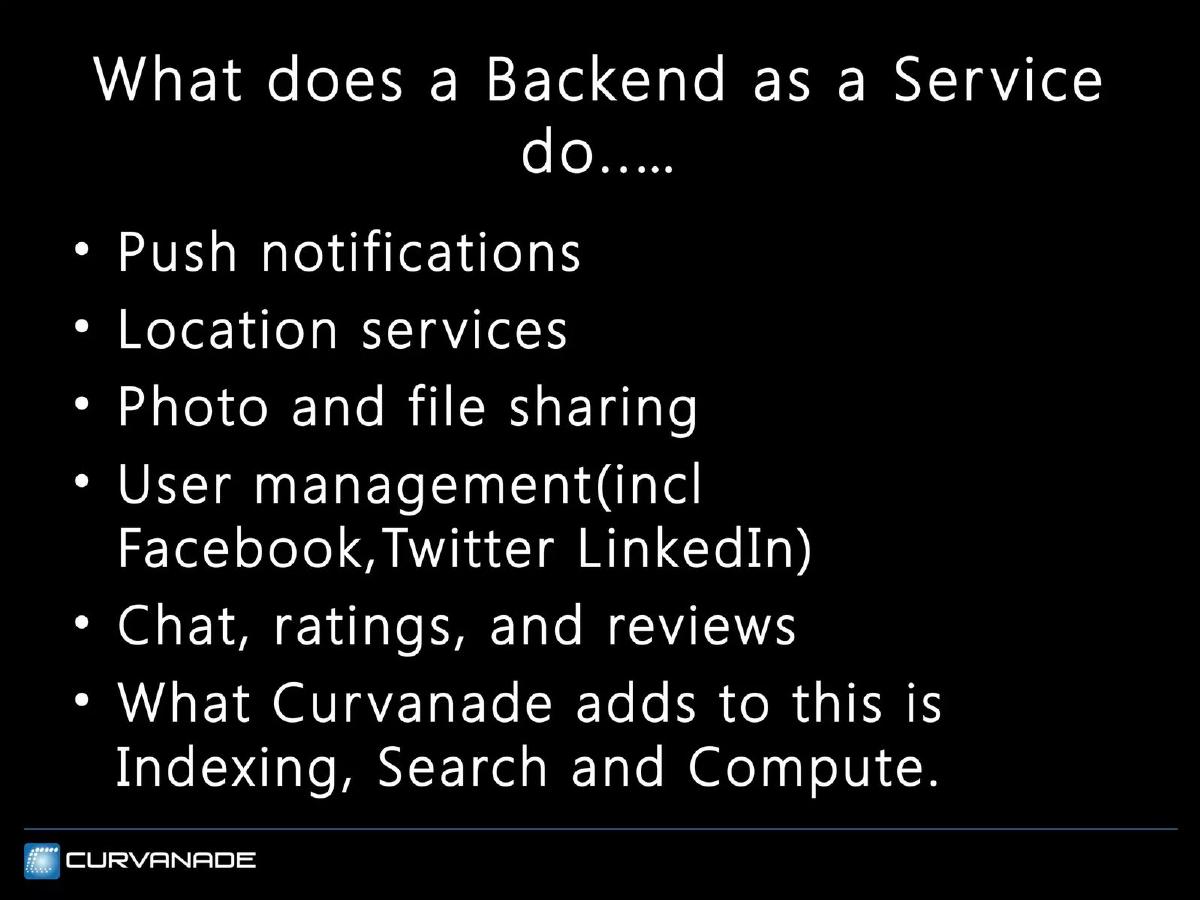
Curvanade uses this slide to educate the reader on the BaaS category while carving out their specific niche. They list standard features: push notifications, location services, photo/file sharing, user management (including Facebook, Twitter, and LinkedIn integration), and social features like chat and ratings. The final bullet point is the most important for their differentiation: 'What Curvanade adds to this is Indexing, Search and Compute.'
Slide 4: Market Validation
To prove market demand, the deck includes a chart titled 'Cloud Services Developers Expect to Use in 2012,' sourced from Appcelerator and IDC. The data, based on 585 responses, shows that 35% of developers planned to connect to location services and 33% to notifications. This slide serves to validate that Curvanade’s feature set aligns with the highest-priority needs of their target customer base at the time.
Slide 5: Competition and Advantages
The company lists five key competitors: parse.com, stackmob.com, buddy.com, Kinvey, and mobDB. On the right side of the slide, they list their 'Advantages.' These are purely technical: a proprietary NoSQL key-value graph database with Map/Reduce, being 'built for BigData,' the ability to 'Excute Code' (compute), and the inclusion of a CMS. This slide assumes the investor understands the technical superiority of a graph database over the relational or document stores likely used by competitors.
Slide 6: Infrastructure and Scale
Under the heading '...and we are positioned right where it happens,' Curvanade highlights its global reach. They state they use 'Microsofts Cloud Infrastucture' (Azure) and can leverage nine datacenters worldwide. The slide also includes a market projection: 'One year from now 650 000 000 Devices will run on a App platform,' specifically mentioning iOS, 'Andriod' (misspelled), and Windows 8.
Slide 7: Roadmap
The slide 'Where are we heading the next 12 month' outlines a two-pronged strategy. First, they plan to release 'FREE CODE' to the developer community for social intranets, check-in apps, and blog sharing. Second, they aim to grow their customer base by treating app developers as partners. The roadmap is tactical rather than strategic, focusing on developer relations rather than revenue milestones.
Slide 8: Business Model
The business model is defined simply as 'USAGE.' The company plans to charge based on three metrics: Number of API calls, Number of Push, and Compute. While this is a standard SaaS/PaaS model, the slide lacks any detail on pricing tiers, free trial limits, or how these metrics translate into projected revenue.
Slide 9: The Team
The team slide lists three individuals: Ludwig Ahrle (CTO), Mikael Eriksson (CEO), and Martin Bastmark (CFO), followed by a generic 'Developers' bullet point. This is a significant weakness in the deck. There are no photos, no descriptions of past experience, and no mention of prior successful exits or relevant technical achievements. In early-stage investing, the team is often more important than the product, and this slide fails to build credibility.
Slide 10: Business Objectives
This slide outlines short, medium, and long-term goals. Short term: 'Get the word out' and help the community. Medium term: 'Grow with our partner get a lot of customers.' Long term: 'Be the number one BaaS company.' These are aspirations rather than measurable objectives. There are no KPIs, no user acquisition targets, and no financial goals mentioned.
Slide 11: Contact Slide
The final slide repeats the title information and adds the website URL: www.curvanademobile.com. It maintains the cross-platform logos from the first slide, reinforcing the core message of universal backend support.
What Curvanade Does Well
The deck is highly focused. It does not waste time on fluff and stays strictly within the realm of the product's utility. By citing third-party IDC data, the founders successfully demonstrated that they were building features that developers actually wanted in 2012. The technical differentiation—specifically the mention of a proprietary NoSQL graph database and server-side compute—would have been compelling to a technically-minded investor at a time when most BaaS providers were simple wrappers around basic databases.
What is Missing from the Deck
The omissions in this deck are substantial and likely hindered its effectiveness as a fundraising tool. First, there is no 'Ask.' An investor reading this deck would have no idea how much money the company is looking for or what that money would be used to achieve. Second, there is no traction. Even if the product was in beta, showing developer sign-ups, API call growth, or partnership letters of intent is crucial. Third, the team slide is inadequate. Without professional context for the founders, an investor cannot assess the 'founder-market fit.' Finally, the deck contains several typos (e.g., 'Infrastucture,' 'Applfication,' 'Andriod,' 'Excute,' 'Buisness'), which can signal a lack of attention to detail to a potential backer.
What Founders Should Copy
Founders can learn from Curvanade’s clear categorization of their product. They didn't just say they were a 'mobile tool'; they explicitly stated they were 'BaaS' and 'The BackBone for Apps.' This clarity helps investors immediately place the company in a mental map of the industry. Additionally, the use of a 'standard features vs. our additions' list (Slide 3) is an excellent way to show how a startup is building on top of an existing market rather than trying to invent a new one from scratch. Citing specific competitors by name (Slide 5) is also a sign of confidence and market awareness that founders should emulate, provided they can clearly articulate their advantages.
Final Assessment
The Curvanade deck is a product-centric document that functions better as a technical overview than a venture capital pitch. While it identifies a high-growth market and a clear technical path, it fails to address the 'business' of the startup. To be successful, a pitch deck must balance the 'what' (the product) with the 'who' (the team) and the 'how' (the financials and traction). Curvanade focused almost entirely on the 'what,' leaving the most important questions for an investor unanswered.
Frequently asked questions
- What is the core product Curvanade is offering?
- Curvanade offers a product called CurvanadeMobile, which functions as a Backend-as-a-Service (BaaS). It provides developers with pre-built infrastructure for push notifications, location services, file sharing, user management, and social integration. Their specific value-add beyond these standard features includes indexing, search capabilities, and server-side compute functions, all built on a proprietary NoSQL graph database.
- How does Curvanade plan to make money?
- The business model is entirely usage-based. According to slide 8, the company intends to generate revenue through three primary metrics: the number of API calls made by an application, the number of push notifications sent, and the amount of compute resources consumed. However, the deck does not provide specific pricing tiers, margins, or projected average revenue per user (ARPU).
- Who are the primary competitors identified in the deck?
- Slide 5 lists five specific competitors: parse.com, stackmob.com, buddy.com, Kinvey, and mobDB. Curvanade attempts to differentiate itself from these established players by highlighting its proprietary database architecture and its ability to execute code (compute) and manage content through an integrated CMS, features they imply are superior to the competition.
- What is the scale of the market opportunity according to the slides?
- Curvanade cites a projection on slide 6 that 650,000,000 devices would run on an 'App platform' (iOS, Android, and Windows 8) within one year of the deck's creation. They also use 2012 IDC data to show that a significant percentage of developers were actively seeking cloud-based services for location (35%) and notifications (33%).
- What critical information is missing from this pitch deck?
- The deck is missing several vital components for a successful fundraise. There is no 'Ask' slide detailing how much capital is being raised or the valuation. It lacks a 'Traction' slide showing current users or revenue. Furthermore, the 'Team' slide lists names and titles but provides no biographies, and there are no financial projections or unit economics included.