Curie's 2018 seed deck, which secured $350,000, is an outlier in the world of fundraising. With only 10 slides and almost no body text, it relies entirely on the presenter to fill in the gaps. The deck focuses on the transition from physical to digital retail, highlighting a team with experience at Apple and Capital One. It positions 'Camera AI' as the bridge between offline browsing and online purchasing, claiming a 'Patent Pending' status for its technology. However, the deck is notably silent on business model, competition, and specific go-to-market strategy. It functions more as a visual…
Key takeaways
- The deck uses a high-contrast, dark-mode aesthetic with minimal text, forcing the audience to focus on the presenter's voice.
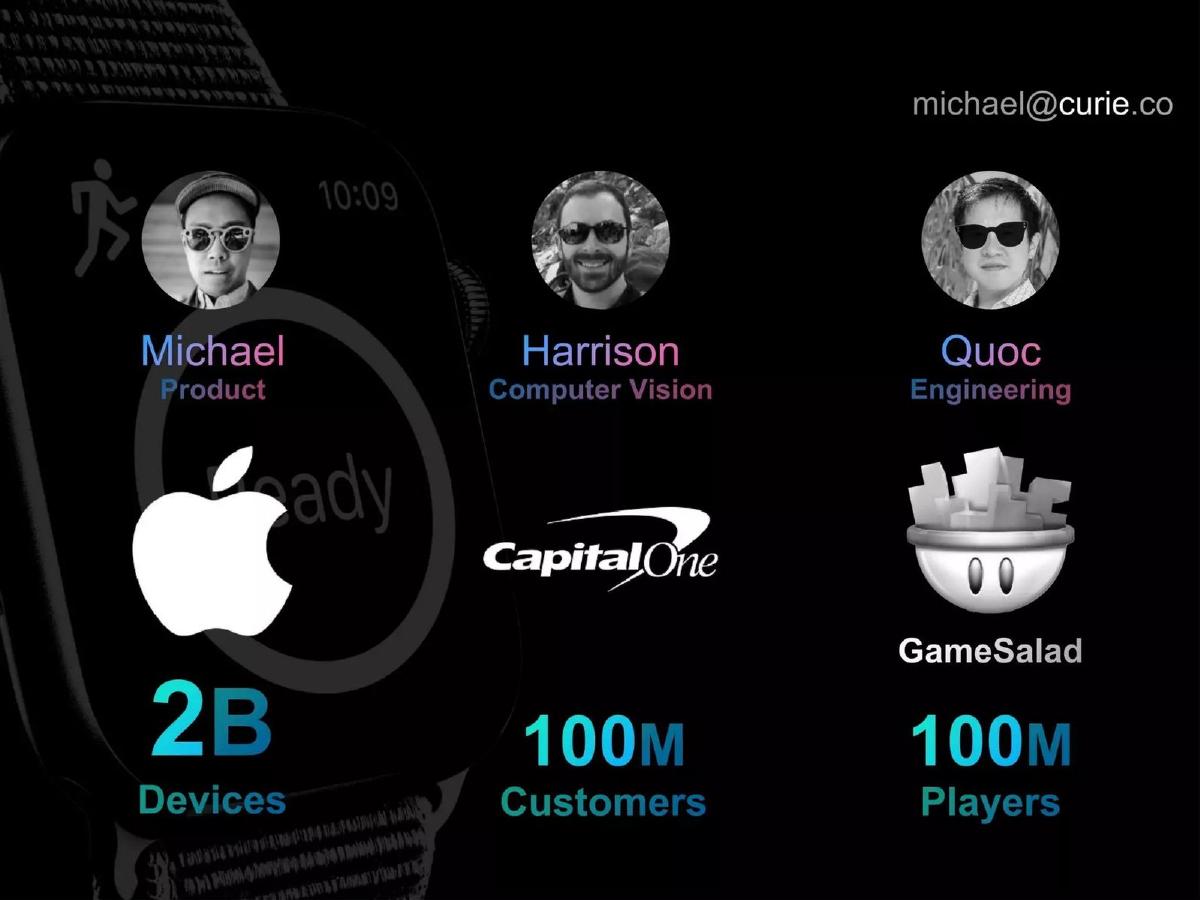
- Slide 2 establishes immediate credibility by highlighting a team with experience at Apple (2B devices), Capital One (100M customers), and GameSalad (100M players).
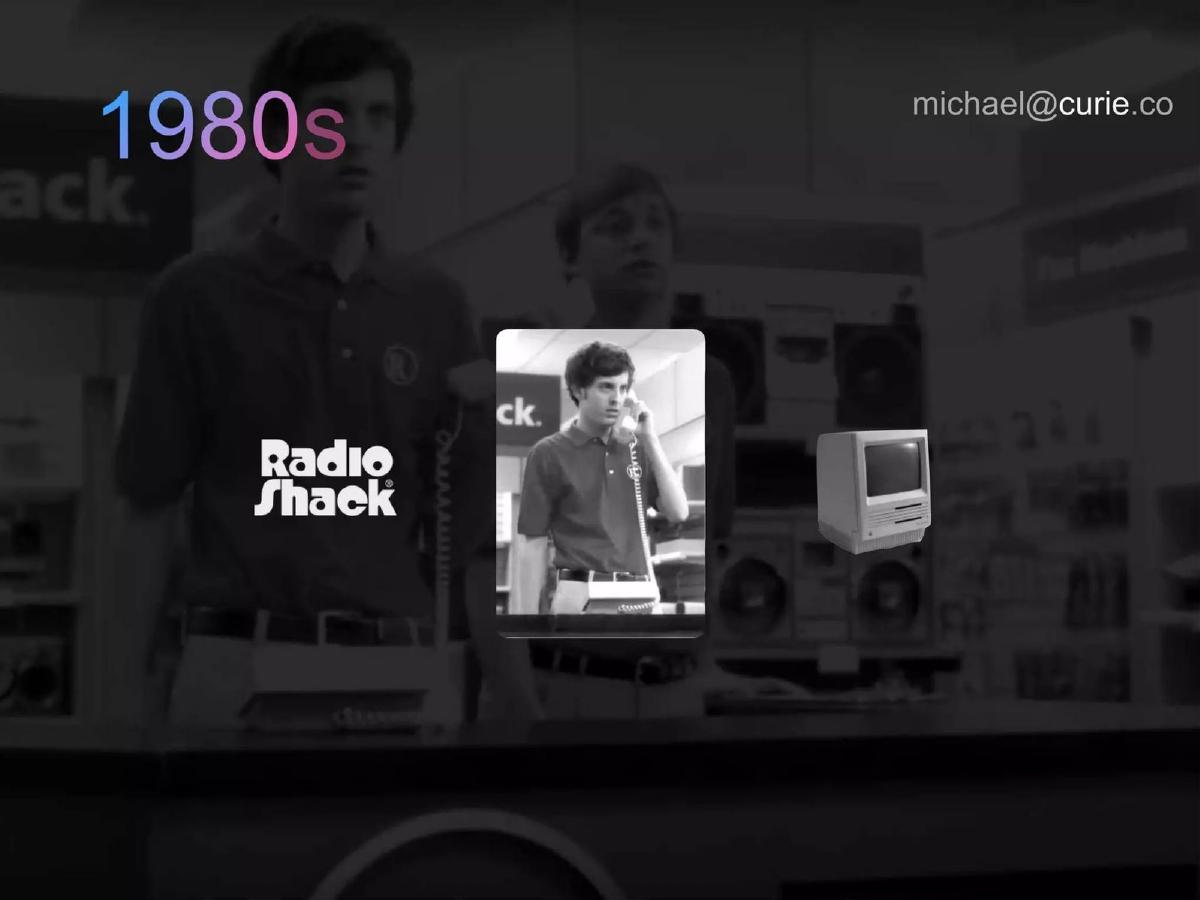
- The problem is framed through a historical lens on Slide 3, contrasting the 1980s RadioShack experience with modern fragmented retail.
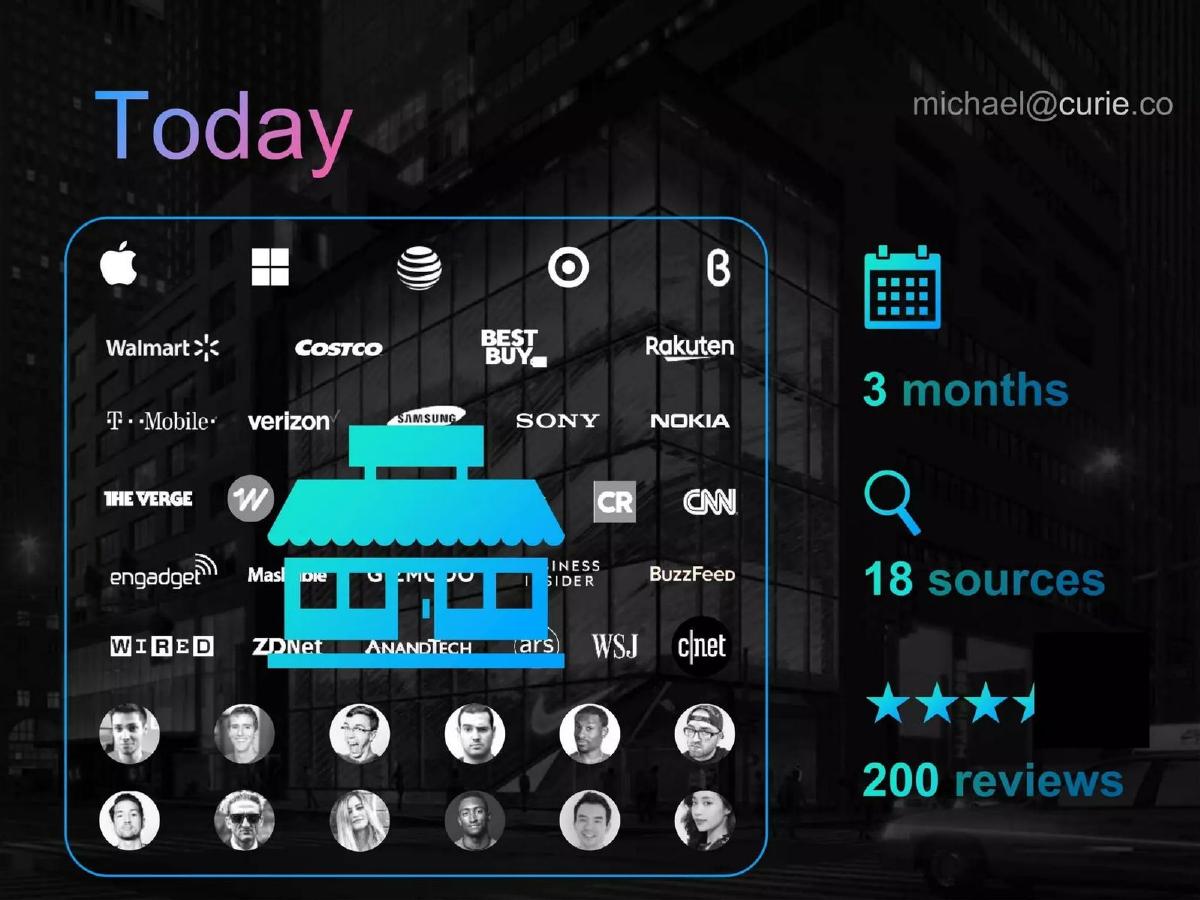
- Slide 4 quantifies the modern 'research' burden, citing 18 sources and 200 reviews over 3 months for a single purchase.
- The technology is described as 'Camera AI' on Slide 9, featuring crowdsourced labeling, typeless input, and personalized news.
- Curie claims a 'Patent Pending' status for its core technology on Slide 9, providing a small layer of defensibility.
- The deck concludes on Slide 10 with an 'In Alpha' status, showing availability on both the App Store and Google Play.
- There is no mention of unit economics, revenue projections, or a specific fundraising ask within these 10 slides.
The Visual Minimalism of Curie
Curie’s pitch deck is a striking example of the "less is more" philosophy. In an era where many founders feel the need to cram every possible data point into a 20-slide presentation, Curie opted for a 10-slide narrative that is almost entirely visual. This deck was used for a 2018 seed round that raised $350,000, and it reflects a very specific moment in the tech cycle where computer vision and "Camera AI" were high-conviction themes for investors. The deck doesn't try to explain the math; it tries to sell a vision of a frictionless future.
Slides 1-2: The Hook and the Pedigree
Slide 1 is a minimalist title slide. It features the word RETAIL in a large, gradient font over a dark image of a smartphone camera array. The only other text is a contact email. This immediately sets the stage: this is a company focused on the intersection of retail and hardware-enabled software.
Slide 2 is the team slide, and it is arguably the strongest slide in the deck. Instead of listing degrees or previous job titles, it uses logos and massive numbers to signal competence. Michael (Product) is paired with the Apple logo and the figure 2B Devices . Harrison (Computer Vision) is paired with Capital One and 100M Customers . Quoc (Engineering) is paired with GameSalad and 100M Players . This is a high-level way of saying, "We have built things that hundreds of millions of people use." For a seed investor, this pedigree often outweighs the need for early revenue figures.
Slides 3-5: The Problem and the Friction
Slide 3 takes a nostalgic turn, showing a black-and-white image of a RadioShack from the 1980s . This serves as a baseline for how retail used to work: a single physical location with a limited set of choices and a direct human interface. It establishes the "before" state of the industry.
Slide 4, titled Today , contrasts this with the current fragmented reality. It shows a grid of dozens of logos—Walmart, Costco, Best Buy, The Verge, Wired, and various social media faces. To the right, it lists the cost of this fragmentation: 3 months of time, 18 sources of information, and 200 reviews . The slide uses a blue store icon to represent the physical world being buried under a mountain of digital noise. The message is clear: shopping has become a chore.
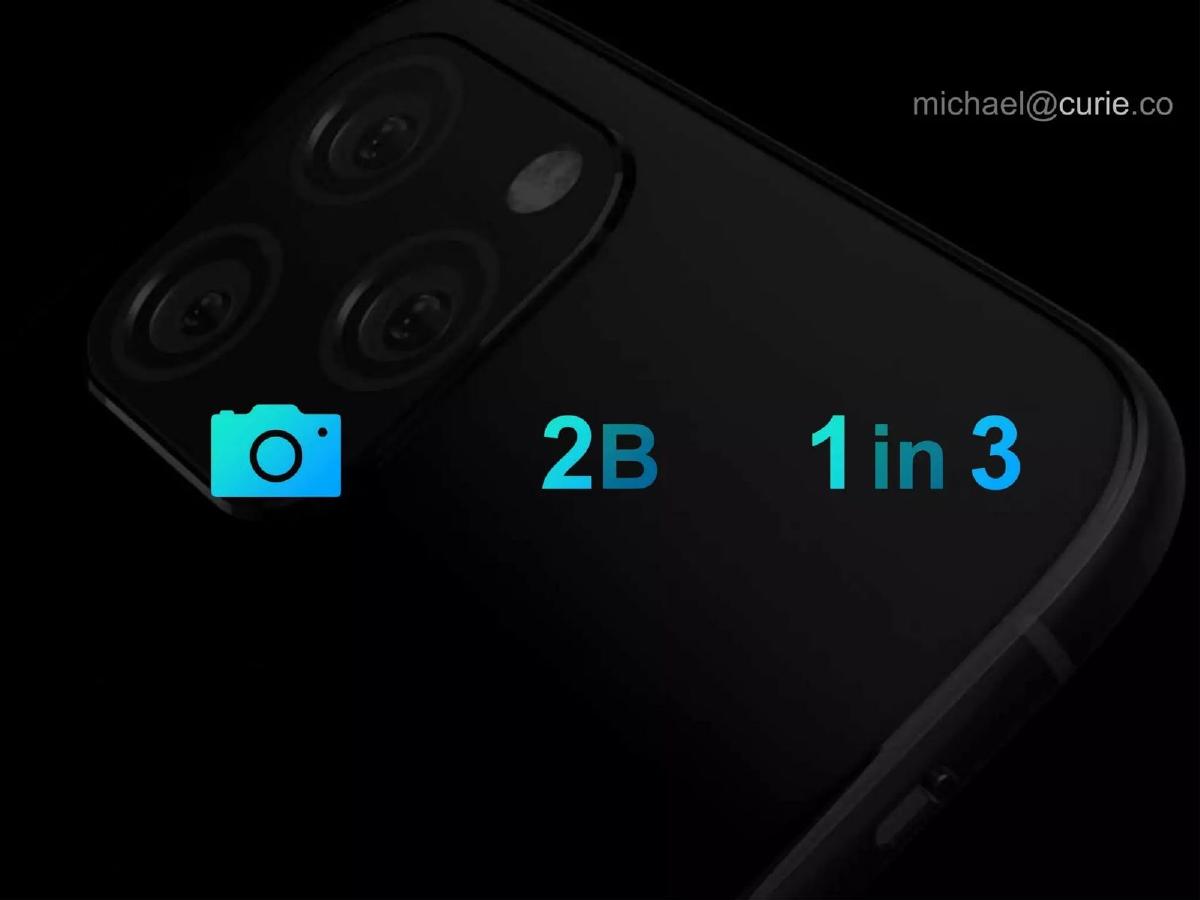
Slide 5 introduces a key statistic: 1 in 3 . Accompanied by a camera icon and a figure of 2B , this likely refers to the two billion smartphone users, one-third of whom are already using their cameras as a tool for retail discovery. This slide bridges the gap between the problem (fragmentation) and the solution (the camera).
Slides 6-8: The Solution and the Funnel
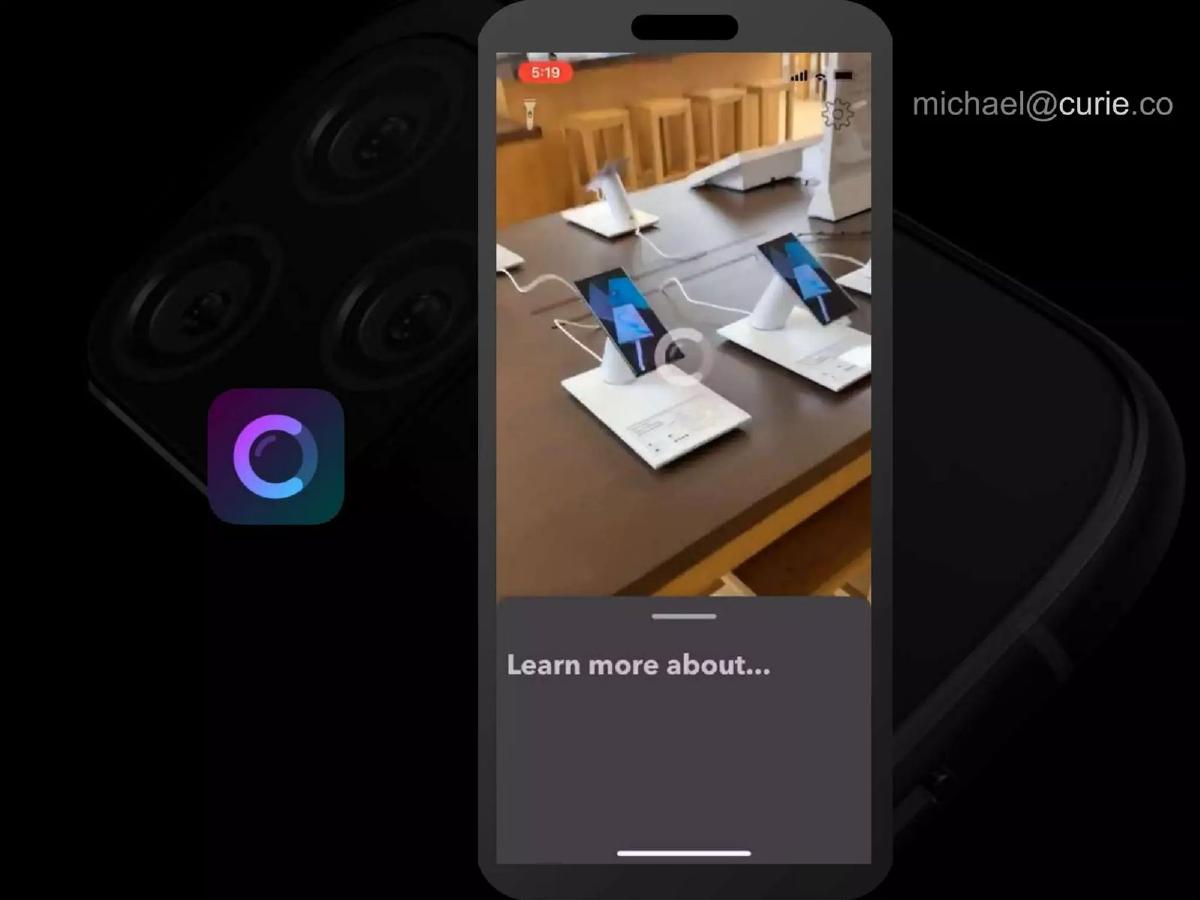
Slide 6 is a visual demonstration. It shows a smartphone mockup running an augmented reality or computer vision interface inside a physical store. A "loading" icon and the Curie logo suggest that the app is identifying products in real-time. There is no text on this slide other than a "Learn more about..." prompt, forcing the viewer to imagine the utility.
Slide 7 simplifies the user journey into three steps: Research , Decide , and Purchase . Each step is paired with an icon (camera, checkmark, credit card). This is the core of Curie's value proposition: collapsing the long, 3-month research cycle identified on Slide 4 into a single, camera-driven flow.
Slide 8 introduces the technical term for their solution: Camera AI . It also notes Patent Pending , which is a critical detail for a seed-stage deep tech company. The slide breaks down the AI's functions into three buckets: Crowdsources Labeling , Typeless Input , and Personalized News . This gives a glimpse into the "how"—using community data and computer vision to remove the need for typing and manual searching.
Slides 9-10: Attribution and Status
Slide 9 focuses on Real World Attribution . It uses a flow diagram showing a person walking, spending money (O2O - Online to Offline), and interacting with a brand. It repeats the 1 in 3 metric and features a massive 90% figure. While the slide doesn't explicitly state what the 90% refers to, in the context of retail attribution, it often refers to the percentage of retail sales that still happen in physical stores despite digital research. This reinforces the need for a bridge between the two worlds.
Slide 10 is the closing slide. It states that the product is In Alpha and provides links to the App Store and Google Play. This shows that the team isn't just pitching an idea; they have a functioning product that investors can actually download and test. Like the rest of the deck, it is devoid of a specific "ask" or financial roadmap.
What Works in This Deck
The primary strength of this deck is its narrative clarity . By stripping away almost all text, the founders ensure that the audience isn't distracted by reading slides while they are talking. The use of high-contrast visuals and recognizable logos (Apple, Capital One) creates an immediate sense of professionalism and scale. The transition from the 1980s to the present day is a classic storytelling device that effectively frames the "why now" of the business. Furthermore, the inclusion of "Patent Pending" and "In Alpha" provides just enough evidence of progress to satisfy early-stage curiosity.
What is Missing
This deck is a "teaser" or a "presentation deck," not a "leave-behind" deck. Because it lacks so much context, it would be difficult for an investor to evaluate the business based on the slides alone. Specifically, the following are missing:
Business Model: There is no explanation of how Curie makes money. Is it a SaaS fee for retailers? An affiliate model for purchases? A data play? · Competition: The deck ignores the existence of Google Lens, Pinterest Lens, or Amazon’s own visual search tools, which are direct competitors in the "Camera AI" space. · Market Size: While it mentions 2B devices, it doesn't define the Total Addressable Market (TAM) in dollar terms. · Unit Economics: There is no mention of the cost to acquire a user or the expected lifetime value. · The Ask: The deck does not state how much money they are raising or what they plan to do with the capital.
What a Founder Should Copy
Founders should study Curie's Team Slide (Slide 2) . Instead of writing a paragraph about why you are smart, show the scale of the products you have touched. If you worked at a major company, find the biggest number associated with your department and put it next to the logo. It creates an instant "halo effect." Additionally, the Problem Framing (Slide 4) is excellent. Quantifying the frustration of a current process (18 sources, 200 reviews) makes the problem feel tangible and urgent. Finally, the Visual Consistency is top-tier. The dark theme and consistent icon style make the company look like a polished brand from day one, which is vital for building trust at the seed stage.
Final Analysis
Curie's deck is a high-stakes gamble on the founder's ability to command a room. It provides the skeleton of a story but requires the presenter to provide the muscle and skin. For a $350,000 seed round in 2018, this level of minimalism was effective because it focused on the two things that matter most at that stage: a massive problem and a team capable of solving it. However, founders in a more crowded or capital-constrained market might find that they need to include more of the "missing" elements—specifically competition and monetization—to get a deal across the finish line today.
Frequently asked questions
- What is the primary value proposition of Curie according to the deck?
- Curie positions itself as a 'Camera AI' solution that streamlines the retail journey. By using computer vision, it aims to collapse the 'Research, Decide, Purchase' funnel (Slide 8) into a single, seamless experience. The deck suggests that by using a smartphone camera, users can bypass the traditional friction of searching through dozens of sources and reviews, moving directly from real-world product discovery to transaction.
- How does the team slide establish authority?
- Slide 2 avoids long biographies in favor of massive scale metrics associated with the founders' former employers. By listing '2B Devices' under the Apple logo for Michael, '100M Customers' for Harrison at Capital One, and '100M Players' for Quoc at GameSalad, the deck implies the team is capable of building and managing products at a global scale, which is a powerful signal for a seed-stage investor.
- What market gap does Curie aim to fill?
- The deck identifies a massive inefficiency in how consumers interact with retail today. Slide 4 illustrates that a typical purchase involves 18 sources and 200 reviews over a 3-month period. Curie aims to solve this 'information overload' by providing 'Real World Attribution' (Slide 9), essentially connecting the physical act of looking at a product to the digital data required to buy it.
- Is there any mention of a business model or revenue?
- No. The 10 slides provided contain zero information regarding how the company intends to make money, their pricing structure, or their target customer (B2B vs B2C). While the catalogue listing mentions supplying e-commerce and AI-training, the deck itself focuses entirely on the user experience and the underlying 'Camera AI' technology without discussing monetization or financial projections.
- What is the significance of the '1 in 3' metric mentioned twice?
- The '1 in 3' metric appears on Slide 5 and Slide 9, always accompanied by a camera icon. While the slide text doesn't explicitly define it, in the context of retail and computer vision, this typically refers to the frequency of consumers using their phones to research products while physically in a store. It serves as a data point to justify why a camera-based AI solution is the correct interface for modern retail.