Curipod’s 9-slide Seed deck is a lean, metric-driven presentation that secured $4.6M in 2023. The company targets the education sector by using generative AI to reduce the 10 hours teachers spend weekly on lesson planning. The deck is notable for its lack of traditional financial projections or market sizing, choosing instead to focus entirely on product-market fit and viral adoption. With a user growth rate of 673.11% in Q1 2023 and a participant count reaching 140,000 by April 2023, the narrative relies on the 'hockey stick' growth curve to prove demand. It serves as a prime example of how…
Key takeaways
- The deck identifies a specific pain point: teachers spend 10 hours every week making lessons (Slide 2).
- Curipod claims to reduce lesson creation time from hours to 10 seconds using AI (Slide 4).
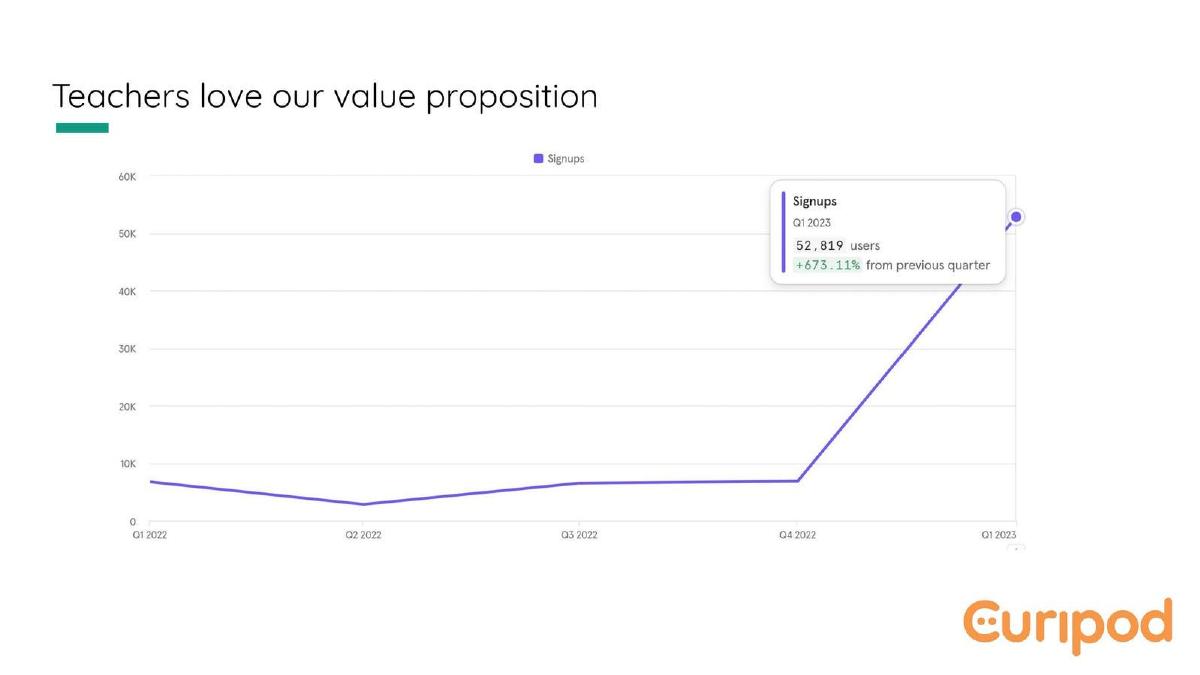
- User growth exploded by 673.11% between Q4 2022 and Q1 2023, reaching 52,819 users (Slide 6).
- Student engagement, measured by 'Sum of Participants,' scaled from near zero to 140,000 in under two years (Slide 7).
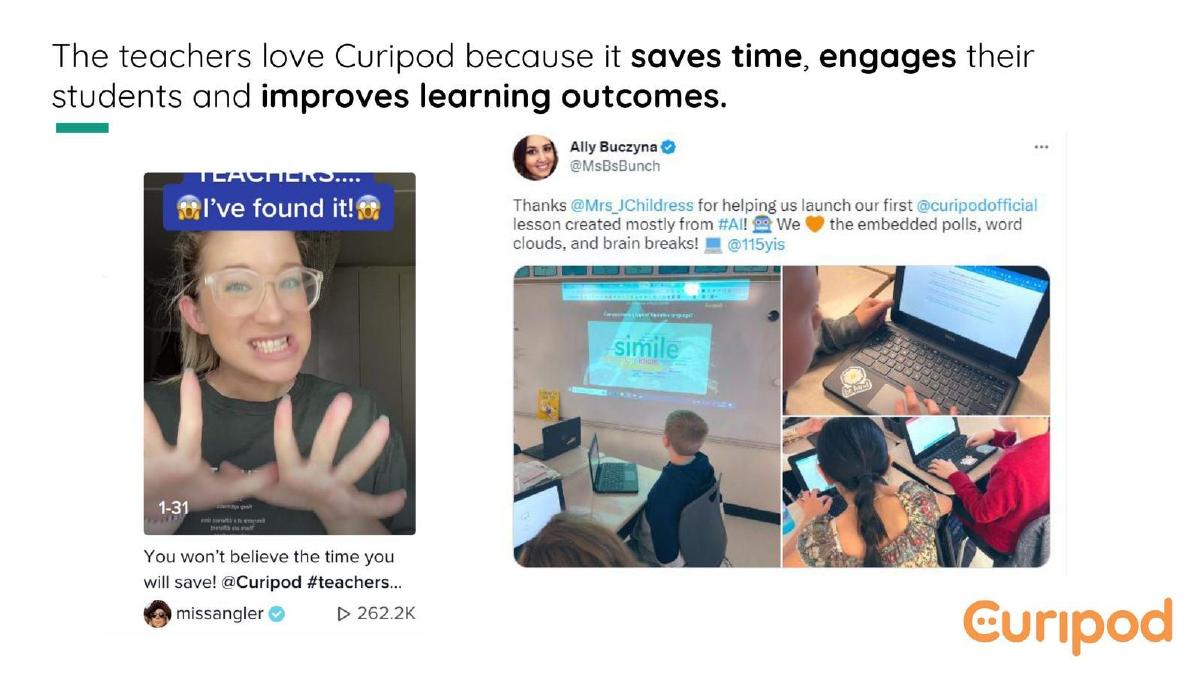
- Social proof is heavily leveraged through screenshots of viral TikTok and Twitter posts from verified educators (Slide 5).
- The deck completely omits a business model, revenue figures, market size (TAM), and a specific funding ask.
- The team slide highlights technical and operational backgrounds from firms like Cognite, Telenor, and Visma (Slide 9).
- The 'Why Now' slide attributes success to the shift from print to digital and rapid advances in AI (Slide 8).
The Lean AI Growth Narrative
Curipod’s 2023 Seed deck is a study in brevity. Raising $4.6M with only nine slides is an outlier in the fundraising world, but the content of those slides explains why. The deck leans heavily into the 'generative AI' tailwinds of 2023, focusing almost exclusively on a single pain point and the resulting explosion in user growth. As reported by Business Insider, this European startup successfully navigated the Seed round by proving that teachers were not just using the tool, but evangelizing it.
Slide 1: Title and Mission
The deck opens with a clean, minimalist title slide. The tagline, "Make 21st century skills-based lessons," sets the stage for a product that is focused on modern pedagogy. The branding is friendly and approachable, utilizing a soft green and orange palette that fits the education sector.
Slide 2: The 10-Hour Problem
Slide 2 identifies the core friction in a teacher's life: "Teacher spend 10 hours every week making lessons." This is a classic 'hair on fire' problem. By quantifying the pain in hours per week, Curipod gives investors a metric to measure their solution against. The simplicity of the slide—just one sentence—forces the reader to sit with the weight of that inefficiency.
Slide 3: The AI Solution
The solution is presented as the direct inverse of the problem: "Make interactive 21st century skills-based lessons in seconds with AI." This slide establishes the value proposition: moving from hours to seconds. It positions Curipod not just as a tool, but as a massive productivity multiplier for the education workforce.
Slide 4: Product in Action
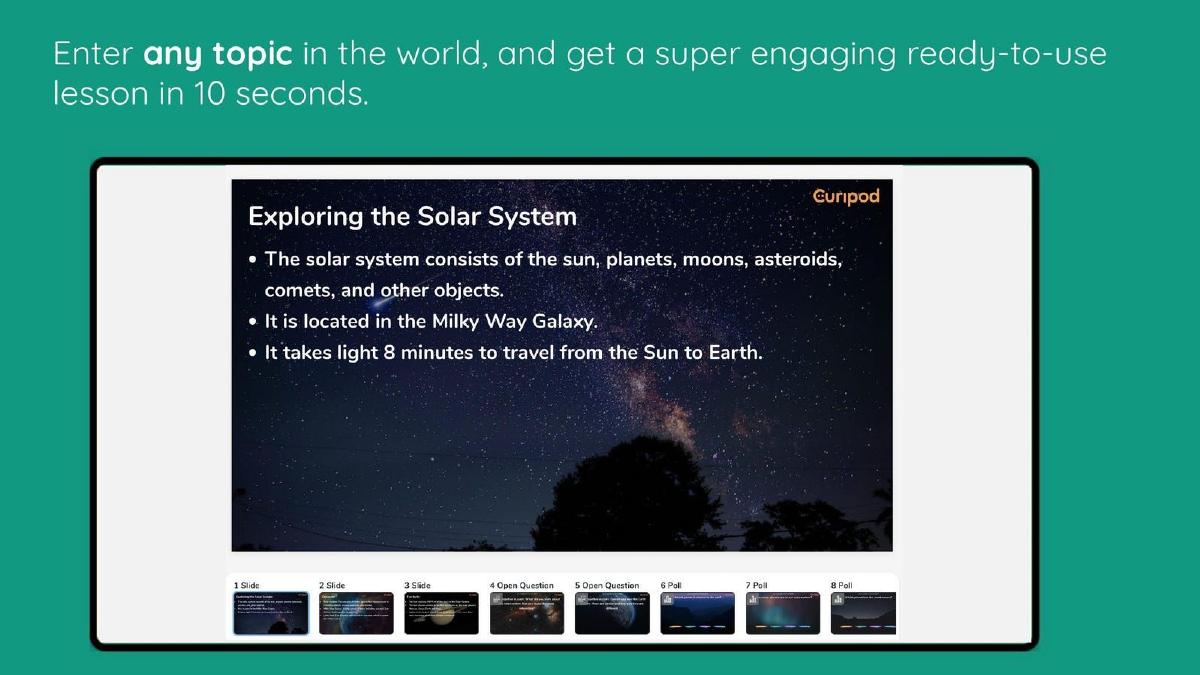
Slide 4 provides a visual demonstration of the platform. It claims users can "Enter any topic in the world, and get a super engaging ready-to-use lesson in 10 seconds." The screenshot shows a lesson on "Exploring the Solar System," featuring bullet points, images, and a tray of interactive elements like open questions and polls. This slide is crucial because it proves the AI isn't just generating text; it's generating a structured, multi-modal classroom experience.
Slide 5: Viral Social Proof
This is perhaps the most important slide for a Seed round. It features a TikTok screenshot from 'missangler' with 262.2K views and a tweet from a verified educator. The text states, "The teachers love Curipod because it saves time, engages their students and improves learning outcomes." In EdTech, organic viral growth is the holy grail, as it suggests the company can bypass the slow, expensive process of selling to school districts by winning over individual teachers first.
Slide 6: The Growth Inflection Point
Slide 6 shows the 'Signups' chart, which is the definitive proof of product-market fit. The chart shows a flat line through 2022, followed by a vertical spike in Q1 2023. The callout box highlights 52,819 users and a staggering +673.11% from previous quarter . This growth coincides with the broader public release of advanced generative AI models, showing that Curipod successfully rode the wave of AI adoption.
Slide 7: Student Engagement Metrics
While Slide 6 shows teacher adoption, Slide 7 shows student engagement. The "Sum of Participants" metric tracks how many students are actually interacting with the lessons. The graph shows a peak of 140,000 participants in April 2023 . This is a vital 'stickiness' metric; it proves that teachers aren't just signing up—they are actually using the tool in live classroom environments.
Slide 8: The Macro Environment (Why Now)
Slide 8 addresses the 'Why Now?' question. It lists four drivers: "From print to digital," "The advances in AI," "A change in pedagogics," and "Rapid infrastructure development." This slide contextualizes Curipod’s growth within a larger technological shift, suggesting that the company is a natural beneficiary of the AI revolution and the digitization of schools.
Slide 9: The Team
The final slide introduces the six-person core team. It highlights a mix of leadership and technical talent. Notable logos under the team members include Cognite, Telenor, Visma, and NTNU . The presence of two software engineers and a product manager alongside the founders suggests a product-heavy organization capable of maintaining the rapid pace of AI development.
What Curipod Does Exceptionally Well
The Curipod deck is a masterclass in momentum-based storytelling . By the time an investor reaches Slide 6, the narrative is already won. The deck doesn't waste time on theoretical market sizes or complex competitive matrices. Instead, it relies on three pillars: a massive time-saving promise, visual proof of the product, and undeniable growth data. The inclusion of the TikTok view count (262.2K) is a modern fundraising tactic that signals a low Customer Acquisition Cost (CAC), which is highly attractive to Seed investors.
What is Missing from the Deck
Despite raising $4.6M, this deck is missing several components usually considered 'mandatory' by venture capitalists:
Business Model: There is no mention of how Curipod makes money. Is it a freemium model? A per-teacher subscription? A district-wide SaaS license? The deck is silent on revenue. · Market Size (TAM): There is no slide estimating the total addressable market. While the problem is universal for teachers, the deck doesn't quantify the dollar value of the opportunity. · Competition: The deck does not mention competitors like Nearpod or Kahoot, nor does it explain how Curipod’s AI-first approach creates a moat against them. · The Ask: Remarkably, the deck does not state how much money they are raising or what the milestones for the next round will be.
Lessons for Founders
Founders can learn two major lessons from Curipod. First, traction trumps everything . If you have a 673% growth rate, you can afford to skip the TAM slide. Investors are looking for outliers, and a vertical line on a chart is the most efficient way to signal that you are one. Second, show, don't tell . Instead of describing how AI helps teachers, Curipod shows a finished lesson and a teacher crying 'I've found it!' on TikTok. This emotional and visual proof is far more persuasive than a list of features.
Frequently asked questions
- How does Curipod justify its value proposition to investors?
- Curipod justifies its value by focusing on extreme time savings and viral adoption. By stating that teachers spend 10 hours a week on planning and showing that Curipod can generate a lesson in 10 seconds, they present a clear 3600x efficiency gain. This is backed by a growth chart showing a 673% increase in signups in a single quarter, proving the market is responding to that value.
- Why are there no financial slides in this deck?
- At the Seed stage, especially in a viral EdTech play, investors are often more concerned with user acquisition and product-market fit than early revenue. Curipod likely used this deck to highlight their 'land and expand' potential. The omission suggests they were prioritizing growth metrics to secure a $4.6M round, likely planning to solve monetization once they captured a significant share of the teacher market.
- What role does social proof play in Curipod's fundraising strategy?
- Social proof is central to their narrative. Slide 5 features a TikTok from 'missangler' with 262.2K views and a tweet from a verified teacher. This demonstrates that the product isn't just being used; it is being championed by the community. For EdTech, where sales cycles are notoriously difficult, organic viral growth among teachers is a powerful signal of a low-cost acquisition model.
- Is the 9-slide format enough for a Seed round?
- While 9 slides is shorter than the average 12-15, it was sufficient for Curipod to raise $4.6M. The deck follows a 'traction-first' logic. If the growth curve is vertical enough, you don't need 20 slides to explain why the business is interesting. However, most founders would still be expected to include a 'The Ask' slide, which is missing here.
- What is the 'Sum of Participants' metric on Slide 7?
- This metric likely refers to the number of students who have joined a Curipod session hosted by a teacher. It serves as a proxy for 'active usage' and 'reach.' By showing 140,000 participants, Curipod demonstrates that their platform is actually functioning in classrooms, not just sitting as an unused account in a teacher's dashboard.