Osso VR’s 13-slide deck successfully secured a $66M Series C in 2022 by leaning heavily into clinical evidence rather than just hardware potential. In a sector often dismissed as 'gimmicky,' Osso VR utilized randomized control trials published in the Journal of Surgical Education to prove that their VR training results in performance scores 230% better than traditional methods. The deck is notably light on financial projections and team biographies, choosing instead to focus on a massive Total Addressable Market—highlighting 310 million major surgeries per year—and an impressive roster of par…
Key takeaways
- The deck anchors its value proposition on a 230% improvement in performance scores compared to traditional training (Slide 7).
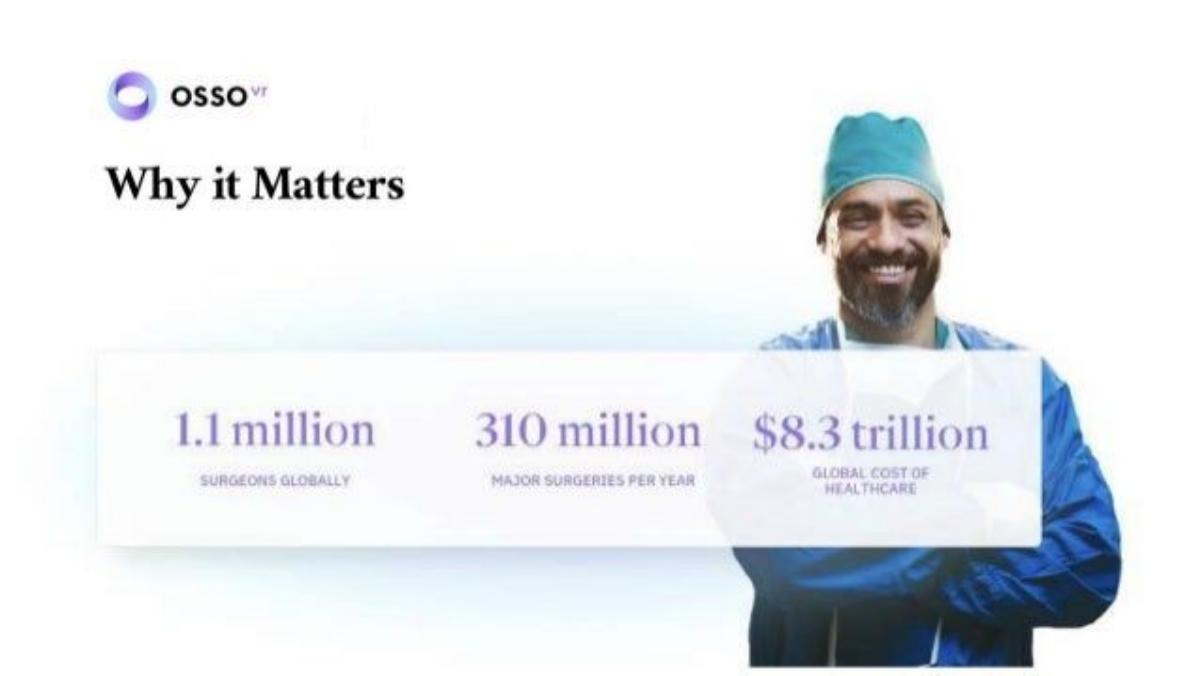
- Osso VR addresses a massive market opportunity by citing 1.1 million surgeons globally and a $8.3 trillion global healthcare cost (Slide 4).
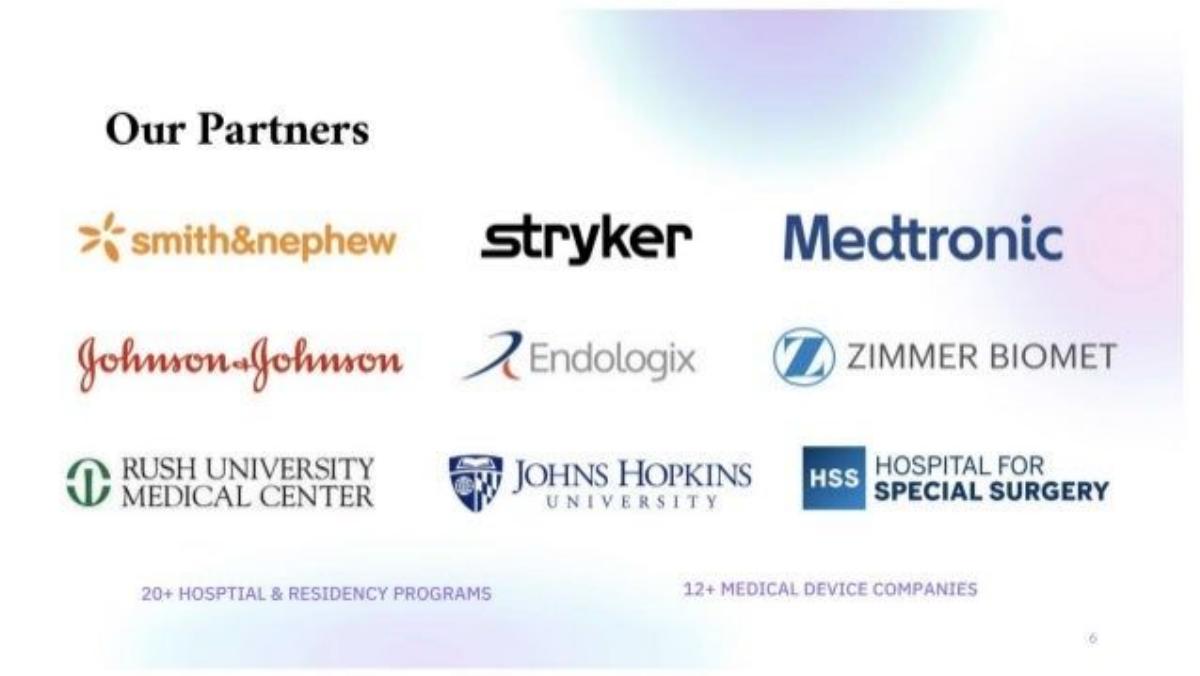
- The company utilizes high-signal social proof by listing partnerships with 12+ medical device companies and 20+ hospital programs (Slide 6).
- Clinical validation is the core of the pitch, featuring a randomized control trial published in the Journal of Surgical Education (Slide 7).
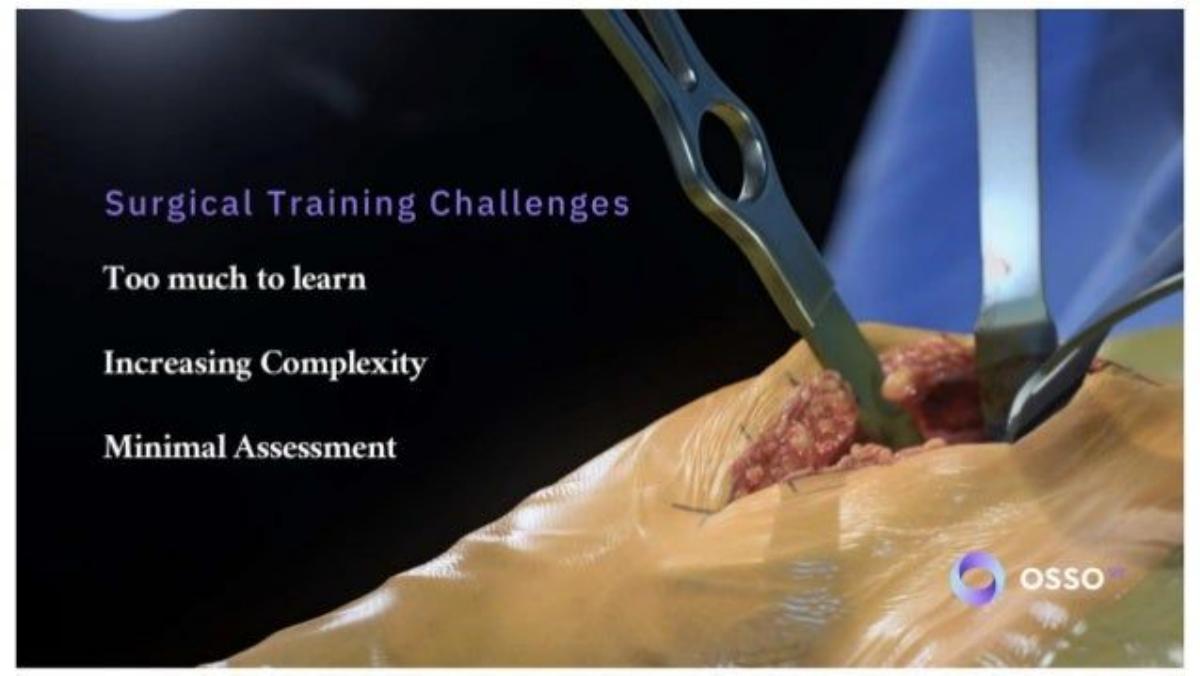
- The deck identifies three primary surgical training challenges: too much to learn, increasing complexity, and minimal assessment (Slide 3).
- A 300% improvement in procedural completion is cited when comparing VR training to traditional PDF-based learning (Slide 8).
- The strategy shift from 'one and done' training to long-term adoption is visualized through a performance-over-time curve (Slides 10 and 11).
- The deck completely omits a team slide, financial history, and a specific 'ask' for the Series C round (Slides 1-13).
The Anatomy of a High-Stakes Medtech Pitch
Osso VR’s Series C deck is a study in clinical authority. While many VR startups focus on the 'wow' factor of the hardware, Osso VR treats the headset as a mere delivery mechanism for a scientifically validated curriculum. Raising $66M in a Series C requires moving beyond user growth metrics and into the realm of systemic impact. This deck does exactly that by focusing on the 'cost of inaction' in surgical training.
Slide 1: Title and Positioning
The cover slide is minimalist, featuring the Osso VR logo and a high-quality render of a VR headset. The tagline, "Operate at a higher level," serves a dual purpose: it refers to the literal act of surgery and the metaphorical improvement in professional standards. It defines the company as the "leading virtual reality surgical training and assessment platform." By including 'assessment,' they signal that this isn't just a video game; it is a data-gathering tool for hospitals.
Slide 2: The Mission
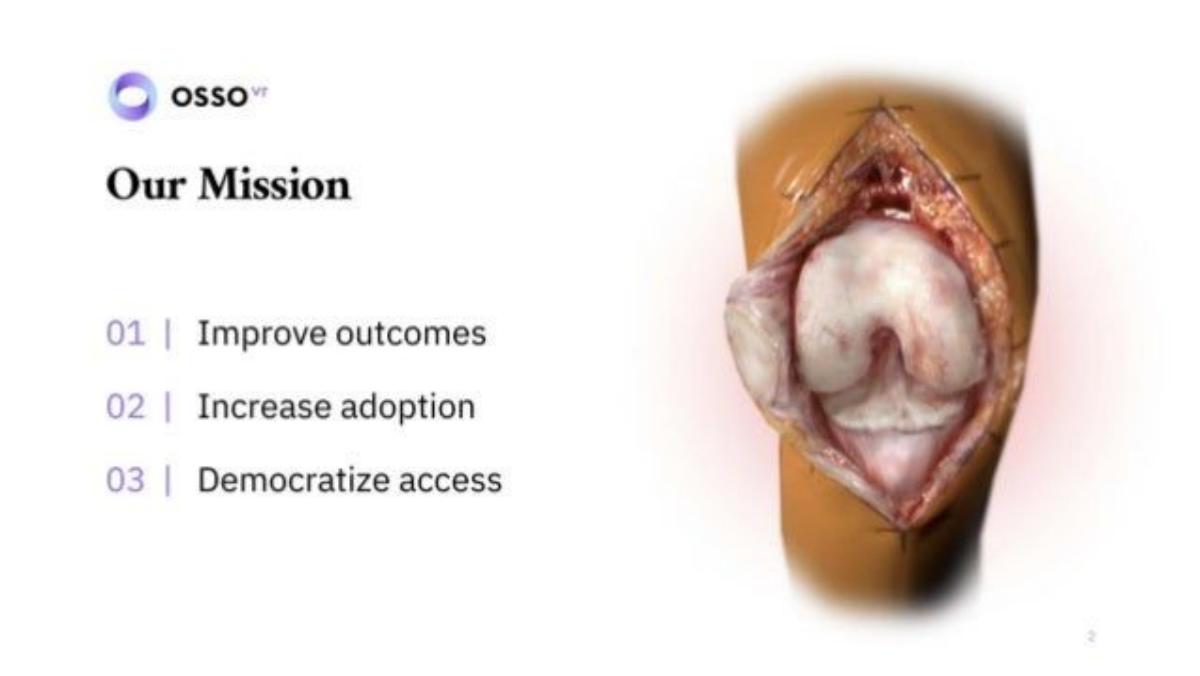
Slide 2 outlines three pillars: "01 | Improve outcomes," "02 | Increase adoption," and "03 | Democratize access." The visual on the right is a realistic medical illustration of a knee surgery. This is a deliberate choice to signal that the company is rooted in medicine, not just tech. The mission is broad enough to justify a massive valuation but specific enough to be measurable.
Slide 3: Defining the Surgical Training Challenges
Osso VR identifies three specific pain points: "Too much to learn," "Increasing Complexity," and "Minimal Assessment." This slide sets the stage for the solution. By highlighting 'Minimal Assessment,' they are attacking the status quo where a surgeon's proficiency is often assumed rather than measured. The background image of a live surgery reinforces the high stakes of the problem.
Slide 4: Why it Matters (The Macro View)
This is the 'Market Size' slide, but it avoids the typical 'TAM' jargon. Instead, it presents three staggering figures: "1.1 million surgeons globally," "310 million major surgeries per year," and "$8.3 trillion global cost of healthcare." By placing their solution within the context of the $8.3 trillion healthcare spend, they suggest that reducing surgical errors or training time has multi-billion dollar economic value.
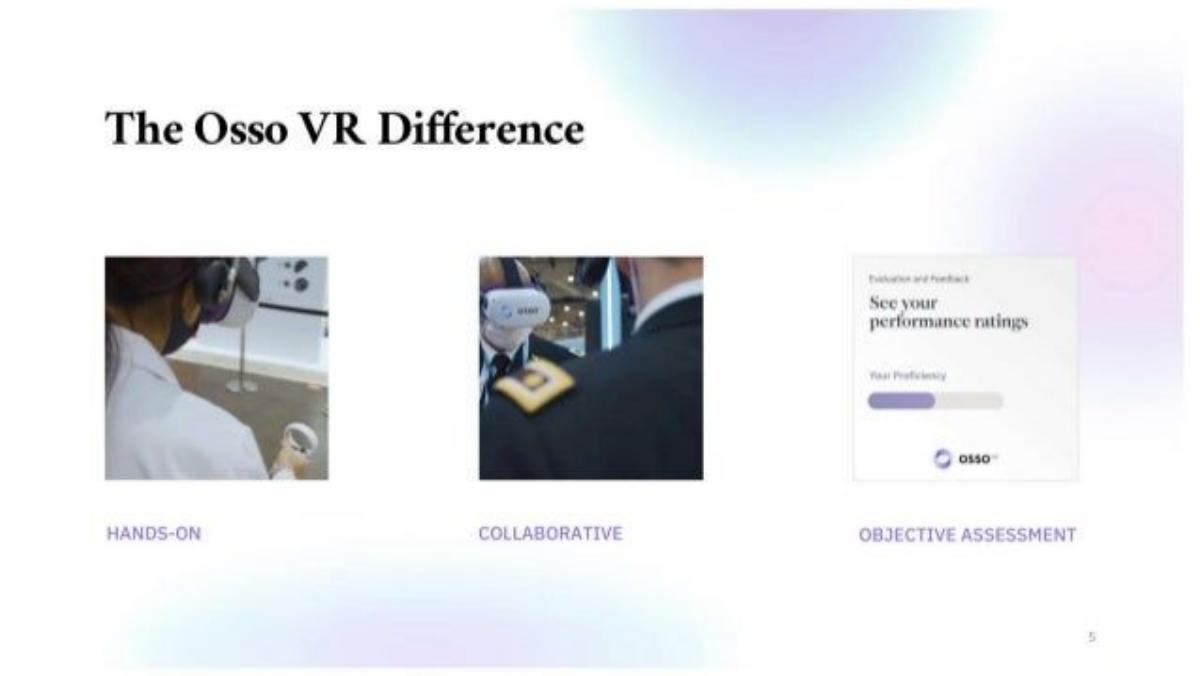
Slide 5: The Osso VR Difference
This slide breaks down the product's core features into three categories: "Hands-on," "Collaborative," and "Objective Assessment." The third point is the most important for the Series C narrative. The visual shows a 'performance rating' screen, emphasizing that the platform provides a data loop that traditional training (like reading a textbook or watching a video) cannot offer.
Slide 6: Social Proof and Partnerships
This is arguably the strongest slide in the deck for an institutional investor. It features the logos of industry giants: Smith & Nephew, Stryker, Medtronic, Johnson & Johnson, Endologix, and Zimmer Biomet. Below the logos, it states "20+ Hospital & Residency Programs" and "12+ Medical Device Companies." For a Series C company, this proves that the product has already been vetted and integrated by the most significant players in the medical field.
Slide 7: Clinical Validation (The 230% Metric)
This slide answers the question, "Does it work?" It cites a "Randomized Trial of a Virtual Reality Tool to Teach Surgical Technique" published in the Journal of Surgical Education (Feb 2020) . The headline metric is that "Performance scores [are] 230% better with Osso VR than with traditional training methods." The bar chart breaks this down into sub-categories like 'Time and Motion,' 'Instrumental Handling,' and 'Knowledge of Instruments,' showing Osso VR (purple) outperforming standard training (dark blue) in every metric.
Slide 8: Further Proof of Accuracy
Continuing the validation theme, Slide 8 cites a study from Clinical Orthopaedics and Related Research . It shows a "300% Improvement" in procedural completion and accuracy. Specifically, the VR group achieved a 78% success rate compared to only 25% for the group using traditional PDF-based instructions. This slide is designed to show that the 230% figure wasn't a fluke; multiple studies confirm the platform's efficacy.
Slide 9: Deep Dive into Knee Arthroplasty
Slide 9 provides even more granular data, focusing on a specific procedure: unicondylar knee arthroplasty . It shows that Osso VR reduces "Procedure Time" and "Redirects" while increasing the "Total Score." This level of detail is intended for the technical due diligence phase of a Series C, proving the platform's versatility across different surgical disciplines.
Slide 10 & 11: The Strategy Shift
These two slides visualize the 'Education Journey.' Slide 10 shows the "Traditional education journey" as a series of 'one and done' events (product demo, cadaver lab, first case) that result in a slow, inefficient learning curve. Slide 11 introduces the "VR enabled digital education strategy." It shows how VR fills the gaps with 'Pre-Train' and 'Refresher Training,' leading to much higher performance levels before the surgeon ever touches a patient. This is the 'Go-to-Market' logic: Osso VR isn't just a tool; it's a new infrastructure for medical education.
Slide 12: Visual Immersion
The penultimate slide is a full-bleed image of the VR environment from the surgeon's perspective. It shows blue-gloved hands holding VR controllers, interacting with surgical tools on a tray. This reminds the investor of the product's high fidelity and 'game-like' engagement, which drives the high adoption rates mentioned earlier.
Slide 13: Closing
The final slide is a placeholder from the source library and does not contain Osso VR-specific information. In a real pitch, this would typically be a contact slide or a summary of the investment terms.
What Osso VR Does Exceptionally Well
Clinical Authority: Most startups use testimonials; Osso VR uses randomized controlled trials. By citing the Journal of Surgical Education, they bypass the skepticism often directed at VR 'gadgets.' They prove that their software has a measurable clinical outcome, which is the gold standard in healthcare investing.
Blue-Chip Validation: Listing Medtronic and Johnson & Johnson as partners is a massive de-risking signal. It tells the investor that the largest potential acquirers in the space are already using and valuing the technology.
Quantified Value: They don't just say they are 'better.' They say they are '230% better.' They don't just say surgery is 'expensive.' They say it's an '$8.3 trillion' problem. Every claim is anchored to a specific, hard number.
What is Missing from the Deck
The Team: There is no slide introducing the founders or the medical advisory board. For a Series C, investors want to see a world-class executive team capable of scaling a global enterprise. While this information was likely provided in other documents, its absence in the main deck is notable.
Financials and Unit Economics: The deck is entirely focused on the problem and the efficacy of the solution. It omits revenue growth, ARR, churn rates, or the cost of customer acquisition (CAC). For a $66M round, these metrics would be the primary focus of the actual due diligence process.
The Ask: The deck does not specify how much they are raising or how they intend to use the capital. This suggests the deck was used as a high-level introduction or a 'teaser' to secure the first meeting, rather than a final 'closing' deck.
Founder's Playbook: What to Copy
The 'Does it Work?' Slide: Every founder in a technical or regulated field should have a slide that explicitly asks 'Does it work?' and answers it with third-party data. It is the most effective way to build immediate trust.
The Journey Comparison: Slides 10 and 11 are excellent examples of how to visualize a 'before and after' scenario. Instead of listing features, they show how their product changes the entire timeline of a customer's experience. This makes the solution feel systemic rather than incremental.
Macro-Problem Framing: If you are solving a niche problem, find the multi-trillion dollar industry it sits within. Osso VR doesn't just 'train surgeons'; it 'reduces the $8.3 trillion cost of healthcare.' Framing your startup as a solution to a global economic inefficiency increases your perceived ceiling.
Frequently asked questions
- Why does the deck focus so much on clinical trials?
- In the medtech and healthtech space, 'efficacy' is the only metric that truly matters to institutional investors. By citing peer-reviewed studies showing a 230% performance increase, Osso VR moves its product from a 'nice-to-have' educational tool to a 'must-have' clinical intervention. This de-risks the investment by proving the product actually works in a measurable, scientific way.
- How does Osso VR define its market size?
- Instead of using traditional TAM/SAM/SOM circles, Osso VR uses three macro figures: 1.1 million surgeons, 310 million major surgeries annually, and the $8.3 trillion global cost of healthcare. This frames the problem as a systemic inefficiency in a multi-trillion dollar industry, suggesting that even a small improvement in surgical proficiency has massive economic implications.
- What is the 'Traditional Education Journey' slide trying to communicate?
- Slide 10 illustrates the 'forgetting curve' and the inefficiency of current training. It shows that product demos and cadaver labs provide very low performance gains. By contrasting this with Slide 11, Osso VR shows how their platform fills the gaps between these events, leading to 'Long Term Adoption' and higher proficiency before the first live case.
- Is the lack of a team slide a red flag?
- For a Series C round, the 'team' is often already known to the lead investors, or the company's traction speaks for itself. While unusual for a general pitch, Osso VR likely relied on its existing reputation and the strength of its partnerships (Slide 6) to establish credibility, though we generally recommend including a team slide to highlight leadership experience.
- What business model does Osso VR use based on the deck?
- The deck doesn't explicitly detail pricing, but Slide 11 mentions 'VR-enabled sales training' and partnerships with 12+ medical device companies. This suggests a B2B model where they sell to both the providers (hospitals) and the manufacturers (device companies) who need surgeons to be proficient in using their specific hardware.