Oshi Health raised a $30M Series B in 2023, led by Koch Disruptive Technologies, by positioning digestive health as a top-four cost driver for employers. The 17-slide deck avoids the common pitfall of focusing solely on user experience, instead leaning heavily into clinical validation and actuarial data. With a 'gold standard' matched-control study showing $10.2K in total medical cost savings per member in year one, the pitch presents a clear financial arbitrage for payers and self-funded employers. While the deck lacks a traditional team slide or a detailed breakdown of the $30M use of funds…
Key takeaways
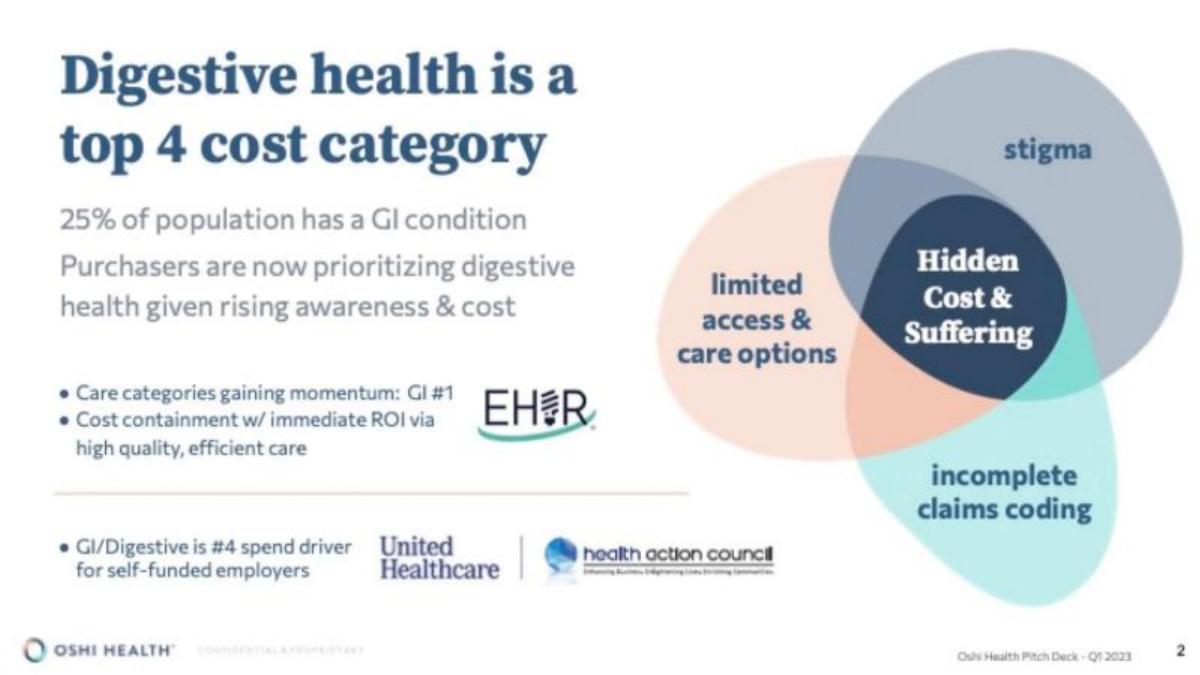
- Digestive health is identified as the #4 spend driver for self-funded employers on slide 2.
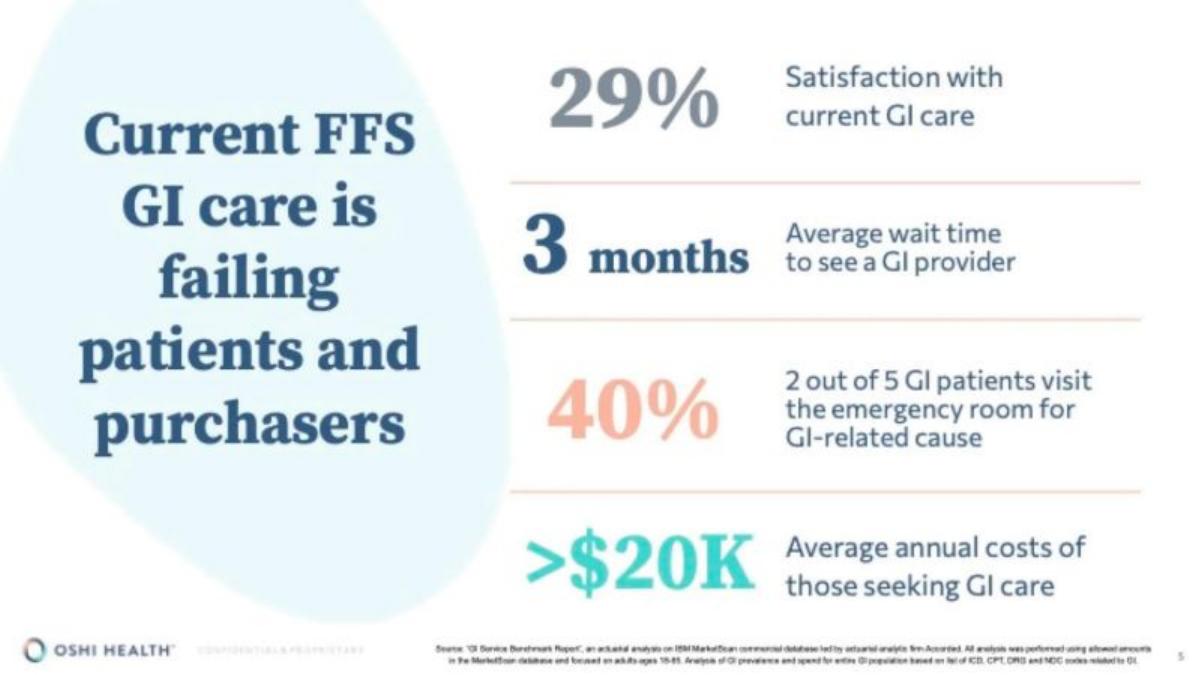
- Current GI care is criticized for a 3-month average wait time and a 40% ER visit rate on slide 5.
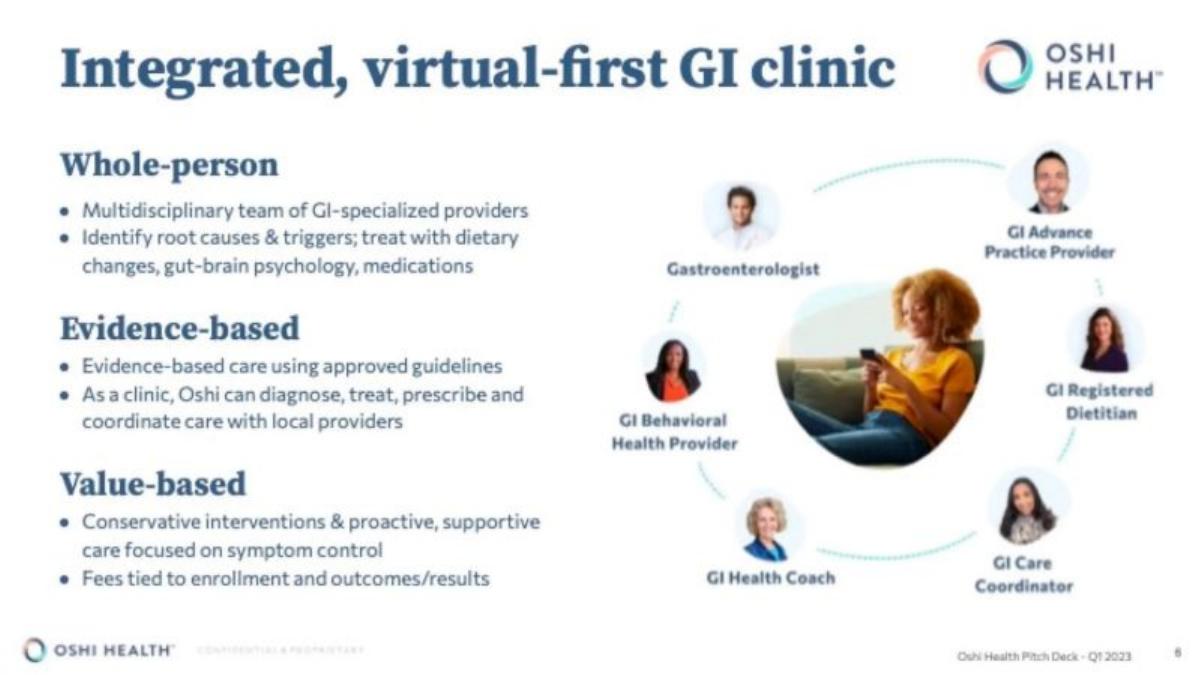
- The platform utilizes a multidisciplinary team including GI-specialized providers, dietitians, and behavioral health providers (slide 6).
- Oshi claims to diagnose and treat 25% of the population across a wide range of conditions, from IBD to motility disorders (slide 8).
- A clinical study with a national health plan demonstrated $10,200 in total medical cost savings per member in the first year (slide 13).
- The business model shifts from fee-for-service to value-based fees tied to enrollment and outcomes (slide 14).
- 91% of members achieve symptom control, typically in less than four months (slide 11).
- The company has achieved insurance coverage for over 20 million people across 20 states (slide 15).
The Macro Problem: Digestive Health as a Financial Burden
Slides 1-2: Setting the Stage
The deck opens with a clean title slide (Slide 1) that immediately establishes the company's mission: "Transforming access, outcomes & economics in digestive health." This is a sophisticated hook for a Series B; it signals that the company isn't just a wellness app, but a solution to a systemic economic problem. Slide 2 reinforces this by labeling digestive health as a "top 4 cost category." It cites UnitedHealthcare and the Health Action Council to validate that GI issues affect 25% of the population. The Venn diagram on this slide is particularly effective, illustrating how "limited access," "stigma," and "incomplete claims coding" result in "Hidden Cost & Suffering." By leading with the financial pain felt by payers, Oshi Health aligns itself with the interests of the people writing the checks.
Slides 3-5: The Failure of the Status Quo
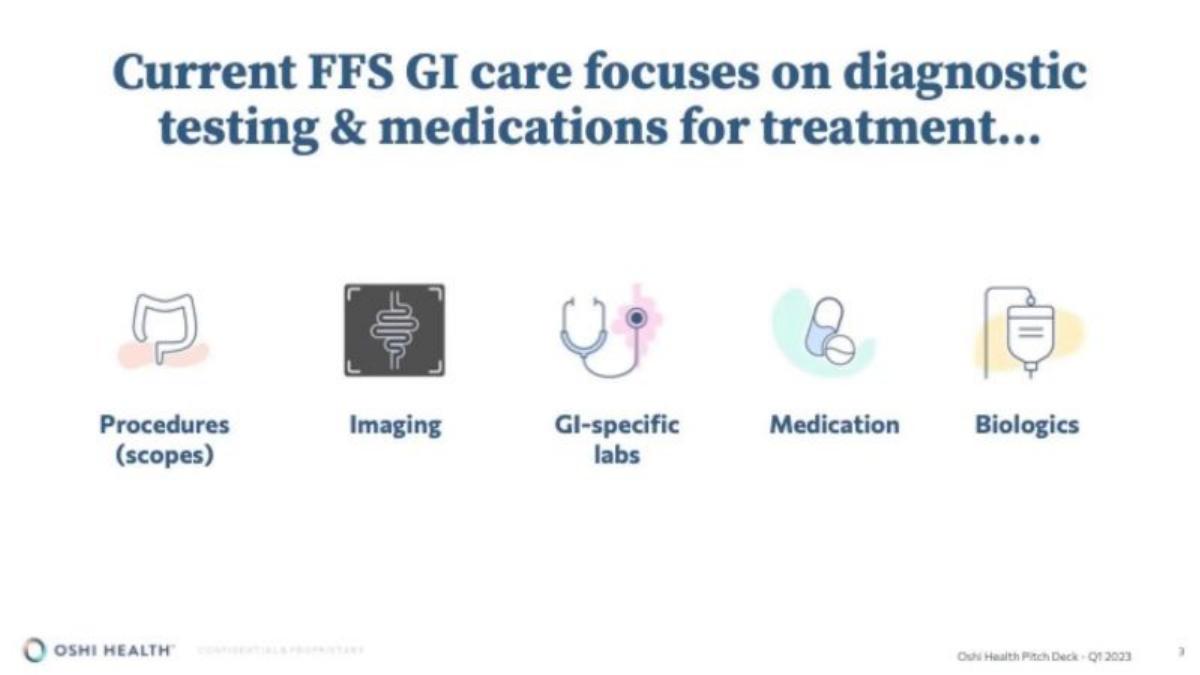
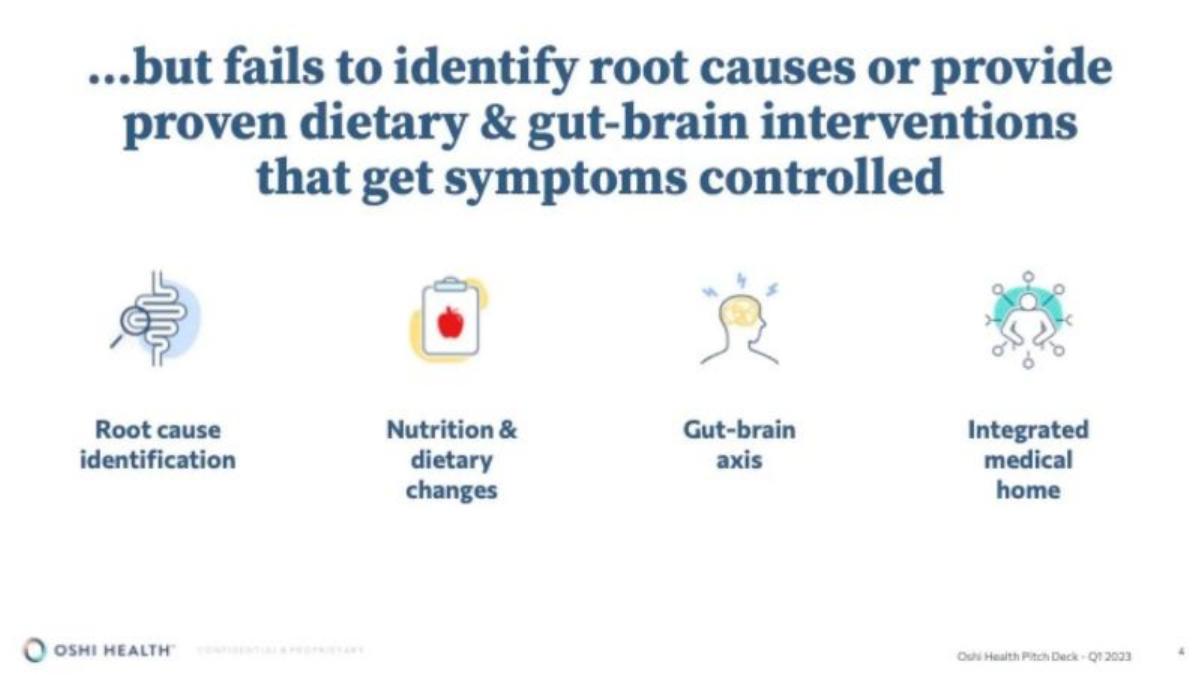
Slides 3 and 4 contrast the current Fee-For-Service (FFS) model with Oshi's approach. Slide 3 lists the staples of traditional GI care: procedures (scopes), imaging, labs, medication, and biologics. Slide 4 then delivers the 'but': this model "fails to identify root causes" or provide dietary and gut-brain interventions. This is a classic 'Old Way vs. New Way' setup. Slide 5 provides the data to back up this failure, citing a 29% satisfaction rate with current care, a 3-month average wait time , and the startling fact that 40% of GI patients visit the ER . The most impactful figure here is the ">$20K average annual cost" for those seeking GI care, setting a high baseline that Oshi intends to disrupt.
The Solution: A Multidisciplinary Virtual Clinic
Slides 6-7: The Integrated Care Model
Slide 6 introduces the "Integrated, virtual-first GI clinic." It emphasizes a "whole-person," "evidence-based," and "value-based" approach. The visual shows a patient at the center of a circle of specialists: a Gastroenterologist, GI Behavioral Health Provider, GI Health Coach, GI Care Coordinator, GI Registered Dietitian, and a GI Advance Practice Provider. This slide is crucial because it justifies the complexity of their service—it's not just an algorithm; it's a coordinated medical team. Slide 7 shows the product in action via mobile mockups, highlighting features like "Next Steps," provider selection, and a video call interface. This demonstrates that the high-touch care described on the previous slide is delivered through a modern, accessible interface.
Slides 8-9: Scope and Care Path
Slide 8 is a dense table intended to show the breadth of Oshi's capabilities. It lists dozens of conditions across categories like Immune-Mediated & Inflammatory (IBD, Crohn's), Motility Disorders (IBS), Esophageal (GERD), and even Liver conditions. This slide answers the investor question: "How big is the addressable patient pool?" By claiming they can "diagnose & treat them all," Oshi positions itself as a comprehensive replacement for traditional outpatient GI clinics. Slide 9 illustrates the "Hybrid Treatment Path," showing how Oshi's virtual care coordinates with "Trusted Local Providers" for physical procedures like infusions or scopes. This acknowledges the reality of medical care—you can't do an endoscopy over Zoom—and shows Oshi as a partner to the existing ecosystem rather than a purely competitive threat.
The Evidence: Clinical Validation and ROI
Slides 10-12: Proving the Outcomes
This section is the heart of the Series B pitch. Slide 10 details a "Rigorous clinical study with national health plan" involving 350 members. Using terms like "Gold standard" and "matched-control design" signals to investors that the data is scientifically valid. Slide 11 is a high-impact 'big number' slide: 91% of Oshi members achieve symptom control , usually in less than four months. Slide 12 adds the human element, reporting 99%+ member satisfaction , a 50% improvement in lost work days , and a 3x improvement in quality of life . For a healthcare startup, these three slides move the needle from 'interesting' to 'investable' by removing clinical risk.
Slides 13-14: The Economic Arbitrage
If Slides 10-12 prove the clinical value, Slide 13 proves the financial value. It claims $6.7K in year-one GI savings and $10.2K in total medical cost savings per member. The slide breaks this down into specific reductions: 85% decrease in avoidable procedures , 70% decrease in GI-related ER visits , and 40% reduction in avoidable medication . This is the exact data a benefits manager at a Fortune 500 company needs to see. Slide 14 explains how Oshi captures this value through an "In-network GI clinic" model with "Fees based on enrollment & outcomes" and "Bundled case rates." This confirms that Oshi is leaning into the industry shift toward value-based care.
Traction and Scale
Slides 15-17: Market Presence and Vision
Slide 15 demonstrates significant market traction. It states that ">20M people have access to Oshi Health care covered by insurance" and that they are "Currently in 20 states containing >60% of the US population." The logos of Aetna, UnitedHealthcare, and Blue Cross Blue Shield provide massive social proof. Slide 16 is a standard vision/mission wrap-up, urging investors to "Join our Mission to Free Millions of People from the Burden of Digestive Conditions." Slide 17 is a placeholder for the bestpitchdeck.com catalogue and not part of the original Oshi presentation.
What Oshi Health Does Well
ROI-First Narrative: The deck is relentlessly focused on cost savings. In a crowded digital health market, Oshi stands out by proving they can save a payer $10k per head. · Clinical Rigor: By citing a matched-control study and presentations at the IHI Forum, Oshi distances itself from "wellness" apps and establishes itself as a serious medical provider. · Clarity of Model: The deck clearly explains how a virtual clinic interacts with the physical world (Slide 9) and how it gets paid (Slide 14). · Visual Hierarchy: The slides use large, bold numbers for key metrics (91%, $10.2K, 20M), making the deck easy to skim while still conveying the magnitude of the opportunity.
What is Missing from the Deck
Team Slide: There is no mention of the founders, the Chief Medical Officer, or the executive team. In a Series B, the pedigree of the leadership team is usually a major selling point. · Financial Performance: While the deck shows cost savings for customers, it doesn't show revenue growth, margins, or burn rate for Oshi. Investors would want to see the path to profitability. · The Ask: The deck doesn't explicitly state that they are raising $30M or how that money will be used (e.g., geographic expansion, R&D, sales team). · Competitive Landscape: There is no slide addressing competitors like Vivante Health or Salvo Health. Oshi assumes its clinical data is strong enough to stand alone.
What Other Founders Should Copy
The "Cost Driver" Hook: If you are in HealthTech, don't just say you help people; identify which of the top spend categories you are attacking. · The Outcome/Satisfaction/Savings Trio: Slides 11, 12, and 13 provide a perfect template for reporting traction: Clinical Outcome + User Satisfaction + Financial Savings. · Specific Condition Mapping: Slide 8 is a great way to show the depth of a clinical solution. It prevents the investor from thinking the product is "just for IBS" or "just for heartburn." · Value-Based Messaging: Aligning your business model with the current industry trend (value-based care) makes the startup feel like an inevitable part of the future healthcare landscape.
Frequently asked questions
- What is Oshi Health's primary value proposition?
- Oshi Health positions itself as an integrated, virtual-first GI clinic that addresses the root causes of digestive issues through a multidisciplinary team. Unlike traditional fee-for-service models that focus on diagnostic testing and medication, Oshi integrates dietary changes and gut-brain psychology to achieve symptom control. Their primary value to 'purchasers' (employers and payers) is a significant reduction in high-cost events like ER visits and avoidable endoscopies.
- How does Oshi Health prove its clinical effectiveness?
- The deck highlights a 'gold standard' matched-control clinical study conducted with a national health plan involving 350 members. The results, presented at the 2022 IHI Forum, showed that 91% of members achieved symptom control in under four months. This data is used to bridge the gap between a digital health app and a legitimate medical intervention, which is critical for a Series B round.
- What is the business model described in the deck?
- Oshi Health utilizes a value-based care model. Slide 14 specifies that they operate as an in-network GI clinic where fees are based on enrollment and outcomes, often using a bundled case rate. This aligns their financial incentives with the payer's goal of reducing overall medical spend, rather than the traditional model of billing for every individual procedure or test.
- Who are the target customers for Oshi Health?
- The deck identifies 'purchasers'—specifically self-funded employers and national health plans—as the primary customers. Slide 15 lists partners such as Aetna, UnitedHealthcare, and Blue Cross Blue Shield. While the care is delivered to patients (B2C model), the revenue is driven by B2B enterprise contracts and insurance reimbursements.
- What are the most significant omissions in this pitch deck?
- The most glaring omission is a team slide; for a $30M round, investors typically want to see the clinical and operational pedigree of the founders. Additionally, there is no financial slide showing historical revenue growth (ARR) or a specific 'Ask' slide detailing how the $30M will be allocated. These may have been handled in a separate data room or supplemental document.