Nuvia’s 2020 Series B pitch deck is a high-conviction document that relies heavily on the technical pedigree of its founders and the stagnation of legacy silicon providers. Rather than focusing on traditional SaaS metrics like MRR or churn, Nuvia sells a 'paradigm shift' in CPU performance. The deck successfully argues that mobile processors have caught up to server CPUs, creating a massive opportunity for a clean-slate architecture. With a team hailing from Apple, Google, and ARM—holding a combined 102 issued patents—the deck positions Nuvia not as a risky startup, but as an inevitable indus…
Key takeaways
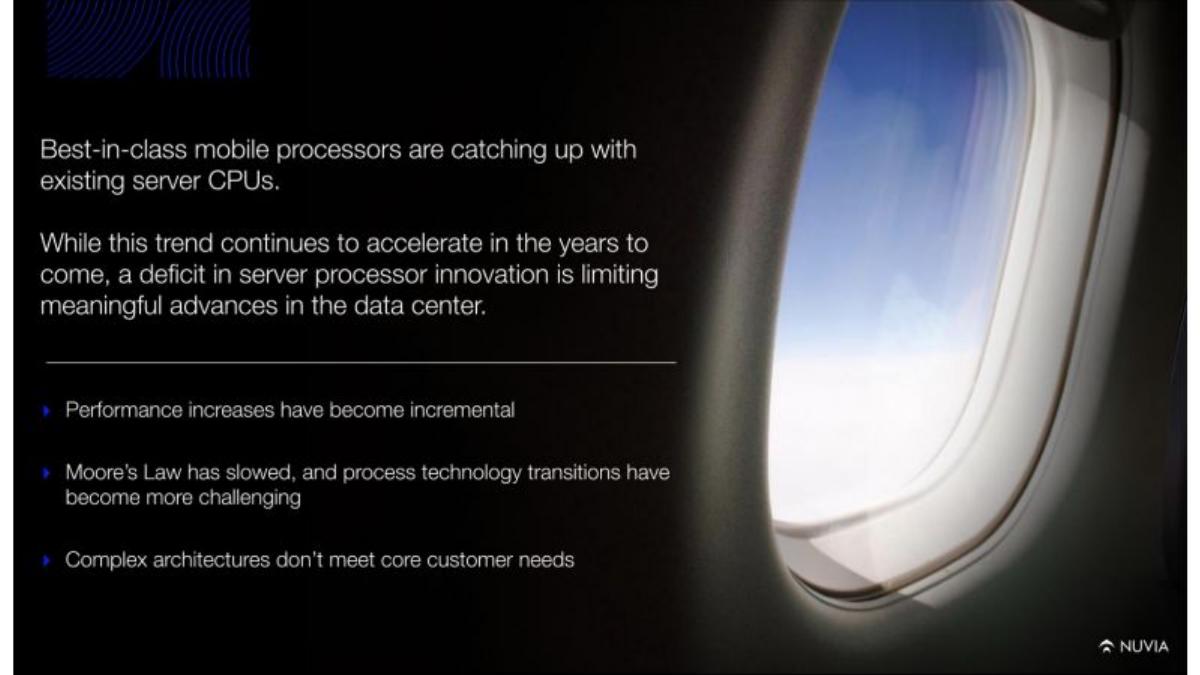
- The deck identifies a specific market gap: mobile processors are catching up to server CPUs while innovation in the data center has stalled (Slide 3).
- Nuvia utilizes a 'clean slate' narrative, building a custom server-class CPU/SoC running the ARM ISA from the ground up (Slide 9).
- Technical authority is established through the founders' patent counts: Gerard Williams III (38), Manu Gulati (58), and John Bruno (6) (Slide 16).
- The core value proposition is visualized through Geekbench 5 performance-per-watt curves, showing Nuvia significantly outperforming Apple, Intel, and AMD (Slide 12).
- The team emphasizes a global footprint with design centers in Santa Clara, Austin, Toronto, and Bangalore to tap into specialized talent (Slide 17).
- Nuvia highlights a 'legacy of industry leadership' by showcasing logos of 40+ companies where their 200+ employees previously worked (Slide 18).
- The deck lacks traditional financial projections or a specific use-of-funds breakdown, relying instead on the magnitude of the technical challenge and the team's ability to execute (Slide 20).
- The fundraising status is explicitly stated as 'Series B coming soon,' following a Series A backed by WRVI Capital, Dell Technologies Capital, and Mayfield (Slide 14).
The Deep Tech Playbook: Analyzing Nuvia's $240M Series B Deck
Fundraising for a semiconductor startup is fundamentally different from raising for a SaaS company. There are no early revenue charts, no CAC/LTV ratios, and no viral loops. Instead, there is physics, engineering pedigree, and the 'Performance Per Watt' curve. Nuvia’s Series B deck is a masterclass in how to sell a vision that requires hundreds of millions of dollars in R&D before a single product ships.
Slides 1-4: Setting the Stage for a Paradigm Shift
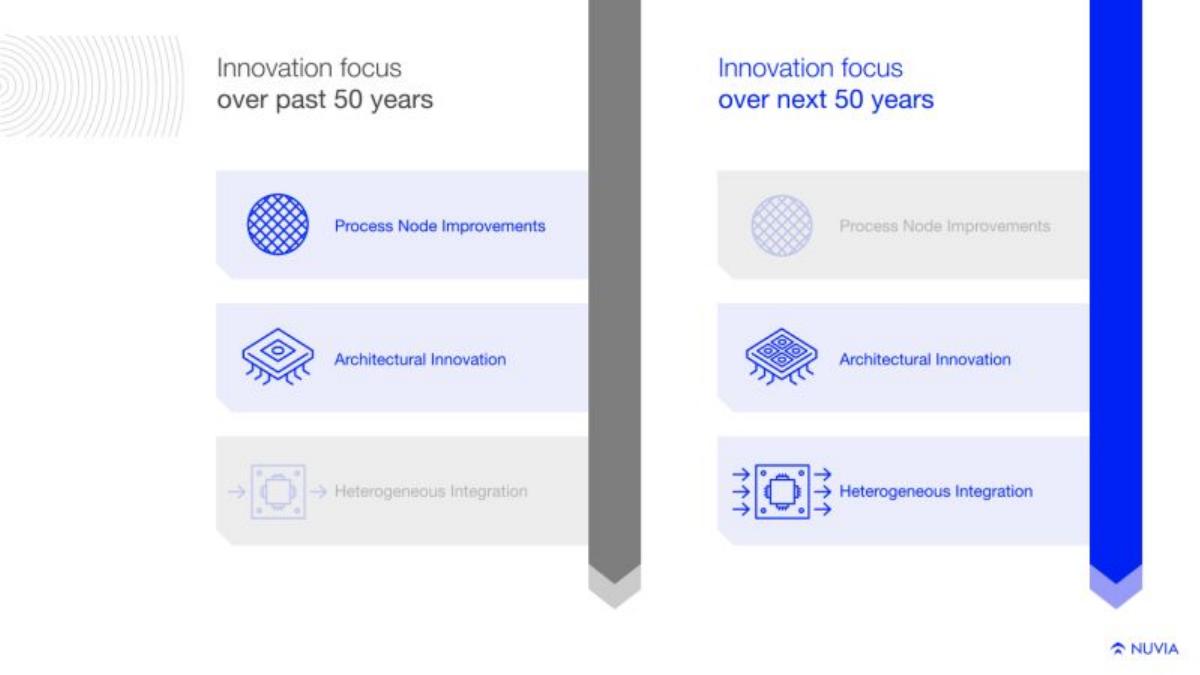
Nuvia opens with a minimalist title slide (Slide 1) featuring the tagline 'A new way of thinking.' This is followed by a dramatic 'The perfect storm' visual (Slide 2), which is a common trope in high-stakes pitching to signal a massive market inflection point. The meat of the problem begins on Slide 3, where Nuvia identifies a 'deficit in server processor innovation.' They make a bold claim: best-in-class mobile processors are catching up with existing server CPUs. This is the foundational 'Why Now?' of the deck. They argue that Moore's Law has slowed and complex legacy architectures are failing to meet customer needs. Slide 4 visualizes the innovation focus of the past 50 years (process node improvements and architectural innovation) versus the next 50 years, where 'Heterogeneous Integration' becomes the dominant driver. By framing the problem as a historical shift, Nuvia positions itself as the only player looking forward.
Slides 5-6: The Data-Driven Opportunity
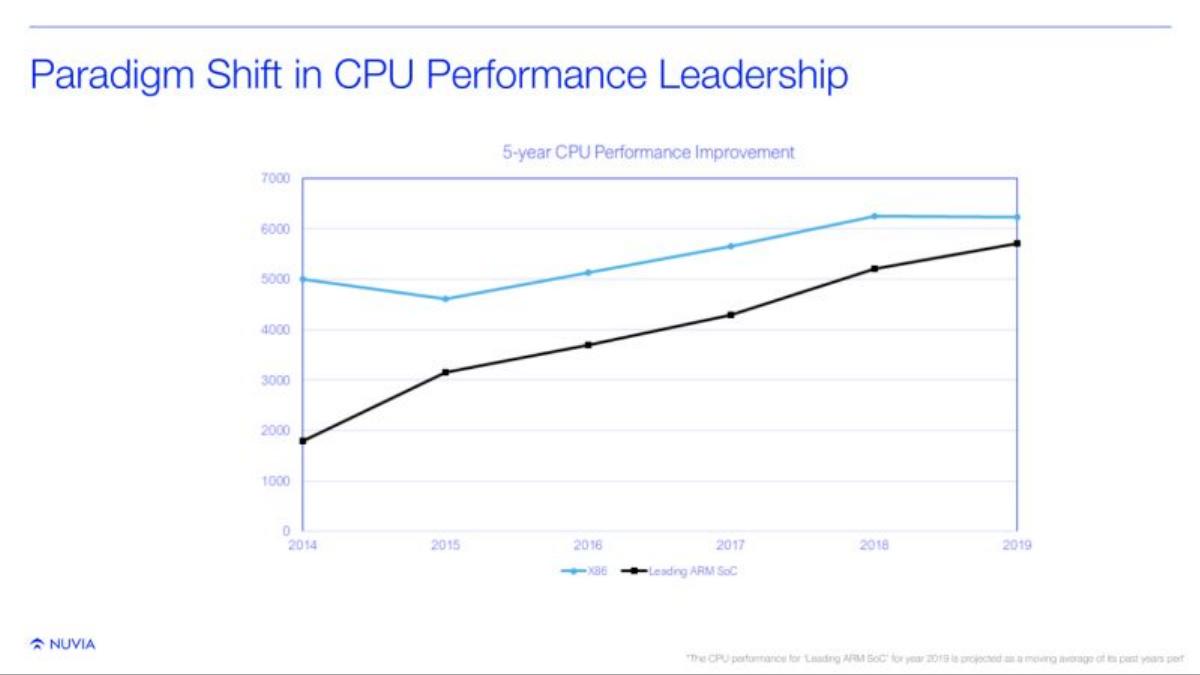
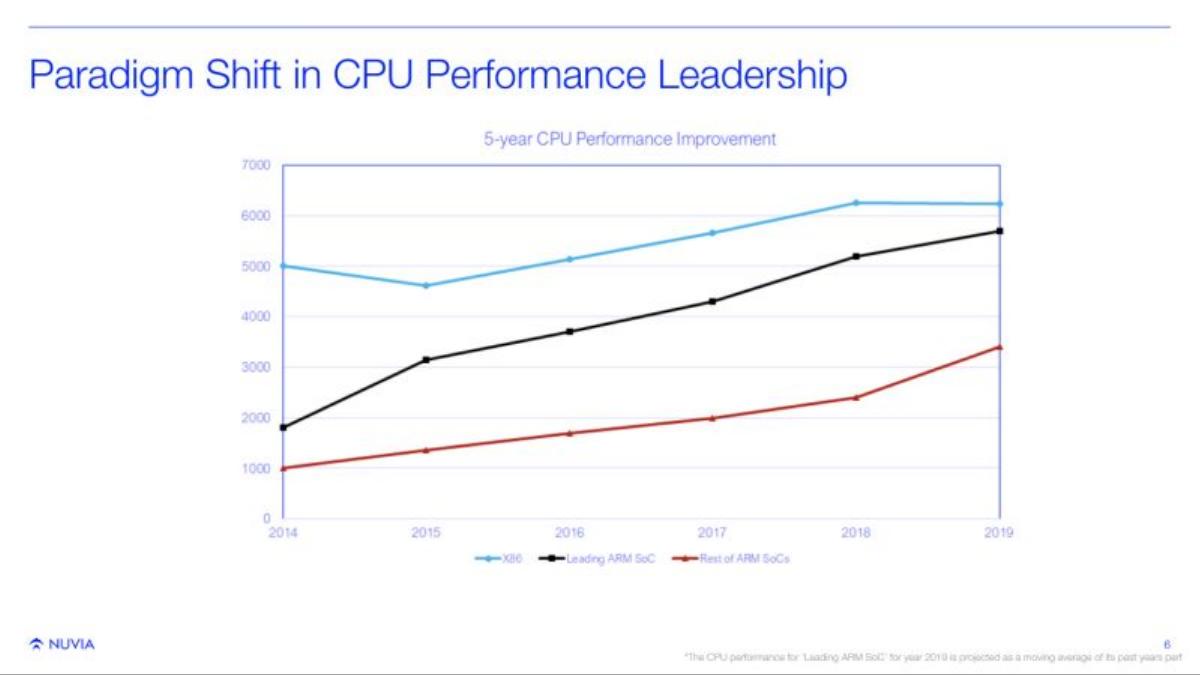
Slides 5 and 6 use line graphs to illustrate a 'Paradigm Shift in CPU Performance Leadership.' The charts show a 5-year CPU performance improvement trend. The blue line (X86) shows a flattening curve, while the black line (Leading ARM SoC) shows a steep upward trajectory. Slide 6 adds a third line for 'Rest of ARM SoCs,' showing that only a few players are truly innovating. This data is critical because it validates Nuvia's choice to build on the ARM ISA (Instruction Set Architecture). It tells investors that the 'winner' in the next decade of computing will be the team that can extract the most performance out of ARM, not those sticking with legacy X86 architectures.
Slides 7-10: The Mission and the Clean Slate
After establishing the market gap, Slide 7 introduces Nuvia as 'A New Approach.' Slide 8 defines the mission: 'to reimagine silicon in a new way, and create computing platforms that redefine performance for the modern data center.' This is a high-level vision slide designed to appeal to the 'big picture' instincts of Series B investors. Slide 9 gets specific about the 'How.' Nuvia is 'starting from scratch' with a custom-built architecture. They highlight three pillars: building a custom server-class CPU/SoC running the ARM ISA, delivering performance leadership in single and multi-threaded workloads, and designing on a leading-edge process node. Slide 10 rounds out the vision by emphasizing 'total cost of ownership' (TCO), which is the primary metric that data center customers (like AWS, Google, and Microsoft) care about.
Slides 11-12: The 'Killer' Metric - Performance Per Watt
Slide 11 and 12 are arguably the most important slides in the deck. They present Geekbench 5 Performance Per Watt data. Slide 11 shows the current landscape, with curves for the Apple A13, Intel i7, and AMD Ryzen. Slide 12 then overlays the Nuvia projection (represented by a large blue 'wing' shape). The Nuvia curve is significantly higher on the Y-axis (Single Core Performance) while remaining far to the left on the X-axis (Power in Watts). This visual is the 'proof' of their technical advantage. It shows that Nuvia expects to deliver nearly double the performance of an Intel i7 at a fraction of the power. In the world of data centers, where electricity and cooling are the largest operational costs, this chart represents a multi-billion dollar value proposition.
Slides 13-15: Values and Momentum
Slide 13 lists the company's values, such as 'Diversity of thought and people' and 'Disruptive agility.' While these might seem like filler, in a talent-war industry like semiconductors, showing a strong culture is a recruiting signal. Slide 14 lists the Series A investors, providing social proof from heavyweights like Dell Technologies Capital and Mayfield. The text 'Series B coming soon...' creates the necessary urgency for the current round. Slide 15 is a transition slide using hot air balloon imagery to reinforce the 'journey' narrative.
Slides 16-18: The Pedigree (The 'Moat')
For a pre-product semiconductor company, the team is the moat. Slide 16 introduces the founders: Gerard Williams III (CEO), Manu Gulati (VP SoC Engineering), and John Bruno (VP System Engineering). The slide lists their previous employers (Apple, ARM, Google, AMD) and, crucially, their patent counts. Gerard Williams III has 38 issued patents; Manu Gulati has 58. This is an extraordinary level of technical authority. Slide 17 shows their 'Worldwide locations,' including design centers in Santa Clara, Austin, Toronto, and Bangalore. This demonstrates that they have the infrastructure to scale. Slide 18, 'A legacy of industry leadership,' is a 'logo cloud' of 40+ companies where their 200+ employees have worked. This slide is designed to show that Nuvia isn't just three guys in a garage; it’s an assembly of the industry’s elite.
Slides 19-21: The Conclusion and Strategy
Slide 19 is a simple 'And we’re just getting started...' transition. Slide 20 summarizes the strategy: building an industry-leading CPU, assembling an experienced team, and taking a 'solutions approach' that will eventually extend into AI, networking, and storage. This expands the Total Addressable Market (TAM) beyond just CPUs, suggesting that Nuvia could eventually challenge companies like Nvidia or Broadcom. Slide 21 is a promotional slide for the platform where the deck was hosted, not part of the original pitch.
What Nuvia Does Well
Technical Authority: Nuvia doesn't shy away from the complexity of their product. By highlighting patent counts and specific benchmarks (Geekbench 5), they speak the language of deep-tech investors. They establish themselves as the 'A-Team' of silicon design.
Focus on the Right Metric: They correctly identify that 'Performance Per Watt' is the only metric that matters in the modern data center. Every other slide in the deck serves to support their ability to win on this single chart.
The 'Clean Slate' Narrative: They turn their lack of legacy products into a strength. By 'starting from scratch,' they argue they can avoid the architectural 'cruft' that slows down incumbents like Intel and AMD.
What is Missing from the Nuvia Deck
Financial Projections: There is no mention of expected revenue, pricing models, or margins. In a Series B, you would typically see some financial modeling, but Nuvia relies entirely on the 'build it and they will come' logic of high-end hardware.
Go-to-Market (GTM) Detail: While they mention 'targeted customer engagement,' they don't name specific partners or pilots. For a $240M raise, investors usually want to see more than just a 'solutions approach'—they want to see a pipeline.
The 'Ask': The deck does not specify how much they are raising or how the capital will be allocated (e.g., tape-out costs, hiring, lab equipment). While the catalogue facts state they raised $240M, the deck itself leaves the 'Ask' for a private conversation.
What Other Founders Should Copy
Benchmark Comparison: If you are in a performance-driven industry, use industry-standard benchmarks (like Geekbench) to show exactly where you sit relative to the competition. Don't use vague 'better/faster/stronger' language; use the X and Y axes.
The 'Legacy of Leadership' Slide: Slide 18 is a brilliant way to show the depth of a team without listing 200 individual bios. Showing the logos of where your team came from is a powerful shorthand for 'we know how to do this.'
Problem Framing: Nuvia’s Slide 3 is a perfect example of how to frame a market opportunity. They don't just say 'servers are slow'; they explain why (mobile innovation vs. server stagnation) and why the current trend makes their entry inevitable.
Frequently asked questions
- How does Nuvia justify entering the highly competitive semiconductor market?
- Nuvia justifies its entry by pointing to a 'deficit in server processor innovation' on Slide 3. They argue that while mobile processors have advanced rapidly, server CPU performance increases have become incremental. By using a custom-built architecture designed from the ground up rather than legacy systems, they claim they can meet core customer needs that existing complex architectures cannot.
- What is the primary technical metric Nuvia uses to prove its superiority?
- The primary metric is 'Performance Per Watt,' specifically using Geekbench 5 benchmarks. On Slide 12, Nuvia plots its projected performance against industry leaders like the Apple A13, Intel i7-1068NG7, and AMD Ryzen 4700U. Their curve shows significantly higher single-core performance at lower power consumption (Watts) compared to all incumbents.
- Who were the key investors in Nuvia's earlier rounds?
- According to Slide 14, Nuvia's Series A investors included WRVI Capital, Capricorn Investment Group, Dell Technologies Capital, Mayfield, and Nepenthe LLC. This slide served as a bridge to the Series B round, which the catalogue facts indicate successfully raised $240M in 2020.
- How does the team slide contribute to the deck's success?
- The team slide (Slide 16) is the deck's strongest asset. It lists the three founders—Gerard Williams III, Manu Gulati, and John Bruno—and highlights their previous roles at Apple, Google, ARM, and AMD. Most importantly, it lists their issued patents (102 in total), which provides immediate credibility for a deep-tech hardware play.
- What is Nuvia's long-term product strategy beyond CPUs?
- Slide 20 outlines a 'solutions approach.' While the initial focus is on building an industry-leading data center CPU/SoC, Nuvia explicitly states that future designs will extend the platform into AI, networking, and storage. This suggests a roadmap aimed at becoming a full-stack infrastructure provider for the modern data center.