Prosoma’s 14-slide deck is a highly structured presentation that addresses the high-stakes world of Digital Therapeutics (DTx). The company focuses on the psychological burden of cancer, citing that over 50% of patients suffer from mental health issues. The deck excels by moving beyond simple app features to highlight rigorous clinical validation—showing a 15-50% reduction in anxiety and depression—and a sophisticated understanding of European and US healthcare reimbursement. While the financial projections are aggressive, aiming for a jump from €100k to €89.9M in revenue over five years, the…
Key takeaways
- The deck leads with clinical efficacy, citing a 15-50% reduction in anxiety and depression among oncology patients on slide 2.
- Prosoma utilizes a multi-pronged business model involving direct prescriptions, pharma partnerships, and payer reimbursement as shown on slide 7.
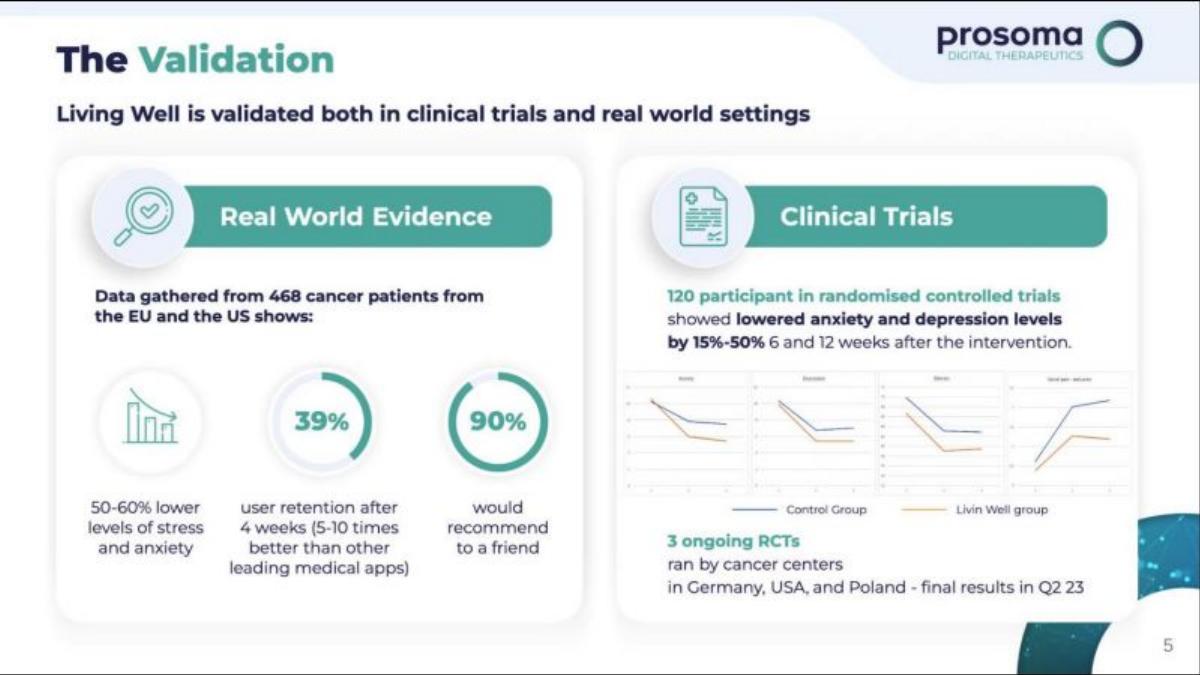
- Market validation is supported by real-world evidence from 468 patients across the EU and US, boasting a 90% recommendation rate on slide 5.
- The company provides a detailed regulatory and sales roadmap for Germany, targeting over 100,000 paid patients by 2027 on slide 8.
- The US strategy is clearly delineated with a timeline for FDA 510(k) submission and a projected price point of €815 on slide 9.
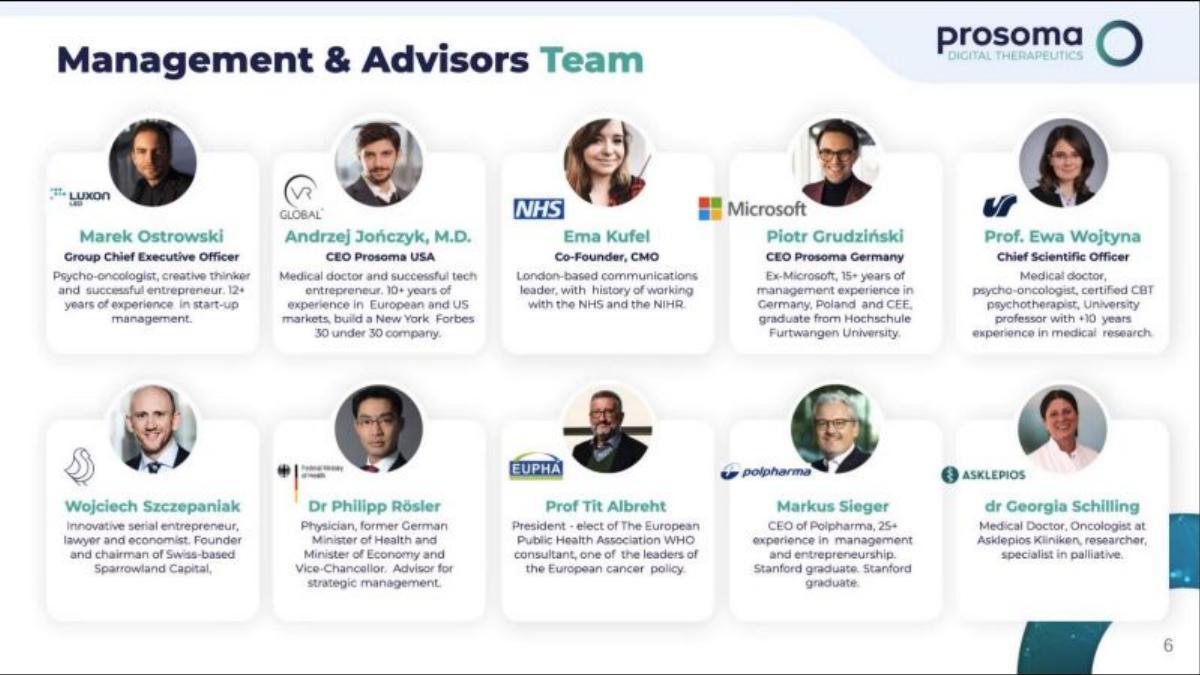
- The team slide (slide 6) is exceptionally strong, featuring ten members including a former German Minister of Health and a WHO consultant.
- Financial transparency is high, with a full table of projected revenues, expenses, and EBITDA through 2027 provided on slide 12.
- The 'Ask' is explicitly stated as a €6M Series A to reach €45M ARR and finalize US/Poland reimbursement pathways on slide 12.
The Prosoma Teardown: A Blueprint for Regulated Digital Health
Prosoma’s Series A pitch deck is a clinical and commercial roadmap for a high-growth healthcare startup. In the Digital Therapeutics (DTx) space, the barrier to entry is not just code, but clinical validation and regulatory approval. This deck addresses those hurdles head-on, providing a clear narrative of how a European-born startup intends to capture the global oncology market.
Slide 1: Title and Mission
The cover slide is clean and professional, featuring a quote from Forbes London (August 2022) that positions the company as a future global leader in oncology DTx. It includes the contact information for Co-Founder and CMO Emanuela Kufel and uses hashtags like #DigitalTherapeutics and #Reimbursement to immediately signal the company's sector and monetization strategy to investors.
Slide 2: Executive Summary
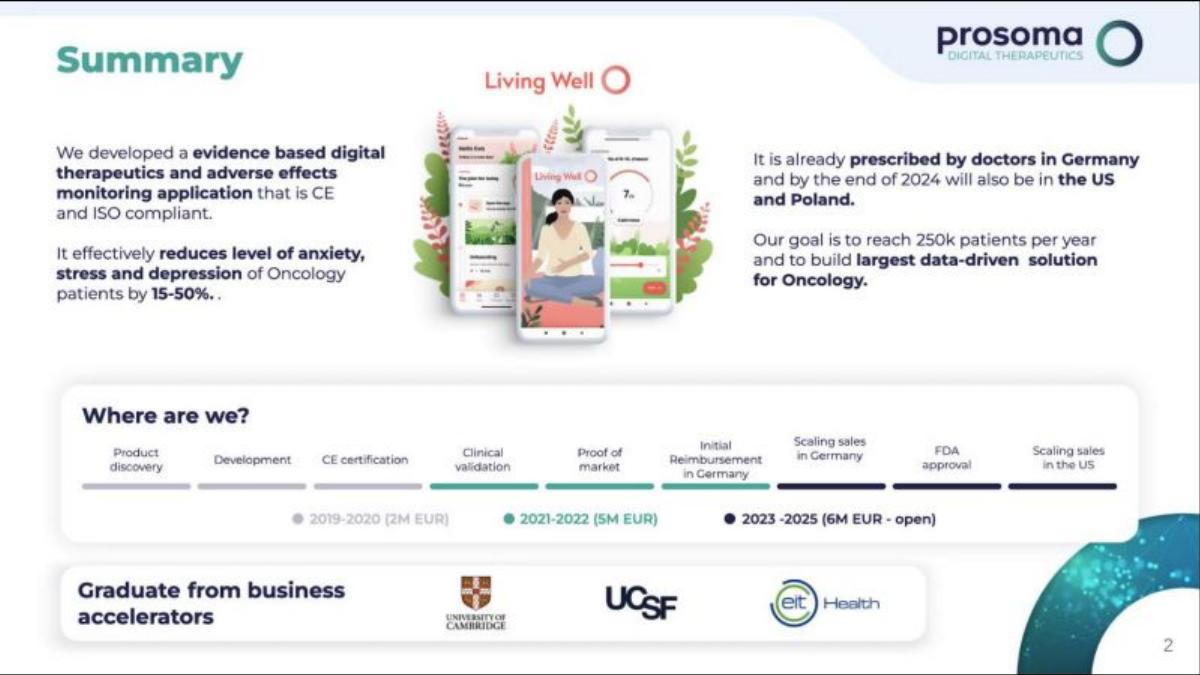
Slide 2 acts as a high-level overview. It introduces 'Living Well,' an evidence-based monitoring application that is CE and ISO compliant. The slide makes a bold claim: it reduces anxiety, stress, and depression in oncology patients by 15-50%. Crucially, it notes that the product is already prescribed by doctors in Germany. The timeline at the bottom shows a progression from 2019 to 2025, noting that they have already raised €7M across previous stages and are now opening a €6M round.
Slide 3: The Problem
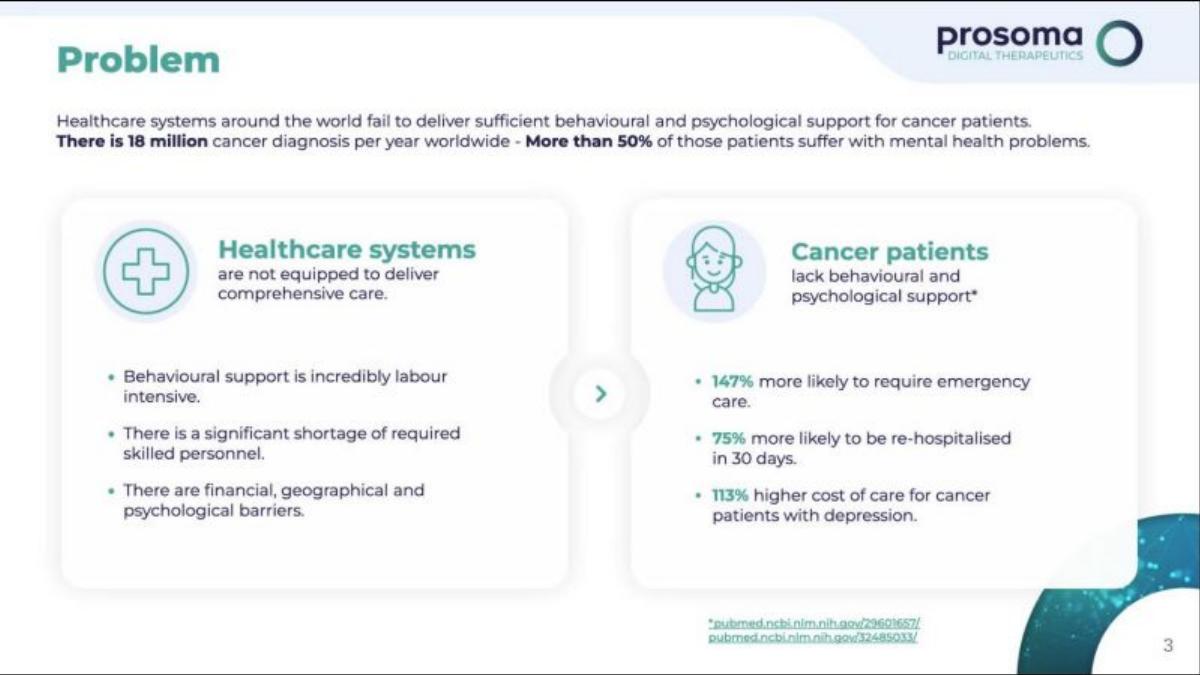
The problem is framed through two lenses: the healthcare system and the patient. Prosoma identifies that 18 million cancer diagnoses occur annually, with over 50% of patients suffering from mental health issues. The slide quantifies the systemic failure: patients with depression have a 113% higher cost of care and are 147% more likely to require emergency care. This effectively turns a 'wellness' problem into a 'financial' problem for payers.
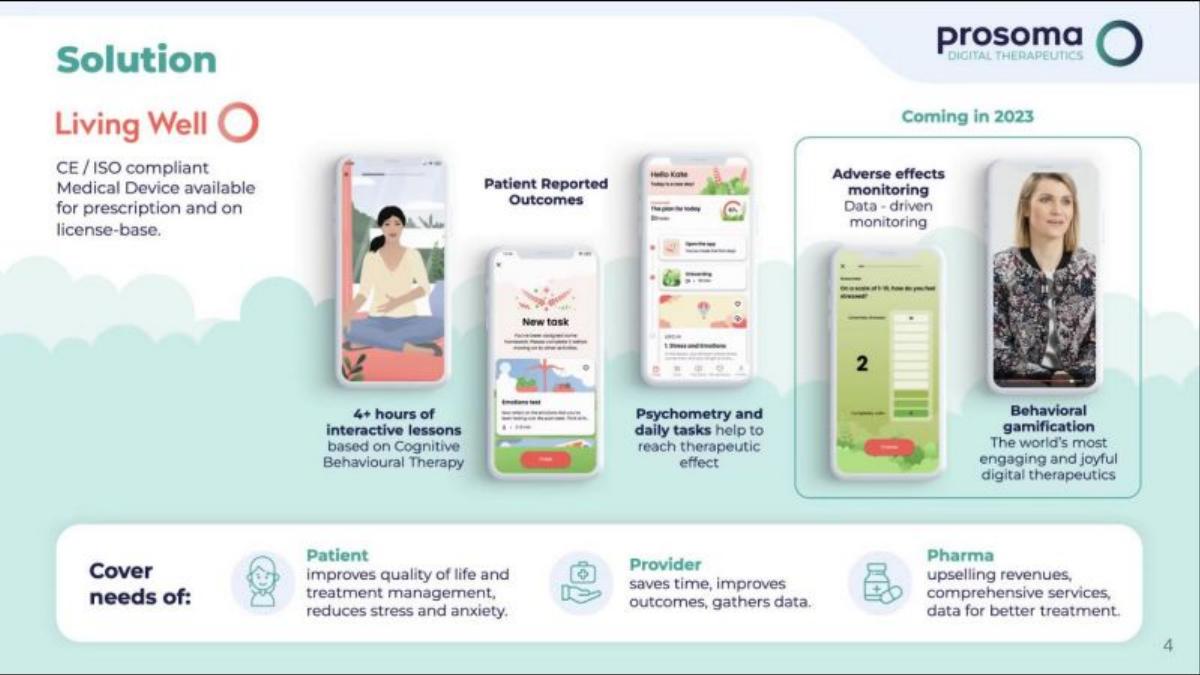
Slide 4: The Solution
The solution slide showcases the 'Living Well' interface. It highlights 4+ hours of interactive lessons based on Cognitive Behavioral Therapy (CBT), psychometry tasks, and 'Behavioral gamification.' It also previews an 'Adverse effects monitoring' feature coming in 2023. The bottom of the slide explains how the product serves three masters: the Patient (quality of life), the Provider (saves time), and Pharma (upselling revenues and data).
Slide 5: Clinical and Real-World Validation
This is perhaps the most important slide for a healthcare VC. It splits validation into 'Real World Evidence' (468 patients) and 'Clinical Trials' (120 participants in RCTs). Key metrics include a 90% recommendation rate and 50-60% lower levels of stress. It also mentions three ongoing RCTs in Germany, the USA, and Poland, with final results expected in Q2 2023. This provides the 'proof' required to back up the earlier claims of efficacy.
Slide 6: Management & Advisors
The team slide is exceptionally dense with 'heavyweight' credentials. It features ten individuals, including CEO Marek Ostrowski (psycho-oncologist) and CMO Ema Kufel (NHS/NIHR background). The advisory section is particularly impressive, featuring Dr. Philipp Rösler, the former German Minister of Health, and Prof. Tit Albreht, a WHO consultant. For a startup navigating European reimbursement, having a former health minister on the board is a significant competitive advantage.
Slide 7: Business Model
Slide 7 uses a flow chart to explain a complex ecosystem. It shows Prosoma receiving 'License-based payments' from Pharma and 'Reimbursement' from Payers/Insurers. The Physician acts as the gatekeeper who issues the 'Prescription' to the Patient. The slide explicitly states that 'Enterprise Value comes from revenue and Data,' highlighting the dual-monetization strategy of software fees and clinical insights.
Slide 8: Scaling in Germany
Germany is the primary beachhead market due to its DiGA (Digital Health Applications) legislation. The slide sets a goal of 7,000 paid patients in 2023, scaling to over 100,000 by 2027. It lists two price points: €490 for DiGA and €290 for selective contracts. It also lists strategic partners like Asklepios (200+ hospitals) and Daiichi-Sankyo, providing evidence of market traction.
Slide 9: US Reimbursement & Distribution
The US strategy is presented with a clear regulatory timeline. It projects a price point of €815 and outlines the path to becoming a Prescription Digital Therapeutic (PDT). The timeline includes FDA pre-sub, a US Pivotal RCT in 2024, and a launch as a PDT in 2025. This shows investors that the company has a sophisticated understanding of the US regulatory landscape, which differs significantly from the EU.
Slide 10: Competitive Landscape
The competition slide uses a standard checkmark matrix. Prosoma compares itself against five competitors (Attune, Mika, Kaiku Health, Vinehealth, and Voluntis). It claims superiority by being the only one to offer the combination of Oncology Mental Health Support, Symptoms Tracking, and 'Engaging content and UX.' It also provides a helpful breakdown of the regulatory status and market presence of each competitor.
Slide 11: Market Size (TAM/SAM/SOM)
The market slide cites a CAGR of 31.4% for the global DTx market, projected to reach $13.4 billion by 2026. Prosoma calculates its TAM at $7.7B (global cancer diagnoses), its SAM at $1B (USA & Germany diagnoses), and its SOM at $100M (10% of newly diagnosed patients in those markets). This is a realistic and well-reasoned approach to market sizing that avoids the '1% of a trillion-dollar market' fallacy.
Slide 12: Investment and Financials
The final content slide details the 'Ask' and the 'History.' It shows €290k Pre-seed, €640k Seed, and various grants and notes totaling several million. The 'Planned' Series A is for €6M in Q4 2023. The financial table is very detailed, showing a jump from €100k revenue in 2022 to €89.9M in 2027, with EBITDA turning positive in 2025 (€2.4M). The use of funds is clearly listed: scaling sales, finalizing reimbursement, and pharma partnerships.
Slide 13: Contact Information
A simple 'Thank you' slide with Emanuela Kufel’s email and phone number. It maintains the branding of the previous slides.
Slide 14: BestPitchDeck.com Promotion
This is an external promotional slide for the source of the deck and is not part of the Prosoma presentation itself.
What Prosoma Does Well
Regulatory Clarity: Most health-tech decks are vague about how they actually get paid. Prosoma explicitly names the DiGA system in Germany and the PDT pathway in the US. · Institutional Credibility: The advisory board is world-class. In a regulated industry, who you know is often as important as what you build. · Clinical Focus: By leading with RCT data and real-world evidence, they speak the language of both doctors and healthcare investors. · Granular Financials: Providing a 5-year table with revenue, expenses, and EBITDA shows a level of planning that many Series A startups skip.
What is Missing
Unit Economics: While they provide price points (€490, €815), the deck does not explicitly state the Customer Acquisition Cost (CAC) or the Lifetime Value (LTV) of a patient, which are critical for SaaS-style models. · Product Deep-Dive: We see screenshots, but we don't get a sense of the 'magic' of the UX. For a product claiming 'Behavioral gamification,' more detail on the engagement loops would be beneficial. · Churn/Retention Data: They mention 39% retention after 4 weeks, but for a chronic condition like cancer, investors would want to see longer-term engagement data.
What Other Founders Should Copy
The 'Problem' Framing: Don't just say 'people are sad.' Say 'sad people cost the hospital 113% more.' Align your mission with the financial incentives of the payer. · The Geography-Specific Roadmap: If you are a global company, show that you understand that the US and EU are different markets with different rules. · The Validation Slide: Use a mix of 'Real World Evidence' (volume) and 'Clinical Trials' (rigor). This covers both the 'does it work' and 'do people use it' questions.
Frequently asked questions
- What is Prosoma's primary product?
- Prosoma’s flagship product is 'Living Well,' a CE and ISO-compliant digital therapeutic application. It is designed to provide behavioral and psychological support to oncology patients, specifically targeting the reduction of stress, anxiety, and depression through Cognitive Behavioral Therapy (CBT) and adverse effect monitoring.
- How does Prosoma generate revenue?
- The company employs a B2B2C model. Revenue is generated through three main channels: direct reimbursement from payers/insurers (like the DiGA system in Germany), license-based payments from pharmaceutical companies for monitoring data, and partnerships with healthcare providers who prescribe the tool to patients.
- What clinical evidence does the deck provide?
- The deck cites data from 468 patients in real-world settings and 120 participants in randomized controlled trials (RCTs). These studies demonstrated a 15-50% reduction in anxiety and depression levels at 6 and 12 weeks post-intervention, along with a 39% user retention rate after four weeks.
- What is the company's strategy for the US market?
- Prosoma plans to enter the US via the Prescription Digital Therapeutic (PDT) pathway. The roadmap includes obtaining FDA Breakthrough Designation, conducting a US-based pivotal RCT, and submitting a 510(k) application, with a target launch as a PDT by 2025.
- Who are the key investors and advisors?
- The Series A was co-led by YouNick Mint and Simpact VC. The advisory board is a standout feature, including Dr. Philipp Rösler (former German Minister of Health), Prof. Tit Albreht (WHO consultant), and Markus Sieger (CEO of Polpharma).