Pruna AI's 13-slide Seed deck is a masterclass in technical positioning for a B2B SaaS audience. By framing the current AI landscape as a 'race' moving too fast for internal teams to manage, Pruna positions its 'AI Optimization Engine' as the essential infrastructure for sustainable deployment. The deck relies heavily on the founders' elite academic and industry backgrounds—citing over 270 research papers and 200k monthly downloads of their open-source work. While it lacks traditional financial projections or a detailed 'ask' slide, it compensates with specific performance benchmarks (e.g., 3…
Key takeaways
- The company positions itself as an 'AI Optimization Engine' that makes AI cheaper, faster, smaller, and greener (Slide 1).
- Pruna identifies four core market pains: rapid evolution, lack of talent, model proliferation, and complex compute options (Slide 2).
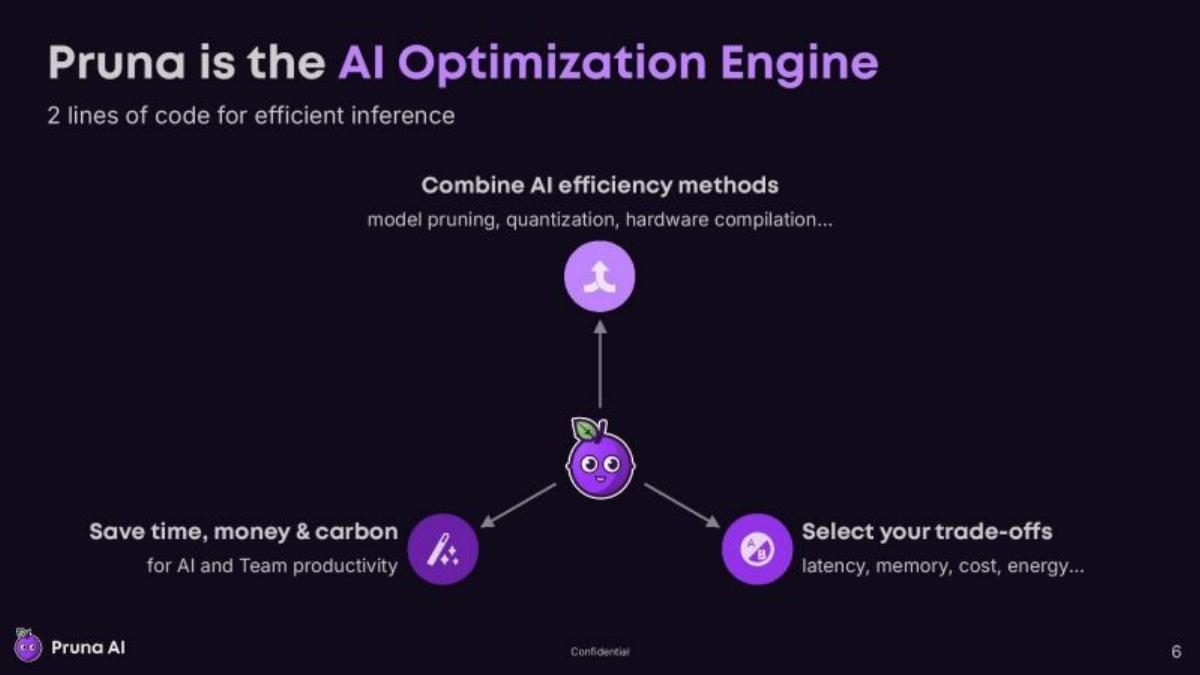
- The solution is marketed as a '2 lines of code' integration for efficient inference (Slide 6).
- Performance benchmarks show significant gains, including reducing GPU memory to 25% and carbon emissions to 33% of the original model (Slide 7).
- The technical scope is broad, covering NLP, LLMs, Image/Video Generation, Computer Vision, and Audio (Slide 8).
- The team slide emphasizes a 'German-French' leadership with deep academic roots, including a Professor of ML and multiple PhDs (Slide 10).
- Social proof is established through >200k monthly downloads and >6.7k open-source models (Slide 11).
- The deck omits a specific financial 'Ask' slide, though catalogue data confirms a $6.5M Seed round was raised.
The Hook: Efficiency in the Age of Excess
Pruna AI enters the market at a pivotal moment. While the first wave of the Generative AI boom focused on model size and raw capability, the second wave—where Pruna sits—is focused on sustainability, cost, and deployment. The deck, consisting of 13 slides, is a highly technical pitch aimed at investors who understand the 'inference tax' currently paid by enterprises.
Slide 1: The Vision
The title slide introduces Pruna AI as "The AI Optimization Engine." It sets a four-pillar value proposition: cheaper, faster, smaller & greener AI . The branding is friendly, featuring a purple plum mascot, which contrasts with the heavy technical content that follows.
Slide 2-3: The Problem and the Partner Requirements
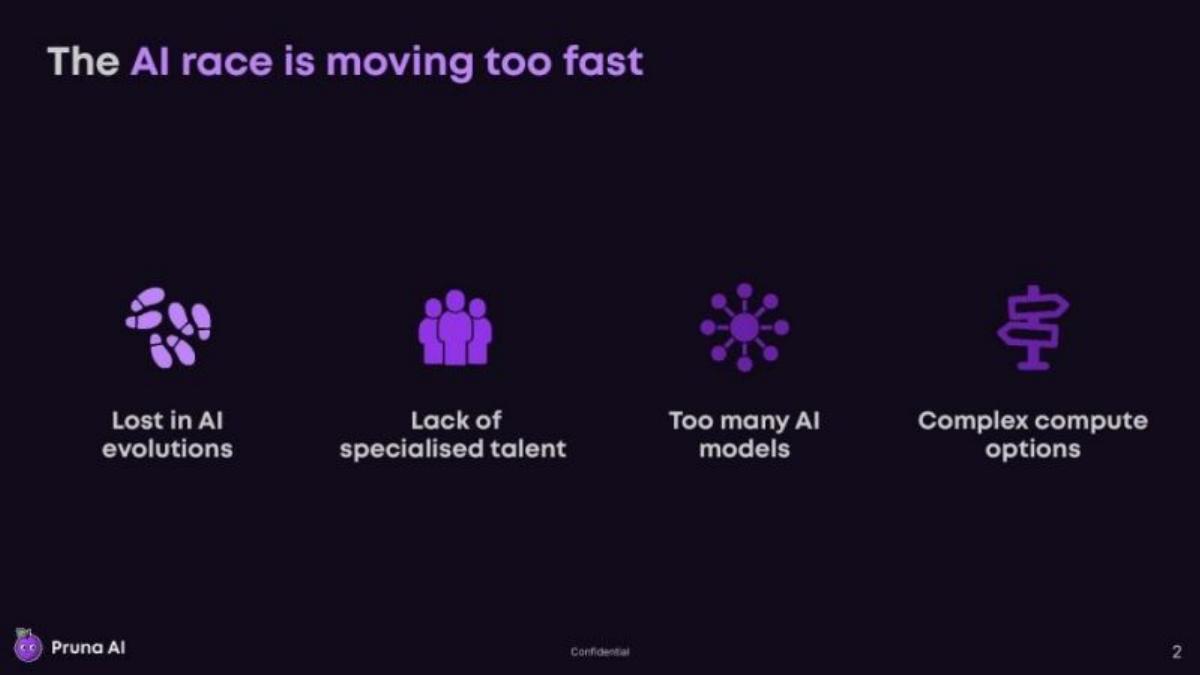
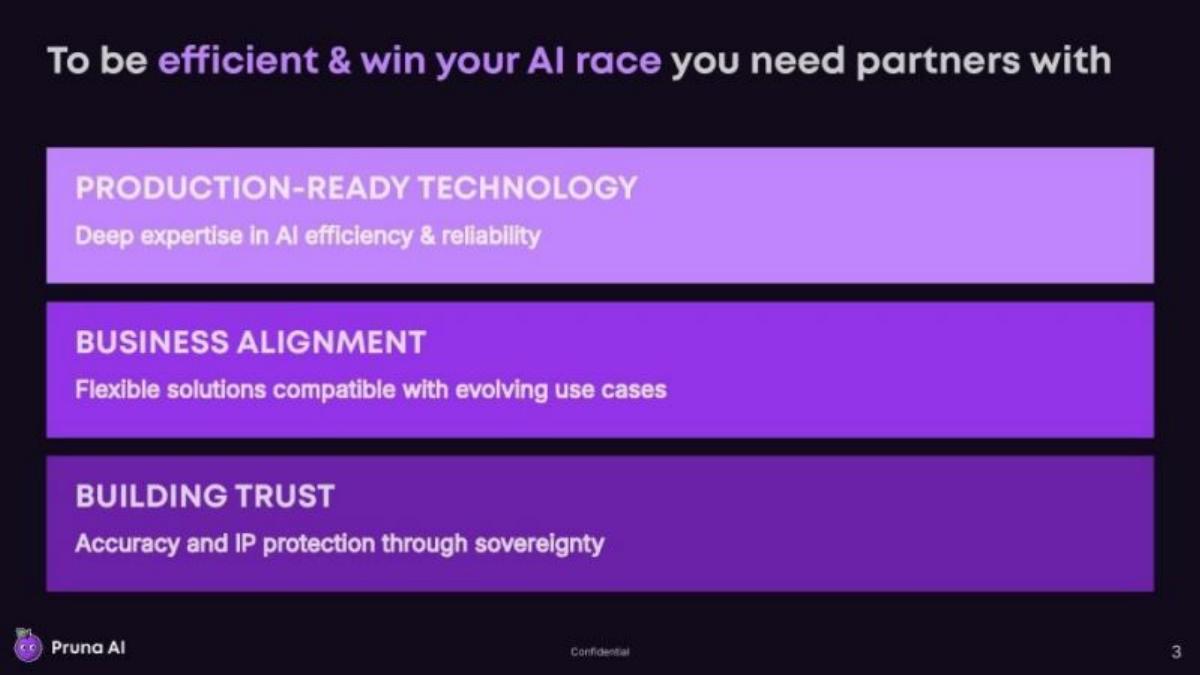
Slide 2, titled "The AI race is moving too fast," identifies four friction points for enterprises: being lost in evolutions, lack of specialized talent, too many models, and complex compute options. Slide 3 follows up by stating that winning this race requires partners with "Production-Ready Technology," "Business Alignment," and "Building Trust" (specifically mentioning IP protection and sovereignty).
Slide 4-5: Market Context and the Gold Rush
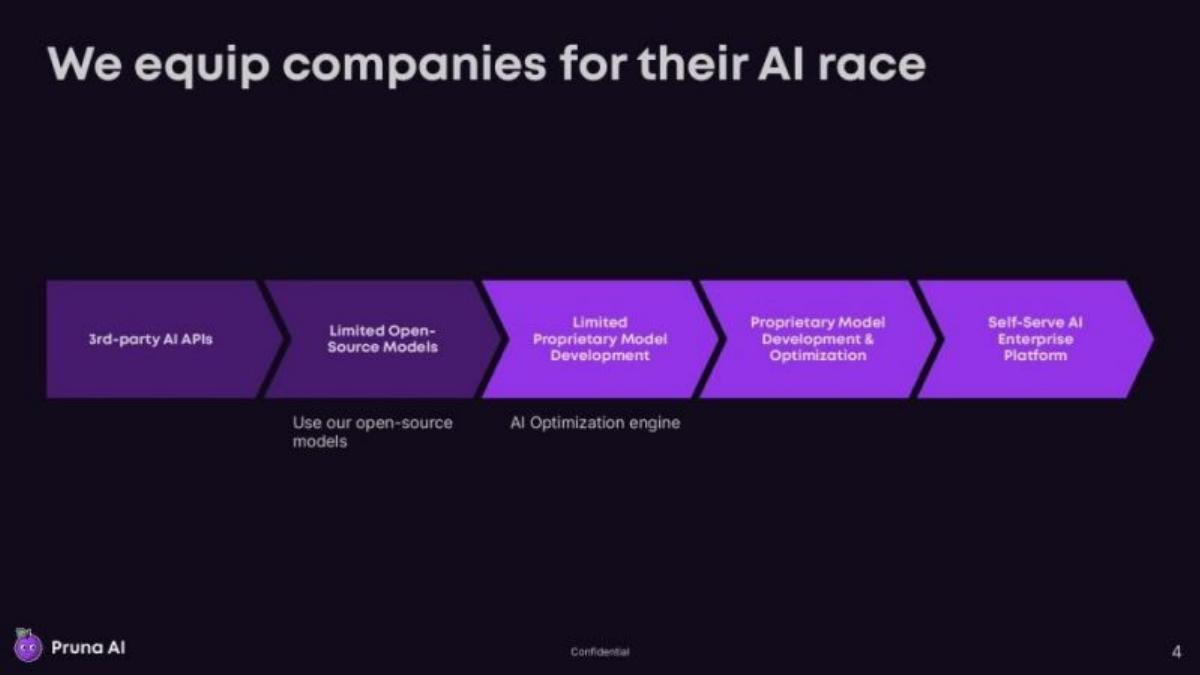
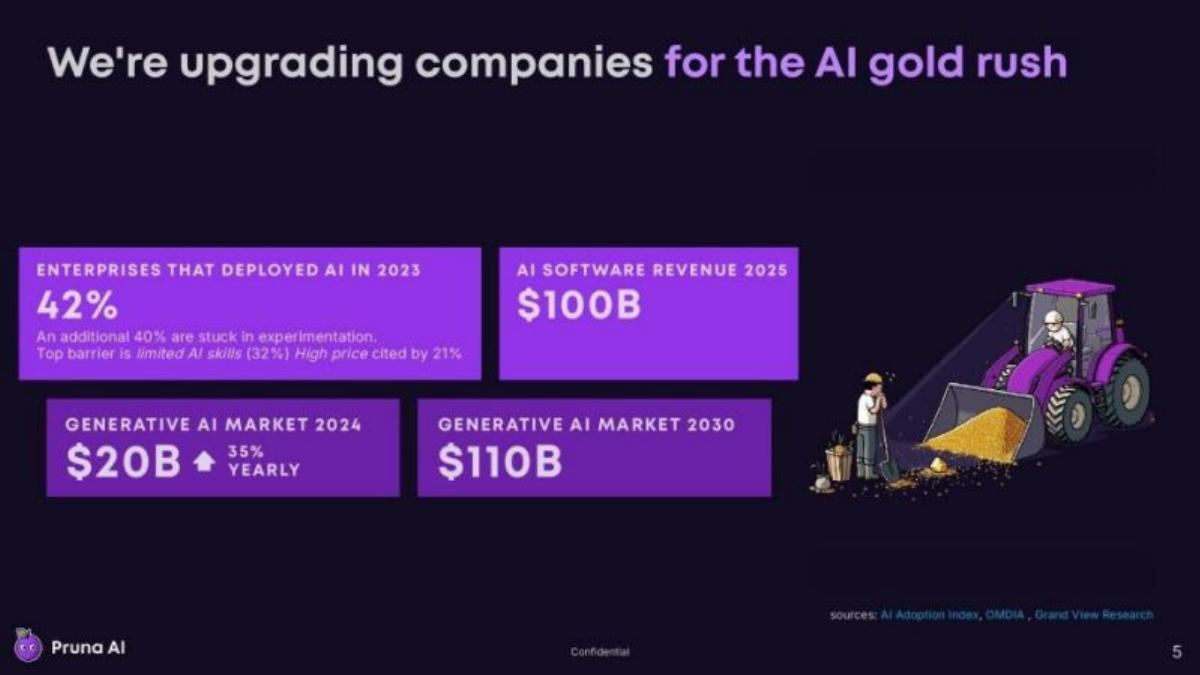
Slide 4 shows a progression from 3rd-party APIs to a "Self-Serve AI Enterprise Platform," positioning Pruna's optimization engine as the bridge between limited proprietary development and full-scale enterprise deployment. Slide 5 uses the "Gold Rush" metaphor, citing significant market figures: $100B AI Software Revenue by 2025 and a $110B Generative AI Market by 2030 . Crucially, it notes that 40% of enterprises are stuck in experimentation, with "limited AI skills" and "high price" being the top barriers.
Slide 6-7: The Solution and Proof Points
Slide 6 defines the product: "2 lines of code for efficient inference." It explains that Pruna combines methods like pruning, quantization, and hardware compilation . Slide 7 is the 'money slide' for technical due diligence, showing impressive benchmarks: 25% GPU memory usage for LLMs compared to the original, 33% latency , and 33% carbon emissions . It also claims to be "Proven on 6500+ AI Models on Hugging Face (#1)."
Slide 8-9: Product Scope and Ecosystem Fit
Slide 8, "Optimize Anything, Anywhere," lists the domains Pruna covers: NLP & LLMs (Llama 3, Mistral), Image/Video (Stable Diffusion), Computer Vision (Yolo, ResNet), and Audio (Whisper). It maps these to use cases like Intelligent Document Processing and Fraud Detection. Slide 9 shows how Pruna fits into the modern data stack, sitting in the "Production" phase between validation and serving, alongside tools like vLLM and Databricks.
Slide 10-11: The Team and Traction
Slide 10 highlights a "German-French" leadership team. The pedigree is elite: Bertrand Charpentier (PhD in ML, TU Munich), Stephan Günnemann (Professor of ML, TU Munich), Rayan Nait Mazi (3rd time cofounder), and John Rachwan (ML Engineer, Design AI). Slide 11 reinforces their authority with "Trusted and Mature" metrics: >270 research papers , >6.7k open-source models , and >200k monthly downloads . The slide also displays logos of supporters including EQT, AWS, Meta, and NVIDIA.
Slide 12-13: Closing
Slide 12 is a repeat of the title slide, and Slide 13 is a promotional slide for the deck source (bestpitchdeck.com), not part of the Pruna pitch itself.
What Works in the Pruna AI Deck
Technical Authority: By leading with academic credentials and a massive volume of research papers, the founders eliminate 'founder-market fit' risk. They aren't just enthusiasts; they are the architects of the field. · Quantifiable Value: Slide 7 provides the exact numbers an ML engineer needs to justify a purchase. Reducing GPU memory to 25% is a direct, massive cost saving. · Simplicity of Integration: The "2 lines of code" claim is a powerful antidote to the "Complex compute options" problem mentioned on Slide 2. · Market Timing: The deck correctly identifies that the 'experimentation' phase of AI is ending, and the 'efficiency' phase is beginning.
What is Missing
Business Model: There is no mention of how Pruna makes money. Is it per-model, per-inference, or a flat SaaS fee? · The Ask: While we know from external data they raised $6.5M, the deck does not specify the amount sought or the milestones they intend to hit with the capital. · Competition: The deck ignores other optimization players (like OctoML or TensorRT). A competitive matrix would help define their unique moat. · Financials: There are no revenue targets, burn rate details, or projections. This is common in highly technical Seed rounds but remains a gap for traditional analysis.
What Founders Should Copy
The 'Stack' Slide: Slide 9 is excellent. Showing exactly where your tool sits in a complex ecosystem (between Databricks and vLLM) helps investors visualize the 'un-stickiness' of the current workflow and where you provide value. · Pedigree as Traction: If you don't have $1M in ARR, use your 'academic ARR.' Pruna's use of research paper counts and open-source downloads serves as a proxy for market trust. · Problem/Solution Alignment: The four icons on Slide 2 perfectly mirror the four value props on Slide 1. This internal consistency makes the deck easy to digest.
Frequently asked questions
- How much did Pruna AI raise with this deck?
- According to the catalogue facts, Pruna AI raised $6.5M in a Seed round in 2024. The deck itself mentions a '6M seed' on Slide 10, which funded their team of 15 people. The round was led by EQT Ventures with participation from Motier Ventures, Kima Ventures, and several high-profile angels including Olivier Pomel.
- What is Pruna AI's core product?
- Pruna AI is an optimization engine for machine learning models. As shown on Slide 6 and Slide 8, it uses methods like model pruning, quantization, and hardware compilation to compress models. The goal is to make AI models more efficient for inference, reducing costs and latency with just '2 lines of code'.
- Who are the founders of Pruna AI?
- The founding team (Slide 10) consists of Bertrand Charpentier (Chief Scientist), Stephan Günnemann (CSO), Rayan Nait Mazi (CEO), and John Rachwan (CTO). The team features heavy academic credentials, including a PhD in ML and a Professor of ML from the Technical University of Munich, with prior experience at Twitter, Stanford, and Google.
- What kind of performance improvements does Pruna claim?
- Slide 7 lists specific efficiency gains: LLM GPU memory reduced to 25% of the original, LLM latency reduced to 33%, Speech-to-text latency reduced to 50%, and LLM carbon emissions reduced to 33%. These metrics support their claim of making AI 'cheaper, faster, smaller & greener'.
- What is missing from the Pruna AI pitch deck?
- The deck is notably missing several standard venture slides: there is no detailed financial forecast, no breakdown of the business model (pricing tiers), no competitor matrix, and no specific 'Use of Funds' or 'Ask' slide beyond a passing mention of the seed round already being raised. It focuses almost entirely on the technical problem and the team's ability to solve it.