The Hermes ATMOSAT Project deck, authored by consultant Paul Galbraith in March 2015, outlines a plan to develop solar-powered Unmanned Aerial Vehicles (UAVs) designed for long-duration atmospheric flight. Positioned as a 'Private Equity Offering,' the company seeks to enter a market previously dominated by Titan Aerospace (acquired by Google) and Zephyr (acquired by Airbus). The project emphasizes commercial availability and cost-competitiveness, claiming a technical capability to carry 180 kg payloads at 20 km altitudes for up to six years. While the deck provides a clear three-phase roadma…
Key takeaways
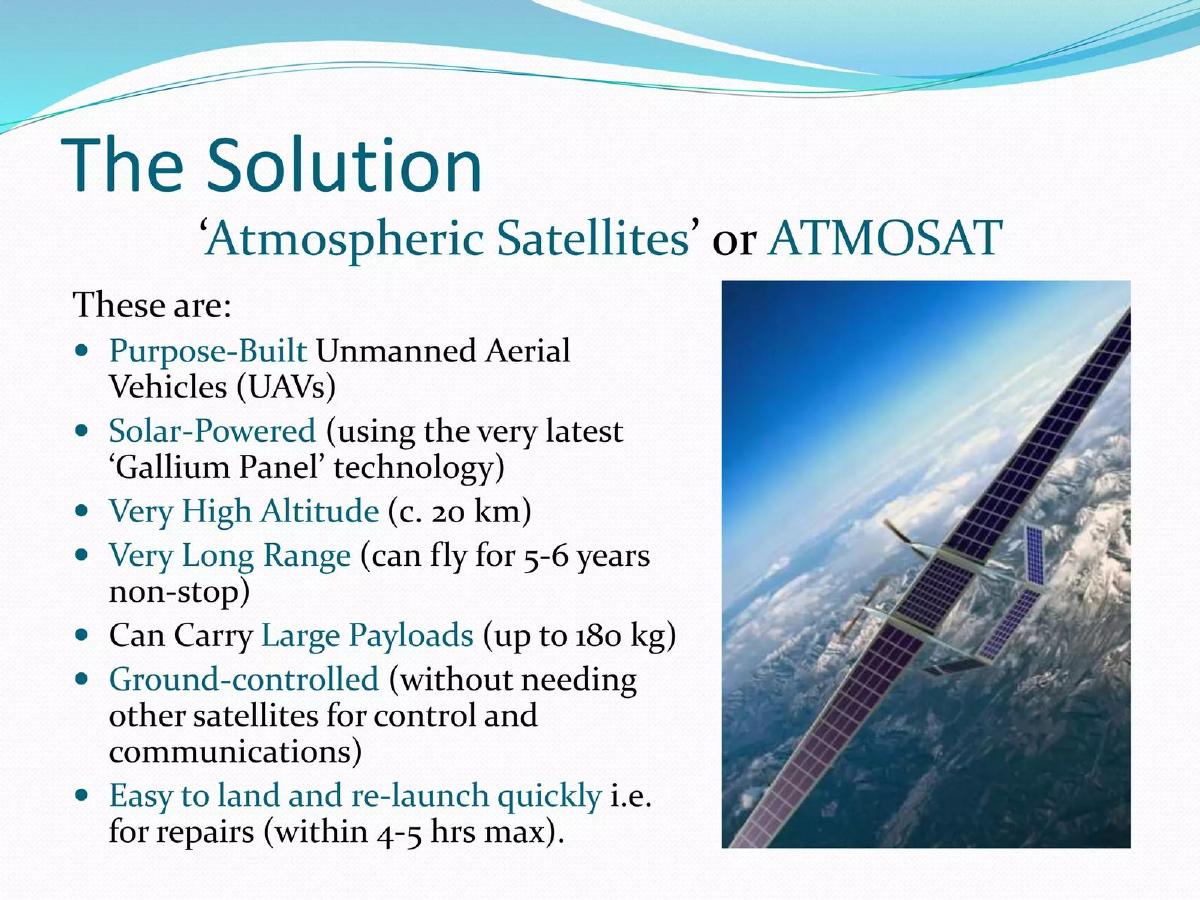
- The ATMOSAT is designed to fly at an altitude of approximately 20 km for 5-6 years non-stop using Gallium Panel solar technology (Slide 2).
- The vehicle is engineered to carry large payloads of up to 180 kg and can be landed for repairs within a 4-5 hour window (Slide 2).
- Hermes positions itself as the third player in the market, following Titan Aerospace and Zephyr, but the only one focused on wide commercial availability (Slide 3).
- The company was founded in January 2015, incorporated in Belize, and operates out of Thailand (Slide 4).
- A formal R&D partnership exists with Kasetsart University’s Aerospace Department in Thailand (Slide 4).
- The development plan involves a 1/10th scale prototype with a 6.3m wingspan, followed by a full-scale 63m wingspan version (Slide 5).
- Phase Three production and first order fulfillment were projected to begin in H2 2017 (Slide 5).
- The deck omits a specific 'Ask' amount, detailed unit economics, and a slide introducing the management team beyond the consultant author (Slides 1-6).
Introduction and Title
The Hermes ATMOSAT Project deck, dated March 2015, presents itself as an 'Early-Stage Aerospace/Hi-Tech Private Equity Offering.' The title slide (Slide 1) identifies the author as Paul Galbraith, a consultant. The branding is minimalist, utilizing a blue gradient background that persists throughout the presentation. The use of the term 'Private Equity Offering' on the cover suggests a search for more substantial, perhaps institutional, early-stage capital rather than a typical venture capital seed round, though the later roadmap refers to a 'Seed Funding Phase.'
Slide 2: The Solution - ATMOSAT
Slide 2 defines the core product: Atmospheric Satellites, or ATMOSAT. These are characterized as purpose-built Unmanned Aerial Vehicles (UAVs). The technical specifications listed are ambitious for 2015: solar-powered flight using 'Gallium Panel' technology, an operating altitude of approximately 20 km, and a flight endurance of 5-6 years non-stop. The slide also notes a payload capacity of up to 180 kg. A key differentiator mentioned is that the craft is ground-controlled without needing other satellites for communication and can be landed and re-launched for repairs within a 4-5 hour window. This slide effectively establishes the 'what' and the 'how' of the technology, emphasizing endurance and maintainability.
Slide 3: The Competitive Landscape
Slide 3 addresses the competition by naming two major players: Titan Aerospace and Zephyr. The deck notes that Titan Aerospace was acquired by Google in 2011 (though historical records usually cite 2014) with an estimated price of USD 20-40 million. Zephyr is noted as being acquired by Airbus with an estimated price of USD 10-30 million. The strategic argument made here is that these incumbents are 'unlikely to make technology commercially available' and are 'unlikely to be competitive in terms of cost.' Hermes positions itself as the third player in the market and the only one focused on broad commercialization. This is a classic 'democratization' play, suggesting that while the giants have the tech, Hermes will have the market access.
Slide 4: Corporate Structure and R&D
Slide 4 provides the corporate background for Hermes Aerospace Corporation. It is described as a spin-off start-up founded in January 2015. The legal structure is somewhat unconventional for a global tech play, being incorporated in Belize while the operating company is registered and based in Thailand. The slide highlights a 'Formal co-operation with Kasetsart University’s Aerospace Department' for R&D. This partnership is likely intended to provide the technical credibility that the small start-up might otherwise lack, leveraging university facilities and academic expertise to offset the risks of being a new entrant in a high-capex industry like aerospace.
Slide 5: The Plan and Milestones
Slide 5 outlines the development roadmap. The company claims that system design is complete and components/suppliers have been selected. The roadmap is divided into three phases:
Phase One: Production of a 1/10th scale model (6.3m wingspan) for aerodynamic testing and promotion, scheduled to start in H2 2015 and complete by H2 2016. · Phase Two: Production of a full-scale (63m wingspan) prototype for final testing, starting in H2 2016 and completing in H2 2017. · Phase Three: Full-scale production and fulfillment of first orders, beginning in H2 2017.
The slide indicates that the company is 'Now' in the 'Seed Funding Phase,' though it does not specify the amount of capital required to reach these milestones.
Slide 6: Further Information
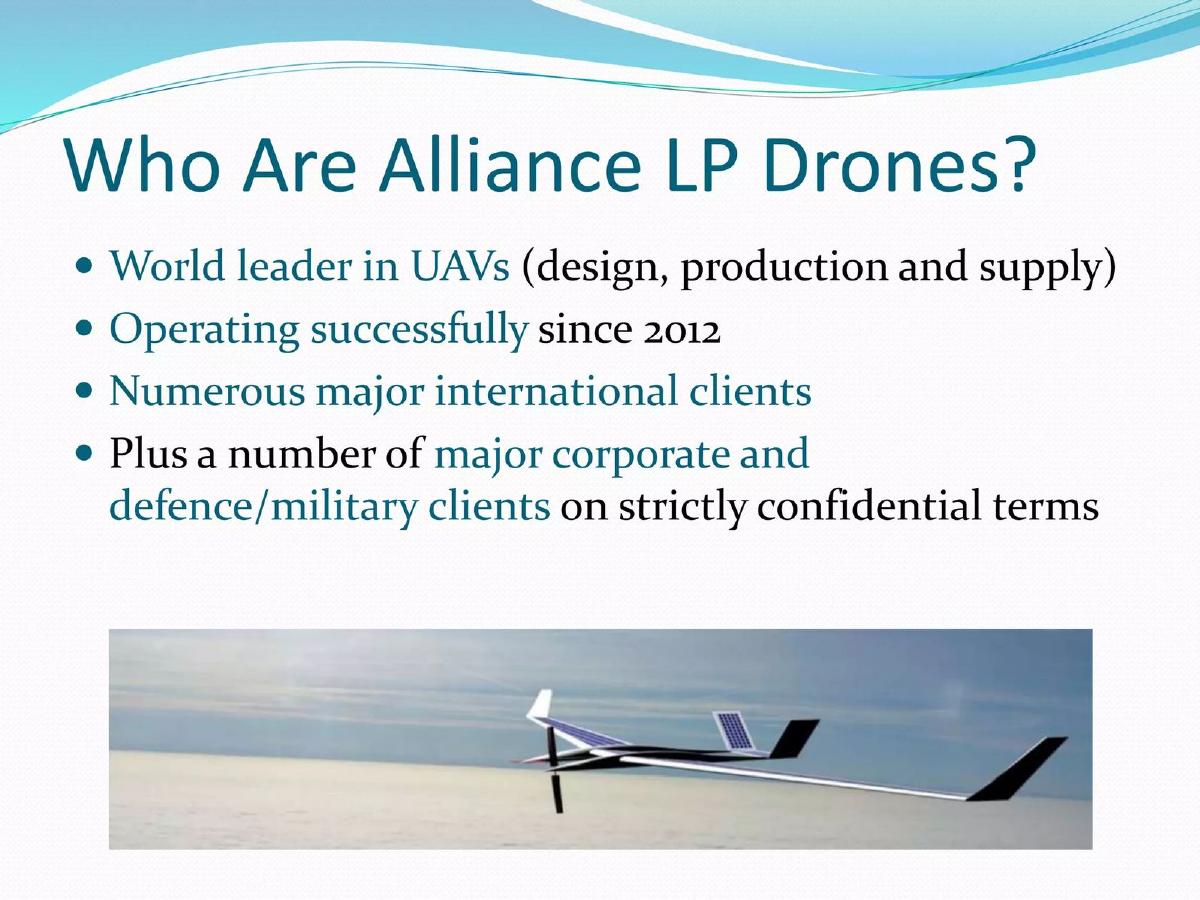
The final slide in this selection provides contact information and links. It references 'Alliance LP Drones Limited' and provides a website, LinkedIn, and Facebook page. The inclusion of a project-specific URL on the Alliance LP website suggests that Hermes ATMOSAT might be a specific project under a broader corporate umbrella or a joint venture. The image on this slide shows a 3D render of the aircraft in a high-altitude environment, reinforcing the 'Atmospheric Satellite' branding.
What Works in This Deck
The deck is highly focused on the technical specifications and the competitive gap. By identifying that Google and Airbus have acquired the primary competitors, Hermes creates a narrative of a 'validated but closed' market. This is a strong hook for investors who believe in the potential of high-altitude long-endurance (HALE) UAVs but feel they have missed the opportunity to invest in the early pioneers. The technical specs (180 kg payload, 5-year flight) are clearly stated, providing a benchmark for performance. The roadmap is also logically structured, using a 1/10th scale model to de-risk the aerodynamics before committing to the massive 63-meter wingspan of the full-scale version.
What Is Missing
The most glaring omission is a dedicated Team slide. While a consultant is named on the cover and a university partnership is mentioned, there is no information on the founders, the lead engineers, or the management team's track record in aerospace. For a project requiring this level of technical sophistication, the 'who' is as important as the 'what.' Additionally, there is no financial data. There are no estimates for the cost of production, the expected price per unit, or the projected revenue. Most importantly, the 'Ask' is missing; an investor does not know if the company is seeking $500,000 or $5,000,000 to reach Phase One. Finally, the 'Market' slide is thin; while it mentions competitors, it does not quantify the demand for these services in sectors like telecommunications, agriculture, or maritime surveillance.
Founder Takeaways
Founders in the deep-tech or aerospace sectors can learn from the way Hermes frames its competition. Instead of claiming they have no competitors, they lean into the fact that their competitors were acquired by giants, using it as proof of market validity while highlighting a 'commercial gap' those giants won't fill. However, founders should avoid the lack of transparency regarding the 'Ask' and the team. In a seed round, especially for hardware, investors need to see a clear budget that maps to the milestones. If you are building a 63-meter aircraft, the capital requirements are massive, and a deck that doesn't address the burn rate or the total capital to get to market will struggle to gain trust. Always include a slide that introduces the human capital behind the technology.
Frequently asked questions
- What is the primary value proposition of the ATMOSAT compared to traditional satellites?
- According to Slide 2, the ATMOSAT offers the benefits of a satellite—long-duration flight at 20 km altitude—but with the added flexibility of being ground-controlled and easily recoverable. Unlike orbital satellites, these UAVs can be landed and re-launched within 4-5 hours for repairs or payload upgrades, potentially lowering the long-term cost of atmospheric data or communication services.
- How does Hermes Aerospace plan to compete with Google and Airbus?
- Slide 3 argues that while Titan Aerospace (Google) and Zephyr (Airbus) are leaders, they are unlikely to make their technology commercially available to third parties. Hermes positions itself as the 'only one making its technology widely commercially available,' suggesting a B2B service model rather than a closed ecosystem owned by a tech giant.
- What are the technical specifications of the proposed full-scale aircraft?
- Slide 5 details that the full-scale (Phase Two) prototype will have a wingspan of 63 meters. This is a significant scale-up from the Phase One 1/10th scale model, which has a 6.3m wingspan. The aircraft is intended to carry payloads up to 180 kg, which is substantial for a solar-powered high-altitude platform.
- Where is the company based and how is it structured?
- Slide 4 states that Hermes Aerospace Corporation is a spin-off start-up founded in January 2015. It is incorporated in Belize but maintains its operating headquarters and registration in Thailand. This geographic choice is linked to their formal cooperation with Kasetsart University’s Aerospace Department for research and development.
- What is missing from this pitch deck that an investor would typically require?
- The deck is missing several standard components: a specific funding 'Ask' (it only mentions being in the 'Seed Funding Phase' on Slide 5), a detailed management team slide, financial projections, and a breakdown of the target market size (TAM/SAM). It also lacks a clear explanation of the business model beyond 'commercial availability.'