HERO presents a solution to drunk driving by creating a rewarded ecosystem for safe transportation. The platform aims to lower the number and size of lawsuits for hospitality businesses while incentivizing customers to change their behavior. By tapping into a nationwide network of friends and family who act as designated drivers, HERO positions itself as a social-first alternative to traditional ride-sharing. The deck demonstrates strong early traction through partnerships with Munich RE and the states of Maryland and Nevada. Financial projections target $9.9M in revenue for 2018, supported b…
Key takeaways
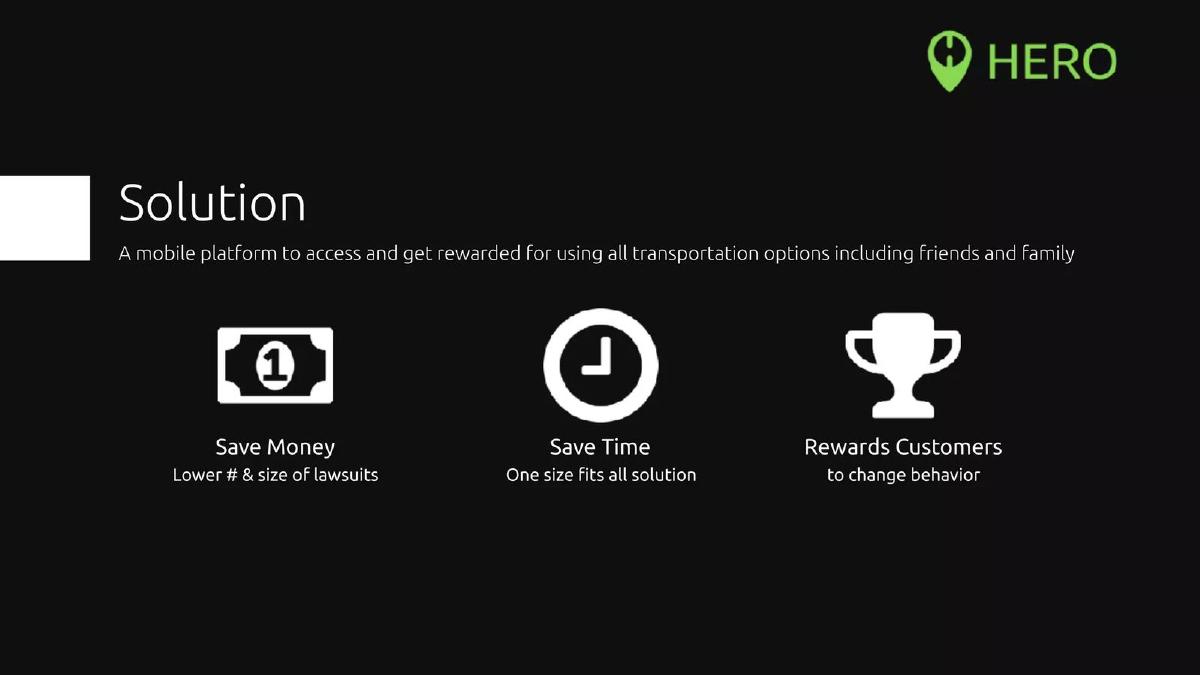
- The platform aims to reduce the legal liability of businesses by lowering the frequency and size of lawsuits related to drunk driving (Slide 2).
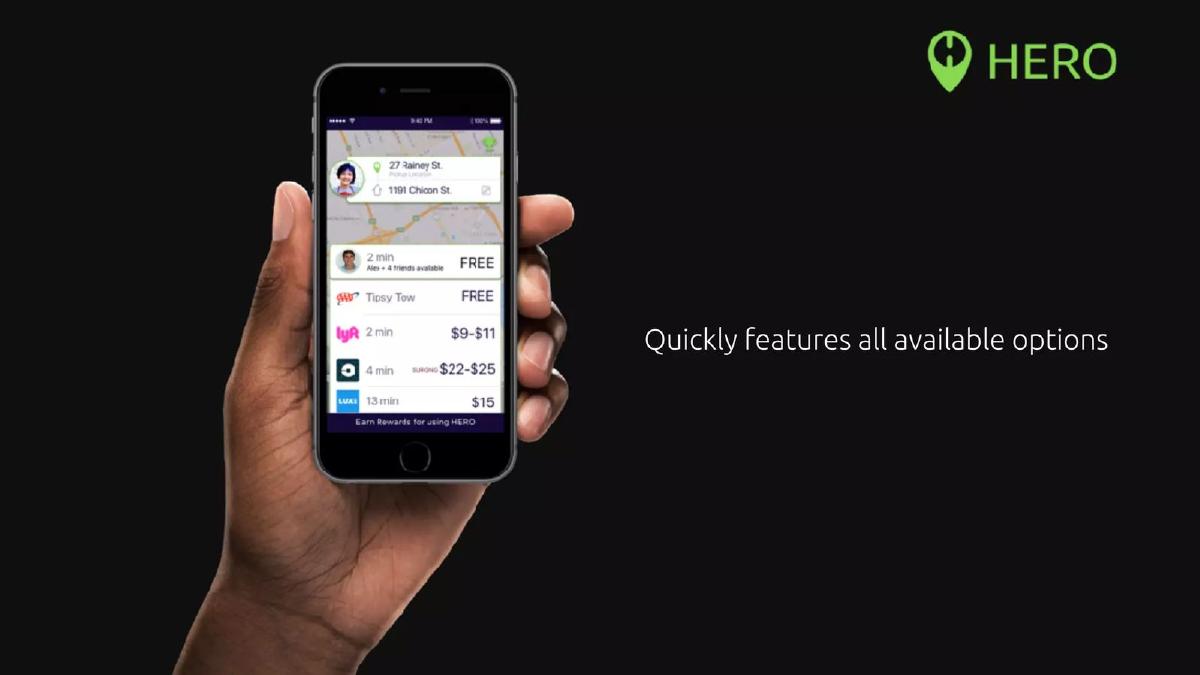
- HERO utilizes a social network model where users can request rides from a list of friends and family with estimated arrival times (Slide 3).
- Viral social media posts showing bars rewarding responsible drivers serve as primary market validation for the concept (Slide 4).
- Research from Texas Venture Labs indicates that 24% of surveyed bars and restaurants have been fined or sued in the past 12 months (Slide 5).
- The company has secured high-level institutional partnerships with Munich RE and the Departments of Transportation in Maryland and Nevada (Slide 6).
- The team includes specialized roles for Government Affairs and PR, reflecting the regulatory and social nature of the product (Slide 7).
- HERO is seeking an $800K seed round to provide 22 months of runway for expansion into Maryland, Nevada, and Texas (Slide 8).
- The deck projects a significant revenue target of $9.9M for the year 2018 (Slide 8).
Executive Summary
HERO is positioning itself at the intersection of social networking, public safety, and the hospitality industry. The deck describes a mobile platform that rewards users for making safe transportation choices, specifically by leveraging their own social circles. By framing drunk driving not just as a safety issue but as a massive legal liability for businesses, HERO creates a B2B2C value proposition where bars and restaurants have a financial incentive to promote the app to their patrons.
Slide 1: Title Slide
The title slide features the HERO logo—a green location pin containing a stylized 'H' that resembles a road or a steering wheel. The background is a dark, blurred image of a road at night. It is labeled simply as 'Pitch Deck' and marked 'Private' at the bottom. The branding is clean and suggests a focus on navigation and mobility.
Slide 2: The Solution
Slide 2 defines HERO as a 'mobile platform to access and get rewarded for using all transportation options including friends and family.' The slide breaks down the benefits into three pillars: Save Money (by lowering the number and size of lawsuits), Save Time (via a 'one size fits all' solution), and Rewards Customers (to change behavior). This slide is critical because it identifies the 'customer' as the business owner who fears litigation, rather than just the end-user looking for a ride.
Slide 3: Product Interface and Network
This slide provides a visual of the app. A hand holds a smartphone showing a list of available drivers: Alex Crosby (6 min), Rory Shively (7 min), David Auld (8 min), and others. The text emphasizes that the app 'taps a nationwide transportation network available to everyone: friends and family who can be designated drivers.' An overlay map of the US with social profile icons suggests a peer-to-peer network structure rather than a gig-economy fleet.
Slide 4: Market Validation (Social Proof)
HERO uses 'outdated methods' of rewarding patrons as proof of concept. The slide shows two viral social media posts. One is a note from Mack's Tavern giving a $5.00 coupon to a patron for not driving home, which garnered 2.3M views. The other is a Facebook post from a patron impressed by a bar's letter of thanks for leaving their car overnight, which received 21K likes. The takeaway is that there is a massive, untapped appetite for rewarding responsible behavior in the hospitality sector.
Slide 5: Market Validation (Data)
To move beyond anecdotes, Slide 5 presents research conducted by the University of Texas MBA program’s Texas Venture Labs. The statistics are compelling: 88% of businesses are concerned about customers getting home safely, 82% believe drunk driving hurts business performance, and 24% have been fined or sued in the past 12 months. Most importantly, 80% stated they would promote HERO in their place of business, establishing a clear path for user acquisition.
Slide 6: Market Adoption
This slide lists current partners and supporters, which gives the startup significant institutional weight. Partners include Munich RE , the State of Maryland , and the State of Nevada . Support is cited from the DOT , universities, and police departments. The slide also mentions a monthly presence at major festivals like SXSW , ACL , and Lollapalooza , indicating that HERO is already active in the field and not just a theoretical concept.
Slide 7: Team
The team slide features eight individuals. Alex Crosby is listed as CEO, and Mike Parks as COO. The technical side is represented by Chris Kaschner (Lead Product Officer), Rory Shively (Back End Engineer), and David Auld (Mobile Developer). Notably, the team includes AJ Bingham for Government Affairs and Halie Noble for PR and Content Strategy, which aligns with the company's need to navigate state regulations and drive social awareness. Devon Crosby serves as Business Associate.
Slide 8: Financials and Ask
The final slide in this set details the financial standing and goals. HERO is raising a Seed Round of $800K to secure 22 months of runway. The slide highlights notable investors: Fontinalis Partners , Star Power Partners II , and Techstars . It also mentions key hires in Maryland and Nevada, including Mike Parks (who is noted as currently being a Major in the US Army). The most striking figure is the projection of $9.9M in revenue in 2018 .
What Works in the HERO Deck
The strongest element of this deck is the Market Validation (Slides 4 and 5). By combining viral social proof with academic research from Texas Venture Labs, the founders effectively demonstrate that the problem is real and that the 'customers' (bars) are already trying to solve it manually. The 24% litigation rate for bars is a 'hair on fire' statistic that makes the B2B sales pitch very logical.
The Partnership Slide (Slide 6) is also excellent. Securing Munich RE and two state governments as partners suggests that HERO has already cleared significant regulatory and insurance hurdles that usually kill startups in the transportation space. This de-risks the investment significantly for a seed-stage participant.
What Is Missing from the HERO Deck
The most glaring omission is the Revenue Model . While Slide 8 mentions a $9.9M revenue target, there is no explanation of how that money is made. Do bars pay a subscription? Does HERO take a cut of the rewards? Is there a lead-generation fee paid by insurance companies like Munich RE? Without this, the $9.9M figure feels like an arbitrary projection.
Additionally, the Unit Economics are absent. The deck mentions 'rewarding customers,' but it doesn't explain who pays for the rewards or what the Cost Per Acquisition (CPA) looks like compared to the Lifetime Value (LTV) of a user or a partner bar. Finally, there is no Competition Slide . In a world dominated by Uber and Lyft, HERO needs to explicitly state why a user would choose to coordinate with a friend on their app rather than simply calling a professional ride-share service.
Founder Takeaways
Leverage Social Proof: If your product automates something people are already doing manually (like the bars giving out paper coupons on Slide 4), show the manual version to prove demand exists. · Quantify the Pain: The statistic that 24% of bars have been sued or fined (Slide 5) is the 'hook' that makes the solution a 'must-have' rather than a 'nice-to-have.' · Build a Regulatory Moat: By partnering with the DOT and state governments (Slide 6), HERO creates a barrier to entry for competitors who might have the tech but lack the institutional relationships. · Align Team Roles with Strategy: Including a 'Government Affairs' role (Slide 7) early on shows investors you understand the specific hurdles of your industry.
Frequently asked questions
- What is the core value proposition for businesses?
- According to Slide 2 and Slide 5, the primary value for businesses is risk mitigation. HERO claims to help bars and restaurants lower the number and size of lawsuits. Research cited in the deck shows that 82% of hospitality business owners believe drunk driving negatively impacts their performance, and 24% have faced legal or financial penalties in the last year, making a preventative solution highly attractive.
- How does the HERO app actually work for the end user?
- Slide 3 shows a mobile interface where a user can see a list of available designated drivers from their own network, such as 'Alex Crosby' or 'Rory Shively,' with specific arrival times ranging from 6 to 11 minutes. It functions similarly to a ride-hailing app but focuses on a 'nationwide transportation network' composed of friends and family rather than professional contractors.
- What kind of market traction has HERO achieved?
- HERO demonstrates traction through diverse channels. Slide 6 lists partnerships with Munich RE and the states of Maryland and Nevada. It also claims support from the DOT, universities, and police. Furthermore, the company maintains a presence at major events like SXSW, ACL, and Lollapalooza, suggesting a robust field marketing and partnership strategy.
- Who are the key investors in HERO?
- Slide 8 identifies three notable investors participating in the $800K seed round: Fontinalis Partners, Star Power Partners II, and the accelerator Techstars. This indicates that the company has successfully navigated a top-tier accelerator program and attracted venture capital specialized in mobility and transportation.
- What are the financial goals stated in the deck?
- The deck is focused on a specific expansion plan. Slide 8 states they are raising for 22 months of runway to launch in Maryland, Nevada, and Texas. The most ambitious figure is a projected $9.9M in revenue for 2018. However, the deck does not explain the specific revenue streams (e.g., SaaS fees from bars, lead generation, or insurance kickbacks) that lead to this total.