The HFOTCO investor presentation, dated June 6, 2018, serves as a technical and financial deep dive into one of the largest fuel oil terminals in the United States. Operating as a subsidiary of the NYSE-listed SemGroup (SEMG), HFOTCO emphasizes its 'take-or-pay' revenue model, which accounts for 88% of its income, providing significant cash flow stability. The deck highlights a diversified, investment-grade customer base and a strategic shift toward becoming a Vacuum Gas Oil (VGO) hub. While the presentation is heavy on operational logistics and macro-market data from the EIA, it effectively…
Key takeaways
- The company operates under a highly stable financial model with 88% of revenue generated by take-or-pay contracts (Slide 25).
- HFOTCO maintains significant customer loyalty, with a weighted-average tenure of approximately 18 years (Slide 25).
- The asset is strategically positioned to serve the Gulf Coast, which has the highest U.S. regional refinery capacity at 7.8 million barrels per day (Slide 13).
- The terminal has successfully diversified its portfolio, reducing fuel oil and related components by more than 30% since 2013 (Slide 29).
- Operational capabilities span a wide range of products including crude oil, residual fuel oil, vacuum gas oil, carbon black, and asphalt (Slide 21).
- 75% of contracted capacity is held by diversified investment-grade counterparties, mitigating credit risk (Slide 25).
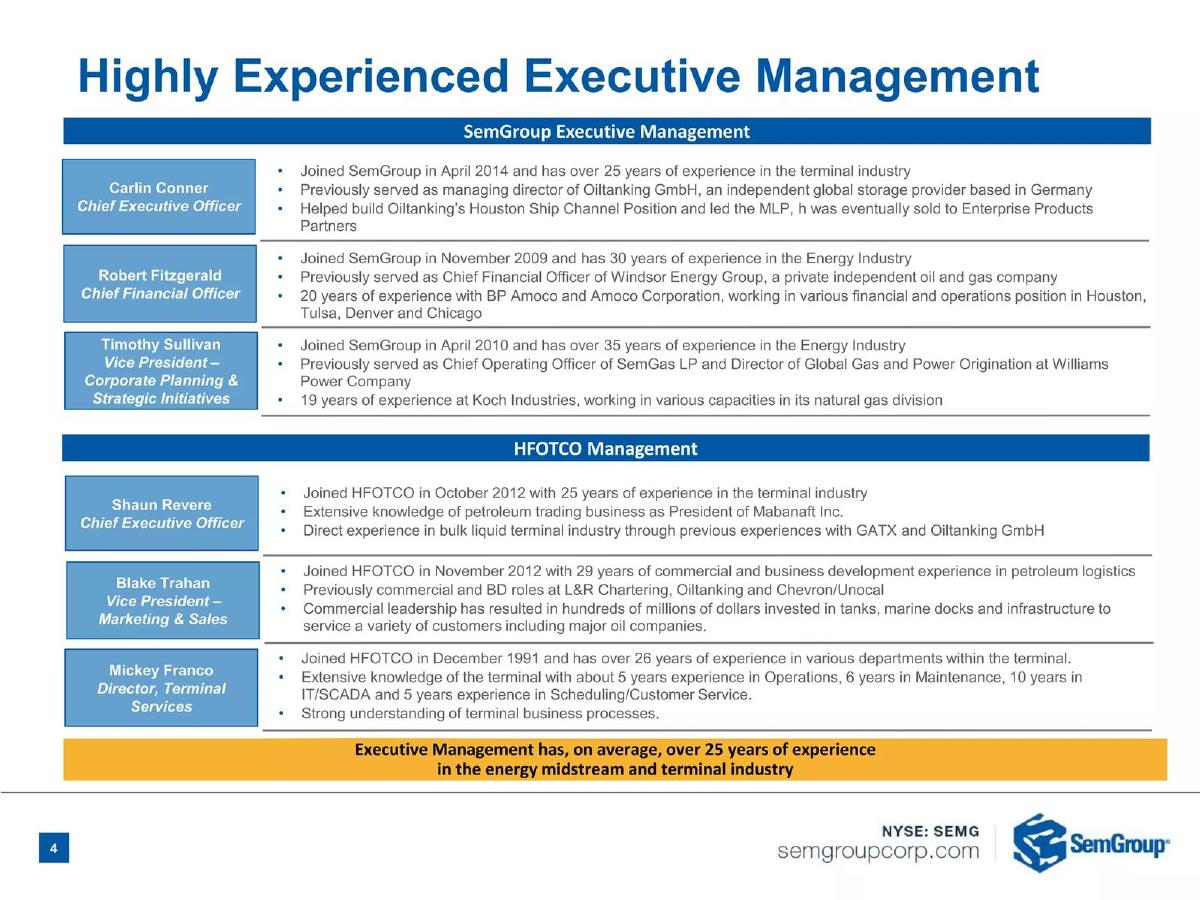
- The presentation is structured for institutional investors, featuring a dedicated appendix and clear executive leadership transitions (Slides 5, 9, 33).
- The deck highlights the necessity of blend-capable assets for low sulfur fuel blends, positioning HFOTCO as a VGO hub (Slide 29).
Introduction and Corporate Context
The HFOTCO (Houston Fuel Oil Terminal Company) investor presentation, dated June 6, 2018, is a professional corporate deck designed to showcase a specific midstream asset under the SemGroup umbrella. The deck is characterized by its industrial aesthetic, utilizing high-resolution photography of storage tanks, pipelines, and maritime logistics to ground the financial data in physical reality. As a 'SemGroup Business,' the presentation carries the branding of its parent company, including the NYSE ticker 'SEMG' on every slide footer, signaling to investors that this is a regulated, public-market-grade asset.
Slide 1: Title and Visual Identity
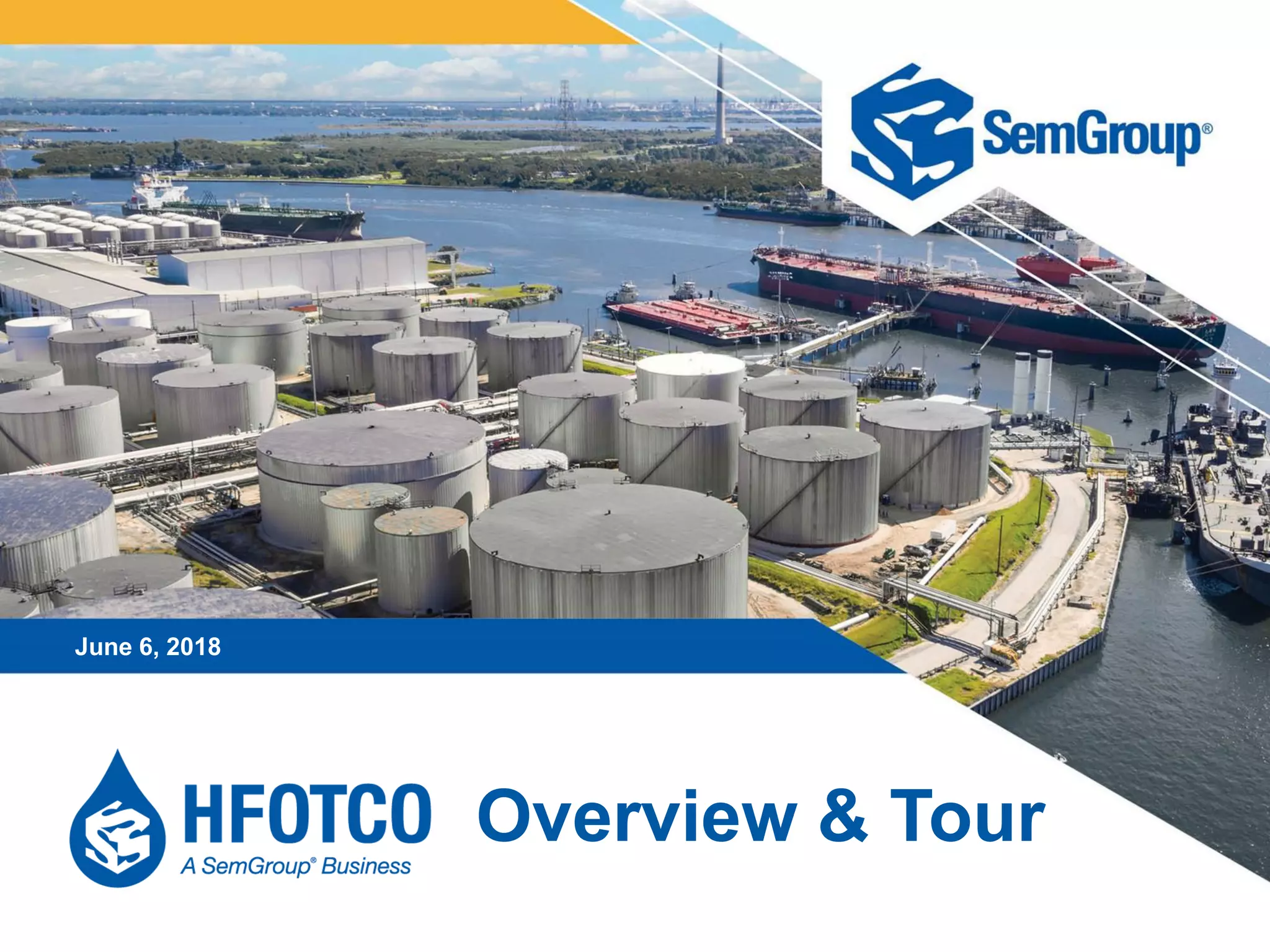
The cover slide establishes the scale of the operation. It features an aerial view of the Houston terminal, showing dozens of large-scale storage tanks situated along a deep-water channel with multiple tankers docked. The title 'HFOTCO Overview & Tour' suggests this deck was likely used for an analyst day or a site visit, where investors were given a physical walkthrough of the facilities. The date, June 6, 2018, places the presentation in a period of significant midstream infrastructure expansion in the U.S. Gulf Coast.
Slides 5 and 9: Leadership Introduction
Slides 5 and 9 serve as transition points to introduce the executive team. Slide 5 features Carlin Conner, CEO of SemGroup, while Slide 9 introduces Shaun Revere, CEO of HFOTCO. The use of full-page transition slides for individual executives is a common tactic in large corporate presentations to signify the importance of management expertise. However, these slides contain no biographical data or track record information, assuming the audience is already familiar with the leadership or that a verbal introduction will provide the necessary context.
Slide 13: Macro Market Positioning
Slide 13 provides the 'Why here?' for the business. Titled 'U.S. Refineries,' it utilizes data from the EIA (Energy Information Administration) to map out regional refinery capacity and complexity across the United States. The slide highlights the Gulf Coast as the dominant player in the industry, with 7.8 million barrels per day of capacity. By contrasting this with the Midwest (2.9 million) and the West Coast (2.0 million), HFOTCO positions its Houston location as the most strategic point in the domestic energy supply chain. The map also distinguishes between refineries with and without cokers, emphasizing the complexity of the regional infrastructure that HFOTCO supports.
Slide 17: Operational Transition
Slide 17 is a simple header slide titled 'HFOTCO Overview.' Like the executive slides, it uses a consistent visual motif of large-diameter white piping against a blue sky. This section marks the shift from macro-market data to specific asset-level details.
Slide 21: Product Handling Capabilities
This slide is critical for understanding the terminal's utility. It lists five primary product categories: Crude Oil, Residual Fuel Oil, Vacuum Gas Oil, Carbon Black, and Asphalt. Each category is linked via blue arrows to its end-use applications, such as jet fuels, power generation, tires, and road construction. This visual mapping demonstrates that HFOTCO is not just a 'fuel oil' company, despite its name, but a multi-commodity logistics hub. The inclusion of Carbon Black and Asphalt highlights the terminal's role in supporting industrial manufacturing and infrastructure, not just transportation fuels.
Slide 25: The Financial Moat
Slide 25, titled 'Solid Customer Base,' is arguably the most important slide for an investor. It breaks down the revenue and customer profile using three pie charts: Diversified, Long-Term, and Investment Grade. The data points are highly specific: 88% of revenue is generated by 'take-or-pay' contracts, and 75% of contracted capacity is with 'diversified investment grade counterparties.' The 'Long-Term' chart shows that 52% of customers have been with the company for over 18 years, with a weighted-average tenure of approximately 18 years. This slide effectively argues that HFOTCO is a low-risk, 'utility-like' investment with highly predictable cash flows and minimal counterparty credit risk.
Slide 29: Adaptation and Future-Proofing
Slide 29 addresses the 'Impacts to HFOTCO' regarding market shifts. It acknowledges that while heavy fuel oil is still produced, its value is changing. The company highlights its success in diversifying its 'heated portfolio,' specifically by becoming a 'VGO hub.' A key metric provided is that 'Fuel Oil and related components [have been] reduced by more than 30% since 2013.' This demonstrates management's ability to pivot the asset to handle lighter, higher-value, or more environmentally compliant products like Vacuum Gas Oil (VGO), which is used for low-sulfur fuel blends.
Slide 33: Appendix
The final slide in the provided set is a header for the 'Appendix.' In institutional decks, the appendix usually contains detailed GAAP to non-GAAP reconciliations, environmental safety records, and specific tankage capacities. Its presence indicates a high level of transparency and a readiness for deep-dive due diligence.
What Works in the HFOTCO Deck
The deck is exceptionally strong in demonstrating revenue stability . By highlighting the 88% take-or-pay contract structure and the 18-year average customer tenure, the company speaks directly to the primary concern of midstream investors: cash flow predictability. The use of EIA data to validate the geographic importance of the Gulf Coast provides a factual, third-party anchor for the company's value proposition. Furthermore, the product handling slide (Slide 21) does an excellent job of simplifying complex industrial processes into understandable end-use cases, making the business model accessible to generalist investors.
What is Missing from the HFOTCO Deck
The most notable omission in the provided slides is financial performance metrics . While the deck mentions revenue types, it does not list EBITDA, net income, or capital expenditure (CapEx) requirements. There are no charts showing historical revenue growth or margin expansion. Additionally, the deck lacks a competitor analysis . While it mentions the Gulf Coast is a major hub, it does not explain how HFOTCO compares to other major terminal operators in the Houston Ship Channel, such as Enterprise Products Partners or Kinder Morgan. Finally, there is no ESG (Environmental, Social, and Governance) slide, which, even in 2018, was becoming a standard requirement for institutional energy investors, particularly regarding spill prevention and emissions monitoring.
Founder Lessons: Copy These Strategies
Quantify Customer Loyalty: Don't just say you have 'great customers.' Use a metric like 'weighted-average tenure' (Slide 25) to prove it. · Visual Product Mapping: If your product is a technical 'middle-man' service, use a slide like Slide 21 to show exactly where your output goes in the real world. · Leverage Third-Party Data: Using EIA maps (Slide 13) gives your market claims instant credibility that internal company charts cannot match. · Highlight the Contract Model: If you have recurring revenue or fixed contracts, make that the centerpiece of your financial argument. Investors buy stability. · Show Evolution: Slide 29's mention of a 30% reduction in fuel oil since 2013 shows that the company is not stagnant; it is actively managing its portfolio to meet future market demands.
Frequently asked questions
- What is the primary revenue model for HFOTCO?
- HFOTCO relies heavily on a take-or-pay contract model. According to slide 25, approximately 88% of its revenue is generated through these fixed contracts, which require customers to pay for capacity regardless of whether they use it. The remaining 12% comes from predictable ancillary services such as heating and throughput fees, creating a highly stable and defensive cash flow profile suitable for midstream energy investors.
- Who are the key leaders mentioned in the presentation?
- The presentation introduces two primary executives: Carlin Conner, who serves as the CEO of the parent company SemGroup (Slide 5), and Shaun Revere, who is the CEO of HFOTCO (Slide 9). This structure indicates a clear hierarchy where the terminal operations are managed by a dedicated specialist while remaining integrated into the broader corporate strategy of the NYSE-listed parent entity, SemGroup.
- How does HFOTCO fit into the broader U.S. refining landscape?
- HFOTCO is located in the Gulf Coast region, which is the most critical refining hub in the United States. Slide 13 shows that the Gulf Coast has a capacity of 7.8 million barrels per day, dwarfing other regions like the Midwest (2.9 million) and the West Coast (2.0 million). By operating in this high-density complex, HFOTCO serves as a vital logistics link for major oil companies and refiners.
- What products does the terminal handle?
- As detailed on slide 21, the terminal handles a diverse array of petroleum products. These include Crude Oil (for motor and jet fuels), Residual Fuel Oil (for power generation and bunker fuel), Vacuum Gas Oil (for intermediate refinery feed), Carbon Black (for tires, plastics, and ink), and Asphalt (for road construction). This diversity allows the terminal to remain relevant across multiple industrial and transportation sectors.
- How has the company adapted to changing environmental or market demands?
- Slide 29 highlights that HFOTCO has proactively diversified its 'heated portfolio.' Since 2013, it has reduced its reliance on traditional fuel oil and related components by more than 30%. It has transitioned into a hub for Vacuum Gas Oil (VGO), which is a critical component for producing low-sulfur fuel blends, aligning the business with tighter maritime and environmental regulations regarding sulfur emissions.