The Hexo Corp April 2021 investor deck serves as a strategic roadmap for a maturing cannabis leader aiming for EBITDA positivity. With a heavy focus on brand segmentation—ranging from value-tier 'Bake Sale' to premium 'UP Cannabis'—the presentation demonstrates how Hexo achieved a 27% market share in Quebec and reached 98% of Canadians through diverse distribution channels. The deck is particularly notable for its detailed operational breakdown, showcasing 2.3 million square feet of facility space and an annualized run rate of 90,000 kg. It concludes with a formal transaction overview for the…
Key takeaways
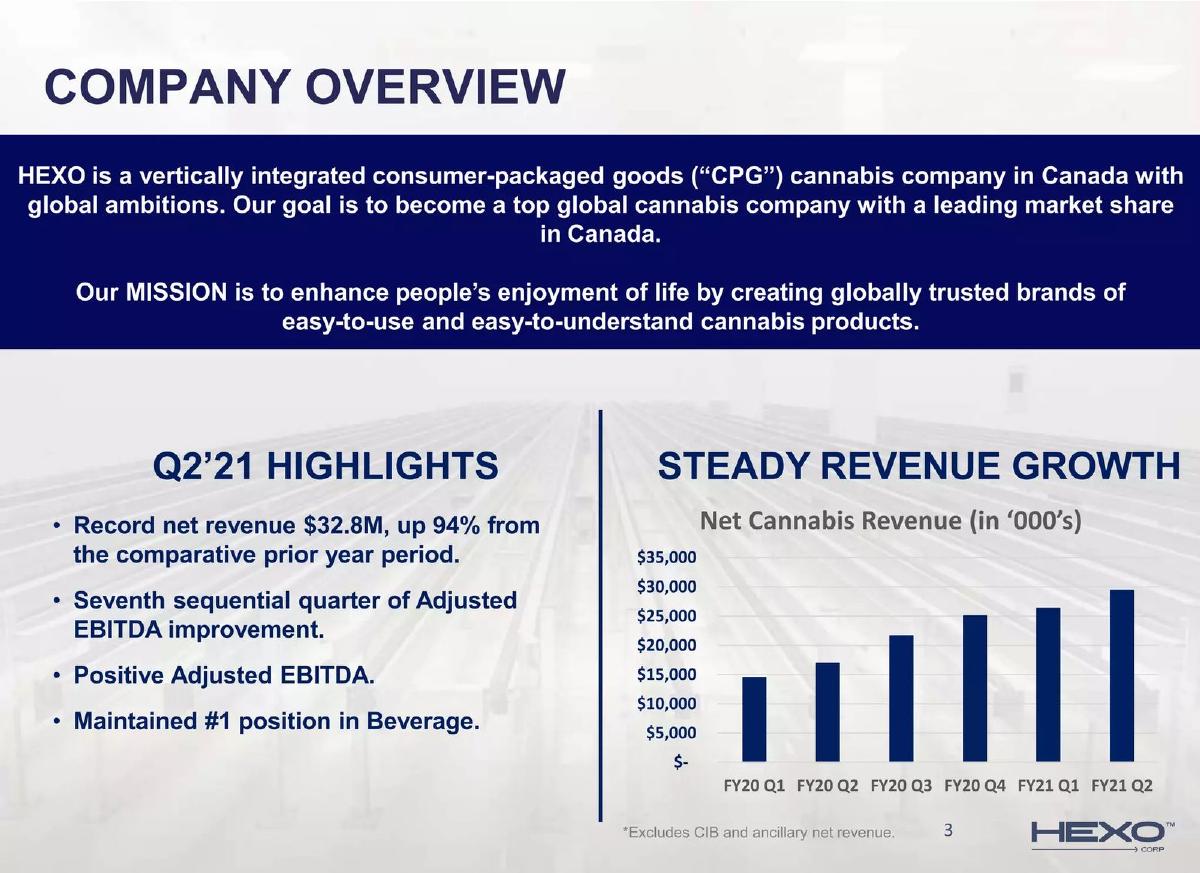
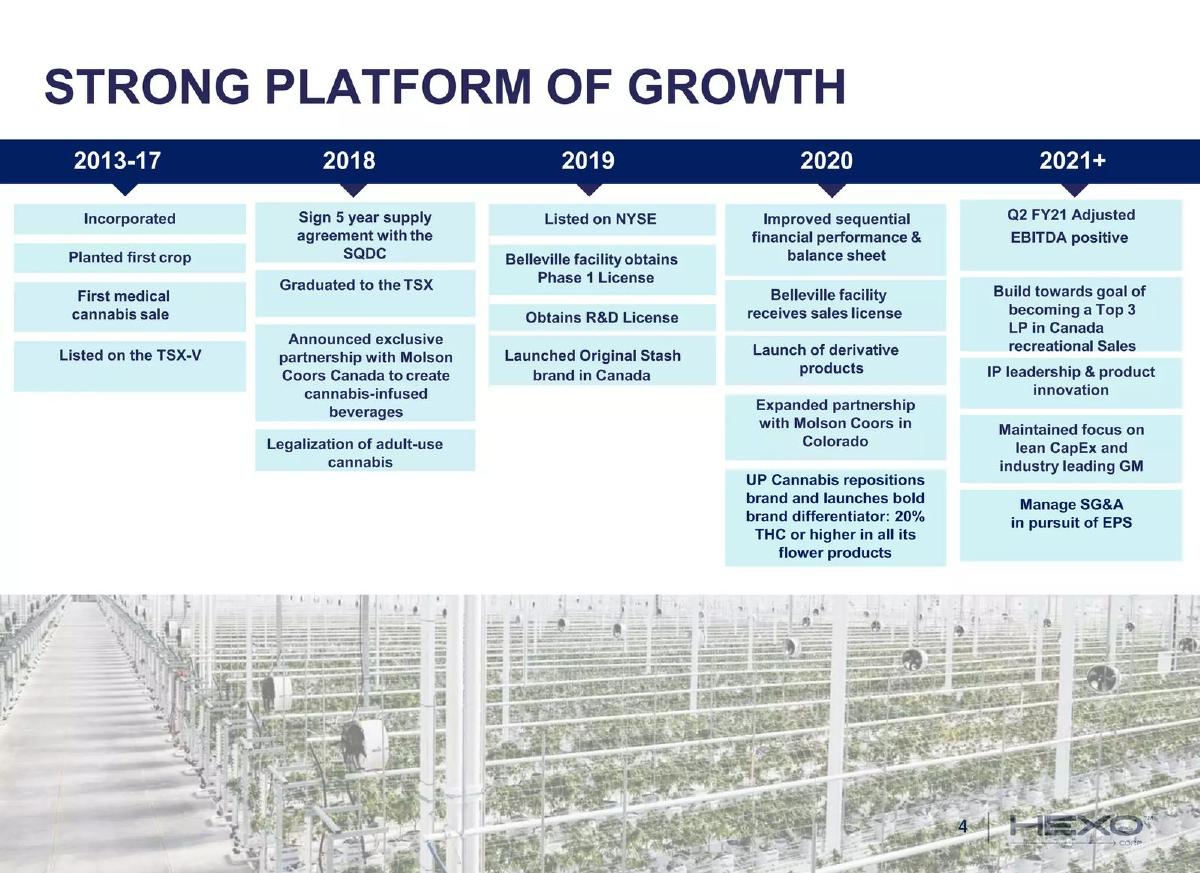
- Hexo achieved Q2 FY21 Adjusted EBITDA positive status, a critical milestone for the capital-intensive cannabis sector (Slide 4).
- The company utilizes a multi-brand strategy to target different consumer segments, including HEXO for mid-price, HEXO Plus for higher-mid, and Bake Sale for extra value (Slides 8, 10).
- Hexo maintains a dominant 27% overall market share in Quebec as of late 2020, supported by a 74% share of the hash market (Slide 8).
- The distribution network reaches 98% of Canadians through a mix of government-run and private retail agreements across all 10 provinces (Slide 13).
- Operational scale is significant, with 2,328,400 total square feet across four facilities in Quebec and Ontario (Slide 16).
- The current annualized production run rate is stated at 90,000 kg of flower and trim (Slide 16).
- The management team features deep CPG and finance experience, including former executives from Mars Inc., Pepsi Bottling Group, and Sobeys Inc. (Slide 20).
- The Zenabis acquisition was structured as a stock-for-stock combination with a 19% premium based on the 20-day VWAP (Slide 23).
Hexo Corp: A Study in Cannabis Market Consolidation
The April 2021 investor deck for Hexo Corp represents a pivotal moment for the company. At this stage, the Canadian cannabis market had moved past the initial 'green rush' and into a phase of intense competition, price compression, and consolidation. Hexo’s deck focuses on three core pillars: brand segmentation, operational scale, and strategic M&A. By positioning themselves as a CPG (Consumer Packaged Goods) company rather than just a cultivator, Hexo attempts to justify its valuation through market share and efficiency rather than just raw growth potential.
Slide 1: Title and Positioning
The cover slide establishes the corporate identity with the tagline Strategic · Innovative · Visionary . It clearly displays its dual listing on the TSX and NYSE under the ticker HEXO. The imagery of a cannabis leaf is standard for the industry, but the clean, corporate blue aesthetic signals a move toward professional, institutional-grade investment appeal rather than the 'counter-culture' roots of the industry.
Slide 4: The Growth Timeline
Slide 4, titled Strong Platform of Growth , provides a chronological history from incorporation in 2013-17 to the 2021 outlook. Key milestones include:
2018: The 5-year supply agreement with the SQDC and the exclusive partnership with Molson Coors Canada. · 2019: Listing on the NYSE and the launch of the 'Original Stash' brand. · 2020: Launch of derivative products and the repositioning of the 'UP Cannabis' brand. · 2021+: The achievement of Q2 FY21 Adjusted EBITDA positive status and the goal of becoming a Top 3 LP (Licensed Producer) in Canada.
This slide is effective because it shows a consistent track record of hitting regulatory and commercial milestones, which builds investor confidence in management's ability to execute on future goals.
Slides 8 & 10: Multi-Brand Strategy
These slides detail how Hexo segments the market. Slide 8 focuses on the HEXO and HEXO Plus brands. In Quebec, Hexo held a 27% overall market share between October and December 2020, including a staggering 74% of the Hash market . The deck uses a table format to define Price Point, THC Range, and Distribution for each brand, a clear way to show how they avoid cannibalizing their own sales.
Slide 10 introduces Bake Sale , launched in April 2021. Positioned as 'Extra Value' with a 14-17% THC range, it is marketed as an 'all-purpose flower' for cooking or extending a stash. This brand is a direct response to the 'value' segment that dominated the Canadian market in 2020-2021, showing that Hexo is responsive to consumer trends toward lower-priced, high-volume products.
Slide 13: Market Leadership and Distribution
Slide 13 uses a map of Canada to visualize Hexo's reach. The company claims to reach 98% of Canadians through supply agreements in all 10 provinces. The slide highlights their 'Preferred supplier relationship in Quebec' and the relaunch of the UP Cannabis brand with a '20%+ THC' differentiator. This slide is crucial for proving that Hexo has the 'pipes' (distribution) to move the 'liquid' (product) they produce at scale.
Slide 16: Operational Excellence
This slide provides the hard data on Hexo's production capacity. It lists four main facilities:
Gatineau, QC: 1,310,000 sq. ft. for greenhouse cultivation and automated manufacturing. · Belleville, ON: 912,600 sq. ft. for processing, R&D, and distribution. · Vaughan and Brantford, ON: Smaller labs for edibles and genetics.
The total footprint of 2,328,400 sq. ft. and a current annualized run rate of 90,000 kg are the 'hero' metrics here. The right side of the slide lists 'Low Cost Drivers' like automation and competitive utility costs, though it lacks specific dollar-per-gram figures which sophisticated investors usually look for.
Slide 20: Experienced Management Team
Hexo leans heavily on the CPG experience of its leadership. The team includes:
Sébastien St-Louis (CEO): Co-founder with 8+ years at the helm. · Trent MacDonald (CFO): Experience at Sobeys Inc. and Indigo. · Donald Courtney (COO): Former COO of MedReleaf with experience at Mars Inc. and Pepsi.
The inclusion of Mars and Pepsi in the bios is a strategic choice to frame Hexo as a consumer goods powerhouse rather than a simple farming operation.
Slide 23: Transaction Overview (Zenabis Acquisition)
The final slide in this selection details the acquisition of Zenabis Global, Ltd. The structure is a Stock for Stock Combination where Zenabis shareholders receive 0.01772 HEXO shares per ZENA share. Key details include:
A 19% premium based on the 20-day VWAP as of Feb 12, 2021. · Pro forma ownership: 87.43% HEXO / 12.57% Zenabis . · Expected to close in Q4 2021 .
This slide serves as the 'call to action' for the deck, explaining the next phase of Hexo's growth through inorganic expansion.
What Works in This Deck
Clear Segmentation: The use of tables to define brand tiers (Price, THC, Distribution) is excellent. It prevents the 'brand soup' problem common in cannabis decks where investors can't tell the difference between product lines.
Regional Dominance: By leaning into their 27% market share in Quebec, Hexo creates a 'moat' narrative. They aren't just one of many; they are the leader in a specific, large territory.
Operational Transparency: Listing the exact square footage and purpose of each facility provides a sense of tangible asset value, which is important for a company listed on major exchanges.
What Is Missing
Unit Economics: While the deck mentions 'Low Cost Drivers,' it does not provide the 'Cash Cost to Grow' or 'All-in Cost per Gram.' In a market defined by price wars, these metrics are vital.
Inventory Management: The Canadian cannabis sector struggled significantly with inventory write-downs during this period. The deck does not address how Hexo manages its biological assets to avoid oversupply.
International Strategy: The deck is almost entirely focused on Canada. For a NYSE-listed company, investors often look for a clearer path to U.S. entry or European medical market expansion, which is largely absent here.
What a Founder Should Copy
The 'Growth Platform' Slide: Slide 4 is a masterclass in showing momentum. If you are a later-stage startup, use this format to show that your current success is the result of a long, disciplined sequence of wins.
The Distribution Map: Slide 13 effectively uses a map to turn abstract 'partnerships' into a visual representation of market dominance. If your product has a physical footprint, map it.
CPG Framing: Hexo successfully frames its leadership through the lens of traditional industry (Pepsi, Mars, Sobeys). Founders in 'new' industries should always highlight their team's experience in 'old' industries to signal stability and operational maturity.
Frequently asked questions
- What is Hexo's primary market advantage according to the deck?
- Hexo's primary advantage is its dominant position in Quebec and its broad national reach. Slide 8 notes a 27% market share in Quebec, while Slide 13 highlights that their supply agreements reach 98% of the Canadian population. This is bolstered by a 'hub-and-spoke' operational model with over 2.3 million square feet of facility space, allowing for high-volume production and R&D.
- How does Hexo segment its product offerings?
- Hexo uses a tiered brand strategy. 'Bake Sale' targets the 'extra value' segment with 14-17% THC (Slide 10). The core 'HEXO' brand targets the mid-price market with 17-20% THC, and 'HEXO Plus' or 'UP' targets the premium segment with 20%+ THC (Slides 8, 13). This allows them to capture different price points and consumer needs simultaneously.
- What are the key terms of the Zenabis acquisition mentioned in the deck?
- According to Slide 23, the Zenabis acquisition is a stock-for-stock combination where ZENA shareholders receive .01772 shares of HEXO for each ZENA share. This represents a 19% premium. Post-transaction, HEXO shareholders were expected to own 87.43% of the combined entity, with the deal expected to close in Q4 2021.
- What operational metrics does Hexo use to demonstrate efficiency?
- Hexo points to its 'Low Cost Drivers' on Slide 16, which include state-of-the-art automation, purpose-built cultivation, and competitive water and electricity costs. They cite a total facility footprint of 2,328,400 sq. ft. and an annualized run rate of 90,000 kg to prove they have the scale necessary to compete on price in the value segment.
- Who leads Hexo Corp, and what is their background?
- The leadership team, shown on Slide 20, is led by Co-founder & CEO Sébastien St-Louis. The team includes CFO Trent MacDonald (formerly of Sobeys and Indigo) and COO Donald Courtney (formerly of Mars Inc. and Pepsi). The presence of leaders from traditional CPG and retail backgrounds suggests a focus on supply chain efficiency and brand management.