Aviwell's pitch deck presents a compelling case for a deep-tech intervention in the global food security crisis. By combining 30 years of university research with modern AI/ML techniques, the company aims to improve livestock Feed Conversion Ratios (FCR) using natural, native microbial consortia. The deck highlights a significant shift from continuous antibiotic or hormone use to a single-dose 'Natal Imprinting' model at birth. With €4.3M in seed funding and €4.8M in non-dilutive grants already secured, Aviwell demonstrates strong early momentum. The presentation effectively balances high-lev…
Key takeaways
- Aviwell is headquartered in Toulouse, France, with offices in Boston, operating at the intersection of digital and life sciences (Slide 2).
- The company claims a successful proof of concept in geese, inducing a 250% growth in 30% of geese without force-feeding (Slide 2).
- Their primary market focus is the €20B+ broiler Feed Conversion Ratio (FCR) market (Slide 2).
- The discovery platform utilizes 'in silico' AI/ML algorithms and 'in vivo' bacterial libraries to identify microbial consortia (Slide 7).
- Aviwell's solution requires only a single dose at birth, compared to the ~200 doses required by traditional continuous-feed competitors (Slide 11).
- The company projects a rapid revenue scale from €0.16M in 2024 to €255.81M by 2028 (Slide 13).
- Aviwell has secured €4.8M in non-dilutive grants from Bpifrance and the European Innovation Council (Slide 16).
- A Series A raise is targeted for late 2024, with approximately €6.8M already committed (Slide 17).
Aviwell Pitch Deck Analysis
Aviwell presents itself as a deep-tech solution to one of the most pressing global issues: food security. The deck is structured to move from a massive global problem to a highly specific, scientifically-backed solution, eventually landing on a scalable platform model. It positions the company not just as a supplement provider, but as a data-driven life sciences firm.
Slide 1: Title and Mission
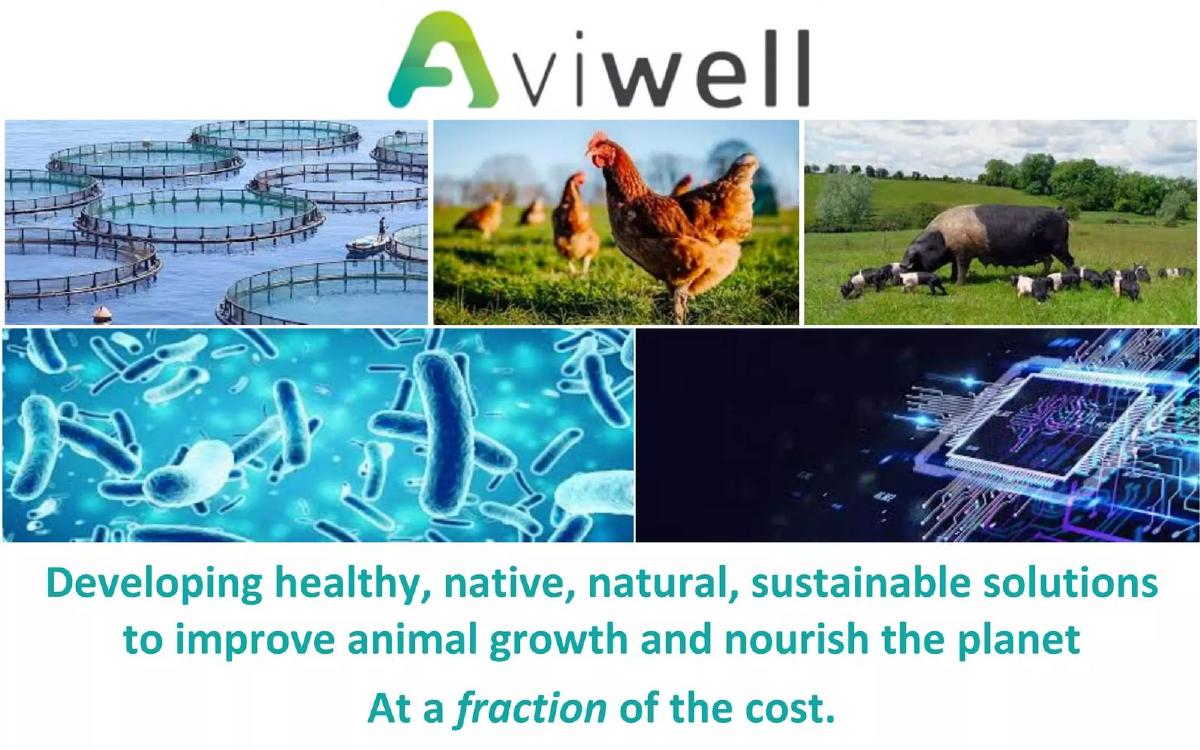
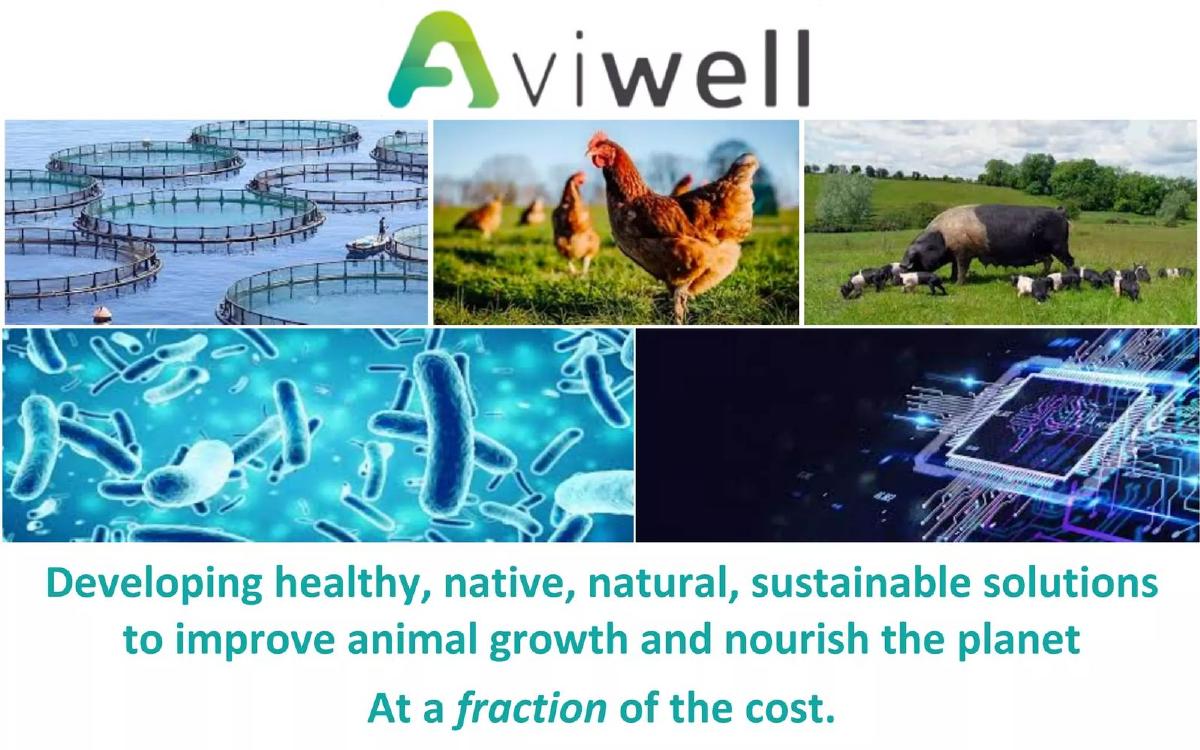
The cover slide establishes the brand and its core value proposition: "Developing healthy, native, natural, sustainable solutions to improve animal growth and nourish the planet at a fraction of the cost." The imagery connects aquaculture, poultry, and swine farming with microbial science and computing, signaling the "Digital & Life Sciences" convergence mentioned later.
Slide 2: Company Overview
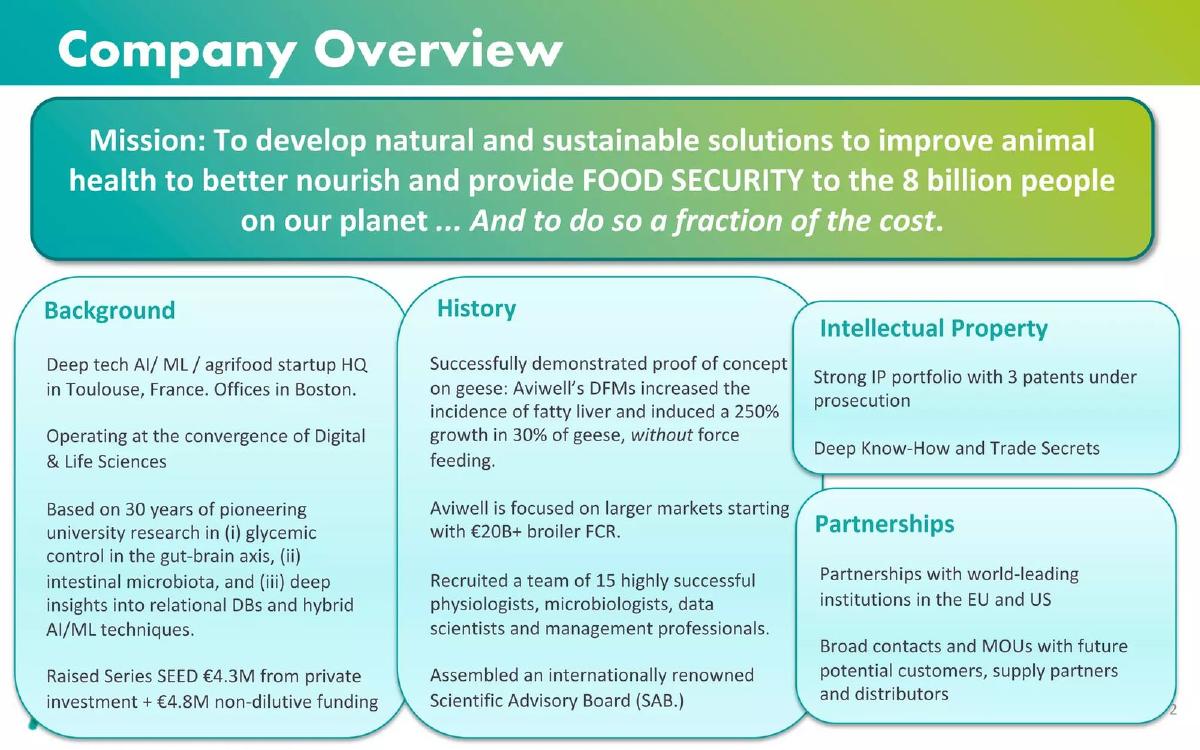
This slide serves as a dense executive summary. Key facts include:
Headquarters: Toulouse, France, with Boston offices. · Scientific Foundation: 30 years of university research in the gut-brain axis and intestinal microbiota. · Traction: Proof of concept in geese showing 250% growth in 30% of subjects without force-feeding. · Funding: €4.3M Seed + €4.8M non-dilutive. · IP: 3 patents under prosecution plus trade secrets.
Slide 3: Executive Team + Selected Partners
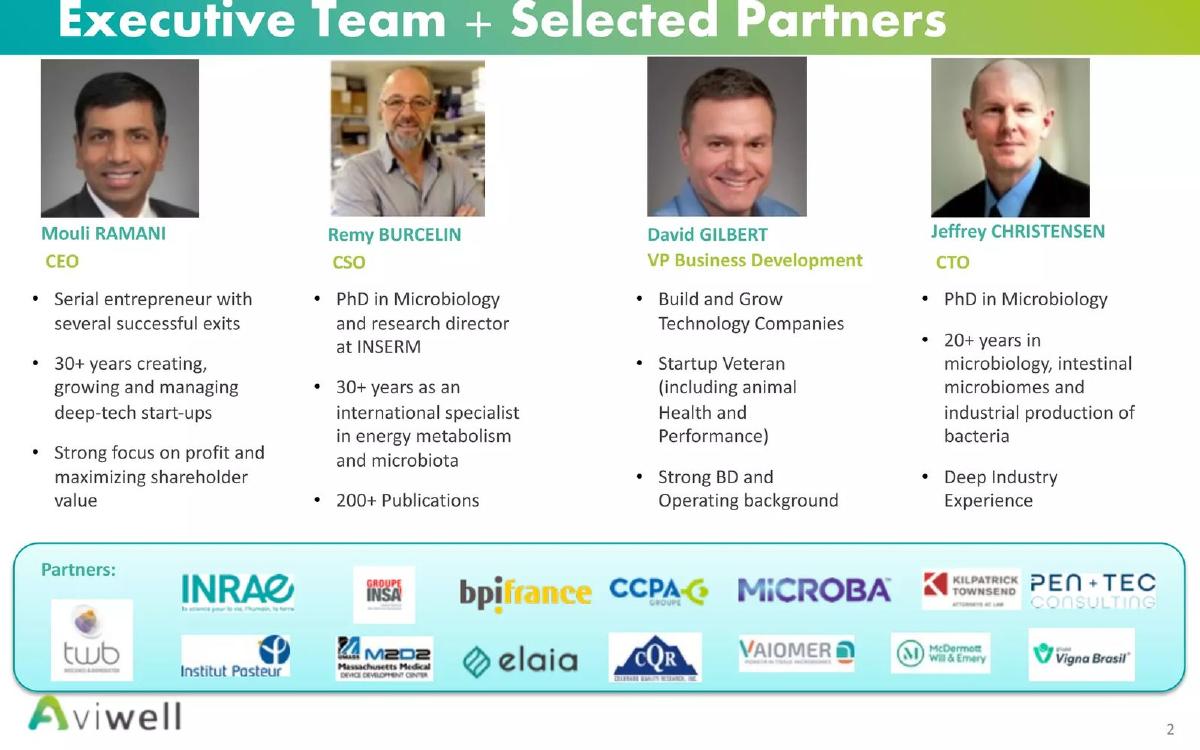
The team is led by Mouli Ramani (CEO), a serial entrepreneur, and Remy Burcelin (CSO), a PhD with 30+ years in energy metabolism and 200+ publications. The presence of a VP of Business Development (David Gilbert) and a CTO (Jeffrey Christensen) suggests a balance between commercialization and technical execution. The partner list is extensive, featuring major French institutions like INRAE, Institut Pasteur, and Bpifrance, which adds significant institutional credibility.
Slide 4-5: Problems & Needs
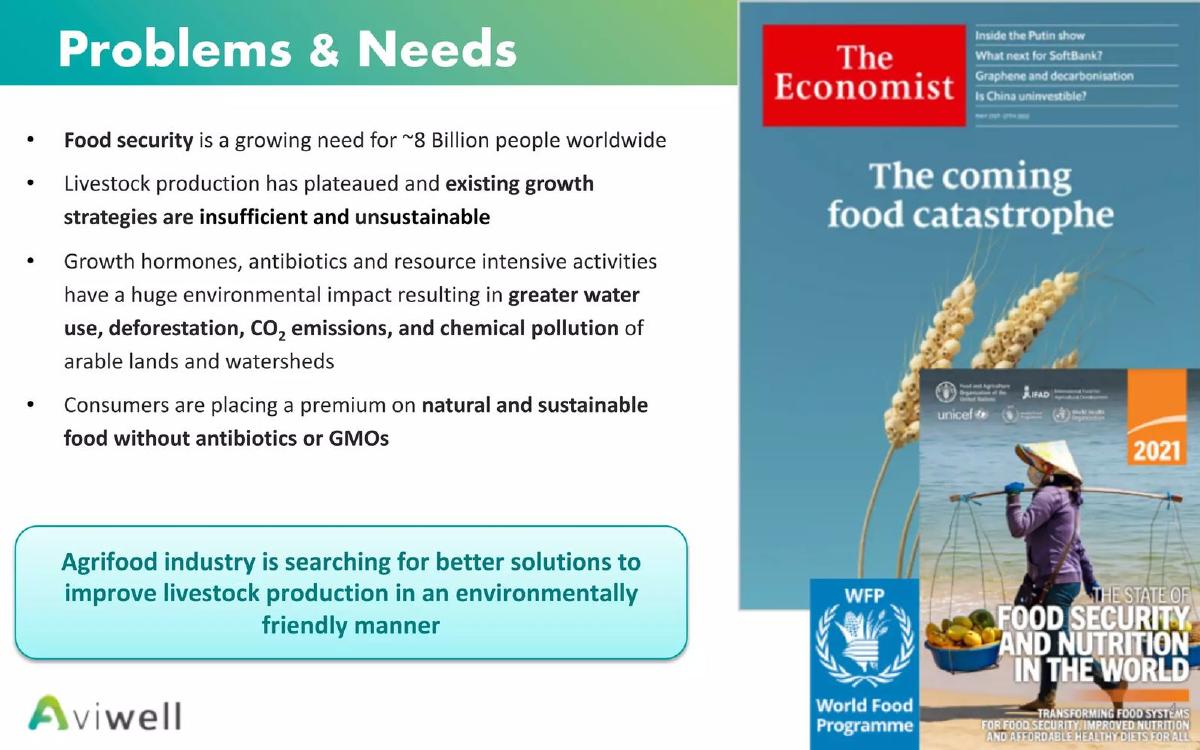
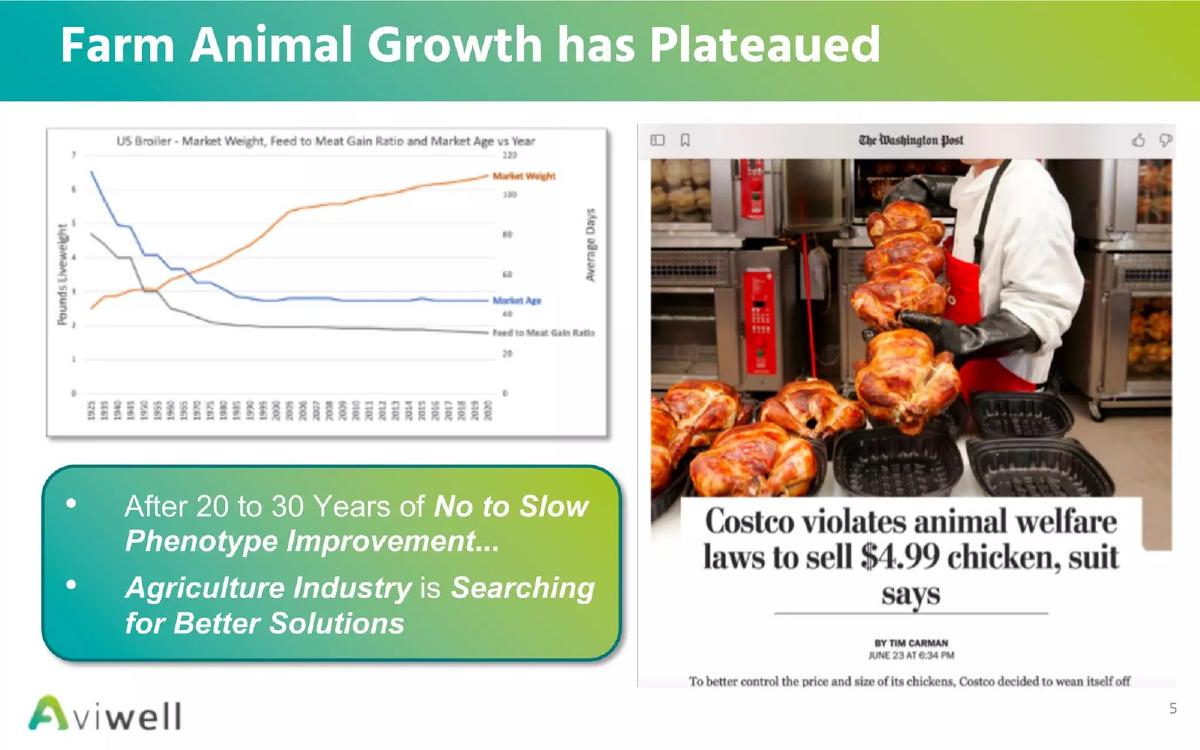
Aviwell frames the problem using high-authority sources like The Economist ("The coming food catastrophe") and the World Food Programme. Slide 5 specifically highlights that farm animal growth has plateaued over the last 20-30 years. It uses a Washington Post headline regarding Costco's chicken production to illustrate the tension between low consumer prices and animal welfare/sustainability.
Slide 6-8: The Proprietary Platform
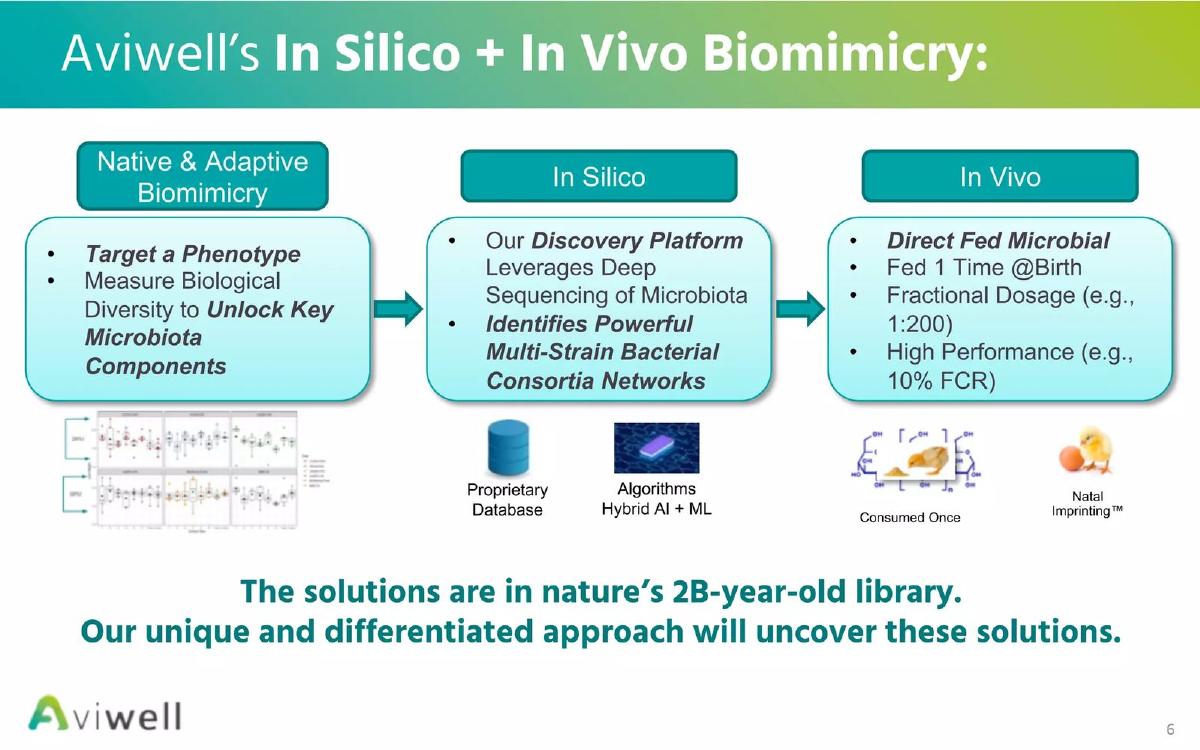
These slides detail the "In Silico + In Vivo Biomimicry" process. Slide 6 explains the workflow: targeting a phenotype, using AI/ML to identify bacterial consortia from a "2B-year-old library," and delivering a fractional dosage. Slide 7 introduces the "Discovery Platform" components, including the "Bourget" proprietary database and the "Natal Imprinting" delivery method. Slide 8 emphasizes that the platform is species-agnostic, capable of targeting any phenotype (FCR, body weight, Omega-3 content) across various animals.
Slide 9-10: Product Vision and Value
Aviwell visualizes its impact by comparing current growth cycles to their "Aviwell Inside" model. The key claim is a 10% improvement in Feed Conversion Ratio (FCR) via a single dose at birth. Slide 10 lists the commercial benefits: smaller agricultural footprint, reduced time to market, and improved flock uniformity. The "1 Dose vs 200" comparison is a powerful economic hook for industrial farmers.
Slide 11-12: Competition and Sustainability
Slide 11 is a standard 2x2 matrix, but instead of axes, it uses a table to compare performance (5-10% FCR improvement vs. 0-5%) and dosage (One dose vs. ~200 doses). It names several major incumbents like DSM, ADM, and DuPont as "Me-Too Performance" competitors. Slide 12 reinforces the ESG angle, citing decreased water consumption, reduced pollutants, and 100% native/natural solutions.
Slide 13-14: Revenue and Market Size
The revenue chart on Slide 13 shows a classic venture-backed "hockey stick" projection. The company expects to cross the €20M mark in 2026 and reach €255.8M by 2028. The revenue is split between product sales (Broiler FCR being the largest) and platform subscription services. Slide 14 calculates a ~$300B Worldwide Total Addressable Market (TAM), broken down by species: $20.7B for Broilers, $25B for Aqua, $35.2B for Milk, and $20.8B for Swine.
Slide 15: Intellectual Property
The deck lists three specific patent filings covering liver fatty acid content, multi-omic discovery techniques, and microbial compositions for poultry FCR. It also categorizes their "Know-How" and "Trade Secrets," which include bacterial libraries and unique animal models for validation.
Slide 16-17: Fundraising and Use of Funds
Aviwell highlights its success in securing non-dilutive capital, including €2.5M from the European Innovation Council. Slide 17 details the Seed round led by Elaia and MFS. It explicitly states a goal for a Series A in late 2024, noting that ~€6.8M is already committed. The use of funds is clearly prioritized: accelerating poultry trials, building out the discovery platform, and increasing headcount in technical roles.
What Works Well
Clear Differentiation: The "1 dose vs 200 doses" argument is a brilliant way to simplify a complex biological advantage into a clear operational and cost benefit for the customer. · Scientific Credibility: Citing 30 years of research and listing a high-caliber Scientific Advisory Board (SAB) helps mitigate the perceived risk of a deep-tech investment. · Platform Play: By showing the platform is species-agnostic, Aviwell expands its potential from a single-product company to a broad biotech infrastructure play.
What Is Missing
Unit Economics: While the deck mentions "a fraction of the cost," it does not provide specific data on the cost to produce the DFM versus the expected selling price or the specific ROI for a farmer. · Regulatory Roadmap: Developing new microbial consortia for food animals involves significant regulatory hurdles (EFSA in Europe, FDA in the US). The deck mentions "regulatory pathway activities" in the use of funds but doesn't detail the expected timeline or current status. · Detailed Competition: The competitive slide groups all major incumbents into one "low performance" bucket. A more nuanced view of how these incumbents might react or their own internal R&D efforts in microbiota would be beneficial.
Founder Takeaways
Leverage Non-Dilutive Funding: Aviwell’s ability to secure €4.8M in grants is a massive signal of technical validation and capital efficiency that founders should highlight prominently. · Visualizing the 'Before and After': Slide 9's simple illustration of chicken growth cycles makes the value proposition instantly understandable to a non-technical investor. · Phased Market Entry: Starting with a specific proof of concept (geese) before moving to a massive market (broilers) shows a logical, de-risked path to scale.
Frequently asked questions
- What is Aviwell's core technology?
- Aviwell uses a proprietary discovery platform that combines MultiOmics (metagenomics, metabolomics, etc.) with hybrid AI and machine learning. This platform identifies specific 'Direct Fed Microbials' (DFMs) from a 2-billion-year-old natural library to target specific animal phenotypes, such as improved growth or feed efficiency, without using hormones or GMOs (Slides 6 and 7).
- How does Aviwell's product differ from existing livestock supplements?
- Most current solutions require continuous feeding throughout the animal's life, totaling approximately 200 doses. Aviwell’s 'Natal Imprinting' technology allows for a single dose administered at birth, which the company claims provides long-term benefits and a 10% improvement in Feed Conversion Ratio (FCR) (Slides 10 and 11).
- What is the company's current funding status?
- As of the deck's publication, Aviwell had raised a €4.3M Series Seed led by Elaia, MFS, and Third Culture Capital, with €500K of that round still noted as open. Additionally, they secured €4.8M in non-dilutive grants in 2022. They are preparing for a Series A in late 2024 with €6.8M already committed (Slides 16 and 17).
- Which markets is Aviwell targeting?
- While starting with the €20.7B broiler chicken market, the platform is species-agnostic. The deck outlines expansion into aquaculture (Omega-3/6), dairy cattle (milk quality), swine (FCR), and egg layers, targeting a total worldwide addressable market of approximately $300B (Slide 14).
- What are the projected financial outcomes?
- Aviwell projects significant growth, starting with modest revenues of €0.16M in 2024 and €3.48M in 2025. By 2028, they forecast total revenue reaching €255.81M, driven primarily by broiler FCR product sales and discovery platform subscription services (Slide 13).