Auxia's 10-slide Series A deck is a clinical example of how to pitch high-scale AI infrastructure to enterprise investors. By framing the problem as an 'iceberg' where post-acquisition journeys (activation, retention, monetization) are neglected despite rising CAC, they create a compelling case for their 'Agentic' platform. The deck highlights massive technical scale—processing 2 billion events and 175 million decisions daily—to prove they aren't just a wrapper. With a founding team hailing from leadership roles at Google and Meta, and an advisor list featuring CMOs from Google and Booking.co…
Key takeaways
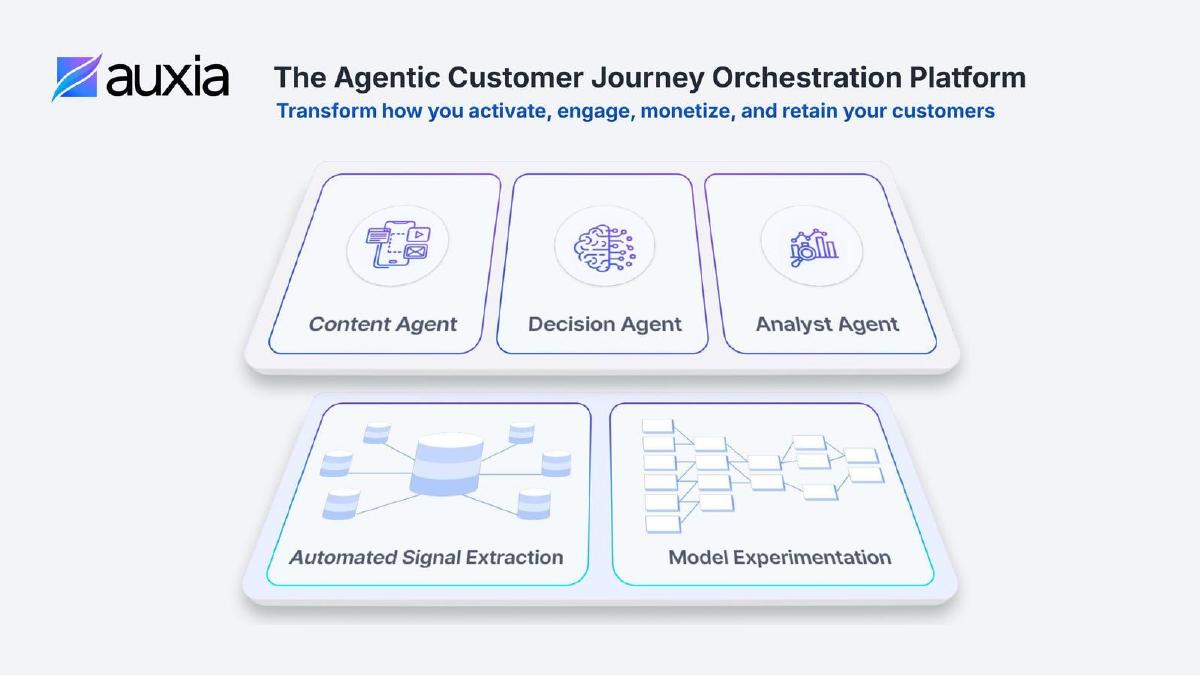
- The platform is built on three core agents: Content, Decision, and Analyst, supported by automated signal extraction (Slide 2).
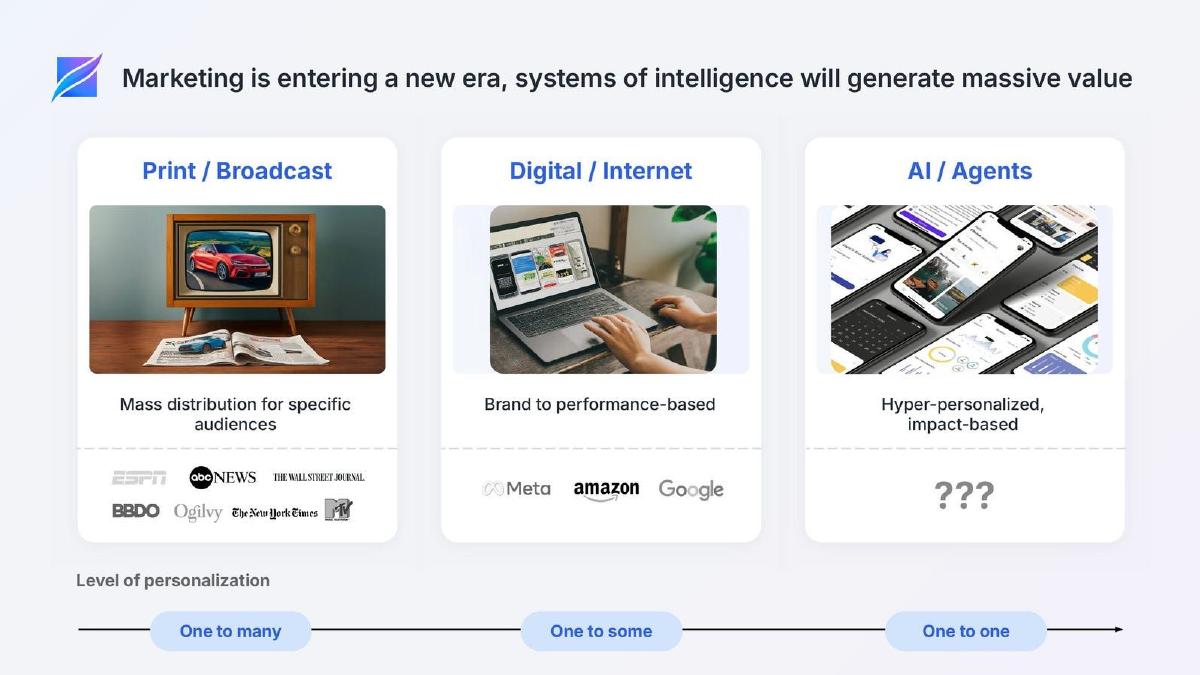
- Auxia positions the current era of marketing as 'AI / Agents' focused on 'one-to-one' hyper-personalization, succeeding the 'Digital / Internet' era (Slide 3).
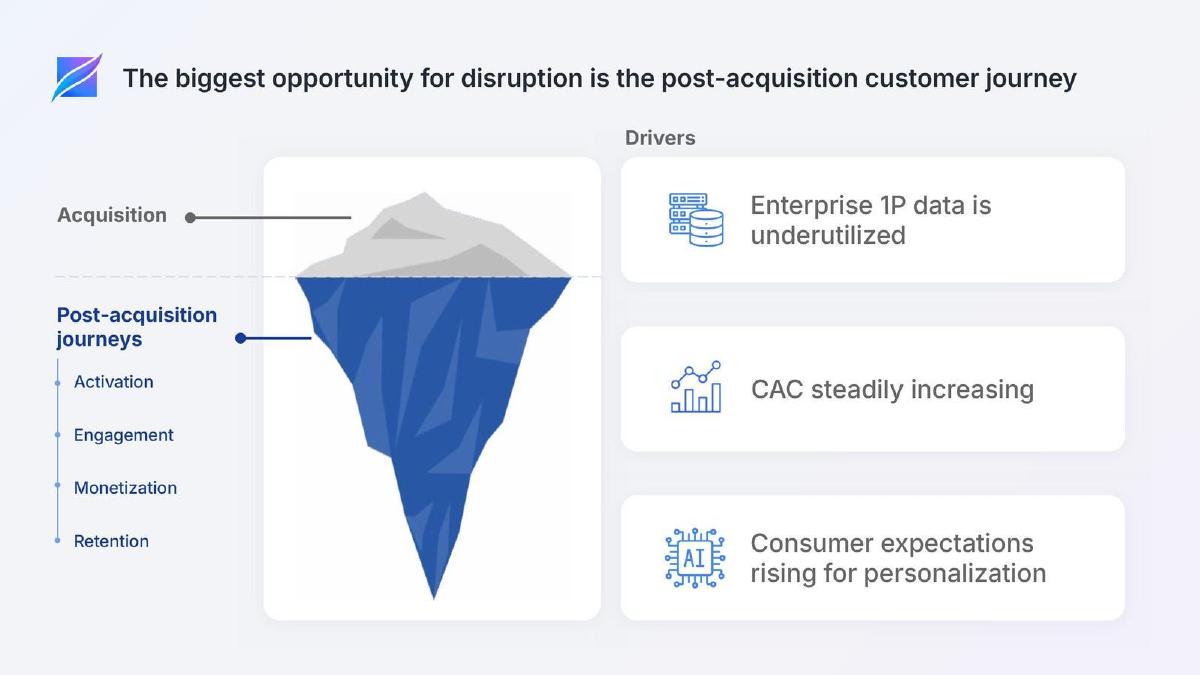
- The 'Iceberg' visual effectively argues that while most focus is on acquisition, the real opportunity lies in post-acquisition journeys like activation and retention (Slide 4).
- Technical validation is provided through high-volume metrics: 2B events processed per day and 3.5K peak queries per second (Slide 7).
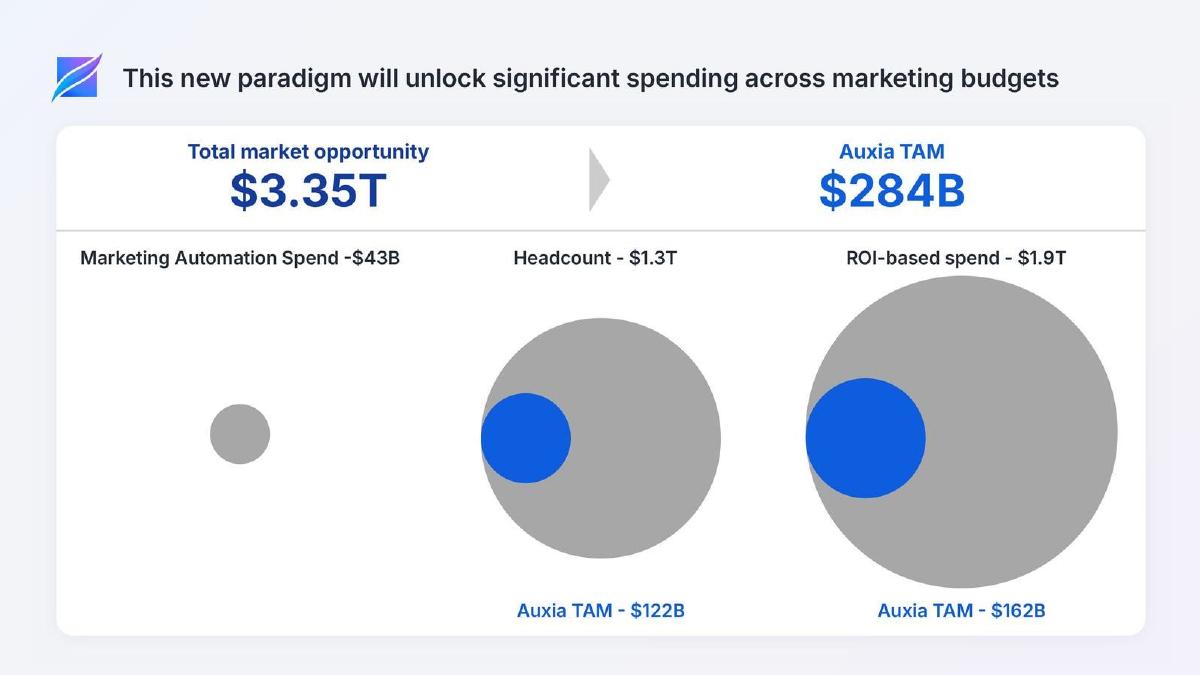
- The TAM calculation is aggressive, totaling $284B by including $122B in headcount replacement and $162B in ROI-based spend (Slide 6).
- The team slide features significant pedigree, including a CEO who was a former VP of Marketing at Google and a CTO who was an Eng Lead at Meta (Slide 9).
- The deck uses a 'redacted' strategy for ARR and ACV, suggesting these figures were shared under NDA rather than in the broad pitch (Slide 7).
- The 'Ask' slide is structured around three pillars: Scaling Sales & Marketing, Bolstering Customer Success, and Accelerating R&D (Slide 10).
The Strategic Narrative of Agentic AI
Auxia’s pitch deck, used to secure a $23.5M Series A in 2024, is a masterclass in narrative framing. In a crowded AI market, the company avoids the 'AI wrapper' trap by positioning itself as a foundational 'Agentic Customer Journey Orchestration Platform.' The deck is lean, consisting of only 10 slides, yet it covers the essential pillars of a high-growth SaaS business: a massive shift in market paradigms, a technical moat built on scale, and a team with undeniable pedigree. By focusing on the 'post-acquisition' phase of the customer lifecycle, Auxia identifies a high-value pain point that resonates with enterprise leaders struggling with rising acquisition costs.
Slide 1: Title and Visual Identity
The opening slide is minimalist, featuring the Auxia logo and a wave-like graphic. There is no tagline or mission statement here, which is a bold choice that relies on the subsequent slides to build the value proposition from scratch. The branding is clean and 'enterprise-blue,' signaling stability and professional grade software.
Slide 2: The Agentic Platform Architecture
Slide 2 introduces the core product concept. It defines the 'Agentic Customer Journey Orchestration Platform' through three specific AI agents: Content Agent , Decision Agent , and Analyst Agent . Below these agents sit the technical foundations: Automated Signal Extraction and Model Experimentation . This slide is critical because it moves the conversation from 'what we do' (marketing) to 'how we do it' (autonomous agents). It suggests a closed-loop system where data is extracted, decisions are made, content is generated, and results are analyzed without constant human intervention.
Slide 3: The Market Evolution
This slide uses a classic 'three eras' framework to create a sense of urgency. It tracks marketing from Print / Broadcast (One to many) to Digital / Internet (One to some) and finally to AI / Agents (One to one). By placing question marks under the 'AI / Agents' column where logos like Meta and Google sit in previous eras, Auxia implicitly positions itself as the future category leader. The core message is that we are moving from performance-based marketing to impact-based, hyper-personalized marketing.
Slide 4: The Iceberg of Opportunity
Slide 4 identifies the specific problem space. Using an iceberg visual, it shows 'Acquisition' as the small visible portion above water, while 'Post-acquisition journeys' (Activation, Engagement, Monetization, Retention) represent the massive, hidden opportunity. The slide lists three drivers for this shift: underutilized 1P (first-party) data , steadily increasing CAC , and rising consumer expectations for personalization . This is a sophisticated 'Why Now?' slide that targets the CFO's concerns about marketing efficiency.
Slide 5: The Complexity Gap
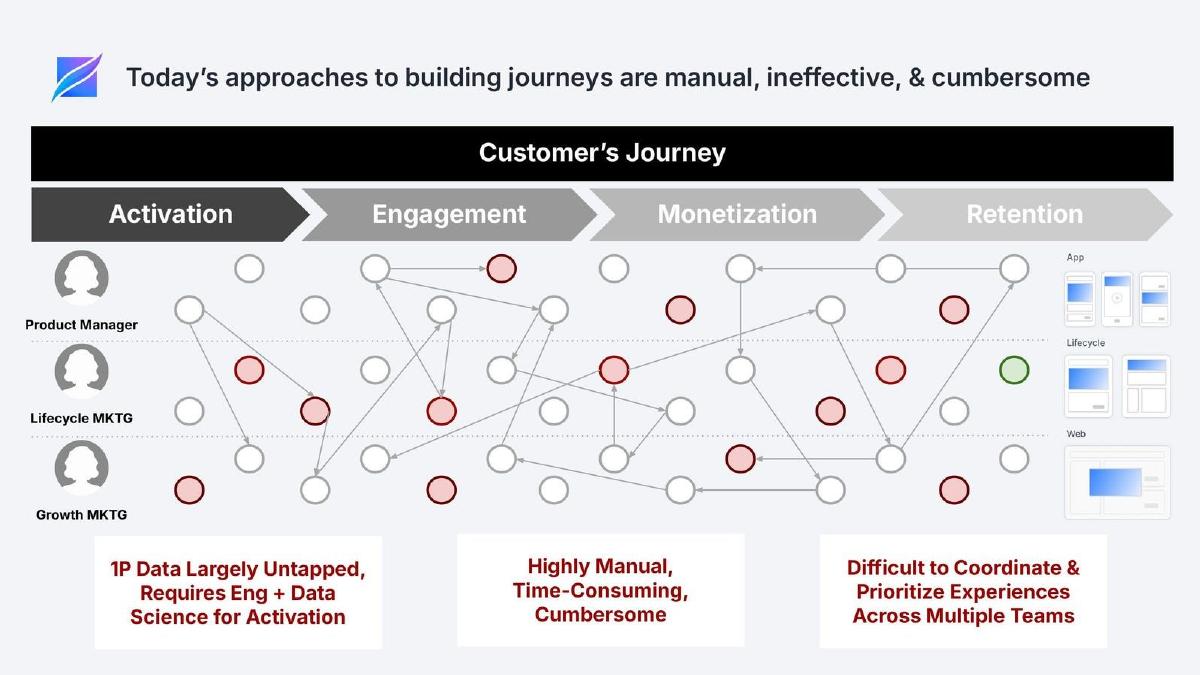
Slide 5 illustrates the current 'manual, ineffective, & cumbersome' process of building customer journeys. It shows a chaotic web of nodes involving Product Managers, Lifecycle Marketing, and Growth Marketing across App, Lifecycle, and Web channels. The three key pain points highlighted are: Untapped 1P data requiring engineering/data science , manual/time-consuming workflows , and difficulty coordinating across multiple teams . This slide sets up the 'before' state that Auxia’s agents are designed to replace.
Slide 6: TAM and the Labor Arbitrage Play
The TAM (Total Addressable Market) slide is particularly aggressive. Auxia claims a $284B TAM , which is significantly larger than the traditional $43B Marketing Automation Spend . They reach this number by including $122B in Headcount and $162B in ROI-based spend . This is a clear signal to investors that Auxia isn't just a software tool; it is a labor-replacement or labor-augmentation play. They are going after the budgets currently spent on the human teams depicted in Slide 5.
Slide 7: Traction and Technical Scale
Slide 7 provides the 'proof of life.' While the ARR and Total Decisions graphs are redacted, the slide includes impressive technical metrics: 175M+ Decisions Per Day , 2B Events Processed Per Day , and 3.5K Peak Queries Per Second (QPS) . These are enterprise-scale numbers. They prove that the platform is not a beta test but a high-throughput engine capable of handling the data loads of the world’s largest consumer brands. The mention of '9 months since launch' suggests a very fast ramp-up.
Slide 8: Revenue Projections
Slide 8 is entirely redacted, labeled simply 'Revenue projections for 2025.' In a public teardown, this offers little information, but in a live pitch, this slide would be the basis for discussing the company's growth rate, churn, and expansion potential. The fact that it is a dedicated slide suggests the founders were prepared to defend a specific, high-growth financial model.
Slide 9: The High-Pedigree Team
This is arguably the strongest slide in the deck. CEO Sandeep Menon is a former VP of Marketing at Google who led marketing for Android and Chrome. CTO Ravi Desu was an Engineering Lead at Meta with 10+ years in growth engineering. The 'Elite roster of advisors' is equally impressive, featuring the CMO of Google , the former CBO of Meta , and the CMO of Booking.com . For a Series A, this level of industry validation is rare and likely played a massive role in the $23.5M raise. It answers the 'Why Us?' question with overwhelming force.
Slide 10: The Ask
The final slide outlines the use of funds for the Series A. The amount is redacted as $XXM (reported as $23.5M). The funds are allocated to three areas: Scale sales & marketing (building an enterprise sales team), Bolster customer success (optimizing land and expand), and Accelerate R&D . The inclusion of '$XM+ in 2025' placeholders for each category indicates a disciplined approach to budget allocation.
What Auxia Does Well
1. Problem Framing: The 'Iceberg' metaphor is a brilliant way to reframe the marketing conversation. By moving the focus away from the crowded acquisition space and toward the 'underwater' post-acquisition journey, Auxia carves out a unique territory where they can claim leadership.
2. Technical Credibility: Many AI pitches are light on technical specifics. Auxia’s inclusion of QPS (Queries Per Second) and daily event processing volumes (2B+) provides immediate comfort to technical due diligence teams. It shows the system is built for the 'Big Data' requirements of the Fortune 500.
3. Social Proof: The advisor list is a 'who's who' of the marketing world. Having the current CMO of Google and the former CBO of Meta as advisors isn't just for show; it suggests that the people who would actually buy this software have already vetted the concept and the team.
What is Missing from the Deck
1. Case Studies or Specific ROI: While the deck mentions 'ROI-based spend' and high decision volumes, it lacks a specific 'Customer X saw a Y% increase in retention' slide. For a Series A, investors usually want to see at least one or two concrete examples of the platform in action.
2. Competitive Landscape: The deck assumes a 'blue ocean' for agentic journeys. It does not address how Auxia competes with or integrates into existing giants like Salesforce Marketing Cloud, Adobe Experience Manager, or Braze. A 'Competitive Landscape' or 'Integration Ecosystem' slide would have clarified their positioning relative to the $43B marketing automation spend they mention on Slide 6.
3. Unit Economics: There is no mention of LTV (Lifetime Value), CAC (Customer Acquisition Cost), or gross margins. While Slide 7 mentions ACV (Annual Contract Value) is redacted, the underlying economics of the business are not discussed in this version of the deck.
Founder Takeaways: What to Copy
Use the 'Era' Framework: If you are building in a new category like AI Agents, use Slide 3’s approach. Show the evolution of the market and leave a 'gap' that only your company can fill. It makes your solution feel like a historical inevitability rather than just another tool.
Quantify Technical Scale: If your product handles data, don't just say 'we are scalable.' Use metrics like 'Events Processed Per Day' or 'Peak QPS.' These are objective measures of engineering quality that resonate with sophisticated investors.
Target the 'Hidden' Problem: Like the Iceberg slide, find the part of your industry that everyone knows is important but no one is focusing on. By highlighting the 'Post-acquisition' journey, Auxia avoids a direct head-to-head battle with every other acquisition-focused AI tool on the market.
Leverage Your Pedigree: If you have a high-pedigree team or advisors, don't bury them at the end. Auxia’s team slide is a powerhouse. If your team has 'been there, done that' at the highest levels, make sure their titles and former companies are front and center.
Frequently asked questions
- What is an 'Agentic' platform as described by Auxia?
- As shown on Slide 2, Auxia defines its agentic platform through three specialized AI agents: a Content Agent, a Decision Agent, and an Analyst Agent. These agents work on top of automated signal extraction and model experimentation layers to automate the complex, manual workflows currently handled by product and marketing teams.
- How does Auxia justify its $284 billion Total Addressable Market (TAM)?
- Slide 6 breaks the TAM into two primary buckets: a $122B opportunity in replacing or augmenting 'Headcount' and a $162B opportunity in 'ROI-based spend.' This approach suggests the platform isn't just competing with marketing software budgets ($43B), but also with the labor costs of human teams currently managing these journeys.
- Why does the deck focus on 'post-acquisition' rather than 'acquisition'?
- Slide 4 uses an iceberg metaphor to show that while 'Acquisition' is the visible tip, the 'Post-acquisition journey' (Activation, Engagement, Monetization, Retention) is much larger and currently underserved. They argue that rising Customer Acquisition Costs (CAC) make retaining and monetizing existing users the biggest lever for growth.
- What technical proof points does Auxia offer to show they can handle enterprise scale?
- Slide 7 lists specific high-scale performance metrics: 175M+ decisions per day, 2B events processed per day, and a peak of 3.5K queries per second (QPS). These figures demonstrate that the platform is already integrated into high-traffic environments and is not just a conceptual prototype.
- Who are the key people behind Auxia according to the team slide?
- Slide 9 highlights CEO Sandeep Menon (former VP Marketing at Google) and CTO Ravi Desu (former Eng lead at Meta). The 'Elite roster of advisors' includes the CMO of Google (Lorraine Twohill), the former CBO of Meta (David Fischer), and the CMO of Booking.com (Arjan Dijk).